
The NLPer/cultural anthropology nerd in me was fascinated by this article, which looks at the names for colors among various cultures. In NLP, we say “the map is not the territory,” meaning we live through our maps of the world, not so much through the actual world, and language is a huge part of our maps.
Did you know that some cultures have only two words for colors, words that mean light and dark? All light and warm colors—white, reds, yellows, oranges, pinks—are called by the word meaning light, and all dark, shadowy, cool colors—blues, greens, browns, black—are called by the word meaning dark.
The Japanese language did not distinguish between blue and green until the 20th century, and only did so with American influence. (English recognizes 11 colors. It’s a colorful language.)
In studying words for colors across multiple cultures, researchers came up with algorithms for determining exactly where a color fits in with the shades in a color group. (Remember the 64-crayon box that had yellow-green and green yellow? Barely distinguishable, but one was slightly more yellowish and the other was slightly more greenish.)
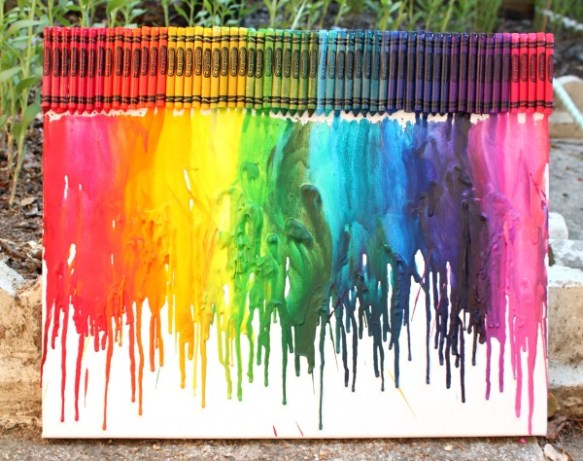
The blog, Empirical Zeal, that published this publishes posts from several sources and all posts are written using primary sources. (Unlike my blog, obviously. I’m not a scientist, but I can appreciate science sometimes, and I really just like to share some of the amazing stuff I find out there on the inter webs. I think maybe “humanist” is a good description for my angle.)
The spectrum has no natural boundaries, it would seem, and the perception of color is not universal. Languages also change over time, and many have followed the same route. Since most languages have two to 11 names for colors, scientists have determined that the first two color terms will be light and dark, or white and black. The third will be red, and the next will be either green or yellow. Once both those distinctions come into use, green splits into two, and you now have blue. (The Japanese word for blue green is midori. Author’s note: Thanks to Tim for correcting me on this.)
The research done on native speakers of 110 different languages using 400 color tiles was called the World Color Survey. Further research used algorithms to distinguish color groups. The algorithms were fairly predictive of how actual cultures grouped shades.
The picture that’s emerging is that colors aren’t quite random slices of the visual pie. They’re somewhat basic categories that humans from different cultures gravitate towards, and must have to do with how the biology of how we see the world. In other words, rainbows have seams. We can distill a rainbow into its basic visual ingredients, and a handful of colors come out.
If you get to the end of this, click the link for Part Two, about how naming colors messes with our brains!
 The Well: bodymindheartspirit