Being a Five, reading, writing, and what works

Part of my journey as a Five on the Enneagram has had to do with my attitude about information.

As a child, I took to reading like a duck to water. I soon became an indiscriminate reader. Comic books, school books, the classics, storybooks and novels, poems, my parents’ books/magazines/newspapers (they were avid readers too), cereal boxes, food labels, trashy magazines, entire menus, every sign that I encountered, billboards, and so on.

My eyes and my mind were very attracted to the written word. (I wear contact lenses now, but my glasses were as thick as Coke bottles.)

I behaved as if I believed that if I read everything I possibly could, at some point I would understand everything. Life, the universe, my purpose, the answers.

This was an unconscious belief, as so many are.

The irony is that I missed out on some important aspects of living because I had my nose in a book!

On the plus side, I was a very good student in school and have gotten many jobs because I could read and write well. (Being an avid reader is the basis for being a good writer, in my opinion.)

I’ve become more discriminating with age, I’m happy to report. I don’t read everything any more. Whew. That wasn’t a very good strategy, was it?

In fact, these days if I start reading a book and if it is not compelling from the start, I put it aside. Maybe I’ll finish it later, maybe not.

Of course, much reading is simply required — road signs, food labels, homework, text messages, deposit slips.

I’ve become more conscious about why I read. Now it’s more of a choice about what information or inspiration will broaden or deepen my journey. 

The reading I most treasure these days is finding new and useful information, information that makes a difference in people’s quality of life. I guess you could call this kind of information insight or wisdom. 

That kind of reading and discerning gives direction to this blog.

I love discovering what works, and I love to share what I find. When I think of what “the truth” means to me, it’s useful information that works or that serves quality of life. Like how to prevent insomnia or a particularly useful way of phrasing an idea, for example.

I’ve also become more attracted to the questions. More on that to come.

Heck, maybe this is one of those things that you know about me already. If so, please rejoice that I’m becoming more conscious.
Each moment, life as it is, the only teacher: quotes from Joko Beck

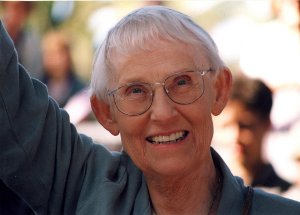
Charlotte Joko Beck died yesterday, very peacefully, at the age of 94. She was a Zen teacher who made a major impact on American Buddhism.

Here’s a quote from an article that puts her work into perspective (no longer available online):

The Ordinary Mind School was among the first Zen communities to consciously engage the emotional life and the shadows of the human mind as Zen practice. The late Charlotte Joko Beck and her dharma heirs  adapted elements of the vipassana tradition — a relentless inquiry into the contours of the human mind—as unambiguous Zen discipline.

Here are some quotes from her:

With unfailing kindness, your life always presents what you need to learn. Whether you stay home or work in an office or whatever, the next teacher is going to pop right up.

Caught in the self-centered dream, only suffering;
holding to self-centered thoughts, exactly the dream;
each moment, life as it is, the only teacher;
being just this moment, compassion’s way.

Enlightenment is not something you achieve. It is the absence of something. All your life you have been going forward after something, pursuing some goal. Enlightenment is dropping all that.

One idea that really hampers us is to believe that people get ‘enlightened,’ and then they’re that way forever and ever. We may have our moments, and if we get sick and have lots of things happening, we may fall back. But a person who practices consistently over years and years is more that way, more of the time, all the time. And that’s enough. There is no such thing as getting it.

Wisdom is to see that there is nothing to search for. If you live with a difficult person, that’s nirvana. Perfect. If you’re miserable, that’s it. And I’m not saying to be passive, not to take action; then you would be trying to hold nirvana as a fixed state. It’s never fixed, but always changing. There is no implication of ‘doing nothing.’ But deeds done that are born of this understanding are free of anger and judgment. No expectation, just pure and compassionate action.

Practice is just hearing, just seeing, just feeling. This is what Christians call the face of God: simply taking in this world as it manifests. We feel our body; we hear the cars and birds. That’s all there is.

Life always gives us exactly the teacher we need at every moment. This includes every mosquito, every misfortune, every red light, every traffic jam, every obnoxious supervisor (or employee), every illness, every loss, every moment of joy or depression, every addiction, every piece of garbage, every breath. Every moment is the guru.

So a relationship is a great gift, not because it makes us happy – it often doesn’t – but because any intimate relationship, if we view it as practice, is the clearest mirror we can find.

Practice can be stated very simply. It is moving from a life of hurting myself and others to a life of not hurting myself and others. That seems so simple — except when we substitute for real practice some idea that we should be different or better than we are, or that our lives should be different from the way they are. When we substitute our ideas about what should be (such notions as “I should not be angry or confused or unwilling”) for our life as it truly is, then we’re off base and our practice is barren.

We have to face the pain we have been running from. In fact, we need to learn to rest in it and let its searing power transform us.

We learn in our guts, not just in our brain, that a life of joy is not in seeking happiness, but in experiencing and simply being the circumstances of our life as they are; not in fulfilling personal wants, but in fulfilling the needs of life.

Meditation is not about some state, it is about the meditator.

Zen practice isn’t about a special place or a special peace, or something other than being with our life just as it is. It’s one of the hardest things for people to get: that my very difficulties in this very moment are the perfection… When we are attached to the way we think we should be or the way we think anyone else should be, we can have very little appreciation of life as it is…whether or not we commit physical suicide, if our attachment to our dream remains unquestioned and untouched, we are killing ourselves, because our true life goes by almost unnoticed.

12 states of attention

Update: This post was originally written in 2010, and it’s now 2023. Some things have changed. I’ve met and taken several trainings with Nelson. He’s a crusty, lovable curmudgeon and very, very smart.

You can find Nelson’s archived Navaching website here.

You can get a new or used copy of his book The Structure of Delight on Amazon.

If you’re a fan of Nelson Zink and in particular his work on peripheral vision and nightwalking, you might be interested in attending a nightwalking training in Taos, New Mexico, with Katie Raver. Details here.

~~~

My most recent post, Refining Awareness, includes some instructions about using your vision to focus down to the pixel level, and then to open your vision and let everything come into your field of vision.

These activities are based on a set of exercises called the 12 states of attention that I learned about and practiced and taught, so that now I seem to have internalized them enough that I don’t consciously think about it.

The three main senses we use are seeing, hearing, and feeling, or visual, auditory, and kinesthetic. NLP 101.

Each of these senses can be experienced externally and internally. For example, I can see the computer in front of me, and I can close my eyes and remember the image or imagine the computer morphing into a piano. That’s Visual External and Visual Internal (remembered and constructed).

You can further expand your sensory acuity by practicing using each sense as broadly and as narrowly as possible. Hence, look at a pixel, then let everything come in. Those states are Visual External Narrow (VEN) and Visual External Broad (VEB).

You can do this with hearing as well. You can focus on one sound in your environment (or in your memory or imagination), and you can focus on all the sounds.

Same with kinesthetic awareness. Internal, external, narrow, broad.

A man I’ve never met but who has been a teacher for me came up with the 12 states of attention. His name is Nelson Zink, and he’s got a pretty amazing website, Navaching. Click here to read about the 12 states of attention. He’s got a lot to say and says it well. (And check out his other pages. It’s pretty fascinating. I also do nightwalking. And read his book, The Structure of Delight.)

The point is that through our conditioning, most of us come to favor some states and neglect others. If you enjoy having more resources, you can practice these states and gain awareness skills. You never have to be bored again, and you will reach more of your potential!

So when I meditate and do a body scan, I may bring to awareness my skin, starting with my head and slowly going down my body to my foot, bringing each area into awareness (Kinesthetic External Narrow).

Or I may attend to how my head, chest, and belly feel (Kinesthetic Internal Somewhere-Between-Narrow-and-Broad).

When I do whole body awareness, I am using the Kinesthetic Internal/External Broad state of attention, including my energy field.

(The convention is that the skin is the boundary between external and internal for the kinesthetic sense. But because my energy body radiates through my skin, my skin is a permeable boundary, and I’m sensing internally and externally at the same time.)

The kinesthetic sense may actually be a lot of senses, including balance, knowing where my foot is in space, temperature, tactile, muscular, and so on. Emotions are usually classified as kinesthetic as well, since we feel them in the body.

Anyway.

Wisdom is a broad state, no matter whether we’re seeing the big picture, hearing the cosmic OM, or feeling connected to Source. Big Mind is a broad state, and that’s a skill gained from meditation.

Check out Zink’s website and practice the exercises given, if you like. It will bring you gifts of knowing yourself and experiencing more of your full potential.