The most effective diet tip of all

Get in touch with your hunger.

That’s all. Just get in touch with your hunger.

How long has it been since you actually felt hunger? We live with abundant food all around us, but our bodies haven’t evolved much from 10,000 years ago when the human species was hunting and gathering its food, feasting in times of plenty and going hungry in lean times.

Many modern people go for years without ever feeling hungry, so that when it does happen, they don’t know the sensation—and if they do know it, they gobble food down to avoid feeling it as quickly as possible. Feeling anything has become something to be avoided.

Many people eat according to the clock, not according to their stomachs. And we wonder why we have such an obesity problem. It’s not just the HFCS. It’s not being in touch with our bodies, with our hunger, with what “enough” actually is.

If you feel stuck with unnecessary weight or a poor diet, if you’ve used food to numb your feelings while comforting yourself, try this:

Postpone your next meal until you feel hungry and really notice the sensations in your body of feeling hungry.

There are wonderful wise lessons to learn from feeling hunger that can help you live a healthy life that you actually experience and enjoy first-hand.

  • You can allow yourself to feel hunger and know that you are going to survive. You are not going to starve to death from a little hunger (even though your mind may be telling you so). Death by starvation unfortunately did happen 10,000 years ago and sadly still happens even now, but it’s pretty rare in first world countries. How much discomfort is actually there, on a scale of 1 to 10 with 10 being excruciating discomfort? Can you feel it as simply sensation without judging it as painful?
  • You can recognize the signature of feeling hungry. How do you know it’s hunger? Where in your body do you feel it? Feel it for 5 or 10 or 30 minutes. How does it change—does it ebb or constantly get more intense? Do you forget sometimes that you’re feeling hungry? Can you distinguish between feeling hungry and feeling thirsty? What happens to your hunger if you drink water?
  • You can experiment with how much food, and what kinds of foods, you can eat to no longer feel hungry. After fully experiencing your hunger, eat three bites of food slowly, savoring the taste and the mouth-feel and thoroughly chewing each bite before swallowing. Wait one minute and notice your hunger again. How has it changed? Now eat three more bites and notice. Notice how many bites of food you need to eat for your hunger to go away, and notice how long it stays away before it returns.

You can totally play with eating in this way! A couple of weeks of eating like this is quite refreshing after mindless eating and pretty much guarantees that just by being in touch with your hunger and eating accordingly, you will drop a few pounds.

More importantly, you may feel more energy and gratitude for your life.

~

Caveat: When is it not a good idea to play with hunger? When you have issues with your blood sugar. If you are diabetic or pre-diabetic or have hypo- or hyperglycemia, or get really shaky when hungry, you need to take extra good care of yourself and consult a knowledgeable professional first.
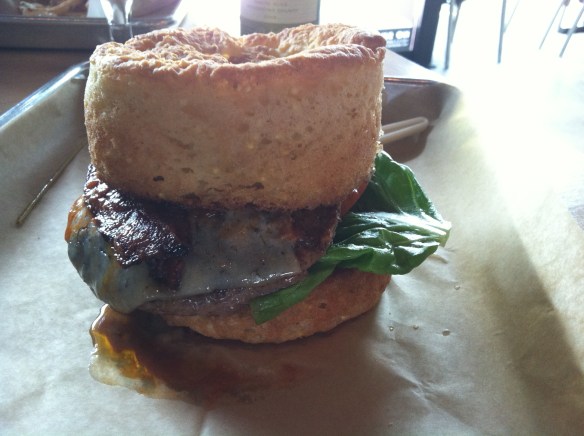
Best gluten-free burger in Austin at Hopdoddy’s!

I’m not sure I’ve mentioned this, but my body does not digest wheat well at all. I learned this five or six years ago, and after going without it for a couple of months while on a strict diet to clear excess candida, I noticed a very unfamiliar feeling — I felt, well, well, and I had hardly any fatigue, digestive issues, or feeling like my mood and energy level were on a roller coaster ride. For the first time in, like, forever.

I changed my diet drastically, although it took time for me to really accept that if I ate that piece of pizza, I’d feel bad and “pay for it” later for a few days. I did learn, though. Over time, I learned that I can handle maybe a quarter teaspoon of wheat (such as dusted on blackened fish) without problems.

So being an all-American girl raised in Texas, I missed eating burgers. Not that they were ever a mainstay of my diet, but when you can’t have wheat, you find out what you miss. (Burgers and pizza.)

A couple of times I craved one so badly, I went out and ate one, gluten bun and all, and paid the price for satisfying my craving, which was several days of digestive upset and not feeling too well.

Then I’d make them at home with ground bison patty and toasted Ezekiel bread made from sprouted grains, which my body tolerates. (Toasting it is the only way to make it palatable, in my opinion.) It was good, but I still missed being able to just go out to a burger joint and eat a burger.

Well, today was bliss. I ate lunch with my daughter at Hopdoddy’s, a fairly new and very popular Austin restaurant on South Congress that offers a variety of burgers on a variety of buns — including gluten-free. I’d read reviews about how good their burgers were and that they offered gluten-free buns. I looked forward to tasting for myself.

This is what I had:

That, my friends, is a gluten-free bun, and it was light and kind of crispy on the outside. Toasted! And it actually had some flavor, too.

The Buffalo Bill burger (using bison from Thunderheart Bison, South Texas) came with blue cheese, apple-smoked bacon, “Frank’s hot sauce,” and “sassy sauce.”

All I can say is that it was delicious, and it feels so great to know I won’t feel ill. I’m not a big meat or burger eater, but it’s great to know I can indulge occasionally.

I’ll be back!

~~~

Postscript, 11/17/13: For a down-home, less expensive alternative to Hopdoddy’s, I’d also like to give kudos to Wholly Cow (downtown and South Lamar) for making grass-fed burgers (request Udi’s gluten-free buns) and for their awesome Fit Cross Paleo Burger, served with portabello mushroom caps in place of buns! Both made with local, grass-fed beef.

The 4-Hour Body, continued: pre-hab and weight loss

I blogged in January that I was starting to read Tim Ferriss’ new book, The 4-Hour Body. Well, I’m still reading it! It’s a big book chock full of interesting information, and I’m reading it from front to back, which Tim does not recommend.

Well, I’m up to page 332 out of 474 (excluding the 100 pages of appendices, bonus material, and index), reading about something Tim calls “pre-hab”. This chapter is about stabilizing the body to prevent injuries. The man who has worked with world-class athletes to improve their consistent high performance is Gray Cook, and Tim pumped him for information for do-it-yourselfers like me to do at home.

It’s all about gaining strength and stability using basic movement patterns.

Boy, I need this. A strong wind can almost blow me over. I’m 58 and understand how devastating a fall can be in a way I didn’t when I was a lot younger (“Why don’t you just get up?”). Even though I’m probably fitter than average for someone my age, I can always improve.

So apparently you can self-assess by doing some exercises and noticing left-right imbalances and wobbling/shifting. Then there are four corrective exercises to fix the most common imbalances/weaknesses.

These have names like chop and lift, Turkish get-up, two-arm single-leg deadlift, and cross-body one-arm single-leg deadlift.

You might as well be speaking a foreign language, Tim!

I’m going to pursue this, and I wish for someone who speaks this language to magically show up and guide me. Know anyone?

~~~

I do have something else to report from The 4-Hour Body. I followed the Slow Carb diet in February. Subtitle: How to Lose 20 Pounds in 30 Days Without Exercise.

Results: I lost only 4 pounds but lost several inches converting fat to muscle. I don’t have an accurate way of measuring BMI, just a scale, and it showed a loss.

Note: I have been on a gluten-free diet for several years, and I also (usually) avoid potatoes. That’s probably where most people who eat those things lose the 20 pounds.

This diet calls for no rice, no dairy, no fruit/sugar/sweeteners, just eating the same meals of animal protein/legumes/veggies every day. Yep, beans, eggs or fish, and veggies at every meal. Good thing I love refried beans.

The bonus is one day a week you can eat whatever you want. Yes, built-in cheating! I went all out twice and then binged moderately, with a kefir and pomegranate and stevia smoothie and occasionally ice cream.

I learned gratitude for the variety of legumes in this world. Refried beans, fava beans, limas, snap peas, black beans. The beans really help each meal “stick to your ribs” so you don’t get hungry and snack in between meals.

I lost inches around my upper arms, thighs, and waist, and I gained an inch around my hips. That inch is all in my booty, from doing kettlebell swings twice a week. I’m sure it’s building bone density too.

Have you read the book and tried any of his suggestions?