About MaryAnn Reynolds

I practice advanced bodywork in Austin, TX, specializing in Craniosacral Biodynamics and TMJ Relief.

Awareness is everything

Awareness is everything.

Okay, I’m going to bed.

Can the world be different?

Spent much of the morning online, catching up on Facebook and email, and finishing reading a remarkable article I started last week, The Women’s Crusade.

Here’s the link: http://www.nytimes.com/2009/08/23/magazine/23Women-t.html

The article mentions a nonprofit in Hyderabad, India, called Prajwala, on page 3. A 14-year-old Hyderabad girl from a poor family was forced into prostitution in New Delhi under false pretenses (a job as a maid). She witnessed the murders of 3 other girls who resisted. She was never paid and often beaten.

Eventually the police freed her and returned her to Hyderabad. She was taken in by Prajwala, which teaches new skills to girls rescued from brothels. She now earns a decent living as a bookbinder, is getting an education and helping put her younger sisters through school.

The thesis of the article is this: “With education and with help starting businesses, impoverished women can earn money and support their countries as well as their families. They represent perhaps the best hope for fighting global poverty.”

Here’s another quote: “In Asia alone about one million children working in the sex trade are held in conditions indistinguishable from slavery, according to a U.N. report…. India probably has more modern slaves than any other country.”

The wheels of my mind and heart began turning. Here, listen to them creak:

This is happening in India, the home of yoga, a practice that I love, that has given so much to me, and to so many other Americans, who are fortunate enough to be able to take yoga classes and go on yoga vacations and retreats.

Wow, this is the kind of reporting (from Nicholas Kristof and Sheryl WuDunn) that I would pay for. It’s not just about how bad things are. The article notes a few organizations that are making a difference in places around the planet.

Most beautifully, it provides a big insight into how to make the seemingly impossible actually happen — end poverty by focusing on educating and empowering women.

Creak. What if, and this is a big what if, American yogis adopted Prajwala as their nonprofit of choice, to give something back to the country that gave us yoga?

I emailed Prajwala with questions. It’s not as easy as you think — they don’t take PayPal, for one. I want to know how to help — not just by giving money, but by connecting American yogis to Prajwala. How can I best proceed? Ideas welcome!

My mind was churning with this when I sat on the zafu. First my body became still, then my breath slowed, my mind slowly slowed, my energy softened.

It’s not about me. It’s something moving through me.

It comes from a heart that has repeatedly been horrified by how humans can treat each other and a mind that wants so much to believe that the world can be different.

I ask you, can it?

Life and love are synonymous

Today is Valentine’s Day and also Chinese New Year. The zendo was packed this morning. I usually see Peg on Sunday mornings, but not today — I got there a little later than usual, not expecting a group of people in line ahead of me, waiting to see her. She didn’t have time to see everyone, including me.

I did a walking meditation, a seated meditation, another walking meditation, and then it was time for the service.

Peg passed out a reading, which we all read together aloud and then discussed. My Valentine’s Day gift to you, dear readers, is to share the text. My skills in formatting in WordPress are not that developed, so imagine this, in the shape of a heart.

Love Beyond Emotion, by Ligia Dantes, from The Unmanifest Self: Transcending the Limits of Ordinary Consciousness

As long as our relationships are dependent on our emotional state, we cannot enjoy peace among others or within ourselves. Emotions swing between extremes and are too varied in intensity for the entire human organism to live a harmonious life. A change in this way of functioning is desperately needed if peace is to prevail in the world.

Love is true neutrality; it does not judge or evaluate. It does not feel good or bad; since it is not mere thought, it does not change into an opposite. It does not like or dislike. It does not blame, so it does not need to forgive. It does not have choices or preferences, opinions or positions. It does not dictate, is not authoritative.

Love does not differentiate between life and death. It has no expectations other than what is. Love is not an ideal to venerate; it cannot be known through knowledge or thought. Love is not words, but the energy of life itself without opposites, without death.

Love is a way of being, experienced by humans and visible only in our actions. Life and love are synonymous. They are the eternal activity of universal energy without boundaries, movement, or form.

Love, being all-encompassing, is the context of all contents of the universe, and thus is infinite. And what is infinite cannot be known within the finite mind. Only in a state of being that is beyond the finite human mind-form can love be the manifest. Thus love is manifest-unmanifest, form and emptiness. Our minds can express it only in paradox.

Love is all life is and, as such, can only be lived.

I like the equation of love being the energy of life itself, visible only in our actions.

Happy Valentine’s Day.

Being present in my own life more

Ha! I am just this minute getting off the zafu. Just as the pain in my hips really got to me, and I thought, “I have to move — this is unbearable,” the chimes went off. The pain had been mostly in the background until that moment. Little victory dance!

It’s been about six weeks since I began meditating daily. I’ve written about my experiences on the mat, the insights gained.

Today I want to convey more about my experiences off the zafu — how meditation has carried over into my non-sitting life.

It hasn’t solved my problems or made them go away. Well, maybe some minor problems became non-problems, while others have become clearer, standing out in more relief.

It does seem to have given me more faith that when it’s time to make decisions, I will make the right decisions. I have less trepidation about going through life. I am an Enneagram type 5, a fear-based person. This is a good thing, people.

Meditation may have changed how I relate to time. It feels like there’s more “now”, that time passes more slowly, or it may be that I notice more. Noticing more on the mat extends to off-the-mat awareness as well.

I seem to have more patience, more ability to allow moments to unfold, without jumping to conclusions or having knee-jerk reactions. Not that I never do that any more! Not at all. But I do that less, and I stay present more.

This feels like a kind of grace to me. A slow, ineffable, deepening, widening process of getting in touch with my own humanness is occurring, concomitant with becoming a daily meditator.

I don’t want to miss out on my own life any more, the life that happens when you’re making other plans, you know?

It’s working.

article: Damage to One Brain Region Can Boost “Transcendent” Feelings

I like learning about scientific discoveries, especially those that have to do with health and well-being and the brain. Sometimes the findings are surprising to me, and often I feel happy for scientists to be learning something that I already “know” is true! Because scientists learn using a painstaking method. I am not often painstaking, not a scientist.

But then, I could be wrong. It’s all a hypothesis to me–if a belief works, use it. If not, discard it. My Museum of Old Beliefs is vast!

Often these reports on scientific discoveries add to my knowledge about how the body-mind works because they contain details about areas like anatomy that I am finding more and more interesting. I have been buying picture books about anatomy. I don’t know where if anywhere this is leading, but I’m finding it more and more interesting.

I will post links on this blog to articles I come across that are interesting to me. Here’s the first one:

http://blogs.discovermagazine.com/80beats/2010/02/11/damage-to-particular-brain-region-can-boost-transcendent-feelings/

Wandering Mind and her family, Thoughts, Equanimity, Chakras, Pain, Curiosity, and Moments of Emptiness, came to visit

Today is a day off work. Slept in, started laundry and set dirty dishes to soak, then sat.

Really, there’s not much to report from today’s sitting. Nothing really new or different. I sat, did body scan (now tied to breath), and then Wandering Mind and her family, Thoughts, Equanimity, Chakras, Pain, Curiosity, and Moments of Emptiness, came to visit.

I thought about last night’s class on the Diamond Sutra. Sometimes things seem funny to me that no one else is responding that way to, and I keep my mouth shut. The way Subhuti and the Buddha spoke to each other sounded exceedingly formal to my ears, and some mischievous part of me wanted to insert the word “Dude” in there. So pardon this indulgence.

“Even so, Dude, if a noble son or daughter should set forth on the bodhisattva path, how should they stand, how should they walk, and how should they control their thoughts?”

“Well, said, Dude! Well said. So it is, Dude. It is as you say.”

I am probably not cut out to be a scholar.

The gist of it is a paradox, which in my admittedly limited familiarity with Buddhism, seems most characteristic of Zen. “…I shall liberate [all beings]. And though I thus liberate countless beings, not a single being is liberated… And why not? Dude, a bodhisattva who creates the perception of a being cannot be called a bodhissatva. And why not? Dude, no one can be called a bodhisattva who creates the perception of a self, a being, a life, or a soul.”

Who creates the perception? See, this is something people struggled with in 400 BC too. Maybe creating a perception means interpreting experience. Maybe creating a perception means naming. We did an exercise in knowing and softening to not knowing.

Flint Sparks, the Zen priest who taught this class, brought up Jill Bolte Taylor’s video and book, My Stroke of Insight, and her description of right-brain awareness, as a way, in my perception, of helping us grok the shift in awareness from ordinary left-brain thinking that the Dude is pointing to.

But I could be wrong.

Insights about pain

Sitting this morning, I noticed that when I sit, it doesn’t take long for pain somewhere in my body to come to my attention.

Could it be an artifact of how I usually pay attention? Beta waves? Intriguing concept, but I don’t have a way to know.

Anyone got a good used biofeedback machine for sale? I’m not joking. I’d love to play with getting feedback on my brain wave patterns.

Am I looking for the pain? I don’t think so. Maybe it’s more that when I close my eyes and my internal dialogue stops, I become aware of my body — specifically aware of the places that are feeling pain because those sensations are most intense.

And  yet they are parts of a whole body-mind system.

I reminded myself that there were vast areas of my body that were not feeling any pain. I gave some attention to them. What does it feel like to not feel pain?

At first, I didn’t feel much of anything. Just “normal,” whatever that is. Then I noticed that I particularly felt strong in the core of my body — from my sit bones up through the center of my torso, neck, and head, it felt as if a nice strong column was holding me up. Being yoga! Yes!

The areas that do feel pain are usually small. A twinge here, a pulling sensation here. Rarely are they larger than a muscle, and usually they seem to be part of a muscle or an adhesion in the fascia that separates muscles. Rather, the nerves associated with those places are what feels pain, or so I’ve been taught.

Learning about pain is part of yoga. If you stop stretching as soon as it feels uncomfortable, you will not lengthen your muscles and become flexible and open up your meridians. In yoga, with time, you learn to recognize when pain is telling you, “Hey! Back off!” and when it is telling you, “Just breathe and hold this a little bit longer, and that muscle will release.”

I suppose it is the same with meditation. Pain may be one of those frequent visitors to the guesthouse. How can we become more at ease with each other?

I feel grateful and astonished that I have a nervous system that works! What a miracle that is, one of the myriad miracles under our very noses all the time. Just like the miracle that most of my body isn’t feeling pain!

Sitting with compassion

Third morning of sitting early. Only had time for 20 minutes; had to get my granddaughter up, dressed, and ready for school. Will pick up the other 10 minutes this evening.

I reset the alarm for earlier. I like getting 30 minutes in.

Yesterday after sitting, I went to my chiropractor, Dr. Chandler Collins, and after testing and doing what I think of as anchoring muscle combinations, he adjusted first my left ilium and then my right.

It seemed like not much moved. The adjustments were small, seemed to be only a couple of millimeters, if that. But then…I noticed feeling stronger when I stood, not like you could knock me over with a feather, which is how I’ve felt since April 25, 1996, the date of a serious car wreck that destabilized my sacrum/pelvis.

Yesterday was a day of getting used to it. Noticing how standing is different, how walking is different, how driving is different. By the end of the day, soreness in new places. Going to sleep, not being able to tell if my neck was crooked. Reorganizing, reorienting.

There are  more adjustments to be done next week. Something to do with the Hamstring Group. (They’re architects, you know. j/k) Another week of keeping my core stable and avoiding torque. And then, maybe he’ll give me some homework and I can really get strong.

Practice today centered on something Peg said on Sunday. I was attempting to convey how my realization that awareness is everything, everything is awareness, was rippling out into my life. How my dislike for certain characters, like Pat Robertson and Baby Doc Duvalier, were parts of my awareness. How I feel some responsibility for the quality of my awareness, and how it doesn’t feel good to feel contempt or scorn toward others.

She said, “Do you know them?”

No. I don’t. I only know what I’ve read or seen or heard about them. I’ve never met them.

Chances are, if I did know them, who they are would of course be different than how I judge them now. I’d know them with breath, voice, movement, energy, a family, relationships, desires, suffering, eye movements, context, filters. They’d be fuller and more complex, not demonized. I could find compassion for them. I would be curious about their awareness and compassion.

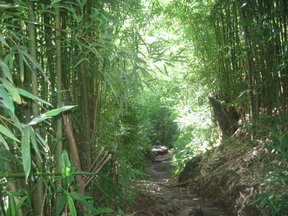
Photo: Entering the bamboo cathedral

Book influences meditation

This morning’s zazen was heavily influenced by a book I’m reading titled The Open-Focus Brain: Harnessing the Power of Attention to Heal Mind and Body. Les Fehmi, biofeedback pioneer and director of the Princeton Biofeedback Centre, and Jim Robbins, science journalist, are the authors.

The major premises of the book are that (1) the way we customarily pay attention is using a narrow focus on objects and details, (2) that this habitual narrow focus produces chronic stress and is useful only in limited circumstances, and (3) that there are other ways of paying attention that are immersive and diffusive — ways that alleviate physical/emotional pain and optimize performance and well-being.

I’m about halfway through reading it. The book comes with a CD with a couple of recorded trances on them, and that’s what influenced my meditation.

Simply put, one of the trances is becoming aware first of your thumbs in a three-dimensional way. Then you do that with your forefingers, then thumbs and forefingers together, then the space between them.

You add an awareness of a subatomic level in which the distances are vast. We are made mostly of space. You gradually expand to include the whole body and the space in and around it.

Doing this felt a little different from sensing my energy body. The feeling was denser, less like light, and more like pulses, currents,  and vibrations. It was not chakra-centered. It was more centered on the physical layer.

John Daniewicz, a member of my sangha, recommended a book called The Alphabet Vs. the Goddess: The Conflict Between Word and Image, which seems to have a related premise: that when humanity became literate and used our eyes for reading and writing, we rewired our brains into left-brain dominance and lost our right-brain way of awareness. Or at least that is my second-hand understanding of it.

I’m adding it — not ironically — to my to-read list, along with Buddha’s Brain. With a note that I wonder what it would be like to read and write nothing for a year. Sounds restful.