Poetry, reciprocity, feeling absolutely useless and enjoying it

I used to post poems I liked to this blog, but I stopped a while back and removed them (well, all except for Shoveling Snow with Buddha by Billy Collins, widely available online).

By the way, Shoveling Snow with Buddha is a wonderful poem to read in August when it’s over 100 degrees. Just saying.

The major reason is that poets are often impoverished and yet the best ones give us the beautiful gifts of lifting spirits and expanding worldviews, maybe shifting our  identities for the better, touching our hearts and souls.

Somehow they manage to use words, which are a left-brain tool, to convey right-brain experiences of intuition, wonder, and new associations.

Every poem available online is also available in a book, and when you buy a book of poems, the poet makes money. They don’t make money from having their poems published online.

Buying a book of poems reciprocates the poet for his or her talent, sweat, and generosity. They need to eat too. (I think Billy Collins is doing pretty well, though, and I have bought a handful of his books. Billy, if you disagree, please let me know.)

I still subscribe to Panhala, which sends me a daily email with a poem in it. Each poem includes the poet’s name and the printed source — so you can buy the book or find it in a library, if you choose.

I have a hunch that Panhala, even though it posts poems for free, probably steers more people to poetry in general, to particular poets, and to buying poetry books than anything else online. Joe Riley does it as a labor of love. No advertising, just poems, photos, and music.

Today’s Panhala poem makes me want to make an exception to my rule. It’s by David Ignatow, is titled For Yaedi, and is from New and Collected Poems, 1970-1985.

It’s a short poem, and I’m going to only quote part of it.

…When I die
I want it to be said that I wasted
hours in feeling absolutely useless
and enjoyed it, sensing my life
more strongly than when I worked at it.

Thank you, David Ignatow. Thank you for that poem. I love that sentiment. I find myself longing for some hours to waste. I’m so used to being productive, to forging ahead, to getting things done.

My shoulders tight, especially my right shoulder, which seems to be where that forging ahead energy resides in my body. 

I got my grades in massage school, and I’m doing so ridiculously well that I realized I could afford to slack off a little. I stayed home half a day, turned in an assignment a day late, and made 80 on a quiz. So there.

Thoughts have been swirling about finishing the work on the trailer, big expenses coming up (tuition, car repairs or replacement, finishing the next four months of massage school), dwindling savings, finding work, and this intensely hot drought that seems to be unending.

I am going to set aside several hours tomorrow to waste while I sense my life strongly. Maybe a little shaking medicine, sitting, breathing, yoga, toning, journaling, walking — no, wait, that’s useful. I’m going for useless.

Hmm.

I think tomorrow is the day to let my feet lead me. They’re already telling me they plan to take me to Barton Springs.

My hunch is that I will probably have more resources to draw on to solve my problems after taking a useless day than I would have if I had a useful day.

I’ll post the outcome on Monday.

New 30-Day Project: The Month of Living on Discounts (via 30 Days at a Time)

My friend Shelley Seale is doing a series of 30-day projects this year. She’s calling it “the year of living consciously”. She’s worn no more than 6 items of outerwear, eaten only locally grown food, meditated, practiced happiness and giving and living sustainably for 30 days at a time, and then incorporated what works into her life.

Now she’s starting 30 days of living on discounts. Can’t wait to learn more about living well frugally!

New 30-Day Project: The Month of Living on Discounts Today I start my newest 30-Day experiment – using only coupons, Groupons and other discounts on everything I buy. I already take some good advantage of things like Groupons, but this 30-day period I will push it to the limit to see if I can live for an entire month doing only that with everything I buy. A guy named Josh Stevens lived off Groupon for a entire year, and blogged about it. Keep reading for more rules and guidelines that I've laid out … Read More

via 30 Days at a Time

Top 20 thoughts to think while meditating

This is a repost from Elephant Journal, written by Blake Wilson. I found it quite hilarious!

My favorites:

15. I got this shit down!

12. Everyone would totally freak out if I started floating.

If you’ve spent much time on the zafu, you may like this a lot too. Click the link above to read the rest.

You can check out Blake’s blog here.


The Five Tibetans plus one

My training to become a massage therapist includes training my own body. We practice and are graded on our own biomechanics when delivering massage. After just a few weeks (and considering there are students who are right out of high school and from very conventional backgrounds), the teachers are beginning to convey that massage therapists transmit their own health and well-being through their hands — the energetic connection.

Just this past week, my class’ primary practical massage teacher, Cindy Anderson, introduced us to the Five Tibetans.

I’ve encountered this series of exercises before, years ago. Cindy says we will be doing them regularly and that past students often thank her for teaching them — and tell of practicing them on mountaintops and other unusual places!

Curious Mind here googled “Five Tibetans” to learn more (especially to learn that they may not always be taught well on videos), and then headed over to Wikipedia to read about them.

Highlights: The Five Tibetan Rites are reputed to be at least 2,500 years old. The origins are unknown. They predate modern yoga (asana). Some of the exercises bear some similarity to certain asanas, so perhaps they influenced yogasana. Who knows?

They are done in order as a vinyasa (flowing sequence) and are said to stimulate the chakras. Many other claims have been made as well — they are a fountain of youth, reversing the aging process, and such. I think you can safely say they build strength, flexibility, and balance, and they will give you more energy.

You start by doing a small number of repetitions — 1, 3, or 7, depending on your comfort and ability level, but no more to start. You add repetitions slowly until you can do 21 of each. Add repetitions so slowly that you do not feel sore the next day. Never do more than 21. (Although apparently some yoga geeks do 108 of each! Make up a rule that works for you, is what I say.)

The Wikipedia description is good, including that you stand erect and take two deep breath cycles between each. Cindy has us exhale through rounded lips with eyes open wide.

There’s a whole blog about them: The Five Tibetans — Expert Advice, Support, and Information. It offers free downloads of the original English description of the exercises, posters of the exercises and warm-ups (should you need them), and a PDF showing 7 undulations to relieve office tension that will be helpful to readers with desk jobs who are concerned about their health.

The blog is connected to a website that offers DVDs showing you how to do the exercises and even Five Tibetans teacher training.

However, if you just want to see them, here’s a pretty good animated description.

If you do them for the first time from reading this blog, and if you don’t already have a regular yoga practice, please please please do each one very slowly and mindfully, tuning into what’s happening in your body, and never go beyond what’s comfortable for you. Be very gentle, especially with your neck and back.  Be mindful and err on the side of caution!

If you are not in shape, please download the warm-up exercises mentioned above and do them first.

Right now, I think of them as an alternative to a morning sun salutation — and that’s just where I’m coming from now. Both sun salutations and the Five Tibetans build strength and flexibility. They work the major muscles and joints of the body. They are fun to do, as well, at least for me. I’ll mix them in with my daily sun salutations, and perhaps later I’ll write a post about what I like about each practice.

The sixth Tibetan rite is a breathing practice. It is not usually taught in the US (our culture tends to frown on celibacy) but is recommended only for those living a monastic or committed celibate life. Wikipedia included a brief description and a link here. You do this exercise only to transfer the energy of the sexual urge up into the spiritual centers of the body.

Your meditation cushion is your body

I’m sharing a link to an Elephant Journal article, an interview with meditation master Reggie Ray. It’s part 1 of 3, and after reading this, I will be looking for the rest of it.

This section of the interview particularly caught my attention. See if it catches yours.

When I found out that I was going to do this interview with you, I sat down and listened to some other interviews you had done. On your website I found an interview entitled, “The Body As The Guru.” In it you were talking about the spiritual path and daily life.  The host of the show said, “We have to take our practice off of the cushion,” which I have heard a thousand times. But your response was a new one on me. You said, “Or we have to redefine what it means to sit on a cushion.” You didn’t really go into what you meant in that interview… So, I am asking you to do elaborate on it now.

Reggie Ray: When we’re sitting on the cushion we are actually extending our awareness into our bodies. We are in a way present within the totality of our being, which on the surface is a somatic being. The information we need for our life arises within us, it becomes clear.

If you get up off the cushion and there is a transition into something else, which might be a lot heavier or disembodied that means you are not present in your life. Your cushion is your body. That happens whether you are sitting on a zafu or you are in your daily life.

You mentioned the transition from the cushion to the front door, so to speak. Basically, one is meditation, but the other is not. Is it fair to say that if there is a transition taking place, not only is there something off about the way that you are being present in your daily life, but also in your sitting practice? Is it possible that in such situations meditation is contrived? Is the transition happening because we are trying to zone out on the cushion or create some sort of meditative trance? Or are we present in the body while we are on the cushion, and then migrating into our head as we walk out of the door?

Reggie Ray: That’s a good point. If you sit down to meditate with some idea about a state of mind you are trying to get to, or have memory of some pleasant experience from the past, then you’re not doing anything different than sitting in a meeting and trying to make a good presentation, trying to impress the people around you. Only in this case, you are trying to impress yourself. That is not meditation. Meditation is when you sit and let go of all your effort, and allow yourself to be present.

That’s what meditation is.

So, as you’ve mentioned, joining your practice with your daily life—9 to 5, wife or husband, kids, and work—from the vajrayana’s point of view, this is the ideal situation. These aspects of our daily life have a capacity to break through our defenses, push our buttons, and invite us to unfold. You’ve said that spirituality is the unfolding of human personality towards its perfection. I am assuming that by “perfection” you do not mean some static idea about perfection. So what exactly do you mean when you say “perfection?”

Reggie Ray: Actually, instead of the term perfection, I would rather say, “fulfillment” or “realization.” In the same way that an animal goes through it’s life-cycle—from being an embryo, all the way to death—at the moment of death the biological, and I would say, spiritual imperative of being a lion or a worm is fulfilled.


So with human beings, we could use the analogy of initiation in indigenous societies. In indigenous societies, at a certain point people go through an initiation, which introduces them to the fact that life is much bigger than what they might have thought when they were children or even during adolescence. Our natural human awareness is limitless. Everything in creation has a life-cycle, and when people are allowed to unfold—when they are allowed to follow the natural, biological, and genetically driven cycle of what it means to be human—our understanding and awareness becomes bigger and bigger. We have more appreciation for other people’s points of view, for the world beyond our world—the animal world, the plant world, and the universe. That is what I am talking about.

There is a natural tendency towards what Buddhist call “enlightenment,” but it can also be seen in the indigenous societies. That is really what we are talking about.

In Buddhism we call it buddha-nature, but buddha-nature isn’t simply an established state. It is a process of being in the river of spiritual maturation that goes on-&-on, never reaching a static point. Perfection, in this case, refers to fulfilling the journey of the human life. When are fully and completely with what it means to be human, we have let go of any attempt to pin ourselves down, solidify ourselves, or encrust ourselves at any stage. It is an unending, open process. When we have completely let go of any attempt to withdrawal from life or freeze ourselves, that’s what I mean by perfection.

Why massage, yoga, shaking medicine, and movement make you feel so good

One of the coolest things I’ve learned in my first two weeks of massage school, besides that I actually know something from my years of experiencing bodywork and that my hands love connecting with people, is about fascia.

If you don’t know, fascia is the name for a type of connective tissue, a thin membrane. It is labeled superficial when it is right under the skin and deep when it surrounds, binds, and separates muscle. It’s really all the same — these terms just differentiate the location.

The semi-transparent membrane on an uncooked chicken breast is fascia.

Here’s a new word: thixotropism, from the Greek for touch and turning. It refers to the fascia’s ability to change from one state to another. Fascia has two states: a thin fluid (sol) and a thicker gel. In its thin state, it is fluid, pliant, and elastic, offering a wider range of movement. In its gel state, it is tougher, more inflexible, and restricts movement.

When the body is out of alignment, such as when the head is jutting forward, the fascia supporting those straining neck muscles become more gel-like, stiffer, and supportive.

When you feel stiff, it’s because the fascia is in its gel state.

Through touch, exercise, and/or stretching, fascia “melts” from gel to sol and becomes looser, more flexible, and elastic. This allows the muscles to be manipulated in massage, increases joint range of motion, and frees the body from restrictions in movement.

When you move fluidly and freely in your body, your fascia are in the sol state. And of course, that feels fantastic.

This is at least one piece of the physiology of why it feels so good to get a massage, do yoga, warm up your muscles through work or exercise, and do the movements of TRE and shaking medicine.

They literally transform stiffness into fluidity.

Conversely, this is why it feels bad to sit for prolonged periods, and why we need to stretch after the stillness of sleeping.

If you want to feel free in your body, move, shake — and get massages.

What you need to know about standing desks

To counteract the ill effects of sedentary (from the Latin sedentārius: sitting) jobs, manufacturers are beginning to offer standing desks. Actually, they aren’t new. According to Wikipedia, standing desks were popular in the 18th and 19th centuries in the homes of the rich.

Furthermore, some of the world’s most talented writers wrote/write while standing. We’re talking Hemingway, Nabokov, Lewis Carroll,  and Thomas Wolfe.

Novelist Philip Roth, a great living writer, stands at a lectern to write and paces while he thinks, claiming to walk half a mile for every page he writes.

Who knows? Maybe writing is the one thing they did differently that helped them manifest their genius. It certainly seems to be better for the brain than sitting (see my previous post mentioning that movement of the sacrum pumps cerebro-spinal fluid, which nourishes the brain).

Perhaps before making the switch, you’re wondering how many more calories you would burn by standing instead of sitting. Here’s a calculator where you enter your weight and hours worked to find out the extra calories burned in a workday at a standing desk versus sitting. I’d burn 221 more calories per day. That’s very significant. I could lose a few extra pounds and then eat a little more!

Hmm. Could desk jobs be the real reason for the obesity problem in our society?

Adapting to a standing desk may take a week or so. Your feet may hurt from standing all day. You may be extra tired at first. Some people who’ve made the switch swear by a cushioned mat, like this writer, who had an adjustable IKEA Jerker desk (unfortunately discontinued) and switched it to standing mode. She writes about adjusting to it, which took her three days, and later using a mat and a footrest.

Of course, the least expensive way to create a standing desk is to simply put boxes, crates, or shelves on top of your regular desk and arrange your computer on them. You can create different levels for your monitor and keyboard if you like.

Personally, I’d put my big monitor at eye level and place an external keyboard at elbow level or slightly lower.

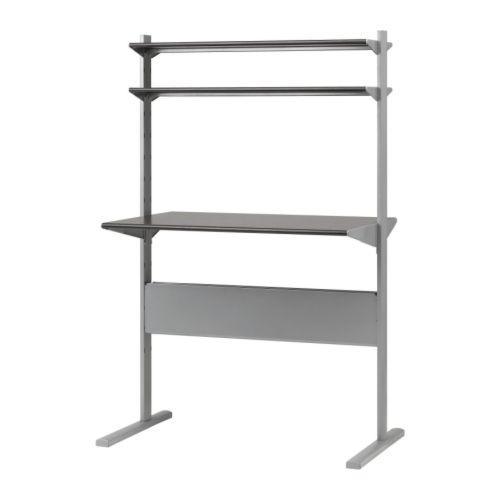
IKEA sells the least expensive standing desk that I found online, the Fredrik workstation for $119, shown below. There’s a wider version for $149. Assembly is required, of course.

Then there are the IKEA hackers — people who repurpose IKEA products to make what they want. Here’s an inexpensive conversion using PVC pipe.

Here’s another hack, the wide standing desk.

This article shows a couple of adjustable-height desks that allow users to flip a switch to adjust the height. This sounds great, for $700+.

Finally, here is a website devoted to creating your own treadmill desk. If you already have a treadmill, apparently you can do this for as little as $39, a significant savings over buying the top-of-the-line Steelcase Walkstation at $4,399, shown below.

Meditation and creativity

A lot has been written about how the practice of meditation helps people become calmer and more centered. Here’s a link to an article about how it can help people become more creative.

…can intelligence and creativity really be as “neuroplastic” as memory and motor skills? Intelligence, much less creativity, has not been conclusively linked with any one area in the brain. The closest analogues are the so-called executive functions, brain systems involved in planning, integrating of sensory information, and abstract thinking, that are thought to be concentrated in the prefrontal cortex. There is, says Aronson, a way to improve executive functioning, and it’s the very same practice prescribed by Alexander: mindfulness meditation.

I particularly liked the description of creativity:

It involves the ability to make unexpected connections, to move fluidly among concepts, to consolidate past memories, ideas, or impressions and arrive at new insights.

Each moment, life as it is, the only teacher: quotes from Joko Beck

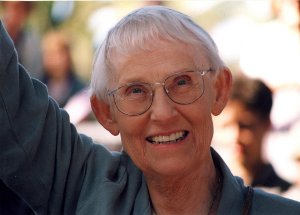
Charlotte Joko Beck died yesterday, very peacefully, at the age of 94. She was a Zen teacher who made a major impact on American Buddhism.

Here’s a quote from an article that puts her work into perspective (no longer available online):

The Ordinary Mind School was among the first Zen communities to consciously engage the emotional life and the shadows of the human mind as Zen practice. The late Charlotte Joko Beck and her dharma heirs  adapted elements of the vipassana tradition — a relentless inquiry into the contours of the human mind—as unambiguous Zen discipline.

Here are some quotes from her:

With unfailing kindness, your life always presents what you need to learn. Whether you stay home or work in an office or whatever, the next teacher is going to pop right up.

Caught in the self-centered dream, only suffering;
holding to self-centered thoughts, exactly the dream;
each moment, life as it is, the only teacher;
being just this moment, compassion’s way.

Enlightenment is not something you achieve. It is the absence of something. All your life you have been going forward after something, pursuing some goal. Enlightenment is dropping all that.

One idea that really hampers us is to believe that people get ‘enlightened,’ and then they’re that way forever and ever. We may have our moments, and if we get sick and have lots of things happening, we may fall back. But a person who practices consistently over years and years is more that way, more of the time, all the time. And that’s enough. There is no such thing as getting it.

Wisdom is to see that there is nothing to search for. If you live with a difficult person, that’s nirvana. Perfect. If you’re miserable, that’s it. And I’m not saying to be passive, not to take action; then you would be trying to hold nirvana as a fixed state. It’s never fixed, but always changing. There is no implication of ‘doing nothing.’ But deeds done that are born of this understanding are free of anger and judgment. No expectation, just pure and compassionate action.

Practice is just hearing, just seeing, just feeling. This is what Christians call the face of God: simply taking in this world as it manifests. We feel our body; we hear the cars and birds. That’s all there is.

Life always gives us exactly the teacher we need at every moment. This includes every mosquito, every misfortune, every red light, every traffic jam, every obnoxious supervisor (or employee), every illness, every loss, every moment of joy or depression, every addiction, every piece of garbage, every breath. Every moment is the guru.

So a relationship is a great gift, not because it makes us happy – it often doesn’t – but because any intimate relationship, if we view it as practice, is the clearest mirror we can find.

Practice can be stated very simply. It is moving from a life of hurting myself and others to a life of not hurting myself and others. That seems so simple — except when we substitute for real practice some idea that we should be different or better than we are, or that our lives should be different from the way they are. When we substitute our ideas about what should be (such notions as “I should not be angry or confused or unwilling”) for our life as it truly is, then we’re off base and our practice is barren.

We have to face the pain we have been running from. In fact, we need to learn to rest in it and let its searing power transform us.

We learn in our guts, not just in our brain, that a life of joy is not in seeking happiness, but in experiencing and simply being the circumstances of our life as they are; not in fulfilling personal wants, but in fulfilling the needs of life.

Meditation is not about some state, it is about the meditator.

Zen practice isn’t about a special place or a special peace, or something other than being with our life just as it is. It’s one of the hardest things for people to get: that my very difficulties in this very moment are the perfection… When we are attached to the way we think we should be or the way we think anyone else should be, we can have very little appreciation of life as it is…whether or not we commit physical suicide, if our attachment to our dream remains unquestioned and untouched, we are killing ourselves, because our true life goes by almost unnoticed.

7 things to remember when teaching yoga to kids

Last fall I had an opportunity to teach yoga once a week to 20+ fifth graders for a few months. We didn’t have mats or much space to work in, so after they removed their shoes and gathered on the carpet, I focused on mostly seated and standing poses for 15 minutes.

Very few of them had much experience with yoga. I wanted the students to love yoga as much as I do, and to create a program that might result in them later continuing to practice yoga.

Here are my take-aways from the experience:

1. Keep it simple. Om means “everything that is”. Namaste means “I honor you.” Don’t overwhelm them with Sanskrit and anatomy.

2. Teach them belly breathing. It will serve their lives well to learn it now. Ask about it now and then. After a couple of months, it may become a habit.

3. Leave them wanting more. Keep sessions short and make it fun. Let them experience the joys of yoga. So their downward-facing dog isn’t perfect. They’re 10! Let it be, and let them howl or bark like dogs! There’s plenty of time later for them to perfect their poses if they choose.

4. Pay attention and ask for feedback. Can everyone see? Did everyone hear that? Where do you feel that pose the most? What is hard about that pose? Yoga is about awareness. Foster it.

5. Be inclusive. As with adults, some kids take to yoga more than others. Praise all effort lavishly, and tell them it’s not a contest — yoga is good for every body. After a couple of months, ask them to remember what it was like the first time they did tree or eagle pose. They’ll get it.

6. Ask for volunteers to demonstrate poses after you’ve taught them a few times, and over time, give everyone a chance to demo a pose. They will learn the poses better, knowing they may be in front of the class, and be eager to get in front of their peers!

7. Let them experience sitting in silence for a minute at the end of the class. That may be a revelation — it was for the kids I taught, who begged to sit longer. (We worked up from one minute to five.) They may not get any silent stillness in their lives other than this — and they may really begin to value it at a young age.