Leslie Kaminoff reviews “The Science of Yoga: The Risks and the Rewards”

This book, The Science of Yoga, written by a New York Times science writer, was at the heart of the recent controversy about yoga injuring people as posited in a New York Times article.

Leslie Kaminoff has posted two video responses to the article. (See my previous post to view them.)

This third video is his response to the book, which he recommends that all yogis read — and then gives a mixed review.

Correlation is not causation, as Kaminoff says. If you cite how many people are injured doing yoga, but fail to compare it to injuries from any other physical activity, there’s no perspective — and that’s a journalistic failure. Broad apparently does not come across as a credible science writer because of this in Kaminoff’s eyes, which is disillusioning considering the NY Times’ “gray lady” status among newspapers, but putting forth questionable data supports his agenda — and sells books.

Of course, journalism has been in the fire for years. Maybe Fox News is the equivalent of Bikram.

Watch the video to find out what Broad’s agenda is. You might be surprised that he picks on individuals (especially one whose Ph.D. came from an institution that ironically Broad finds not credible, and a small organization, the International Association of Yoga Therapists).

Yoga helps by magnitudes more people than it injures. Just make sure you get a good teacher who knows anatomy, and keep in mind that it’s your responsibility to be aware of your body and to set your limits to protect yourself.

30,000 views! Thanks, readers!

Today my blog passed a major milestone. It’s received over 30,000 views! That’s since late December 2009, so it’s taken a little more than two years.

When I started blogging, I did not know where I would go with it. I just knew I liked writing and sharing useful information that helped people live better, healthier lives, and blogging was a way to do it.

Persistence pays off. A lot of people start blogs and then abandon them. I don’t believe more than a week has passed since I started it without me posting something, and I usually make several posts each week. I hope I’ve gotten better.

I really want to thank you for reading it. Not every post will be everyone’s cup of tea, of course, but as I can see from the stats and subscriptions, more people are finding it to be of value.

I like that. Thanks, y’all!

How yoga changes the brain’s stress response

Ha ha! Psychology Today includes a column called PreFrontal Nudity: The Brain Exposed. Love it!

This column, Yoga: Changing the Brain’s Stressful Habits, by Alex Korb, Ph.D. in neuroscience, is about the stress of yoga.

Yoga is controlled stress, as Leslie Kaminoff says.

Yes, that’s right. Yoga is stressful. If you don’t believe me, then get down on all fours with your hands shoulder width apart and your feet hip width apart. Push your hands and toes into the floor and lift your butt high. Stick your sacrum up as high as it will go.

Let your head drop.

Oh, and be sure your fingers are spread as wide as they can spread, middle fingers pointing forward, and without moving your hands, rotate your arms so your inner elbows are pointing more forward than toward each other.

Straighten your back. Don’t let it collapse! Let your shoulder blades flatten into your back but keep your kidney area full. Imagine you’re making one long line from wrist to tailbone.

Pedal your feet up and down if you need to, but really, try to get your heels to the floor with your legs straight. Feel that hamstring stretch! Feel those calf muscles and Achilles tendons!

Now push your hands and feet into your mat and away from each other!

Are you feeling relaxed yet?

So don’t forget to breathe. Keep your breathing calm and steady. Breathe through your nose while constricting the back of your throat to make a sound like the ocean.

Now how are you doing? Congrats on your downward facing dog, by the way.
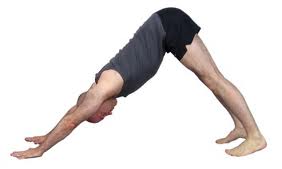
Korb accompanied his dad to a yoga class and learned first-hand how yoga retrains the brain. He thought it was going to be all pretzel twists and enlightenment, until his dad explained ujjayi breathing to him.

This next statement may sound to you either profound or extremely obvious, but it comes down to this: the things you do and the thoughts you have change the firing patterns and chemical composition of your brain. Even actions as simple as changing your posture, relaxing the muscles on your face, or slowing your breathing rate, can affect the activity in your brain…. These changes are often transient, but can be long-lasting, particularly if they entail changing a habit.

As a neuroscientist, despite my initial incredulity, I came to realize that yoga works not because the poses are relaxing, but because they are stressful. It is your attempts to remain calm during this stress that create yoga’s greatest neurobiological benefit.

 The fascinating thing about the mind-body interaction is that it works both ways. For example, if you’re stressed, your muscles will tense (preparing to run away from a lion), and this will lead to more negative thinking. Relaxing those muscles, particularly the facial muscles, will push the brain in the other direction, away from stress, and toward more relaxed thoughts. Similarly, under stress, your breathing rate increases. Slowing down your breathing pushes the brain away from the stress response, and again toward more relaxed thinking.

It [the physiological stress response] is, in fact, just a habit of the brain. One of the main purposes of yoga is to retrain this habit so that your brain stops automatically invoking the stress response.

Here’s the real kicker in my opinion, where a Ph.D. western scientist new to yoga really gets what it’s all about:

The good news is that you don’t actually have to go to a class to practice yoga. The poses most people associate with yoga are just a particular way of practicing yoga called the asana practice (“asana” translates to “pose”). The asana practice challenges you in a specific way, but life itself offers plenty of challenges on its own. Under any stressful circumstance you can attempt the same calming techniques: breathing deeply and slowly, relaxing your facial muscles, clearing your head of anxious thoughts, focusing on the present. In fact, applying these techniques to real life is what yoga is all about. Yoga is simply the process of paying attention to the present moment and calming the mind.

Yogis, does that not warm your hearts?

Nonyogis, does this not inspire you to practice yoga?

Couldn’t we all use a little more attention in the present moment and a calmer mind?

How yoga is connected to Rolfing

Tom Myers on The Century of the Body: Fascia, Yoga and the Medicine of the Future.

Loved this interview with Tom Myers, author of Anatomy Trains (which I hope to be studying in March at the Lauterstein-Conway School of Massage).

Until I read it, I had no idea that Ida Rolf was an early (1920s) practitioner of yoga, and that she developed Structural Integration (aka Rolfing (TM)) as a way to bring the benefits of yoga to people without the actual practice of yoga, since yoga wasn’t readily available.

Boy, would she be surprised at how popular yoga has become! And, the rise of yoga in America doesn’t seem to have put a dent in the Rolfing business either, perhaps because yoga helps people become more aware that their bodies are bound up, and they seek Rolfing.

My Rolfer, Mary Kimberlin in Dallas, told me that being Rolfed was the equivalent of doing yoga for five years in terms of the freedom of movement. I believe that. I was practicing yoga before I got Rolfed, and it definitely accelerated my flexibility in asana practice.

Here are excerpts from the interview:

Fascia—or connective tissue—is what glues us together. So, it’s a broad use of the word fascia. What we’re really talking about is the body-wide extracellular net that holds us together.

So, again, people have been paying a lot of attention to the chemistry and neurology of conditions like depression, and not much attention to shape. But shape is hugely important, and that’s where yoga and bodywork really shine.

We’re really just looking at the very beginning of the potential offered by body work, yoga, Rolfing, osteopathy, and so on—all these body therapies contributing to this realm.. This next century is going to be the century of the body, because this is the century in which we need to learn to change behavior.

We need to learn how to get people to change behavior, because so many of the big diseases are all lifestyle-related. At the heart of big, epidemic conditions like heart disease and diabetes really are behavioral, lifestyle issues. These are conditions where people need to change their habits more than they need to take the medicine.

Yoga was very small until quite recently. Pilates was very small until quite recently. And bodywork was quite limited until very recently. Going forward, I think we will see these unite into a very powerful combination of manual therapy and movement, where everybody is speaking one language.

Yogadork’s guide to yoga community response to NY Times article

From the great Yogadork, here’s the complete and exhaustive guide to the yoga community’s response to the New York Times article about how yoga can wreck your body.

Thanks, Yogadork, for compiling this and for promising to add more as new responses surface.

I’m glad the conversation is happening. The original article seemed to deliberately fan some flames in order to promote a book by New York Times science reporter William J. Broad. A lot of egos are on the line — yoga in America has become an industry, a far cry from one of six schools of Indian philosophy.

The guide includes Part 2 of Leslie Kaminoff’s response to the controversy. He said in his workshop that he was about halfway through reading The Science of Yoga: The Risks and the Rewards (available for preorder, publication date is Feb. 7) and thinks it’s worth the read (even if possibly not entirely fair or accurate, still, good enough).

And with that, I’m bowing out of continuing to post about this controversy. After I read the book (and it’s not at the top of my reading list — gotta study for the massage licensing exam first), I’ll post a review.

Yoga (asana) has been part of my life since 1982. I feel fortunate to have discovered and made this practice part of my life. It’s transformed my being in all its koshas, brought me good health and spiritual gifts, and there’s still learning to be done. It’s blessed me.

My advice for preventing injuries is to work with good teachers who understand anatomy far beyond what’s required to become an RYT-200, teachers who teach small enough classes that they can really keep an eye on each student and keep them out of trouble.

Also, pay a lot of attention to what you’re doing. Use and cultivate your awareness.

Now that’s yoga.

Sadie Nardini Responds to “How Yoga Can Wreck Your Body”

Sadie Nardini Responds to “How Yoga Can Wreck Your Body”. | elephant journal.

Here’s yet another response from a well-known yoga teacher to the controversial recent New York Times article. Sadie Nardini recommends that students concerned about the possibility of injuries choose instructors based on how much anatomy training they’ve had. Very little is required for the RYT-200 credential. I think it’s about 20 hours.

She mentions Leslie Kaminoff as being an expert on anatomy. I took a workshop with him today. Nearly half the class of 70 were yoga teachers. He showed us some of the Anatomy Trains cadaver video and a couple of Gil Hedley’s cadaver videos (I posted his video on “fuzz” previously).

Leslie and Amy Matthews have updated their book, Yoga Anatomy, which Sadie recommends.

She makes some good points, especially noting the contradictions in what Glenn Black said to the New York Times and what he said to the Huffington Post about his own yoga injuries and whether yogis should do headstand.

It’s your body–don’t trust it to just anyone. Ask any prospective yoga teacher what, if any yoga injuries they’ve had, and if, for example, they’re about to go into spinal surgery from years of severely over-expressing themselves in yoga posture, then move on.

In addition, each student has a responsibility to check themselves before they wreck themselves in class. You might not know everything about yoga poses or anatomy, but you do know the feeling when you’re pushing too hard.  So when the urge to go all agro on a pose arises, whether it’s to strain toward strength or flexibility, it’s ultimately up to you to resist the ego’s siren song–something that leads even more experienced yogis to push their limits, then act mystified at the fact that this supposedly ‘healing’ practice hurt them instead.

Yogi Glenn Black responds to NY Times article

Eden G. Fromberg, DO: Yogi Glenn Black Responds to New York Times Article on Yoga.

Glenn Black, who was liberally quoted in the controversial New York Times article about yoga and injuries (I blogged about it in The dark side of yoga), was later interviewed by Huffington Post. He elaborates on his opinions in the interview — click the link above to read it all.

EF: What is the best way to overcome injuries from yoga?

GGB: Remedial exercises that overcome the source of the injuries. And people need to get bodywork. Not just any bodywork. They need to look for people who work on really moving the joints and connective tissues.

Here’s something else that stood out for me:

GGB: Kofi Busia is one of best asana teachers around. Whether his students get hurt, I have no idea. But he is holding headstands for a long time, and people don’t say anything.

Kofi Busia is one of my yoga teacher’s yoga teachers, or rather, one of my asana teacher’s asana teachers. And also a yoga teacher — he has translated the Yoga Sutras. I don’t know how he teaches headstand, but I do know that the way he (and other advanced Iyengar teachers) teach shoulderstand uses props for safety.

Click the link above to read Black’s thoughts on whether yogis need to adhere to a vegetarian or vegan diet!

Leslie Kaminoff responds to NYTimes article about yoga wrecking your body

My 2 Cents about “How Yoga Can Wreck Your Body” | Leslie Kaminoff’s Yoga Anatomy.

Leslie Kaminoff, author of Yoga Anatomy, responds to the recent New York Times article via video.

To equate yoga with asana practice, is a very deep and false connection.

There’s a lot more. The video is 10 minutes and the best response I’ve seen so far. I’m happy to say I will be doing a workshop with him next month.

New York Yoga: How Yoga Can Lead to Pure Happiness

New York Yoga: How Yoga Can Lead to Pure Happiness.

Here’s another really great response to the recent, rather fear-mongering New York Times article about yoga that I blogged about in The dark side of yoga.

I liked this clarity:

…let’s not forget why we all practice in the first place: to attain yoga.  What is yoga?

Yoga is one of the six orthodox philosophical systems of the ancient Indus civilization that was codified by Sage Patanjali some time around 2500 BC. The entire yoga philosophy is summed up in 196 short statements, the Yoga Sutras, that describe techniques as to how to attain the state of yoga, a state of being when the mind is still and silent by arresting its modifications.  This leads to freedom from unhappiness. Using specific, technical terms, Sage Patanjali describes the transcendental experience that is yoga.

And this:

But, the most important thing about practicing yoga is that, just like any other activity, … it requires practice and familiarity with the fundamentals of that activity.  Therefore, it is the job of the yoga student to become a teacher. That does not mean everybody has to go to a teacher’s training. It means that every student needs to find the teacher within, the teacher who is determined, who is clear about what they are doing, who is organized, who listens, who pays attention to what is going on around and inside them. 

It’s about practice, dedication, and awareness. Best injury-prevention methods in the world.

Follow-ups to NYT article about yoga injuries

I wanted to post links to several follow-up articles relating to my recent post The dark side of yoga about last week’s New York Times article about yoga and injuries, How Yoga Can Wreck Your Body so that if you are following this controversy through my blog, you can keep up.

Ashtanga Yoga New York posted an article, How the NYT Can Wreck Yoga. This article cites two reasons for the increase in yoga injuries: overzealousness on the part of students and the yoga industry.

The article states that too much zeal is a trait of a particular type of person “no matter what a teacher may caution.” (I just wonder if some of the people with this trait become bad yoga teachers themselves.)

The second reason is about the $5 billion per year yoga products and services industry and a value system that is based on economic incentive. The author argues that quality declines when the potential for making money is great, resulting in yoga becoming “McDonafied”. Therefore, more injuries occur because teachers and studios are more into making money than teaching quality yoga that prevents injuries.

Some good data are included, and the writer brings up injury rates in other physical activities, like basketball or football.

A balanced, serious, and accurate scientific report on the risks of yoga would have, at a minimum, explicitly stated that no one actually knows the injury rates for yoga, as is actually the case.

Click the link above to read the whole thing and all the comments.

Another article was published on Yogadork’s excellent blog. Is the New York Times Wrecking Yoga? The Community Responds includes the response mentioned above as well as a letter by Roger Cole, senior Iyengar teacher and Ph.D., to the New York Times, setting the record straight:

‘The article incorrectly states that yoga master B.K.S. Iyengar “insisted” that students practice shoulder stand in a manner that dangerously hyperflexes the neck. In fact, he insists on exactly the opposite. Mr. Broad cites a Yoga Journal column I wrote describing a method of “reducing neck bending in a shoulder stand by lifting the shoulders on a stack of folded blankets…” This safer method was invented by B.K.S. Iyengar and he has long been adamant that all of his certified teachers must teach the pose this way. Mr. Iyengar, who recently celebrated his 93rd birthday, still maintains a vigorous yoga practice that includes long holds in headstand (without support) and shoulder stand with his shoulders lifted on a prop.

The column describing Mr. Iyengar’s safer shoulder stand technique, entitled “Keep the Neck Healthy in Shoulderstand,” is at http://www.yogajournal.com/for_teachers/1091. The original version of Mr. Broad’s article supplied an incorrect link.

This is the way I was taught to do and teach shoulder stand by my teacher and trainer Eleanor Harris, as I mentioned in my previous post on this topic.

The third (so far) article was posted by Charlotte Bell on the blog of Huggermugger, a company that sells yoga supplies. In Youch! Yoga Injuries: How Not to Wreck Your Body, this 30-year yoga practitioner says matter of factly that any time you take your body out of its normal range of motion, there’s the potential for injury.

She wishes the NYT had examined modern versus traditional yoga teacher training. Me too. The traditional way has a teacher training students individually.

This is the model I chose. I was one of two students in my seven-month-long teacher training by Eleanor, who trained in the Iyengar tradition as well as other styles and who has over 20 years of experience. The other student, Kandice, and I had both been in Eleanor’s yoga classes for a good period of time before beginning her teacher training. She was aware of our practices and could address our needs individually.

The modern way of teacher training is often one-size-fits-all, for up to 40 students at a time, sometimes in a short amount of time.

Which do you think is going to produce better yoga teachers and reduced injury rates?

Bell also makes the point that yoga is not just poses:

We all know that yoga is not just poses, but asana remains the centerpiece of most Western practice. I wonder if the rise of yoga-related injuries might also be related to the fact that asana has been taken out of its original context. When the physical practice for its own sake becomes the be-all, end-all, it is much easier to become forceful and competitive, which IMO is the source of many yoga injuries. Consider how practicing the eight limbs tempers asana practice:

  • Yama:  The yamas teach us to approach practice with honesty, generosity and the spirit of non-harming.
  • Niyama:  The niyamas teach us about contentment, self-study (so that we know how poses affect us), and that our practice is not just about ourselves, that our practice is for the benefit of all beings.
  • Pranayama:  Giving our breath primacy in asana practice, as Donna Farhi teaches, shows us how to practice with the continuity of our breath in mind, so that we don’t move beyond the limits of our body’s ability to breathe freely.
  • Pratyahara:  Pratyahara teaches us to not become attached to the pleasant—or unpleasant—sensations we feel in practice.
  • Dharana:  Dharana steadies the mind so that we can see more clearly what is happening in our bodies as we practice.
  • Dhyana:  Dhyana refines our awareness of the experiences of each passing moment.
  • Samadhi:  Gives us a taste of the settling of the mind into silence—the true definition of yoga.

Well said, Charlotte Bell.