Fantastic prehistoric cave art movie

Do you ever think about the human species, where we came from and where we’re going? I do. I’m very excited about seeing a new movie, The Cave of Forgotten Dreams, that will probably be the closest look any of us will ever get of the oldest art created by our species.

By all accounts the art is pretty wonderful.

The film is by Werner Herzog, who has made so many memorable films, like Fitzcarraldo, Encounters at the End of the World, Grizzly Man, and many more dramas and documentaries.

The Cave of Forgotten Dreams is about Chauvet Cave in France, which contains the oldest art known to be in existence. The film is also Herzog’s only (and probably last) film to be made in 3D.

Here’s some background information about prehistoric cave art, which I have long loved for its mystery and beauty. For perspective, science tells us that humans have been around for 190,000 years but only began writing around 5,000 years ago. All that time before writing is considered prehistoric. Not much is known about most of our species’ history.

The first major cave with paintings discovered by modern humans was Altamira. In 1879, the nine-year-old daughter of a nobleman who was also an amateur archeologist led her father into this northern Spanish cave to see the paintings on its walls. The cave had been sealed by a rockfall 13,000 years ago, and only when a fallen tree disturbed the rocks was human entry again possible.

The next year, he and other Spanish archeologists proclaimed the paintings to be Paleolithic in origin.

They were ridiculed. We may laugh about this now, but for years, the cave paintings were thought by many eminent scientists to be forgeries, because prehistoric humans were considered incapable of creating such art!

(Remember the stereotypical cave man, often a subject of cartoons? I think instead of being dull and stupid, they must have been exquisitely alive. No manmade toxins in the environment, acute senses because of the need to be alert for predators and food, the need to observe patterns and develop skill to survive, the importance of the group, living with a much smaller human population with much less competition…. Hmm. We may have peaked early.)

Anyway, in 1902, the leading proponent of the forgery idea famously admitted he had made a mistake in print (‘mea culpa”).

Horses, bison, goats, deer, wild boars, negative handprints made by blowing paint around the hand, and abstract shapes appear in Altamira.

Other Spanish caves with prehistoric art were soon discovered, but none matched Altamira. The Altamira paintings are estimated to be 17,000 years old.

The second major discovery of prehistoric cave paintings was at Lascaux in southern France. Four teenage boys discovered the cave in 1940 when a dog disappeared into it. They followed the dog, saw the art, and told their teacher, who told an expert.

The oldest Lascaux paintings as old as 20,000 years. There are over 2,000 figures of animals, humans, and abstractions: horses, stags, cattle, bison, felines, bird, bear, rhinoceros, aurochs (huge bulls) appear, as do some abstractions that may be maps of constellations.

After he visited Lascaux in 1948, Picasso is said to have said:

They’ve invented everything.

The cave of the new Herzog film is Chauvet Cave in southern France. It was discovered in 1994 by three archeologists who felt an updraft of cool air while exploring a cliff.

Chauvet has never been open to the public. Only a handful of researchers and scientists have been inside. Herzog is the only filmmaker granted access, and he was limited in how many people and what kind of equipment he could bring in. He winged it pretty well, I hope.

The oldest Chauvet paintings were painted 37,000 years ago. These paintings made when both Homo sapiens and Neanderthals coexisted in Europe, one species on its way in, the other on its way out.

The artists used perspective, shading, stencils, pointillism. They worked with the caves’ contours to produce 3D effects. They blew paint through hollow tubes to create a certain effect.  They used charcoal and colored clays from the earth to draw and paint with, made lamps of animal fat and plant wick to see what they were doing, created brushes, even built scaffolding.

They painted eight legs instead of four to produce the effect of a running animal and used repetition of the same image with the legs in different positions, making the world’s first “motion pictures.”

The art looks fresh and spontaneous, as if painted with a skilled, practiced hand. There is evidence in places of pigment being scraped away and painted over. These guys and gals (some of the hands depicted on the walls are female) were serious artists.

Here’s a description from Judith Thurman’s article on Chauvet in the New Yorker:

From here, one emerges into the deepest recess of Chauvet, the End Chamber, a spectacular vaulted space that contains more than a third of the cave’s etchings and paintings—a few in ochre, most in charcoal, and all meticulously composed. A great frieze covers the back left wall: a pride of lions with Pointillist whiskers seems to be hunting a herd of bison, which appear to have stampeded a troop of rhinos, one of which looks as if it had fallen into, or is climbing out of, a cavity in the rock. 

Now maybe you’re getting a sense of why this movie is so meaningful. It opens up so many questions: Was this art created for ritual purposes? Was it for good luck in hunting or to celebrate a successful hunt? Was it for fun, because they could? Why are humans and plants and landscapes not depicted? Were these paintings made by shamans, teenagers, men, women? How did they get so good?

How is it that perspective wasn’t rediscovered for thousands of years?

Imagine the later painters encountering the earlier paintings. Some paintings were painted over a period of thousands of years. Imagine collaborating with your distant ancestors.

Mammoths, lions, bison, and rhinoceroses all existed in southern France during this time!

Getting to see these images is a rare opportunity to see our species freshly and to have a little more information into the big mystery of life, at the same time as these images deepen the mystery about who we are and where we’re coming from.

The carbon dioxide in human breath damages cave paintings. Fungus and mold grow and spread. All these caves are now closed to the public, with research carefully monitored, but replicas have been made of Altamira and Lascaux, and one is planned for Chauvet. So we probably won’t get to see the real thing.

This is as close as it gets.

Werner Herzog’s website: http://www.wernerherzog.com/home.html

The Cave of Forgotten Dreams trailer: http://www.wernerherzog.com/index.php?id=64

Judith Thurman’s article on Chauvet Cave in the New Yorker:  http://www.newyorker.com/reporting/2008/06/23/080623fa_fact_thurman
A reader’s experience with shaking medicine

I’m feeling very blessed to have recently had two readers of this blog respond to it in depth, either by sending me a personal email with questions or by leaving a lengthy comment on a post and sharing their experience.

Readers, you are welcome to comment on anything you read that so moves you. You may also email me privately with questions. I love the personal connection.

My theory is, if you take the time to ask your questions or share your comments, there are at least 10 people behind you with questions and comments, and I’d like to share them publicly, disguising your name to preserve your privacy unless you explicitly give me permission to use it. This is one of the great strengths of blogging — the community aspect of it. I’m currently getting about 50 views per day and one or two new subscribers a week. This blog is reaching and speaking to people interested in at least some of the things I blog about — people who want to come back. I’m really tickled about it!

Jose Luis shares his experience with shaking medicine, and his experience is worth sharing in a post

Hi Mary Ann,
just a sharing… Shaking Medicine emerged in my life spontaneously during a series of Holotropic Breathwork workshops I attended years ago…and then 12 years ago, I found Brad Keeney’s work: everything fitted… Brad Keeney’s “The Energy Break” is a nice, friendly-user introduction (you can begin inmediately!). Amazing medicine! Finally I could attend two three-days-gatherings: As-toun-ding! It’s a deep mystery, but this I know: It’s heart medicine, for sure…and it keeps “cooking me”…

“Bushman knowing is inspired by feeling love rather than thinking ideas. The more they feed love – loving the loving in a recursively spun positive feedback loop – the more they amplify its presence and impact on their body. It causes them to tremble and shake, an indication to them that they are awake and in the only state worthy of trustworthy knowing. For them, thinking should serve authentically experienced love rather than the latter being an abstraction for intellectual word play. Bushmen seek to make their “ropes” (a metaphor for relationship) strong. They do so by shooting “arrows” of amplified love into one another. You might be tempted to say that they are “cupid scholars” who hunt for “n/om” (the soulful life force). They work to make themselves “soft” through absurd play and open hearted expression so that the arrows and ropes that enhance relational connectivity may pierce and join. Bushman stories emphasize changes that surprise and trip you into being off guard with any convenient category of understanding. In effect, Bushman knowing is all about letting yourself out of any and all typological grids of abstraction so that the Heraclitean movement of spirited love can dance you into ever shifting relations with life.
***
A group of elder women n/om kxaosi were asked what made them so strong in matters of n/om (Keeney 2010). They replied, “we are this way because of the tears we have wept for the ancestors who have passed on.”  The deepest longing human beings experience often comes from the loss of a loved one. Rather than trying to emotionally get over it, these Bushman elders keep the longing alive, feeding it until it breaks their hearts wide open in an awakened way, bringing them inside a more expansive and intimate relation with their ancestors. In this connection tears flow along a channel that keeps their relationships strong and permits a never-ending expression of love and soulful guidance.

Another intense form of longing is familiar to all lovers who fall deeply in love. In this infinite ocean of Eros we find there is more than simple love. There is loving love. When we become lovers of loving, the ropes are inseparable from us and carry our hearts into the highest realms.”

Nice interview with Brad here:
http://www.futureprimitive.org/2008/05/shaking-up-bradford-keeney-phd/

warm regards
Jose Luis

PS (Peter Levine speaks briefly about the connection between trauma and spirituality at the end of his latest book…in fact he is writing a book about the spiritual experience…)

Thank you, Jose Luis. I took the liberty of making bold some things that popped out at me.

I’m adding Brad Keeney’s The Energy Break to my next book order. I love what he has written about love in the Bushman culture. I’m still reading Shaking Medicine and recently got Shaking Out the Spirits.

I would so love to know about these gatherings! Please email me about these.

Love is embodied experience. It does mean opening to our own softness and letting down our defenses, which once protected us but often become habitual. I thank healer and bodyworker Fran Bell for showing me the difference.

The intent of Bushman storytelling seems very Zen-like.

What you shared about Bushman grief expanding the heart came just in time for me to share with a friend who recently lost her mother and is grieving deeply.

Peter Levine’s latest book, In an Unspoken Voice: How the Body Releases Trauma and Restores Goodness, has been highly recommended to me by others as well, and it’s now on my list. His book Waking the Tiger changed my life. One of my friends just got certified in Somatic Experiencing.

Thank you for the link to the interview. Thank you again for sharing.

Starting the process of brainwave optimization

Yesterday I did something I’ve wanted to do ever since I learned about it. I had an assessment of how my brainwaves are working.

I learned that I still have traces of fight-or-flight activity stemming from PTSD. Forty something years after the trauma, after nearly 20 years of yoga, psychotherapy, releasing the traumatic energy block a la Waking the Tiger, over 5 years of meditation, learning NLP, and doing the trauma releasing exercises, this pattern (although much less than it was) is still present in my energy field. All of those healing modalities have helped and been completely worthwhile, to be sure.

Fight-or-flight is a wonderful instinct to have — when there’s something to fight or flee from. The problem is when there’s nothing in the environment to fear, but I am still tense or jumpy. It’s a brainwave pattern.

I’ve wondered how can I know I’ve completely recovered from trauma. The trauma happened when I was young, so I don’t have an adult baseline of well-being to compare to. I’d really like to know that I’m over it and don’t need to spend any more energy on it. Ever.

The aftereffects of a trauma can last a lifetime. I’d like to experience what it is like to be untraumatized. I can’t change the past, but I can change my brain wave patterns and therefore my life.  

Here’s how the process has gone so far. I made an appointment with Gigi Turner at NeuroBeginnings. That is one of three Austin affiliates offering brainwave optimization using the equipment and software and training provided by Brain State Technologies (BST).

The founder of BST, Lee Gerdes, has written a book, Limitless You: The Infinite Possibilities of a Balanced Brain. I have just gotten the book myself. One of the testimonials on the back cover mentions “restoring … humans to a joyful and highly functional state in their daily life.” Yeah.

All of these companies are staying busy, from what I hear, and I’m sure they are all very competent at doing what they do. I connected well with Gigi on the phone and identified with her as a working woman, so I chose her. She’s also the most highly trained BST certified technician in town.

At my first appointment, she had me fill out an extensive online questionnaire. I’m pretty sure they ask about so many issues because BST wants to collect as much data as it can. All in the name of compassionate science. This is a fascinating frontier that I’ve blogged about before.

At the end of the questionnaire, I identified my top reasons for wanting to do this. I listed well-being and happiness first. And, oh yeah, I wouldn’t mind having better spiritual development and meditation, cognitive improvement, social interactions, etc.

Gigi had me sit in a recliner. She put some electrodes on my earlobes and scalp. She then asked me to close my eyes for 2-3 minutes. Then she asked me to open my eyes partially. Then she asked me to open my eyes completely. With eyes open, she had me do an exercise like repeat strings of numbers.

Meanwhile, a big computer monitor with a split screen is showing my left and right hemisphere activity as colors — blues, green, red, each color representing a range of brainwaves like beta, alpha, theta, delta — streaming by.

Pretty and fascinating. I wonder what this means.

Then she’d move the electrodes and repeat the process for a different area of my brain, getting readings for the frontal lobe, parietal, temporal, occipital, cingulate gyrus, and midline, if I remember accurately.

With my eyes open, I’d do a different exercise for each area. I solved math problems aloud, read to myself and answered a question, listened to Gigi reading and answered a question, and just looked around the room.

At the end, she removed the electrodes and showed me a summary on the computer of my assessment. (It’s proprietary, so I didn’t get a copy. Darn! I love looking at data, seeing what pops out.)

Basically for each area of the brain, there’s data about the left and right hemispheres, about each brainwave type, and about ratios between types (such as between beta and theta), as far as I could tell. I bet there’s also data about the brain’s flexibility in moving from eyes closed, partly open, to wide open, and how well it functions doing each assigned task.

From experience, the BST-trained technicians have come to recognize “brainwave signatures” for various conditions like PTSD, ADHD, and so on. But it’s really not meant as a diagnostic tool. It’s meant to be used to harmonize and balance the brain, and this is the starting place.

They also can tell what range the numbers “should” be in for optimal functioning. Not that there’s necessarily anything wrong with being out of range. I imagine some gifts and talents that people have developed (math prodigy, psychic) rely on being out of normal range while doing that activity. The question is, are they happy and healthy? Can their brainwaves change to meet the situation, or are they in a dysfunctional pattern?

Even if you don’t have anything like PTSD, you can probably benefit from tuning up your brain. The literature says it can help with addictions, anger, anxiety, chronic fatigue, chronic pain, compulsive behaviors, eating disorders, learning difficulties, obsessive thinking, panic attacks, poor memory, sleeping difficulties, stress, and a host of other issues.

So it is possible that with the training, I can completely retrain my brain to operate as if I never had PTSD.

I can be less jumpy and experience even more well-being. I’m looking forward to that.

I can also learn to focus better on reading material that is, ahem, less than compelling. Like textbooks and other dry material.

I’m a pretty good sleeper, but Gigi says that optimizing my brain waves will help me sleep even better, waking up even more refreshed. Wow. I’ve had insomnia before and have great compassion for people with sleep problems. I’m looking forward to sleeping more restfully.

BST affiliates can also do things like increase beta in the left hemisphere and increase alpha in the right hemisphere. Yeah, let those hemispheres specialize even more! I imagine this would make someone more cognitively adept when they need to be and happier the rest of the time. I’ll have some of that, too!

So I’m going to do it later this month, when my contract job is completely done. You need to be able to come in for a couple of hours a day every day, or even twice a day, which is why I’ve waited until now.

I understand the process uses sound, and that you actually “observe” your brain waves and optimize them yourself, creating the balance and harmony you desire, rather than matching an external norm.

I will report back here at Well:bodymindheartspirit.

Resentment and poison, failure and feedback

Readers, I am processing something that happened this week, and I beg your indulgence as I move through my stuff. Maybe you find other people’s processing interesting. If not, skip reading this post.

Resentment is like taking poison and waiting for the other person to die. – Malachy McCourt

Social work professor and authenticity researcher Brene Brown posted this quote on Facebook yesterday. (No, I don’t know her in person, but her work is pretty awesome, as are her TED Talks.) The timing for me to encounter this quote was perfect. On Monday night I had a meeting with someone who told me he has resented me for a year, since we both came onto the leadership team of a social and educational organization.

Suddenly I got insight into the tension I’d felt coming from him and how he related to me as if I were a bad employee to be corrected or micromanaged, his dissatisfaction and hypercritical attitude toward any mistakes I made, and a lack of support, gratitude, and appreciation for anything I did, even to the point of undermining me (which was why I wanted to meet with him, to tell him I didn’t like that a bit, you jerk).

It had the ring of truth to it. I also felt horrified. Frankly, it’s creepy to have someone tell you that they’ve resented you for a year. A year!

I left after about 20 minutes. Clear that I don’t want to work with him any more, I ended our “conversation” by resigning. I felt disappointed, but also that there was no real choice. Interest has tapered off. I don’t have hope that the organization will survive.

Later that evening, I found out another person on the leadership team had resigned that morning. And yet another person — also a supporter who has shared his gifts with this organization — soon decided after fruitless and frustrating conversations with this person to take his talents elsewhere. After learning this, I quit as a member.

I just wanna say this:

Hey, dude. Maybe it’s not me. Maybe it’s you.

Maybe members sensed your hidden resentment and decided not to come back. You probably think that’s too woo-woo. But maybe there’s a whole field of awareness that you’ve been blind to.

You were a real pill to work with, and as much as I loved doing my role, even imperfectly, I’m okay with severing our association. Relieved. Let me get away from your poison. I came away with many new relationships with people I do like. I even liked you sometimes, but not as a leader.

Here’s a beef: You don’t use the skills this organization promotes to resolve problems! When I asked you what the outcome was that you wanted, you avoided answering my question. Others have noticed that you have difficulty answering a clear, direct request with a clear, direct answer. The meaning of communication is the response you get.

You went off on a tangent but actually got the outcome I think you wanted — my resignation — without ever directly asking for it.

So, um, you could have just asked for my resignation at any time without all the drama, you know. So why didn’t you?

Dude, where’s your well-formedness?

I don’t even think this has much to do with me. It’s more about his ego.

I understand that he’s working out something karmic in his life. This is not about what he thinks it’s about. It’s about self-revelation. He doesn’t seem to know himself very well or be effective in a leadership role. If people don’t trust him or have confidence in him as a leader, then he’s not a leader, no matter what title he has.

I’ve been thinking a lot this week about what good leadership is. It seems clear to me that it’s situational. People talk about leadership style, but the style has to match the situation.

What works in an employer-employee relationship where you pay someone to fulfill your agenda will not work in an organization composed of volunteers. That is much more about relationship skills and consensus building, rapport and responsiveness, not command and control.

New awesomeness arises out of the ashes. I am free to pursue my best interests, and that’s already taking shape in a very satisfying way.

~~

Update a week later: Everything is perfect just the way it is. When this guy is my age and looks back on who he was at this current time in his life, he will have great perspective on how much richer his map of the world got. His identity, his role in creating this, his ability to be congruent, his skills in relating to people and in leading people will all be vastly more developed and nuanced.

Thank you, readers

At the end of January, this blog had gotten 5,000 views.

Today the count is up to 7,355 views. I also have several new subscribers. Welcome! I hope you find some value here.

Just want to say thanks to all of you. I appreciate you reading my posts and especially enjoy getting your comments.

This blog is an outlet for me to follow and pursue what interests me and share what I discover, both in myself and “out there” in the world. I imagine that not every post is everyone’s cup of tea, but to those who read my posts occasionally, or regularly, I really want you to know how grateful I am to have something to offer. And I’m glad you can pass up the ones that don’t resonate, too!

I feel like I’m on a journey, and I don’t know the destination yet, but getting there is a lot of fun. Thanks for being company on the road.

My cousin the dancing tree

Was driving to my temp job the other day when I noticed a tree violently shaking near the road.

This particular tree was dancing with such abandon, it seemed possessed by a spirit.

Then I realized it was very windy by noticing that all the trees were dancing. (You know, I woke, got ready for work, and walked a short distance to my car. It’s easy to miss how windy it is unless it knocks you over. The sight of this tree knocked me over.)

And still, this tree was dancing with more wildness than the others.

Who’s to say it was not possessed by a spirit? I couldn’t see a spirit, except in the extraordinary fervor of the tree, limbs whipping this way and that.

I connected energetically with that tree. I empathized because of my practice of shaking medicine. A fresh breath, a newness, an expansion, a connection…

Plants shake, animals shake, people shake (but sometimes have to be taught).

A day later, I bought a new metal water bottle. It was green, with a tree image on it.

I just now made that connection in my conscious mind.

Shaking, connection, expansion — it’s contagious! Are you catching it yet?

Tibetan monks in Austin

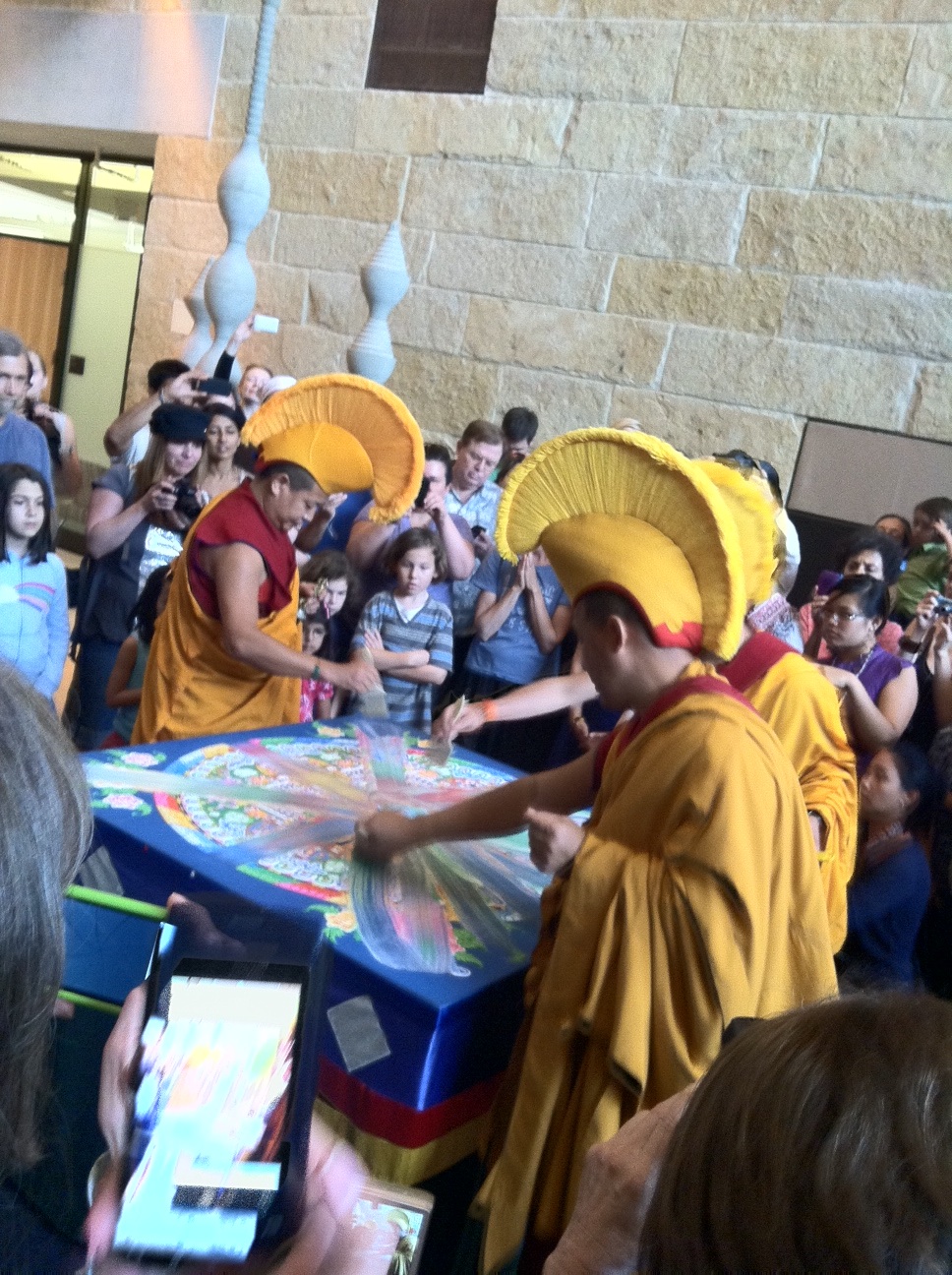
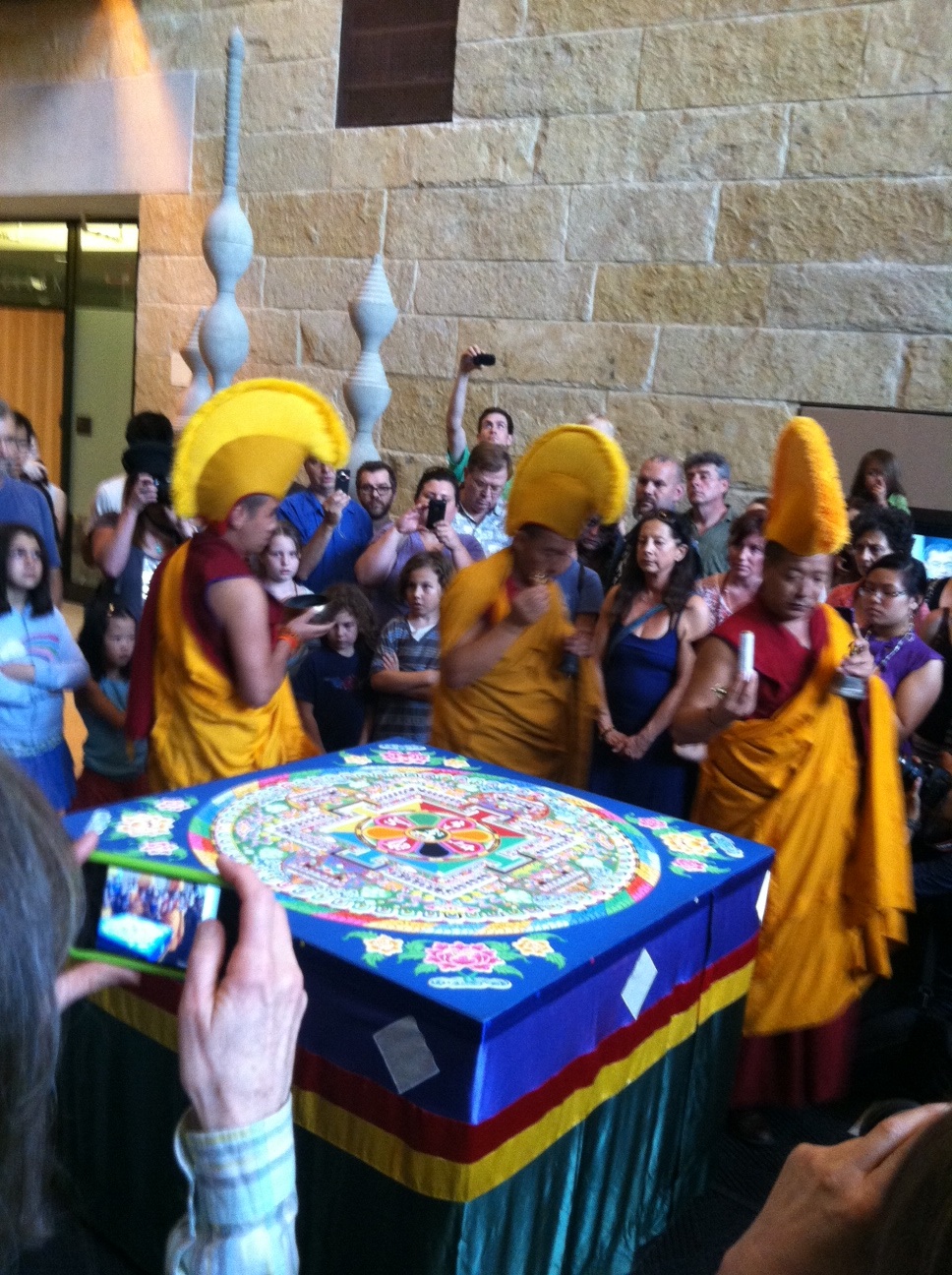
Some Tibetan monks from the Gaden Shartse monastery are visiting Austin. They made a sand mandala at City Hall over the past week, and yesterday they held a ceremony in which they destroyed it. My friend Tom and I went to see it.

Quite a crowd had gathered at City Hall, with people on the stairs and balconies, gazing down. Bumped into old friends Rebecca and Jutta.

One of the monks was American and explained things well. He said one monk was a geshe and described what it takes to become a geshe (20 years of monastic academic studies and a lot of winning debates with other monks). Another was a lama, a title indicating an honored dharma teacher.

You can see their wonderful hats.

They chanted for a long time. I couldn’t understand a word, but I liked it. I recorded it on my iPhone but can’t figure out how to upload a voice memo to my blog, so you can just imagine the chanting.

After destroying the sand mandala with paint brushes, they gave each person attending a small bag of the sand and suggested it was good for two things — to sprinkle on the four corners of your property as a blessing for your home, and to rub a bit of it into the crown chakra of a dying person to ensure a good rebirth.

I couldn’t resist making the final photo my new masthead photo!

So what is this ceremony about? Nonattachment. A visual lesson about creating something of beauty, intricacy, and special meaning, with highly focused, meticulous, and lengthy labor, and then destroying that creation — because life is change and nothing is permanent — and releasing it back to the Source. The practice of presence. Equanimity.

I loved their energy. One of the monks in particular just radiated so much intelligent alive awareness in his mostly silent presence (and no, he wasn’t the geshe or the lama). I felt connected energetically to them all. They radiated such deep well-being.

Here’s a link to their activities for their remaining time in Austin.

Circling the sand painting

Destroying the sand painting

Chanting at the lake...

...as a monk pours the sand into the lake

Ceremony over, posing for photos

New book, Shaking Medicine: The Healing Power of Ecstatic Movement

I found a book, Shaking Medicine: The Healing Power of Ecstatic Movement by Bradford Keeney, at Half Price Books on Sunday when I was looking for another book. Of course it jumped off the shelf and right into my hands!

The author is a professor at the University of Witwatersrand, Johannesburg, South Africa, or at least he was in 2007 when this book was published, and has made a remarkable connection with the bushmen of the Kalahari Desert, who practice shaking medicine ritually. Dr. Keeney has been shaking his whole adult life and has the gift of being able to induce shaking in others.

Plus, he seems to have training in anthropology, systems theory, and hypnosis, so I have a connection there with my NLP training.

Here’s a link to his website. Oh, and he and a colleague (operating as The Mojo Doctors) now offer 5-day experiences they call Rehab for the Soul in New Orleans.

I do like the term shaking medicine better than trauma releasing exercises. And please note that it is about shaking, not dance, although apparently ecstatic dance can unleash ecstatic shaking.

It also seems that the trauma releasing exercises are the latest incarnation of a practice that goes way back in time. It has surfaced in various cultures, religions, and places over millenia. It may be the opposite of meditation: instead of deep stillness, it’s deep uncontrolled movement.

Whatever. It’s good medicine.

I’ll write more as I’ve read more. Just wanted to let y’all know where this path is now taking me…


Fall down seven times, get up eight

I discovered this lovely blog post about the resilience of the Japanese people. Thought it was worth sharing.

They say that in times of crisis people show their true character. Anyone can be cooperative, patient, and understanding when things are going well and life is good. But it is the noble man or woman who can behave with grace and compassion and even kindness when times are very, very bad. For many people in Northern Japan right now, the times could not be worse. And yet, at least to the outside observer, the manner in which the Japanese people conducted themselves in the aftermath of this calamity has been remarkable.

Here’s more:

The best kind of motivation is intrinsic motivation. For the benefit of oneself — and for the benefit of others as well — one must bear down and do their best. Even in good times, behaving uncooperatively or in a rude manner is deeply frowned upon. In a crisis, the idea of complaining or acting selfishly to the detriment of those around you is the absolute worst thing a person can do. There is no sense in complaining about how things are or crying over what might have been. These feelings may be natural to some degree, but they are not productive for yourself or for others.

Click the link to read on.

Claiming some me time

Like the Energizer bunny, I’ve just kept going and going, with work and training and teaching and transitioning toward a new home, and then things started to go not so well. Low back-ache, fatigue, muscle tension, losing things, not handling a situation well, emotional sensitivity, feeling close to overwhelm.

As in, “If one more difficult thing happens, I’m going to lose it, and it’s not going to be pretty.”

As much as I like to meet life from a place of strength and resilience, sometimes that isn’t what’s real.

So I declared this afternoon as me time. You know. Solitary unpressured time — several hours of it — to rest, ruminate, and recover.

I even cancelled my restorative yoga class, which I try not to do, because I know when you need it, you need it, and it’s disappointing if it’s not available.

Yogis and yoginis, namaste. It’s savasana time for me, and for you if you need it! And, I am changing our class time to 7:30-9 pm so we can all have more “day” to enjoy on Sundays, then eat lightly, do the class, drive home, and go to bed all relaxed.

How does that sit with you?

We all need time to be active, time for sleep, and time for rest. In this case, I have not been getting enough rest.

Rest is when I check in with myself and get back on track, reconnect with myself and recenter.

It’s actually one of the best parts about being human. That we can do this!!!

And now, I’m going within, to get in touch with my feelings, breathe, maybe cry a little, curl up with Mango, and get some rest. And plan how to intervene with myself a little bit sooner so this doesn’t happen again. I hate disappointing people! I believe it may be time to restart my regular sitting practice, which has become irregular.

Yep. This is what happens when I don’t meditate. Yep, I’m really remembering that now.