Lovely sweet rain, a morning meditation, and MONEY!

I am adoring my experience of a lengthy, soaking RAIN here in drought-stricken Austin, Texas — off and on yesterday, seemingly all night, and most of this Sunday morning. I’m guessing maybe two inches of precious rain has fallen. Feels like such a blessing.

We (people, air, plants, wildlife, soil, streams, lakes, roads) need this so badly. There are cracks an inch wide in the soil under my trailer and under the dead grass. The only green grass around is under trees that got watered in an effort to keep them alive, and around the new trees I planted starting in late August. They’re drinking it up.

I love being inside my trailer in the rain. The sound of rain on the roof is divine.

And it’s Sunday. Sleeping in (well, to 8 am) to the sound of rain feels wonderfully precious. I’m undecided whether to go out to ecstatic dance, the farmer’s market, the Austin Yoga Festival, or to stay blissfully inside on this wet fall day — I have reading to catch up on, videos to watch, a cat to play with, food to cook, or maybe I’ll mix it up spontaneously.

~~

I just did a 35-minute meditation session. When my attention was focused, it went to body awareness and to hearing. My body awareness has deepened since I started massage school in June, of course. Understanding my hands as antennas, feeling layers of tissues down to the bone, and experiencing others touching me with various levels of connection, compassion, and presence have been quite an education.

Hearing while on the cushion a mockingbird and other birds, rain noises, traffic on wet pavement, my cat rustling in a cabinet, I notice I’m accustomed to picking out single sounds. It’s a nice stretch to take it all in, and like a symphony, to go back and forth between individual sounds and the whole cacophony, like zooming in and out with a camera, only with my sense of hearing. That reminds me, I’m leading my adventurous Fourth Way book group through the 12 states of attention on Tuesday.

~~

Yesterday I was fortunate enough to be able to attend a workshop, Metaphors of Money, taught by Charles Faulkner, an NLP trainer, trader, writer, and researcher. Given that metaphors, conscious and unconscious, underlie our experience (the map is not the territory; a map is a metaphor for metaphors), we examined our metaphors around money.

I personify money. I like it, and I want it to like me. I know money likes me when people write checks out to me and give/mail them to me or hand me cash! Also, when I look at my bank balance and it feels good, I know money likes me. When it doesn’t feel good, I feel pressed, and I take steps to bring more in.

I noticed that as the workshop progressed, every time I heard the word “money,” its visual representation in my mind (cash, dollar sign, checks, bank balance) looked brighter and more vivid. By the end, “money” was glowing with white light!

If this workshop is offered again, you can find out by subscribing to NLP Resources Austin‘s email list. (You don’t have to be trained in NLP to participate.) They have a lot of other cool stuff coming up too.

New discovery about connective tissue

One of my wonderful student massage clients, perhaps triggered by me saying something about fascia (connective tissue), told me about and later sent me a link to this fascinating article, How Pig Guts Became the Next Bright Hope for Regenerating Human Limbs, about how extracellular matrix (ECM), formerly thought to be a kind of structural scaffolding, is actually

primarily a collection of signaling proteins and information that is held within the structural molecules.

ECM can be inserted where tissue has been damaged and destroyed, and somehow it manages to recruit the body’s own stem cells to rebuild nerve, muscle, and other tissues.

It holds promise for regenerating tissues in damaged limbs, preventing the need for amputation, and healing serious wounds without scar tissue.

Thanks, Bruce and Discover magazine.

Why meditators are happier

A very interesting article that fits in well with this blog, Eat, Smoke, Meditate: Why Your Brain Cares How You Cope was published recently in Forbes, the business magazine — an unlikely place for an article about meditation but a good sign, meaning that this kind of information is reaching the conservative mainstream business audience.

The article, by health writer Alice G. Walton, states that for millenia people have turned to different activities to cope with life’s stresses: going for a walk, taking a deep breath, eating, drinking, smoking, praying, taking drugs, running, meditating.

She adds that most people would agree that the mind’s annoying chatter is a major source of unhappiness. It’s the obsessing, worrying, drifting, fearful mind that creates feelings of unhappiness. (We meditators know it as monkey mind.)

This internal chatter and the unpleasant emotions that accompany its thoughts are really what people are trying to get away from. A Harvard study done last year confirmed that mind wandering and unhappiness are clearly connected. That study found that when people are awake, their minds are wandering about half the time.

Another study found that mind wandering is linked to a network of brain cells called the default mode network (DMN for short). This network is only active when we are flitting from one life-worry to the next.

Meditation is about quieting the mind, facing, and then relinquishing those unhappy, stress-inducing thoughts.

New research from Yale has found that the DMN in experienced meditators is markedly less linked to other regions of the brain. And…when the brain’s “me centers” (areas governing thoughts about the self, such as the DMN) are activated, meditators also activated brain areas for self-monitoring and cognitive control.

They did this automatically, even when not being told to do anything in particular.

This implies that experienced meditators habitually monitor their thoughts and control them — a skill learned during meditation. When the mind wanders — when meditating and at other times — experienced meditators bring it back to the present moment.

Could this be the primary benefit of meditation, that you learn to monitor and control your thoughts, and therefore you feel happier?

The article suggests that meditators actually create a new default mode that is more present-centered and less “me”-centered.

The writer wonders whether happiness is really about shifting our tendency away from focusing on ourselves. Another study found that in praying nuns and meditating monks, brain areas for concentration and attention became activated, while areas that govern how a person relates to the world deactivated.

The author states that this suggests that the focus becomes less on the person being a distinct entity from the external world and more on the connection between the person and the external world.

Separation and oneness, away from and toward. Aha!

The article continues, stating that other tools to relieve stress like cigarettes, food, or alcohol actually end up making the users unhappier. Addictions create negative feedback loops that include craving and relief, followed by craving and relief, et cetera.

She concludes:

 Addressing the process itself with other methods (like meditation), which allow you to ride out the craving/unhappiness by attending to it and accepting it, and then letting it go, has been more successful, because it actually breaks the cycle rather than masks it.

Energizing morning beverage: green tea, yerba mate, lemon juice, ginger

Lately in the mornings, I’ve been making myself a cup of tea that has been incredibly energizing. I feel like I have the energy of someone half my age, which would be…under 30. This morning I was literally jumping at ecstatic dance!

Here’s how to make it:

Boil some filtered water and turn off the heat.

Into a tea ball or strainer, add about a teaspoon of loose green tea leaves. You could use a tea bag of green tea if that’s all you have, but be warned: the tea that goes into tea bags is of vastly inferior quality compared to loose tea.

Add anywhere from a pinch to a quarter teaspoon of yerba mate. Too much can give heart palpitations, so more is not better. Start with a pinch and add more if you have no unpleasant side effects.

Put the tea ball into a cup and fill the cup with hot water.

Add about a teaspoon of fresh squeezed lemon juice or other citrus juice.

Add 1 or 2 slices of fresh ginger root, about as thick as a nickel.

Let steep for about 3 minutes. Remove tea ball.

You could add stevia or honey if you like, but I find the astringent taste refreshing. You can also pour it over ice for a refreshing cool beverage.

Health benefits

  • Green tea is a powerhouse for health. It contains catechins, which are antioxidants that scavenge the body for free radicals and destroy them.  The catechins also protect the skin from DNA damage from UV light. Green tea’s EGCG kills cells showing abnormal growth rates — like cancer cells. It lowers the absorption rate of cholesterol from food and increases the rate cholesterol is excreted, so it improves cardiovascular health. Its theanine boosts the activity of T cells, enhancing the immune system. It assists in weight loss by stimulating the metabolism while dissolving triglycerides.
  • Adding lemon juice to green tea boosts the amount of catechins that are absorbed, supercharging it. Green tea alone is already pretty supercharged, so this combo is super-supercharged! By itself, lemon juice has dozens of beneficial properties: it is alkalizing, improves digestion and elimination, cuts phlegm, purifies the blood, improves the skin, lowers blood pressure, aids in weight loss, and more.
  • Yerba mate provides provides energy without the negative side effects of caffeine. Its theobromine (also found in cacao) relaxes the blood vessels, lowering blood pressure. It stimulates the immune system. It also promotes weight loss by decreasing hunger pangs and stimulating the metabolism.
  • Ginger induces the death of cancer cells. It improves digestion, relieves gastro-intestinal distress, is anti-inflammatory and pain relieving. Like the other ingredients, it is stimulating and energizing.

It’s amazing to me that with just a morning cup of lemon ginger green tea mate, I can do so much for my health while I increase my energy for the day. 


Suggestions to relieve insomnia and get to sleep

A couple of months ago, I blogged about some exciting new research about insomnia. It seems that when we lie awake at night, unable to fall asleep, it’s because our brains are overheating. They tend to generate more warmth during the day and cool down at night.

So something happens that moves us out of this biorhythm and into the minor hell of insomnia (or major, if it goes on long enough). When you would like to be sleeping, the monkey mind grabs onto thoughts and won’t let go — generating heat in the brain and preventing sleep.

The researcher experimented with a cooling cap. It seemed to me that there were alternatives that were much simpler and more accessible.

Disidentify with your thoughts

First of all, disidentifying with your thoughts is a useful skill anyone can learn with a little practice. Thinking is what the mind does. It serves a purpose. It is not inherently bad.

The question is whether thinking is appropriate when you want to be sleeping. There’s thinking, and then there’s mind-running-amok.

To disidentify with those thoughts, you simply choose to focus your attention on your breath, or on sounds, sensations, rhythms, your weight against the sheets and pillow, a chakra, your whole body, a state of wonder, an image — find something that works for you. (All this stuff is happening all the time. “Life is what happens to you when you’re busy making other plans,” right?)

Notice that your thoughts are often about something that’s neither here nor now — they’re in the past or future. Bring your attention into the present moment. What are you actually experiencing?

Your mind may interrupt, but as you continue to focus on your present experience, it will interrupt less and less often, and you will fall asleep.

Also, notice whether that thing your monkey mind won’t let go of is something you have any control over. If you can’t influence it, give it up. Trickster is having fun with you. Just plain let go and hand it over to God, the Universe, Spirit (GUS will take care of it). Now go to sleep.

If you can influence it, unless it’s truly life-or-death, sleep on it and see what option comes to mind when you wake in the morning. In other words, pose the question “How can I influence this for the good of all involved?” Let your unconscious mind work and play with the situation while your conscious mind takes the restful break of sleep. When you wake, notice what comes to mind.

You may want to do some journaling.

Drink some cool, clear water

Drink a glass, or half a glass if your bladder wakes you up early, of water that is between room temperature and cool. Ice isn’t necessary — some people believe that ice is too cooling and not good for the human digestive system’s operations. After all, the human race has done pretty well without iced drinks for millenia upon millenia.

Take a mouthful of cool water, close your mouth, hold it for a bit, and then swallow.

You can also put a cool compress of a wrung-out washcloth on your forehead. Do both!

And, while you’re doing these things, think about the cowboy song Cool, Clear Water while you do this! Let water represent the sleep you want to experience.

Here’s a video of the original by the Sons of the Pioneers. Maybe you have a favorite version.

Yawn and open your mouth when you lie down to sleep

Since it’s currently believed that the purpose of yawning is to cool the overheated brain, yawn several times when you are ready to go to sleep.

Also, you can open your mouth just wide enough to let air (cooler than your body, of course) circulate in your oral cavity and cool the adjacent brain. Try parting your teeth half a finger-width.

Continue to breathe through your nose, not your mouth, unless you have nasal congestion.

Use acupressure to reduce heat

I shared this with my bodyworker/acupuncturist Patrice Sullivan, who got excited and shared with me some of the pressure points that reduce heat, because in Chinese medicine’s understanding of health, the body can get out of balance and have too much heat — and of course this can affect the brain.

Press into pressure points with a fingertip or pencil eraser to stimulate them, unblock meridians, and release heat. Press briefly and see what happens. Then try pressing steadily for 30 second to 2 minutes.

The list below includes the poetic names of the points for fun. You may want to google each point to view a graphic with more precision about the location.

  • Gallbladder 42 and 43, Earth Fivefold Convergence and Clamped Stream, are on the foot between the fourth and fifth metatarsals.
  • Liver 2, Moving Between, is on the top of the foot between the first and second toes before the webbing starts.
  • Gallbladder 34, Yang Hill Spring, is outside the knee, in a depression just below the head of the fibula (smaller lower leg bone) toward the front.
  • Heart 7, Spirit Gate, is on the hand on the crease of the wrist closest to the hand, in line with the ring finger.
  • Large Intestine 11, Crooked Pond, is located at the end of the outer elbow crease.
  • Governing Vessel 20, Hundred Convergences, is at the crown of the head.

Report back so others may benefit

I’d love to be wrong about this, but in my opinion, Big Science is probably not going to fund research on simple, effective ways to relieve insomnia unless they can make money off it by selling you something they’ve patented. So it’s up to us to figure out what works and let others know.

Please feel free to try any or all of these methods to relieve insomnia and please report back on what worked and didn’t work for you in the comments for this post.

Thank you.

Perceptual flexibility, the large self, the small self, and feeding the wolf

If you are trying to understand a negative experience, step outside of yourself first. Visualize yourself as a person in a situation and ask, “Why did s/he feel that way?”

Chances are you will discover some new information about yourself, the other person, and/or the situation. Your point of view is larger.

This is a way to gain insight. I don’t know about you, but I find insight to be very valuable.

The less effective strategy is to remember the experience as if you are re-experiencing it, feeling the negative feelings again, and ask, “Why did I feel that way?”

Often your emotion can overwhelm the understanding. People often replay the tape of “he said x, and I felt y” over and over again.

Guess what that does for you?

I dare you to try this now! Think of a recent situation in which you felt an unpleasant emotion. Please pick something with a small to middling emotional effect and not something intensely painful.

For instance, if someone made a remark that you perceived as insensitive and you felt hurt, review the situation as if you are seeing it occur on film. You are one of the characters. See the other character make the remark and see your character reacting.

Now ask, “Why did that remark get to her so much?”

Then notice what happens.

You might need to do this several times to practice if this is new for you.

It’s pretty amazing how such a shift in point of view can make a big difference. Research has shown that people who self-distance from situations that result in unpleasant emotions feel less distressed later, ruminate about the experience less, and are less likely to be hostile when future disagreements arise.

It is amazing to me how many people live decades of their life immersed in either their own point of view, feeling everything intensely, or distancing from everything and not taking anything personally without knowing they can do both — and can choose which point of view to use when.

And…you can review past events and change your point of view. You can actually change your feelings about the past!

We all have a range of emotions. Like the Native American story says, which wolf do you choose to feed? The one with less suffering or more, your own included?

I call this skill perceptual flexibility. It’s worth practicing and cultivating, in my opinion.

By the way, this is elementary Neuro-Linguistic Programming. A scientific study confirmed what NLPers have long known works. I read about it on Steve Andreas’ NLP Blog in case you’d like to read my source.

Prescriptions and modern medicine

I was just reading an article in the New York Times about the effects of exercise on depression, and this sentence caught my eye:

His investigation joins a growing movement among some physiologists and doctors to consider and study exercise as a formal medicine, with patients given a prescription and their progress monitored, as it would be if they were prescribed a pill.

Hallelujah. I am so glad to hear that the medical profession is broadening what it prescribes.

The word prescribe comes from the Latin pre (before) + scribere (to write). It basically means to direct in writing.

Somehow we’ve come to interpret the word prescription as synonymous with pharmaceutical drug. Glad to know it ain’t necessarily so.

Gee, before you know it, doctors may be prescribing not just exercise, but also massage, diet, and rest, changes that have improved health for millenia without corporate profit.

What a concept.

Oh, exercise was found to be helpful for depression.

A doctor who uses yoga in his practice

Saw this article in today’s New York Times and thought I’d share.

When patients with rotator cuff injuries do a pose derived from yoga, the results were as good or better than surgery or physical therapy. The yoga pose is headstand with the forearms making a triangle with the head, but you can do it against a wall — inversion is not required. It works by letting a new muscle do the work of the injured muscle.

Another study found that for patients with osteoporosis or its precursor osteopenia, ten minutes of yoga every day for two years built bone density in the hip and spine, while the controls lost bone density.

Yoga is weight-bearing exercise using the body’s own weight, especially in partial and full inversions. In addition, stretching pulls on the bone where muscles attach, and this can build bone density.

Another article is about piriformis syndrome, when the sciatic nerve is pinched by tight butt muscles. It can be caused by prolonged sitting.

Pressure-point massage can help. Some home exercises can provide relief in the majority of sufferers.

Why massage, yoga, shaking medicine, and movement make you feel so good

One of the coolest things I’ve learned in my first two weeks of massage school, besides that I actually know something from my years of experiencing bodywork and that my hands love connecting with people, is about fascia.

If you don’t know, fascia is the name for a type of connective tissue, a thin membrane. It is labeled superficial when it is right under the skin and deep when it surrounds, binds, and separates muscle. It’s really all the same — these terms just differentiate the location.

The semi-transparent membrane on an uncooked chicken breast is fascia.

Here’s a new word: thixotropism, from the Greek for touch and turning. It refers to the fascia’s ability to change from one state to another. Fascia has two states: a thin fluid (sol) and a thicker gel. In its thin state, it is fluid, pliant, and elastic, offering a wider range of movement. In its gel state, it is tougher, more inflexible, and restricts movement.

When the body is out of alignment, such as when the head is jutting forward, the fascia supporting those straining neck muscles become more gel-like, stiffer, and supportive.

When you feel stiff, it’s because the fascia is in its gel state.

Through touch, exercise, and/or stretching, fascia “melts” from gel to sol and becomes looser, more flexible, and elastic. This allows the muscles to be manipulated in massage, increases joint range of motion, and frees the body from restrictions in movement.

When you move fluidly and freely in your body, your fascia are in the sol state. And of course, that feels fantastic.

This is at least one piece of the physiology of why it feels so good to get a massage, do yoga, warm up your muscles through work or exercise, and do the movements of TRE and shaking medicine.

They literally transform stiffness into fluidity.

Conversely, this is why it feels bad to sit for prolonged periods, and why we need to stretch after the stillness of sleeping.

If you want to feel free in your body, move, shake — and get massages.

What you need to know about standing desks

To counteract the ill effects of sedentary (from the Latin sedentārius: sitting) jobs, manufacturers are beginning to offer standing desks. Actually, they aren’t new. According to Wikipedia, standing desks were popular in the 18th and 19th centuries in the homes of the rich.

Furthermore, some of the world’s most talented writers wrote/write while standing. We’re talking Hemingway, Nabokov, Lewis Carroll,  and Thomas Wolfe.

Novelist Philip Roth, a great living writer, stands at a lectern to write and paces while he thinks, claiming to walk half a mile for every page he writes.

Who knows? Maybe writing is the one thing they did differently that helped them manifest their genius. It certainly seems to be better for the brain than sitting (see my previous post mentioning that movement of the sacrum pumps cerebro-spinal fluid, which nourishes the brain).

Perhaps before making the switch, you’re wondering how many more calories you would burn by standing instead of sitting. Here’s a calculator where you enter your weight and hours worked to find out the extra calories burned in a workday at a standing desk versus sitting. I’d burn 221 more calories per day. That’s very significant. I could lose a few extra pounds and then eat a little more!

Hmm. Could desk jobs be the real reason for the obesity problem in our society?

Adapting to a standing desk may take a week or so. Your feet may hurt from standing all day. You may be extra tired at first. Some people who’ve made the switch swear by a cushioned mat, like this writer, who had an adjustable IKEA Jerker desk (unfortunately discontinued) and switched it to standing mode. She writes about adjusting to it, which took her three days, and later using a mat and a footrest.

Of course, the least expensive way to create a standing desk is to simply put boxes, crates, or shelves on top of your regular desk and arrange your computer on them. You can create different levels for your monitor and keyboard if you like.

Personally, I’d put my big monitor at eye level and place an external keyboard at elbow level or slightly lower.

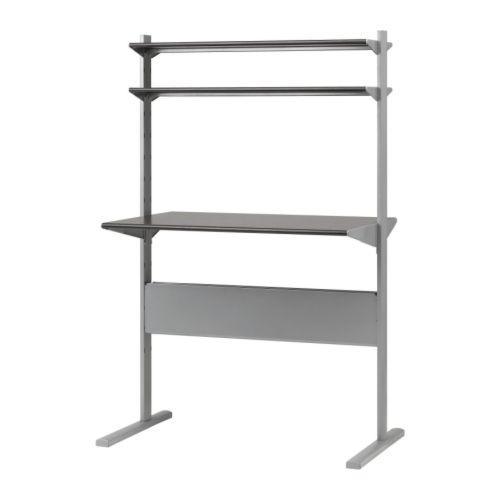
IKEA sells the least expensive standing desk that I found online, the Fredrik workstation for $119, shown below. There’s a wider version for $149. Assembly is required, of course.

Then there are the IKEA hackers — people who repurpose IKEA products to make what they want. Here’s an inexpensive conversion using PVC pipe.

Here’s another hack, the wide standing desk.

This article shows a couple of adjustable-height desks that allow users to flip a switch to adjust the height. This sounds great, for $700+.

Finally, here is a website devoted to creating your own treadmill desk. If you already have a treadmill, apparently you can do this for as little as $39, a significant savings over buying the top-of-the-line Steelcase Walkstation at $4,399, shown below.