Four constructive things to do with your anger

A recent Tricycle Daily Dharma quotation is timely, and I’m sharing. It’s worth exploring anger for what it actually is.

Because we imagine anger is never a good thing, it is easy to think we should practice simply not being angry. But that approach is too general and abstract. It’s important for each of us to be precise, to be real, to be personal and honest, to find out exactly what my anger is. To do that we need to ask ourselves lots of questions about its actual nature.

It is quite a fabulous skill in life to handle anger well — to feel it and not suppress it, and to use it constructively. I’m definitely not saying I’m the most skilled at handling my anger, but I have come to recognize some of its complexity and discovered a key that helps me manage it constructively.

Watch some angry cartoon characters display anger in this video. You may never see anger in humans in the same way again!

First, anger is a body sensation. You can see it in the cartoons. For me, there’s a stiffening, a rigidity that I experience, often in my neck or back. My spine lengthens as I draw myself up to my full height. When it’s more intense, I feel prickly sensations and sometimes heat.

Only rarely have I experienced what Elmer and Daffy do so well, the red face, the steam coming out of ears, the grimace, the fists, the in-your-face stalk, the growl.
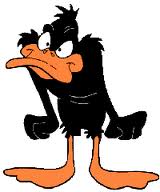
I dream about being Bugs Bunny, but when I wake up, I’m Daffy Duck. ~ Chuck Jones

  • Next time you’re angry, if you can, take a moment and notice what you’re feeling in your body, how your state has changed, what your mind is telling you to do. Just notice.

Anger has degrees of intensity. Anger includes a family of emotions that range from annoyance to rage. There’s a huge difference between asserting oneself when annoyed and abusively vomiting one’s rage on someone.

  • How angry are you on a scale of 1 to 10?
  • Can you describe it explicitly — outraged, irritated, mad, hostile, slow burn, furious, exasperated, chagrined, huffy, miffed, pissed, petulant, sullen, piqued?

Anger needs release. Anger builds toward action. This is where I think most of the problem lies. It’s not the anger itself, it’s what people do to release it that can be so destructive. People can emotionally and physically abuse others because they know no other way of releasing their anger. They finger-point and blame — and most of the time, other people are just doing the best they can, unable to read your mind.

When you’re angry, a different part of your brain is operating than the part that is able to have a dialogue, listen respectfully, and negotiate a solution. Respect that. Allow it. Just remember that.

What you do depends on the degree of your anger. If you feel annoyed, irritated, or dismayed, a few concise words can convey that with minimal damage. If you’re feeling really angry, like at least a 4, it’s more about you, not them.

Also, sometimes people feel their anger and recognize its intensity, but then they swallow it because they don’t want to be destructive but don’t know what else to do. That feels really miserable and isn’t a good solution to “the anger problem”.

  • So…here’s a new skill. When you feel so angry that you might say something you’ll regret, don’t even try to converse. Instead, move your body and make noise. Pace, stalk, make fists, punch a pillow, grimace, wave your arms. Dance with your anger. Growl and howl. You can even let loose a nice juicy string of curse words (or fake or foreign curse words) not aimed at anyone.

The other person witnessing your nonverbal anger may find your anger beautiful, or at least entertaining to watch (if they stay out of your way, right?).

Examine your anger later, when you’re calm. What triggered it? I’m guessing it was probably something you didn’t like, an injustice or injury, or a sense of invasion.

  • Ask yourself and the other party (if they’re willing) some good questions. Did someone violate one of your rules? Did they fail to read your mind? Could you have contributed to it? Did you communicate your preferences with clarity? Or could your rule conflict with their rule? Did they assume something about you that wasn’t true? How do you move forward? There’s a lot of room for understanding when you get to this stage of anger.
  • Also, was there another emotion behind the anger, like fear or hurt?

This is the best thing about anger, in my opinion. You learn more about yourself and the other person, and you’ll improve your communication skills. Sounds like a gift, doesn’t it?

~~~

As long as I’m posting about an emotion, I want to recommend a book that I found very helpful for understanding the emotions and the purpose each serves. It’s The Emotional Hostage, by Leslie Cameron-Bandler. It will help you decode your own emotions and those of others, understand the clear messages that each emotion conveys, and resolve your relationship problems more easily.

~~~

1/30/2012. Just encountered this quote from the Dalai Lama about anger:

When we are angry we are blind to reality. Anger may bring us a temporary burst of energy, but that energy is blind and it blocks the part of our brain that distinguishes right from wrong. To deal with our problems, we need to be practical and realistic. If we are to be realistic, we need to use our human intelligence properly, which means we need a calm mind.

The power of asking questions

I was working in the student clinic, doing another intern massage. The client assigned to me was someone I had worked on previously. She works at a desk job.

The first time, she had complained of neck pain, and she had said she didn’t want to be poked with fingers or knuckles. So I rubbed and kneaded her neck quite a bit and didn’t do any of the deep massage strokes that I felt could have been so helpful had she not had this aversion because many involve “poking”.

On the client evaluation, she said I didn’t spend enough time on her neck!

So when I got her again, I was determined to get a better result. I brought her back to the bay and asked her if her neck was still bothering her. She said yes.

I asked her to show me where her neck was hurting and gave a little demo by putting my hand on the back of my neck and asking, “Is it about here?”

She said, “No, more like here,” and she ran her hands across the tops of her shoulders.

Whoa.

Just to clarify, I said, “So you’re not feeling any pain or tightness here?” again with my hand on the back of my neck.

She said no.

And of course, I was professional, but meanwhile I was thinking,

Girlfriend, that’s totally your upper trapezius — the top of your shoulder — and not your neck.

Many people’s knowledge of their own anatomy has big blank areas.

I asked if there was anywhere else she desired special attention. She said her lower back was bothering her. She also said not to work on her abs or her hands.

So I went to work. I spent a lot of time on her back, with focus on her tight upper traps and her sacrum/lumbar area. When I thought I had probably done enough, I leaned down and asked her if that was enough or if she wanted me to work some more on her back.

She said to do what I needed to do. I guessed from that that she assumed that the students in the massage clinic have to follow a routine, and that if she wanted more back work, it was out of the question. Not so.

I told her I could work on her back some more if she liked. I told her I could spend most of our hour together on her back if she liked.

She said she’d love some more back work.

So I worked on her back for about 40-45 minutes of our hour together. I palpated and explored. I repeated strokes, did them slowly, and emulated deep massage with my palms to avoid the poking of knuckles and fingertips.

I pulled her scapula in and up to shorten her tight upper trap and asked her if that gave her some relief. She said it did.

I wrung, lifted and rolled, and kneaded. I rocked her torso. I came at areas from many directions. I even gave her tapotement (like drumming) after asking if she’d like it, which I think is the first time I’ve done it as an intern.

When I finished her back, I redraped it with sheet and blanket and just pressed her glutes and backs of legs and feet. I rocked her body from the heels and had her turn over, asking how she was doing. “Fine,” she said, with a look of bliss on her face.

I like that look.

I pressed the fronts of her legs and tops of feet and rolled her legs, just to loosen up the hips and make the legs feel included as parts of the whole body.

I skipped her abs as requested and just worked on her pecs, giving pressure to her arms so they felt included, avoiding her hands as requested.

Then I did some more upper back work from underneath, rubbed and kneaded her neck, and stretched her neck.

I ended with massaging her scalp and a fulcrum/stretch of the back of her head.

(So okay, I know some of this is massage geek talk, but I’m sure you get the big picture. If not, come get a student massage and see for yourself. $35, no tipping.)

That massage was so off the books from the routines I’ve learned and yet so rewarding because I used my resources to clarify what she really wanted, and then I got to be creative, continuing to ask for feedback and giving her more of what she wanted.

She was very, very happy with it. She gave me a fabulous evaluation, especially for taking the time to really find out what she needed.

The upshot is that questions are very, very powerful tools. If you know what you want but aren’t getting the results you want, ask questions. It’s all in the communication, baby.

There is great personal power to be had literally just for the asking, especially if you ask the right questions, to get the results you want, to get another person to open up to you, to get insight into someone else’s map of reality, to create something that’s satisfying.

It’s so simple, yet almost like a secret. Have you asked anyone a real good question today?

Now offering bodywork & changework

I offer bodywork and changework sessions in my Spartan Carousel trailer in the Manchaca area of Austin, Texas.

These sessions combine massage (mostly Swedish and deep massage with a few enhancements, more as I learn new skills) and changework (NLP, EFT, Byron Katie’s The Work, and more as I learn new skills).

If you are a new client, I’ll do an intake on your first visit, and we’ll talk about the changes you might wish to manifest in your life. We’ll decide up front how best to spend our two hours together each time you visit.

I offer two-hour morning, afternoon, evening, and weekend sessions.

While I complete my internship in massage school, there is no charge for massage/bodywork, and you may pay what you wish for changework. After I receive my massage license in February, sessions will be $108 for two hours.

Please email (mareynolds27 @ gmail.com), phone, or text me (512 507 4184) to set up an appointment.

You may view an FAQ on the Bodywork & Changework page of this blog.

Yoga + politics: a good match?

It’s All Yoga, Baby has named “The Protester” 2011 yogi of the year.

So how do you feel about yogis being involved in politics? Yoga has been part of the Occupy movement from the start, mostly in the form of yoga classes for the Occupiers.

Some prominent yogis have gotten involved, while many have stayed out of it completely.

Is yoga political? I say clearly, yes, if you understand that yoga is a philosophy and not just exercise. Patanjali’s yamas are one of the eight limbs of yoga, asanas being another. Yes, yoga is actually so much more than asanas.

The yamas are the first of the eight limbs, guidelines for ethical social conduct, or moral principles that initiate the practice of yoga. They are: nonviolence, nonlying, nonstealing, non-sexual excess, and nonpossessiveness. In other words, kindness, honesty, trustworthiness, responsible relating, and nonattachment.

It’s hard to understand how any yogi following the yamas could fail to  clearly see their connection to the issues of the Occupy movement.

Some of you know me personally, and some of you only know me through this blog. I write about wellness, not about politics so much, although I did visit Occupy Austin earlier this year and blogged about it.

I am a yogi. I’ve been one for a long time. I practice yoga because it helps me be whole in body, mind, heart, and spirit. I teach yoga because I want to share its goodness. I study yoga because it is good, and it pleases me to grow. I am more awake because of yoga.

Another way of saying I am awake is to say I occupy myself. I live in the world. I am an activist. I sign petitions. I send letters. I vote. I donate. I want to make a difference for the better, and for sure, I can’t if I do nothing, so I do something.

I’m not that public about it. If you’re my Facebook friend or Twitter follower, you probably see a little more of my activism. There is more to me than being an activist, for sure, but heck, I like peace. I like justice. I like freedom. I like goodness. And I will work for them.

I understand the power of the 99% slogan in protesting corruption, heartlessness, inequity, greed. I also believe we are all part of the 100%. Yoga is about union, yoking, bringing together. Attacking people creates hardness and resistance, just like forcing the body into a pose it’s not ready for is a recipe for injury. Instead, think of the prep work and the softening and melting that allow changes to occur on the mat.

This can happen in the world.

I’m so proud of Occupy for adhering to nonviolence, showing and telling the truths about the occupiers’ lives, and confronting behaviors of stealing, irresponsibility, and greed, both within the movement and in the larger society. This is yoga!

I like respectful dissent, thoughtful protest, free speech, freedom of assembly, clarity. I’d love it if the Occupy movement could get the voters of this country focused on getting money out of politics, i.e., campaign finance reform would be one really meaningful, revolutionary change to focus on. In my opinion, accomplishing that would be taking the people’s power back from those who would subvert democracy out of greed. They know not what they do, and they can change.

I wonder if they ever wonder what their grandchildren will think of them, when today is history.

This activist yogi advocates occupying your body, your mind, your heart, and your spirit. Occupy yourself, live in the world, follow the yamas, and change it for the better.

What if awareness is a quality you are inside of?

Indeed, the ineffability of the air seems akin to the ineffability of awareness itself, and we should not be surprised that many indigenous peoples construe awareness, or “mind,” not as a power that resides inside their heads, but rather as a quality that they themselves are inside of, along with the other animals and the plants, the mountains and the clouds. – David Abram, The Spell of the Sensuous

Thank you, Gioconda, for sharing that quote at the beginning of your yoga class a few weeks ago, and thanks for sending me the actual text and source. The profundity of this quote has been playing with me.

I invite you in this transitional week leading to the new year to play with this concept, to try it on. Ask yourself these questions.

Better yet, pull some questions out of thin air!

What if mind, or awareness, is something we walk around in and live our entire lives inside of, like the air?

What if our entire bodies — torsos, limbs, skin, bone, muscle, organ, connective tissue — are as immersed in this mind as our heads are? Can you experience yourself that way? Can you know with your toes? Discern with your liver? Learn with your heart? Understand with your hand?

What if mind is an element like air? Among the elements, air does represents mind — what if it is mind? We breathe it in for nourishment and exhale into it for release? Does that give new significance to your breathing? And because everyone is doing this all the time, what if the quality of Mind changes by what you and others put into it and take out of it?

Is this the illusion or is it real? Is this consensual reality?

What if expanding your mind, or if you prefer, expanding your awareness, is nothing more than more sensitively experiencing yourself and your surroundings?

And, what if there is no limit to how sensitively you can do this?

What if the boundary between self and environment is just a convenient construct for communication purposes but actually doesn’t exist?

For more on David Abram, here’s a chapter from The Spell of the Sensuous. Excerpt:

For none of the several island sorcerers whom I came to know in Indonesia, nor any of the djankris with whom I lived in Nepal, considered their work as ritual healers to be their major role or function within their communities. Most of them, to be sure, were the primary healers or “doctors” for the villages in their vicinity, and they were often spoken of as such by the inhabitants of those villages. But the villagers also sometimes spoke of them, in low voices and in very private conversations, as witches (lejaks in Bali)–dark magicians who at night might well be practicing their healing spells backward in order to afflict people with the very diseases that they would later cure by day. I myself never consciously saw any of the magicians or shamans with whom I became acquainted engage in magic for harmful purposes, nor any convincing evidence that they had ever done so. Yet I was struck by the fact that none of them ever did or said anything to counter such disturbing rumors and speculations, which circulated quietly through the regions where they lived. Slowly I came to recognize that it was through the agency of such rumors, and the ambiguous fears that such rumors engendered, that the sorcerers were able to maintain a basic level of privacy. By allowing the inevitable suspicions and fears to circulate unhindered in the region, the sorcerers ensured that only those who were in real and profound need of their [healing] skills would dare to approach them for help. This privacy, in turn, left the magicians free to their primary craft and function.

A clue to this function may be found in the circumstance that such magicians rarely dwell at the heart of their village; rather, their dwellings are commonly at the spatial periphery of the community amid the surrounding rice fields, at the edge of the forest, or among a cluster of boulders. For the magician’s intelligence is not circumscribed within the society–its place is at the edge, mediating between the human community and the larger community of beings upon which the village depends for its nourishment and sustenance. 

For more on Gioconda Yoga, click here. She’s got some cool workshops coming up!

(By the way, this is my 500th blog post. When I started this blog two years ago, I had no idea I’d post 500 times or post about this topic. Yay life for creating itself anew every day!)

Astrology for the coming year

One of my favorite astrology writers is Rob Brezsny. His weekly Free Will Astrology horoscopes, available online, via email newsletter, and in weekly print publications like the Austin Chronicle, always stimulate me. He’s that skilled and creative and that good a writer.

Rob is offering three-part in-depth audio discussions of each sign’s outlook for 2012 beginning next week and for the two weeks following. The cost is $6 per sign, with discounts for multiple readings.

Abbreviated versions appear in print. The forecast for each week is published on Tuesdays.

I usually copy and paste the readings for the coming year into a single document that I can read to see the big picture of my outlook. I read both my sun (Aquarius) and rising (Virgo) signs.

My horoscopes for 2011 called this year my bridge-building year, and asked me to meditate on how to call forth, nurture, and direct my yearning. It’s been a year of getting trained to change my work into more of a right livelihood for me, bodywork and change work. It definitely feels like a bridge-building year.

I was told that life would be conspiring to strengthen my brain, sharpen my wits, and see the world with greater clarity. I actually underwent brainwave optimization in June, which has sharpened my wits, and I do feel as though I am seeing the world with more clarity.

I was encouraged to be myself to find success, and to cultivate my unique talents, some of which might still be latent and undiscovered. I had no idea then that I’d be going to massage school. Several confirmations that being myself leads to success have popped up.

My 2011 readings seem spot on in hindsight.

I have a strong hunch that 2012 is going to be about blending heaven and earth, taking my spiritual ideals and putting them into form. At least that is what my personal, local astrologer Laura Waldman says. I’ve encountered that phrase, blending heaven and earth, from Patrice, my acupuncturist as well.

It will be a year of finishing my internship and getting licensed, of starting my private practice, and perhaps doing other work as well.

I also foresee it as a year of deepening and strengthening relationships.

Can’t wait to see what Rob Brezsny says!

I’m looking forward to reading what Rob says the coming year will bring.  Thanks, Rob and Laura, for all you do!

Seeding the winter solstice

Today is the shortest day/longest night of the year. Before any organized religions existed, people celebrated this day as the returning of the light after a season of shorter days. It’s the end of harvest and the beginning of the yin-most season, winter. It’s the season of facing mortality, of gathering seeds with intention to plant new beginnings.

Ancient ruins show us that cultures around the world (from native Americans both north and south to Irish and British to Mediterranean and more, I’m sure) were savvy enough to build structures to mark and hold ceremonies for the solstices and equinoxes.

In those times, communities were more tenuous, and starvation in winter was a real possibility. Gatherings on winter solstice must have included the last feast before winter began in earnest, prayers for survival, requests for blessings from the higher powers, and of course, recognition of our complete dependence on nature, on Gaia, on the mysterious ways of the Universe that brought this astronomical event every year without fail but left so much more seemingly to chance, in somewhat random cycles of life, death, and rebirth.

When the religions came into existence, not being able to compete with astronomical, seasonal facts of solstice celebrations, they supplanted winter solstice observances by piling on their own holidays — Saturnalia, Hanukkah, Yule, Christmas, New Year’s, and more. (For a full listing of winter solstice observances, read the Wikipedia entry for winter solstice.)

In many ways, the new year actually begins today. This day may well be the most powerful day of the year for looking at your present life and allowing your intent for the coming year to make itself clear — bringing light into the darkness.

What do you intend for the coming year? What do you want to learn? What do you want to create? What direction will your life path take you?

Much of the future, of course, must remain dark. What fun would it be if we knew everything that would happen? No surprises, no trusting (or fearing) the universe will bring you just what you need. No challenges to help you rise to the occasion, to assist you to define and refine your character and expand your resourcefulness.

Recently I posted about beauty, and this is one of the 50 reasons why you are beautiful:

3. Beauty is a daring action. One that is built on your authentic intention instead of being attached to the outcome.

Being attached to the outcome leaves no room for the unknown and invites disappointment. Consider that the unknown making itself known may reveal even more beauty than you can possibly imagine.

Building on your authentic intention creates a direction that your actions can then follow, until it’s time to change direction.

Please let yourself dream today, and get in touch with the silent stillness that’s always available — just an intention away. Tapping into the silent stillness allows intentions to arise and clarify. Intentions are the seeds of action. What kind of new year can you intend for yourself?

Getting Naked in the Garden | elephant journal

When we start to understand the way we interpret the unfathomable world, we realize it’s all just story after story that we tell ourselves. We are just making shit up all the time.

via Getting Naked in the Garden | elephant journal.

As my friend Val said earlier tonight, “It’s your illusion. Do what you want!”

The Adam and Eve story in the Bible is one of many creation stories, but it was the one that got sanctioned and published — it’s the “official” story of Judaism and Christianity.

I notice some of my stories have a Before and After. Before my sister died. After the car wreck. Before I was innocent. After I knew first-hand how bad it could be, how much I could hurt. After I suffered, was damaged, lost my innocence, lost my trust.

We live in a world that understands things in terms of Before and After. We like to take incidents and make them meaningful, so that we can daydream about the time before and wish we were there instead of here.

Innocence, curiosity, understanding, gaining experience. What if life is good even when it’s bad because you’re alive?

We are lucky to have experienced pain and stress and grief and trauma. It’s uncomfortable, sure, but it actually makes us better people, smarter people, and often, much more compassionate people, because we can relate to every other human in the world who has experienced pain. Which is everyone.

What if life just happens, and some of it we’re prepared for and enjoy, and some of it takes us off the path we think we’re on, and we adjust? We restore ourselves to wholeness and innocence only to fragment and be disillusioned again. Thus stories are born and are interesting to tell and to hear.

But it’s not a circle. It’s a spiral, because each time, we get something new out of it — self-knowledge, insight into human nature, a different strategy, nonattachment, a bit of wisdom. We spiral through life, revisiting issues at different ages, bringing experience to bear on it each time.

Writer/yoga teacher Julie Peters concludes:

…every traumatic experience I’ve been through has made it more possible for me to understand other humans, to be a better teacher, friend, lover, writer, student, and everything else. With every trauma I go through, I realize, man, we are all still naked in the garden. I’m not getting any more innocent, but the more shit I have to deal with, the smarter I get. And every step of the way, every single time we screw up, we are learning how to do it better, and telling better stories all the time.

Top five regrets of the dying

Yoga teacher Ellen Smith posted this on Facebook, and its wisdom is well worth sharing with you. It was written by a woman named Bronnie Ware who also wrote a book called The Top 5 Regrets of the Dying.

She worked with the dying for the last 3-12 weeks of their lives and asked them about their regrets and wrote about their responses. She writes:

People grow a lot when they are faced with their own mortality. I learned never to underestimate someone’s capacity for growth. Some changes were phenomenal. Each experienced a variety of emotions, as expected, denial, fear, anger, remorse, more denial and eventually acceptance. Every single patient found their peace before they departed though, every one of them.

Here’s a process that can make a huge difference:

Imagine your future when you have only weeks left. Imagine you are aware, lucid, have all your wits.

What would this elder you tell the present you?

What are the changes you can make now so that the elder you can die with no regrets?

50 Reasons Why YOU Are Absolutely Beautiful. ~ Linnea Jensen-Stewart | elephant journal

50 Reasons Why YOU Are Absolutely Beautiful. ~ Linnea Jensen-Stewart | elephant journal.

I came across this list and couldn’t not share it with you! Maybe you will read this list and think of someone special to you, or several someones, and of course you will think of yourself.

Reading this list made me smile, think, laugh, remember, imagine, agree, wonder, qualify.

This one made me think:

3. Beauty is a daring action. One that is built on your authentic intention instead of being attached to the outcome.

There may very well be a future blog post born from that one.

Here’s another:

32. Having faith in someone else’s word, because we know we’ve been true to our own. That is beautiful.

Can I really trust that? It is so beautiful to trust.

What’s most beautiful to you? What is beautiful that’s not on this list? I’d love to hear from you, in the comments.

You are beautiful to me!