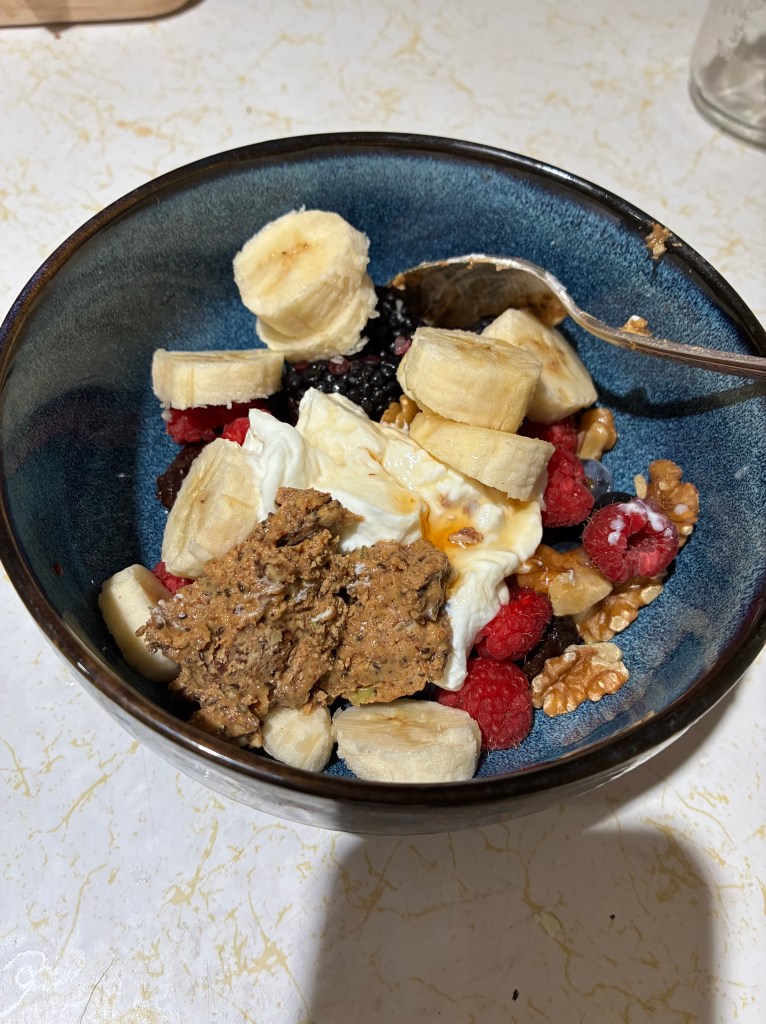
My superfood breakfast is yummy and super-nourishing, and one batch lasts 7 days

I used to not eat until 11 am or so, practicing intermittent fasting. I was usually eating yogurt with berries and walnuts, which was nourishing but not satiating, and I’d be hungry again in a few hours.

Nutritionists are now recommending that eating at least 30 plants a week is great for the gut microbiome, boosting the immune system, reducing inflammation, improving mood and mental clarity, and lowering the risk of chronic conditions like heart disease and type 2 diabetes. (Those healthy gut microbes play a much bigger role in our overall health and well-being than we thought!)

I switched a few months ago to eating a hearty breakfast early every morning, and I’m loving how that is working out for me: I cook once to make an oatmeal base with add-ins that provides 7 servings. Each day I add fruit, nuts and yogurt to one serving of the oatmeal base, and voila — I’m eating over 20 plants every single day.

Here are the details. I cook 3 servings of sprouted rolled oats as the package directs. I add 2-3 servings of hemp, flax, and chia seeds, and cacao, and maca powders to the hot cooked oats, stirring until well-mixed. Then I mix in 1/2 teaspoon each of Ceylon cinnamon, nutmeg, cardamom, and allspice.
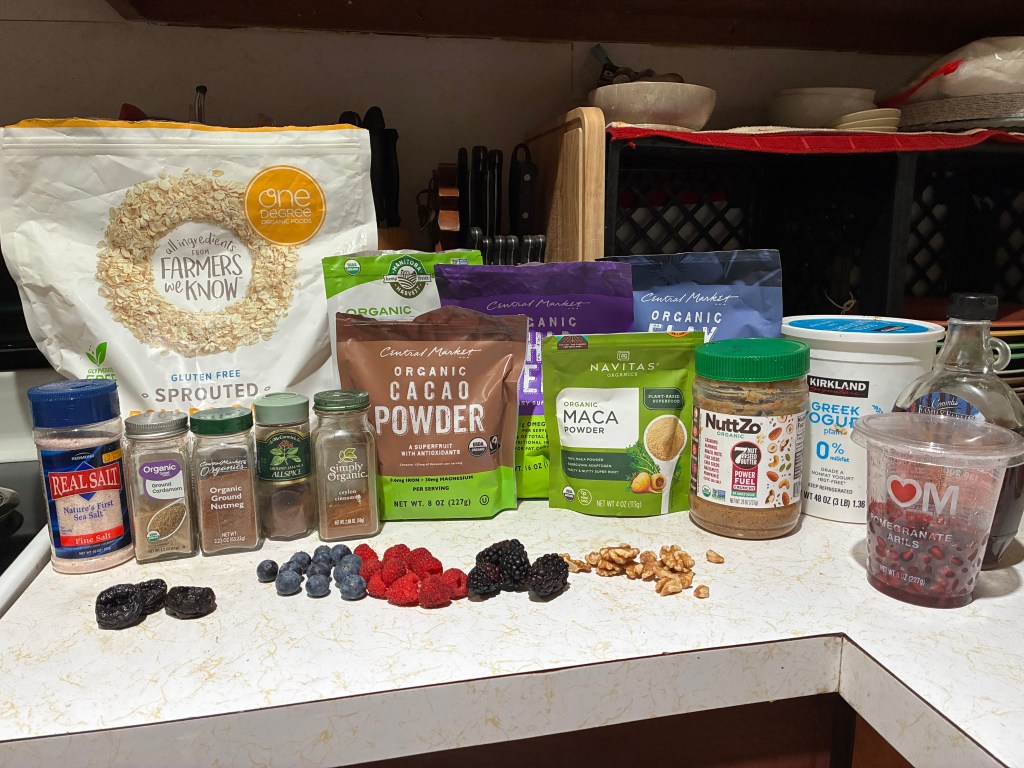
The ingredients, plus half a banana.

That adds up to 10 plant foods in the base. This step (day 1) takes about 20 minutes.

I put one serving (for me, that’s about 1/4 to 1/3 cup) into a soup bowl, add fruit, nuts, and yogurt, and put the rest into a storage bowl the refrigerator.

Once it cools, I slice it into 6 wedges like a pizza and put them into a space-saving ziplock bag.
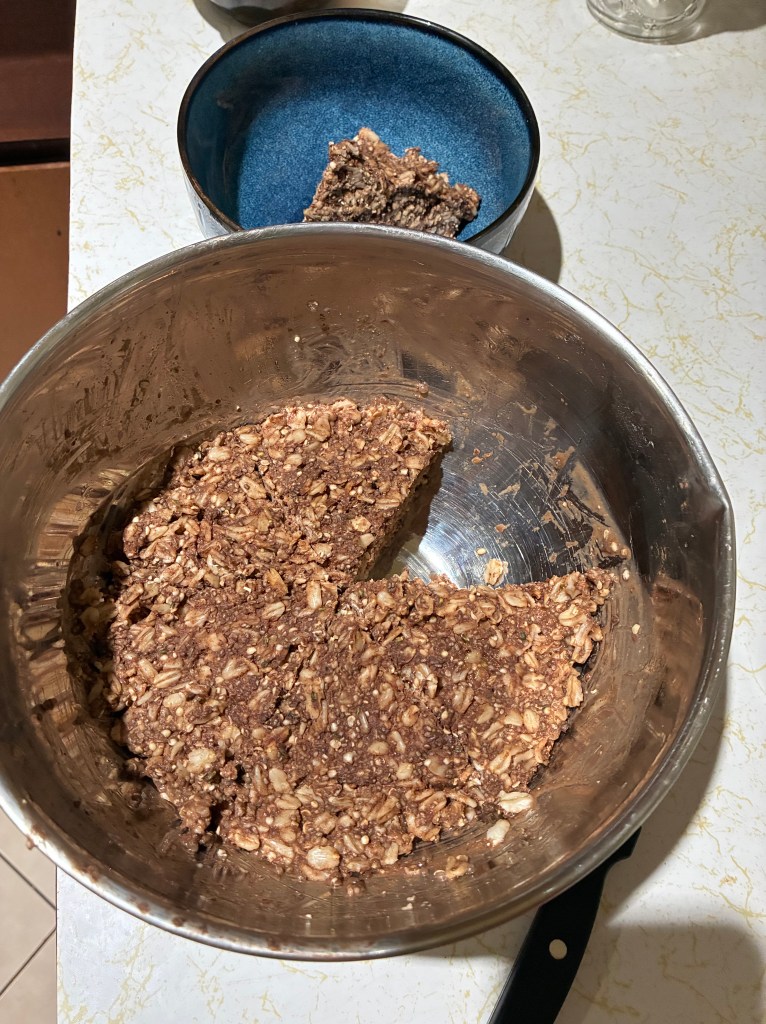
The cooked and cooled oatmeal base divided into 6 servings.

To one serving of the oatmeal base , I add the following:

  • blackberries
  • raspberries
  • blueberries
  • prunes (soaking them in water overnight softens them, and the water can then be used as a sweetener)
  • pomegranate seeds
  • half a banana, sliced
  • 1/4 cup Greek yogurt (not a plant food)
  • a handful of walnuts
  • 2 T raw almond butter OR Nuttzo
  • 1 tsp. maple syrup If needed
This is what I add to the oatmeal base.

That’s 18 with almond butter. If I use Nuttzo, I can add cashews, almonds, Brazil nuts, hazelnuts, and pumpkin seeds to the list of plants (it already includes flax and chia seeds).

When I reheat a wedge on the stovetop (we don’t have a microwave), I mash it up and add some 4-ingredient oat milk, heating until warm. (I’ve already counted oats.)

This step (days 2-7) takes about 10 minutes.

The oatmeal base with fruit, nuts, and yogurt makes a hearty breakfast.

That adds up to 22 plants in just one meal.

Some other benefits: this fiber- and nutrient-heavy meal digests slowly, keeping me feeling full for hours, and it also keeps me regular and energized. I’ll retest with Function Health soon and see how my biomarkers have changed. For the better, I hope!

My other meals are usually a vegetable-based soup, salad, Buddha bowl, or curry for lunch and dinner, and I often have wild-caught fish and either salad or a steamed or roasted veggie for dinner a couple of times a week, so I probably do average at least 30 plants a day.

I feel good. I hardly ever get sick. I work out at the gym, take 3 yoga classes a week, and work part-time in my Biodynamic Bodywork practice 3-4 days a week at the age of 73. I hope to be doing this for the foreseeable future.

My awesome breakfast: supercharged oatmeal

I’m often away from home and busy from 10 am until 6 pm. I wanted to find a breakfast to keep me energized and satiated for that period of time. I’m interested in consuming great nutrition and find most restaurants lacking.

I’ve found something that not only does that, it’s super nutritious and delicious. I haven’t measured, but the oats, seeds, soy milk, walnuts, and yogurt add protein, the walnuts, seeds, yogurt, and olive oil add fat, the yogurt adds probiotics. and it’s got carbs and plenty of fiber from the whole grains and fruit.

I cook 1 cup of organic sprouted rolled oats from One Degree as directed. I add half a teaspoon of olive oil to keep it from foaming up.

If I don’t leave the lid slightly ajar, it’s too watery, so that’s an important part of the instructions. I let it simmer for 10 minutes to get a texture that’s slightly chewy.

After the oats are cooked, I add 3 tablespoons each of flax seeds, hemp seeds, and chia seeds, as well as a teaspoon each of Ceylon cinnamon and nutmeg.

I mix it really well and put it into a covered bowl to store in the fridge.

To eat, I mash about 1/3rd of a cup of the mixture with a couple of tablespoons of organic soy milk and warm it in a small saucepan. (No microwave available.)

While it’s warming, I prepare a one-serving bowl, adding blueberries and walnuts and whatever I have of the following: dried cranberries, blackberries, soaked prunes, pomegranate seeds.

Usually it’s sweet enough without adding anything, but if I want more sweetness, I can add a little bit of the water the prunes are soaked in, which is super sweet and plumps up the prunes. I keep a jar in my fridge. I could add honey or maple syrup if I didn’t have that.

I also add about a quarter cup of yogurt to the bowl. I prefer skyr or Greek yogurt for the protein.

I combine the heated oatmeal and soy milk with the contents of the bowl and stir well.

I get about 6 servings out of one cup of oatmeal. It sustains me very well throughout the day, and when I start to feel hungry again, it’s late afternoon, and I have a light dinner.

I am slowly losing weight without much effort.

I’ve tried intermittent fasting before where I didn’t eat until mid-day, but this timing (I think of it as front-end loading) seems to work so much better for my system.

I do a lot of batch cooking because it’s less time consuming than cooking each meal from scratch. I also make legume-based dishes, like black bean soup or lentil curry, and brown or black rice, doubling or even quadrupling the ingredients to make big batches that I can freeze in meal-sized batches.

Then I simply move a couple of servings from the freezer to the fridge to thaw for 1-2 days, reheat, and voila! Super heathy, inexpensive, delicious meals.

Eating 30 plants a week challenge: a hearty, healthy winter breakfast

This is a challenge that’s been getting some attention, and it’s worth having fun with!

You’ll get more fiber, eat less processed foods, and it supports your healthy gut microbes. Of course, having a healthy gut influences the rest of the body, improving digestion, energy, mood, sleep, and just plain feeling good.

I didn’t used to eat breakfast, as part of an intermittent fasting regimen. Now, I eat a hearty breakfast and eat again when I feel hungry in the afternoon. Letting hunger drive your eating, and then eating slowly and chewing well until satisfied, makes a difference.

That’s often it for the day. No dinner, and it makes intermittent fasting easier.

I do know the experience of overeating because the taste of something is so satisfying. I’m working with that. Also, I used to have a leaky gut and started working to improve my gut health in 2007, so it’s been a focus for a while.

Here’s what I’ve been eating for breakfast, with minor variations:

The organic sprouted rolled oats came from Wheatsville, an Austin food coop. They cook in 5 minutes, although I changed the proportions to 1/3 cup each of boiling water and oats and immediately turn the heat down to as low as it goes.

Add to that coconut milk yogurt, pecans, dried cranberries, beautiful organic blueberries, flax seeds, hemp seeds, maple syrup, and 5 spices (Ceylon cinnamon, nutmeg, ginger, orange peel, and allspice). While the oats are cooking, add everything else to a bowl. When the oats are done, add to your bowl and stir well.

Voila! 13 plants, from Wheatsville, Costco (the pecans and maple syrup aged in bourbon barrels!), and HEB, our beloved Texas chain that does so much for Texas communities in crisis from disasters and Texas public schools.

Really, it’s pretty simple: a whole grain, nuts, seeds, berries, yogurt, a natural sweetener, and spices. Have fun improvising on that!

Next up, a veggie curry served over quinoa.

Can I consume 30 plants in two meals in one day? Stay tuned!

6 variations on the chocolate breakfast smoothie


For months, I indulged daily in eating pieces of chocolate bars with 70 percent or more cacao. It was intensely deep dark chocolate. On good days, I could eat just one small square, and my tastebuds felt gratified and satisfied.

On bad days, half the bar – or the whole dang thing.

I’m not sure if it was the wee bit of sugar or the chocolate that led me to overindulge like that. Chocolate contains magnesium, a mineral most of us are low in, and stress depletes magnesium. Hence chocolate relieves stress. (Bet you knew that already! Yep, that’s the ticket! Stress made me overindulge!)

Sugar is plainly addictive (read more here). Instead of relieving stress, it adds to the body’s stress load and plays a role in obesity, metabolic syndrome, fatty liver disease, diabetes, cancer, tooth decay, malnutrition, heart disease, etc.).

Yes, sometimes a little bit of sugar sneaks into my food (usually in small amounts in a condiment like ketchup or fish sauce), and very occasionally I satisfy a desire for a package of peanut M&Ms. Usually, however, if sugary sweetness is the main point, I forgo it, eating at most 1 teaspoon a day, far below the 32 teaspoons per day the average American consumes.

My tastebuds have changed so that I notice and enjoy the natural sweetness of foods like carrots, liver, caramelized onions, roasted veggies. When I ate sugar regularly, there was no such thing as “too sweet”. Now there definitely is. If you are moving away from sugar, wait for this to happen!

But what to do about cravings for something sweet, without sugar, and chocolate-y?

Make chocolate breakfast smoothies to start each day well!

If you’re concerned about lead and cadmium in chocolate, you can learn more here.

IMG_4715

Empty glass, Buddha Board

Continue reading

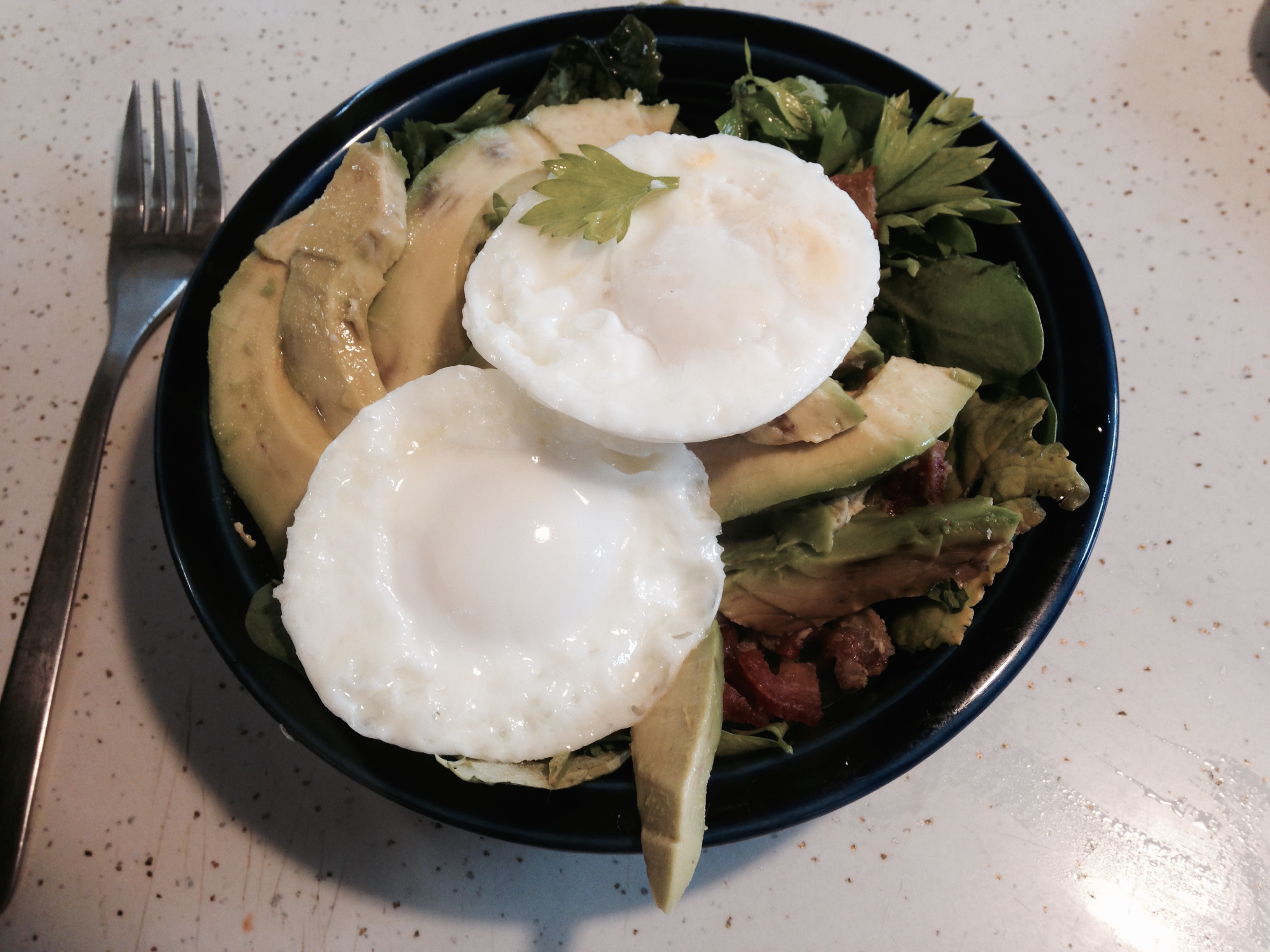
Paleo breakfast salad: Greens with bacon, eggs, avocado

A few months ago, I bought these nifty little silicone cups (Poach Pods) designed to poach eggs. That they do, very well. Just spray with cooking spray, crack an egg, drop it in, and “float the boat” in a pan of boiling water (covered) for 3 minutes to cook the white and leave the yolk a little runny.

I’ve been experimenting with poached eggs atop a bowl of greens, dressed with olive oil and apple cider vinegar. Today I hit the jackpot!

A voice whispered, “Why not add crumbled bacon and avocado? And use the bacon grease as a dressing?”

IMG_4234 Continue reading