About MaryAnn Reynolds

I practice advanced bodywork in Austin, TX, specializing in Craniosacral Biodynamics and TMJ Relief.

Best gluten-free burger in Austin at Hopdoddy’s!

I’m not sure I’ve mentioned this, but my body does not digest wheat well at all. I learned this five or six years ago, and after going without it for a couple of months while on a strict diet to clear excess candida, I noticed a very unfamiliar feeling — I felt, well, well, and I had hardly any fatigue, digestive issues, or feeling like my mood and energy level were on a roller coaster ride. For the first time in, like, forever.

I changed my diet drastically, although it took time for me to really accept that if I ate that piece of pizza, I’d feel bad and “pay for it” later for a few days. I did learn, though. Over time, I learned that I can handle maybe a quarter teaspoon of wheat (such as dusted on blackened fish) without problems.

So being an all-American girl raised in Texas, I missed eating burgers. Not that they were ever a mainstay of my diet, but when you can’t have wheat, you find out what you miss. (Burgers and pizza.)

A couple of times I craved one so badly, I went out and ate one, gluten bun and all, and paid the price for satisfying my craving, which was several days of digestive upset and not feeling too well.

Then I’d make them at home with ground bison patty and toasted Ezekiel bread made from sprouted grains, which my body tolerates. (Toasting it is the only way to make it palatable, in my opinion.) It was good, but I still missed being able to just go out to a burger joint and eat a burger.

Well, today was bliss. I ate lunch with my daughter at Hopdoddy’s, a fairly new and very popular Austin restaurant on South Congress that offers a variety of burgers on a variety of buns — including gluten-free. I’d read reviews about how good their burgers were and that they offered gluten-free buns. I looked forward to tasting for myself.

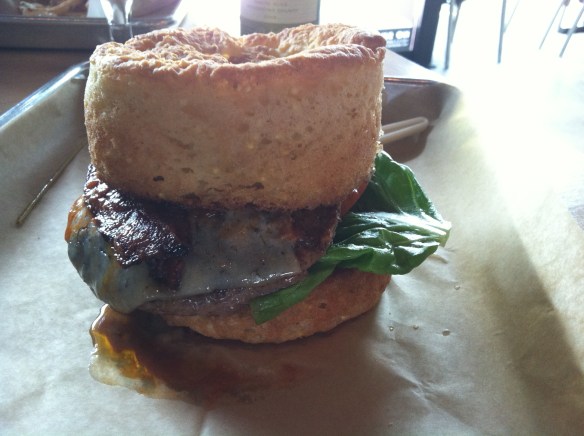
This is what I had:

That, my friends, is a gluten-free bun, and it was light and kind of crispy on the outside. Toasted! And it actually had some flavor, too.

The Buffalo Bill burger (using bison from Thunderheart Bison, South Texas) came with blue cheese, apple-smoked bacon, “Frank’s hot sauce,” and “sassy sauce.”

All I can say is that it was delicious, and it feels so great to know I won’t feel ill. I’m not a big meat or burger eater, but it’s great to know I can indulge occasionally.

I’ll be back!

~~~

Postscript, 11/17/13: For a down-home, less expensive alternative to Hopdoddy’s, I’d also like to give kudos to Wholly Cow (downtown and South Lamar) for making grass-fed burgers (request Udi’s gluten-free buns) and for their awesome Fit Cross Paleo Burger, served with portabello mushroom caps in place of buns! Both made with local, grass-fed beef.

Share your story of healing or transformation through yoga

I received this as a comment on a recent post, but since comments are not that visible on this blog, I thought I’d give it its own post:

Hi there,

Do you have a story of healing or transformation with yoga that you’d like to share with the world? The Yoga Diaries is now accepting submissions. http://theyogadiaries.net/ Please spread the word!

Cheers, The Yoga Diaries

I may be doing the same with trauma recovery stories soon. Bloggers and blog readers, help each other out! I’m looking forward to reading stories about yogic transformation!

A little yoga humor…

YOGA STYLES: a simple, animated guide – yoga humor, yogini style, yoga personality, yoga tips – Y is for Yogini.

Click this link to go to a page that clearly delineates the various styles of yoga.

Seriously. Click the link.

The simplest way to improve your posture

If you’re at all familiar with this blog, I bet you think I’m going to say meditation. Guess what? Ha ha, I’m not!

It’s way simpler than that:

Whenever you’re doing something that does not require use of your hands, turn them so that they’re palm-side up (see the picture above). You also can do it while standing or walking, leaving your arms down at your sides and turning your palms so that they face outward in the direction you’re facing.

This palms-up position may be familiar to committed meditators and yogis who practice shavasana, but it’s foreign to those of us who spend a lot of time at a computer, behind the wheel of a car, holding babies, making lattes, or doing pretty much anything else that requires constant hand use. Even when we’re not using our hands, it’s just habit to sit, walk or stand with our hands facing down or behind us.

Wait for it — there’s a meridian connection: 

In acupuncture, the meridians that run along the inside of the arm, from the chest/underarm to the palm, are Heart, Pericardium and Lung….

Here is just a smattering of the functions each meridian is involved in (there are many more):

  • Heart: breathing, cardiac function, sleep, emotional balance and heat regulation.
  • Pericardium: breathing, blood circulation and upper digestive function.
  • Lung: breathing, immune function, perspiration, body temperature and urination.

…our lifestyles force our hands and arms into an almost constant downward/backward position, creating a tendency to slouch forward. This causes us to cave our upper bodies inward, crunching the Heart, Pericardium and Lung meridians.

Allowing these meridians to flow more freely optimizes their ability to perform their respective functions.

These three meridians are all yin meridians, flowing from the torso to the fingertips.

This is a mudra (energetic gesture in Hinduism and Buddhism). The palms-up mudra, you might have guessed, has to do with receiving energy from spirit or the universe, with allowing. It has to do with being open and surrendering yourself to the Mystery.

Try it when you think about it. Let one or both palms rest facing up, or outward if you’re on your feet. Notice the subtle but significant changes in posture.

Then make it a habit.

Thanks to Sara Calabro for this article.

Reframing trauma recovery as detoxing the whole system

These days I’m thinking of trauma recovery more and more like detoxing.

We all know people — or even do this ourselves — who do fasts or cleanses to rid their bodies of toxins from too much sugar or alcohol, meat, or junk food, after taking drugs, after food poisoning, and so on. I’ve written about the colon/parasite cleanse and the liver/gallbladder flush on this blog. I’ve also done the Master Cleanse, once.

There’s a lot to be said for cleansing for getting rid of recent toxins as well as those that have accumulated in our systems over the years. The proof is feeling better afterwards. If you don’t feel better after doing a cleanse, don’t do it again. Try something else. Be good to your body. It works hard so that you may live and is taken for granted a lot.

Well, trauma recovery is like detoxing your entire system. It’s not so much getting rid of the toxins in your digestive system as letting the harsh, non-nourishing behavior and events that your whole system took in make their way back out of your system.

It may not be pretty, but it’s actually a good sign — it’s so much healthier than keeping it locked up inside, repressed, frozen.

I’m thinking now that there is a natural period after you are safe when you detox, unless you get stuck in a situation with no support for your detoxing, and that’s another story. You have a basis of comparison — safe versus non-safe — now. Because you are safe, you can start to relax. You might want to think, “Whew, that’s it. I’m safe now and can get on with my life.”

Well, that is true, and you will start to bloom. But you might not be prepared for stuff from the past unpredictably sneaking into the present and biting you on the butt. You might not be prepared for intense emotions that may arise. You might not be prepared for the cognitive reframing that occurs as your identity changes from victim to hero of your own journey.

You may sometimes feel pulled in various directions. It is unsettling.  It’s good to find a physical outlet that grounds you. Yoga, bicycling, and walking were all helpful to me. Those things are healthy to do anyway, but it really helps to feel like you have control of some part of your life (your body) at a time when your mind/heart/spirit are in such flux. Exercise/movement is grounding, and the sweat help you detox. Your system wants to release that stuff.

You may reach equilibrium that feels like a few days of inner peace, and then something else — a memory, a dream, a trigger — may come up for you to experience and integrate, bringing you to a new equilibrium, and that cycle repeats, with the periods of equilibrium getting longer and longer. Actually, it’s life.

You  eventually reach a state where the past pretty much stays in the past unless you decide to delve in.

My advice: Let it arise as it arises, because it will do that anyway. It’s a process; it takes time. Notice and honor it. Document it, even — at least write down your dreams.

And it might be good to let a few people know. Ask for help if you need it, and definitely ask for support. You have mine.

Downward-facing dog and the bladder meridian: why it feels (and does) good

The Real Reason Downward-Facing Dog Is So Good for You. | elephant journal.

The connection between yoga and Traditional Chinese Medicine (TCM) fascinates me. When we do yoga poses, we activate various meridians in the TCM system, usually without awareness that we are doing so.

Here’s why doing downward-facing dog pose (adho mukha svanasana) feels so good (once your shoulders open up and the muscles in the back of your legs lengthen) and why it’s so good for your health.

Downward-facing dog  is arguably the most common pose in yoga. It’s done in Iyengar, anusara, vinyasa, ashtanga, bikram, and other styles of hatha yoga. It’s a cornerstone of sun salutations. It’s considered a resting pose in post-beginner yoga classes.

It’s so well-known, even many non-yogis recognize it: palms and soles flat on the floor several feet apart, buttocks high, back and legs straight.

Downward-Facing Dog

Downdog does our bodies so much good because it activates the bladder meridian, the longest channel in the body, running from the inner eye, up over the top of the head, down the back and the backs of the legs, ending at the pinkie toe. It even doubles up on part of its path:
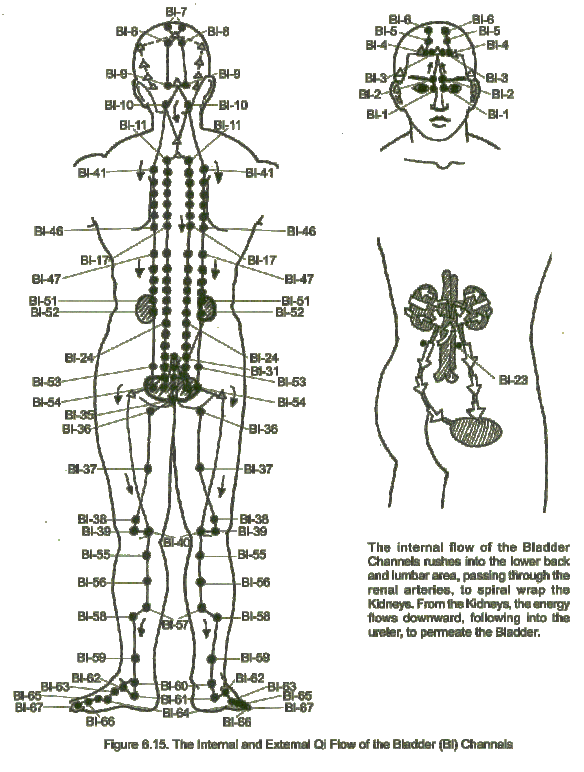
To do downdog is to activate the bladder meridian’s 67 points, more than any other meridian (times two, because there are left and right meridians).

The bladder meridian is yang, meaning it deals with the outer world. The bladder channel is our first line of defense, so activating it boosts immunity. Not only is this meridian related to the urinary bladder, it also relates strongly to (and balances) the sympathetic (fight-or-flight) and parasympathetic (rest-and-restore) nervous systems.

If you are stressed (and most of us are most of the time), stimulating the bladder meridian activates the parasympathetic nervous system, inducing relaxation. It’s why people get so much out of having their backs massaged. Notice all those BL points in the sacrum area? The parasympathetic nervous system is activated by S2, S3, and S4 spinal nerves at the sacrum, and by several cranial nerves as well.

So doing downward-facing dog helps you relax and release tension.

There are also “Back Shu Points” located along the bladder channel. They are associated with organs and with chronic issues like insomnia, asthma, menstrual problems, IBS, anxiety, and so on. Doing downward-facing dog could prevent or alleviate chronic disease.

Downward-facing dog is also an easy inversion for the upper body, refreshing blood to the head and moving lymph.

Plus, you know, it just feels good to stretch like that! Do down dog to stretch the glutes, hamstrings, calf muscles, and Achilles tendons. Even the soles of the feet!

Let it open up your shoulders. Really feel your hands and feet connecting to the ground. Relax your neck and let your head drop toward the ground. Feel your strength. Straighten your legs and work toward lowering your heels to the floor. Do variations (on tiptoes, pedaling your feet, 3-legged dog, wild thing).

Then come down onto your knees, push your butt back toward your heels, and sink into child’s pose to enjoy that relaxation.

Downward-facing dog is a cornerstone of my yoga practice. If I could only do one pose, that would be it! Jai, adho mukha svanasana.

Tao Porchon-Lynch: teaching yoga, ballroom dancing videos

I found more videos of Tao Porchon-Lynch, the world’s oldest living yoga teacher. I just can’t get enough of her! She’s my inspiration, my role model for wellness, because what she can do now is based on what she did when she was much younger: a lifetime of good habits.

She looks, sounds, and feels so healthy! She seems to be wonderfully sweet and so full of vitality! Seeing her living so well is very motivating.

In the first video, she talks about yoga, and you see her teaching a class:

In the second video, she displays amazing ballroom dancing skills. That was filmed in 2009, when she was “only” 91. Her partner looks to be about one-third her age, yet they are well matched on the dance floor.

If you didn’t know, would you ever have guessed she was even over 70?

She has her own website here: http://taoporchon-lynch.com/.

Also, if you missed them, see my earlier posts, The world’s oldest living yoga teacher and More from the world’s oldest living yoga teacher: she tangos!

Knowing and Mystery walked into a bar…

The Curse Of Certainty In Science And Religion : 13.7: Cosmos And Culture : NPR.

Thought-provoking essay on an NPR blog (Cosmos and Culture) by Adam Frank about the only constant in life being change, and how we hunger for certainty, solidity, knowing.

Religions try to provide certainty:

Scriptures are transformed into unwavering blueprints for an unchanging order.

Science might seem the antidote to the constrictions of religion:

Science, in the purest forms of its expression as a practice, holds to no doctrine other than that the world might be known.

But:

When science as an idea is used to push away the tremulous reality of our lived existential uncertainty then it … becomes just another imaginary fixed point in a life without fixed points.

So how about “spiritual but not necessarily religious”?

The world’s history of spiritual endeavor contains many beautiful descriptions of authentic encounters with uncertainty. Ironically these often serve as gateways to the most compassionate experience of what can be called sacred in human life… Dig around in most of the world’s great religious traditions and you find people finding their sense of grace by embracing uncertainty rather than trying to bury it in codified dogmas.

For science, embracing uncertainty means…

… embracing the fuzzy boundaries of the very process of asking questions. It means embracing the frontiers of what explanations, for all their power, can do. It means understanding that a life of deepest inquiry requires all kinds of vehicles: from poetry to particle accelerators; from quiet reveries to abstract analysis.

So how can we live with so much uncertainty? We become patient, forgiving, generous, and inclusive. We find humor, good will, and compassion.

We embrace the mystery of ourselves and these lives we live. A little humility goes far.

I like knowing, or rather, believing I know. I’ve spent much of my life wanting to know, trying to know, believing if I just knew, then … I’d be protected from misfortune, or something like that.

Misfortune happened anyway.

Yet can I really know? Can I really know you? Can I really know truth? Can I even really know myself? No, I cannot.

I operate on assumptions that involve temporary (fictional) certainties. I cling to certainty from moment to moment as I go about my life, taking this-that-the other for granted, and it could all change in any given moment. Yes, tomorrow will come. Yes, I’m going to take that trip, do that thing in the future. I’m going to arrive safely on the other side of the street. I’m going to get home again. I’m going to be emotionally intact at the end of the day. I will see the people who have been important to me again.

And I don’t really know.

Knowing is a convenient truth that works better for me when I understand that it is always accompanied by something much bigger and more powerful, The Mystery. This is the sea of the Nagual.

More from the world’s oldest living yoga teacher: she tangos!

I found this 2006 YouTube video of Tao Porchon-Lynch, whom I posted about recently in The world’s oldest living yoga teacher.

This video was made in 2006, when Tao was “only” 86.

Isn’t she adorable? I aspire to be like her when I’m 86.

Oh, and she also likes to waltz, jitterbug, samba, cha-cha, foxtrot, and tango.

“It lightens up your spirit,” she says.

Video: Baby being bathed in love. Happy YOU day from a mother.

Many of us are not mothers.

Many of us no longer have our mothers.

All of us were born of a mother, have been loved by our mothers (I fervently hope).

This video of a very young infant being bathed gives me pleasure, watching the baby’s response to the water and being held and the caregiver’s gentle touch and attentive nurturing. Notice that not only is the baby calm throughout, it falls asleep!

I like imagining that all infants everywhere receive love like this, and that we carry it forward with us the rest of our lives.

Enjoy.