Each moment, life as it is, the only teacher: quotes from Joko Beck

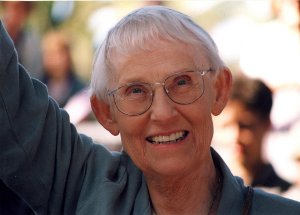
Charlotte Joko Beck died yesterday, very peacefully, at the age of 94. She was a Zen teacher who made a major impact on American Buddhism.

Here’s a quote from an article that puts her work into perspective (no longer available online):

The Ordinary Mind School was among the first Zen communities to consciously engage the emotional life and the shadows of the human mind as Zen practice. The late Charlotte Joko Beck and her dharma heirs  adapted elements of the vipassana tradition — a relentless inquiry into the contours of the human mind—as unambiguous Zen discipline.

Here are some quotes from her:

With unfailing kindness, your life always presents what you need to learn. Whether you stay home or work in an office or whatever, the next teacher is going to pop right up.

Caught in the self-centered dream, only suffering;
holding to self-centered thoughts, exactly the dream;
each moment, life as it is, the only teacher;
being just this moment, compassion’s way.

Enlightenment is not something you achieve. It is the absence of something. All your life you have been going forward after something, pursuing some goal. Enlightenment is dropping all that.

One idea that really hampers us is to believe that people get ‘enlightened,’ and then they’re that way forever and ever. We may have our moments, and if we get sick and have lots of things happening, we may fall back. But a person who practices consistently over years and years is more that way, more of the time, all the time. And that’s enough. There is no such thing as getting it.

Wisdom is to see that there is nothing to search for. If you live with a difficult person, that’s nirvana. Perfect. If you’re miserable, that’s it. And I’m not saying to be passive, not to take action; then you would be trying to hold nirvana as a fixed state. It’s never fixed, but always changing. There is no implication of ‘doing nothing.’ But deeds done that are born of this understanding are free of anger and judgment. No expectation, just pure and compassionate action.

Practice is just hearing, just seeing, just feeling. This is what Christians call the face of God: simply taking in this world as it manifests. We feel our body; we hear the cars and birds. That’s all there is.

Life always gives us exactly the teacher we need at every moment. This includes every mosquito, every misfortune, every red light, every traffic jam, every obnoxious supervisor (or employee), every illness, every loss, every moment of joy or depression, every addiction, every piece of garbage, every breath. Every moment is the guru.

So a relationship is a great gift, not because it makes us happy – it often doesn’t – but because any intimate relationship, if we view it as practice, is the clearest mirror we can find.

Practice can be stated very simply. It is moving from a life of hurting myself and others to a life of not hurting myself and others. That seems so simple — except when we substitute for real practice some idea that we should be different or better than we are, or that our lives should be different from the way they are. When we substitute our ideas about what should be (such notions as “I should not be angry or confused or unwilling”) for our life as it truly is, then we’re off base and our practice is barren.

We have to face the pain we have been running from. In fact, we need to learn to rest in it and let its searing power transform us.

We learn in our guts, not just in our brain, that a life of joy is not in seeking happiness, but in experiencing and simply being the circumstances of our life as they are; not in fulfilling personal wants, but in fulfilling the needs of life.

Meditation is not about some state, it is about the meditator.

Zen practice isn’t about a special place or a special peace, or something other than being with our life just as it is. It’s one of the hardest things for people to get: that my very difficulties in this very moment are the perfection… When we are attached to the way we think we should be or the way we think anyone else should be, we can have very little appreciation of life as it is…whether or not we commit physical suicide, if our attachment to our dream remains unquestioned and untouched, we are killing ourselves, because our true life goes by almost unnoticed.

I’m going to massage school at Lauterstein-Conway!

I was taken with this quote in a book I’m reading.

The leading contemporary philosopher of the body, Don Hanlon Johnson, also underscores how the invention of different body therapies arises from the originator’s own spontaneous movements, which too easily become rigidified when they become formalized and taught to others in an authoritative manner. The most promising future for body therapy will be in the direction of returning us to an experience of basic, natural movements that take place effortlessly and spontaneously.

This quote is taken from the book Shaking Medicine: The Healing Power of Ecstatic Movement, by Bradford Keeney. I’m nearing the end of reading it. (Okay, I’m slow sometimes and usually have four or five books going at once.)

Keeney reports on his first-hand experience with Kalahari Bushman ecstatic shaking practices, shaking medicine on the Caribbean island of St. Vincent, the ecstatic “holy rolling” of the African-American church, the Japanese shaking medicine called seiki (not to be confused with reiki), kundalini, and his own Life Force Theater.

More to come on that…

The quote above fits with the practices of some of the bodyworkers I’m working with, who, although they trained in a rigidified method, have evolved their work in the direction of moving and healing naturally, using their intuition, familiarity with the body, and healing skill to facilitate rapid change and healing.

I’m feeling more solid, aligned, and at ease than ever — and that’s something for someone who’s had nerve damage, PTSD, scoliosis, and serious injuries. (Some of this great feeling of health and wellness may be due to the brainwave optimization process I undertook last week as well. There’s no separation between mind and body.)

Bodywork is a very inspiring area of learning and practice that I want to pursue. I’ll be starting my training later this month in The Lauterstein-Conway School of Massage in Austin, Texas.

There are three more spots to be filled in this class — click the link to learn more.

Buddhist tattoos

Expanding on my previous posts about yoga tattoos, I’m sharing a link to a blog post, Getting a Buddhist Tattoo, on The Buddhist Blog (new to me).

The image below is from that blog post. I find this tattoo to be incredibly beautiful.

The post and the comments are well worth reading if you have an interest in tattoos and Buddhism.

7 things to remember when teaching yoga to kids

Last fall I had an opportunity to teach yoga once a week to 20+ fifth graders for a few months. We didn’t have mats or much space to work in, so after they removed their shoes and gathered on the carpet, I focused on mostly seated and standing poses for 15 minutes.

Very few of them had much experience with yoga. I wanted the students to love yoga as much as I do, and to create a program that might result in them later continuing to practice yoga.

Here are my take-aways from the experience:

1. Keep it simple. Om means “everything that is”. Namaste means “I honor you.” Don’t overwhelm them with Sanskrit and anatomy.

2. Teach them belly breathing. It will serve their lives well to learn it now. Ask about it now and then. After a couple of months, it may become a habit.

3. Leave them wanting more. Keep sessions short and make it fun. Let them experience the joys of yoga. So their downward-facing dog isn’t perfect. They’re 10! Let it be, and let them howl or bark like dogs! There’s plenty of time later for them to perfect their poses if they choose.

4. Pay attention and ask for feedback. Can everyone see? Did everyone hear that? Where do you feel that pose the most? What is hard about that pose? Yoga is about awareness. Foster it.

5. Be inclusive. As with adults, some kids take to yoga more than others. Praise all effort lavishly, and tell them it’s not a contest — yoga is good for every body. After a couple of months, ask them to remember what it was like the first time they did tree or eagle pose. They’ll get it.

6. Ask for volunteers to demonstrate poses after you’ve taught them a few times, and over time, give everyone a chance to demo a pose. They will learn the poses better, knowing they may be in front of the class, and be eager to get in front of their peers!

7. Let them experience sitting in silence for a minute at the end of the class. That may be a revelation — it was for the kids I taught, who begged to sit longer. (We worked up from one minute to five.) They may not get any silent stillness in their lives other than this — and they may really begin to value it at a young age.

My experience with brainwave optimization

Last week I did brainwave optimization, aka brain training, at NeuroBeginnings.  I did the baseline assessment in May and wrote about it here. It’s an astounding new technology with huge potential to alleviate suffering and help people’s brains function optimally without spending a minor (or major) fortune on health care.

Gigi Turner, owner of NeuroBeginnings, likes to schedule the training to start within two weeks of the initial assessment, but we had to work around finishing my 3M contract, which was hard to pin down. You need a full week as free of demands as possible so you can integrate the brain training. It’s a wonderful activity for a vacation (or stay-cation if you live in Austin). 

By the way, Gigi is hard-working, personable, and adorable. She’s easy to relate to, and you know she’s working for your best interests. She’s a woman after my own heart, fascinated with the brain and its workings, making the world a better place one brain at a time.

I did two sessions per day, Monday through Friday, one at 9 am and another at 12:30 pm, each lasting about an hour and forty-five minutes.

Between the morning and afternoon sessions, I hung out at the Zilker Botanical Gardens or walked along Barton Creek. It felt great to move after being still, and being outdoors in scenic nature was refreshing. I’d get lunch at the Daily Juice or Whole Foods, something light and very healthy.

During each session, I sat in a special recliner and either watched a computer monitor or just relaxed doing nothing. Gigi attached electrodes to my head and moved them to various places — frontal, temporal, parietal, and occipital lobes.

There were several exercises I did in every session: sitting and watching a bar move to a lower position,  reclining with the lights off and relaxing deeply, imagining/remembering an activity that uses all the senses, and visualizing a guided meditation.

During all the exercises, I heard musical notes playing. Gigi said you actually want them to stay in the background and not think about it too much. They are random notes, not playing a tune, not rhythmic, not even music — just random notes. There are a variety of musical sounds. You might hear the random notes played on a guitar, xylophone, steel drum, bells, or piano.

I am a thinker. I have a very active mind, and I’m gaining facility in switching from that active, inquiring, analytical state to more relaxed states.

I noticed that I liked it when a lot of notes played fairly densely, and I didn’t like it when one note played over and over, or when there was a long silence. I wanted the “music” to be pleasing to my ears.

A couple of times I would recognize a fragment of a song in a string of 3 or 4 notes and smile to myself. I noticed that if I was getting one note repeatedly, I could move my eyes, and the sound would shift. That’s an NLP trick!

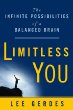
The sounds reflect current brainwave activity, allowing the brain to “see” itself, as Lee Gerdes says in his book, Limitless You. You do occasionally view your brain activity on the monitor, but mostly the brain is hearing itself, and the more in harmony and cohesive the brain gets, the more the sounds reflect that.

You don’t have to do anything. The brain adjusts itself. At least, that’s how I think it works.

Watching the bar was hardest for me. I tried too hard, and it strained my eyes (I wear contacts and need to blink often — did you know your brainwaves change when you close your eyes, even to blink?). I stopped drinking green tea in the morning and brought eyedrops, attempting to make this exercise easier to accomplish.

I finally started getting the hang of it on Friday when I imagined that the sound of the air conditioning was a waterfall that was very nearby. When my attention was split between listening to the “waterfall” and gazing beneath the bar (rather than staring intently at it), I made progress.

I believe that exercise was about my “thinking” mind — aka bringing down my beta waves.

I went into brain training wanting to get rid of any remaining dysfunctional patterns from my childhood trauma and years of PTSD. Most of the changes took place in the frontal and occipital lobes — the center for executive functioning and the visual cortex, respectively. After my last session, Gigi gave me printouts showing how my brainwaves in those lobes had changed over the week of training. She got my left and right hemispheres more in sync in those lobes.

I loved the relaxation exercises. It turns out I’m very good at going into alpha! As I got used to the process, I got pretty good at dropping into theta and good at noticing the difference between alpha and theta. (Theta is where deep healing occurs.) I dropped into delta (sleep) a few times, especially after lunch, at first, but as the week progressed, I was able to stay awake in theta for longer periods.

I really loved the task of imagining I was entering a house, walking upstairs, and entering three rooms. Each day I created different rooms. Here are some juicy ones:

  • A room full of guides — lamas, teachers, angels, masters, buddhas and boddhisattvas, yogis, healers, shamans, seers — who included me and gave me gifts, laying their hands on me.
  • A room of possibilities that I’d like to manifest — travel, prosperity, success, joy, gifts and talents and skills, love, creativity, equanimity, health, goodness.
  • A room containing my fears and obstacles, with wonderful resources to address each one.
  • A room of gratitude for past, present, and future.
  • A room where I gave my gifts and resources to those who needed them.
  • A room of beginner’s mind.
  • A room for my future sage elder self.
  • A room of intuition.

Also, the Jean Houston guided meditation of cleansing the senses works well here. Having NLP training was useful!

During the five days of training, I didn’t experience any sudden or drastic changes in brain functioning, but each day I felt a little bit sharper, more present, more centered.

I learned that my brain operations were actually in pretty good shape to start with, and with a few tweaks it will operate even better. The changes will continue to manifest over a period of months after the training.

To get the most from it, the instructions are that for at least the next three weeks, I need to avoid alcohol and recreational drugs, exercise/walk daily, eat a lot of protein, and drink plenty of water.

It would be helpful to practice awareness through progressive relaxation, visualization while listening to a CD Gigi gave me (I liked the sound of a stream during some of the sessions, which has become an anchor), and doing breathwork.

I also need to postpone appointments for other therapeutic modalities until three weeks have passed, so I’ll need to make some phone calls on Monday.

If you’re interested, I recommend calling NeuroBeginnings for a baseline assessment. Her number is 512-699-6593. The baseline assessment currently costs $160. The entire cost, at present, is $1,635, if I remember correctly. Compared to doctor visits and medication, brain training could actually save you time, money, and side effects. 

I’m going to wait at least three months before going back for a tune-up unless something drastic happens, and then I hope to try one of their new gamma wave protocols.

I look forward to noticing improvements in my brain’s functioning and sharing them with you!

More yoga tattoos!

Alison Hinks, graphic artist and yoga blogger, has a new one up, Some Fun Yoga Tattoos.

Here’s a sample:


Healthy lifestyle turns off disease-causing genes

An important new study from Dr. Dean Ornish shows that changes for the better in diet and exercise, plus adding daily meditation, can create rapid and dramatic changes in genetics.

After three months, 30 men who had avoided conventional treatment for prostate cancer had 48 genes that were turned on — and ten times as many (453) that were turned off. Disease-preventing genes increased activity, while disease-causing genes shut down.

Read it for yourself. Healthy lifestyle triggers genetic changes: study.

It makes sense. We’ve all heard of people who recover their health seemingly miraculously. It may have a lot to do with their belief (or suspension of disbelief) that it is possible to influence their health through changing their basic daily habits — simple changes in food and activity choices.

Thanks to Tim Ferriss for posting a link to this article on Facebook.

And…here’s a link to an abstract that found that just the basic “relaxation response” is enough to trigger positive changes in genes, in both short-term and long-term practitioners.

These studies of course will beget more studies, but no longer can you resign yourself to believing your fate is all in your genes. What you do can activate and de-activate the genes you were born with. DNA doesn’t change, but gene expression does.

Bodywork and TRE update

Yesterday I learned something: there is such a thing as too much bodywork.

I had an early appointment with Chandler Collins, DC, who did applied kinesiology on me. I’d been having some nerve pain down my outer left leg. He made it feel better. That was about 20 minutes.

At 11, I had two hours with Bo Boatwright. We talked and then did some tablework. We did the stretching myofascial release on my hips, and then he spent a good amount of time doing reiki on my left sacroiliac joint. Just quietly holding. I had some shaking in my left arm. Then a lot of neck work.

That is, if I’m remembering right. You’ve heard of “sex haze”? There seems to be such a thing as a bodywork haze, because when I showed up for my appointment with Fran Bell at 1:30, she took a good look at me and could tell I couldn’t integrate much more.

She taught me an exercise using a stability ball, worked on me, woke me up to being more present. We talked, then she got out her pendulum and had me lie on the table. She checked — my chakras were still, not spinning. (Heck, I can’t tell. All I know is how open they are.)

So she did more work with me on the table, and left me there to integrate it. I dipped down into delta waves for I don’t know how long. My chakras were spinning after that, energy reaching at least a couple of feet out.

Advised me to look at tree trunks and go home and take a nap.

It has hardly ever happened that my appointments line up on a single day like that. A few times I’ve seen two healers, but never three.

You really do need time after bodywork to integrate it and get the most out of it. Take a nap or do simple things — gazing at a landscape, walking at a leisurely pace, making a salad, playing with a child, listening to music — not reading, working on a computer, or watching anything intense on TV or movies. 

~~

This morning I did the trauma releasing exercises, which I haven’t done for a few weeks.

Wow. I had an entirely new pattern come up. After shaking of legs, pelvis, arms, shoulders, and neck while lying with knees bent, soles on floor, I straightened my legs. Usually that puts an end to the shaking.

Not today.

My legs wanted to shake while lying straightened on the floor. They even came off the floor for a bit. Then they shook with my heels as pivots. My feet and legs rocked right and left in unison, like windshield wipers. They moved pointing out-in-out-in in unison. They moved forward and back in unison. Sometimes just my knees lifted and lowered repeatedly.

Some of these are Trager-like movements. (I’m barely familiar with Trager but remember that. My astrologer mentioned recently that she was certified in Trager and referred me to someone if I’m ready to experience it.)

When my body stops shaking, I lie still, not knowing if I’m done. Usually, more shaking arises.

I like to give my body the space and invitation to release what needs releasing. When nothing is forthcoming, just being still seems to give the deeper tensions time and permission to release. 

It wasn’t intense shaking when my legs were straight. The most intensity came from my arms and my legs with feet flat on floor. The rest of it was mild to moderate.

~~

I am hoping to start Level I training in TRE later this summer. After completing it, I’ll be able to do sessions with individuals.

Tattoo art on yogis

Loved this NY Times photo piece on tattoos on yogis.

I have a little tattoo on my belly: OM. How about you? Do you have a yoga tattoo?


Allowing the inner Buddha to walk, working with Fran Bell, emergent knowledge

I’m sharing a beautiful article from Tricycle magazine, Walk Like a Buddha, written by Buddhist monk, teacher, and activist Thich Nhat Hanh about walking meditation.

For many of us, the idea of practice without effort, of the relaxed pleasure of mindfulness, seems very difficult. That is because we don’t walk with our feet. Of course, physically our feet are doing the walking, but because our minds are elsewhere, we are not walking with our full body and our full consciousness. We see our minds and our bodies as two separate things. While our bodies are walking one way, our consciousness is tugging us in a different direction.

For the Buddha, mind and the body are two aspects of the same thing. Walking is as simple as putting one foot in front of the other. But we often find it difficult or tedious. We drive a few blocks rather than walk in order to “save time.” When we understand the interconnectedness of our bodies and our minds, the simple act of walking like the Buddha can feel supremely easy and pleasurable.

What this brings up for me is noticing where my attention is. When do I pay attention to my body? My answer has been: not often enough. It’s there all the time, so easy to take for granted. The external world seems so much more engaging because it’s constantly changing.

I walked habitually, without paying much attention (or rather with more attention on my destination than the journey), and as a result, I acquired some mindless movement patterns that actually created stress and tension in my body.

Fran Bell is helping me with that. She shows me there’s an alternative, and it feels so relaxed and healthy! I feel totally in my body. I enjoy it.

But I only see her for an hour a week, and although I retain some of what she shows me, I also become mindless again, some of the time.

The real learning is up to me. Influenced also by the book Effortless Wellbeing, I’ve been paying attention to my body when I lie down, when I sit (at my computer and in the car), when I stand, and when I walk.

Where do I feel tightest, most constrained? Can I just let go of that? Well, yeah!

Here are some of my new awarenesses:

  • Walking as a unit rather than as an assemblage of parts.
  • Feeling the left-right symmetry of my moving body.
  • Feeling the rhythm of walking.
  • Balancing my head easily atop my neck with minimal strain.
  • Balancing my rib cage easily above my hips with minimal strain.
  • Ankles, knees, and hips.
  • Feeling the natural springiness in my walk.
  • Feeling the side-to-side sway of my body.
  • Feeling the relationship between my hip and the opposite shoulder.
  • Letting my arms swing from my dropped shoulders.
  • Keeping my sternum in an easy natural place.
  • Keeping my eyes in a soft gaze.
  • Finding the most ease.

Walking meditation is really to enjoy the walking—walking not in order to arrive, just for walking, to be in the present moment, and to enjoy each step. 

I notice that walking with mindfulness adds presence and pleasure to my life.

He goes on to include some instruction about adding breath awareness to walking medication. Here’s an excerpt I liked:

After you have been practicing for a few days, try adding one more step to your exhalation. For example, if your normal breathing is 2-2, without walking any faster, lengthen your exhalation and practice 2-3 for four or five times. Then go back to 2-2. In normal breathing, we never expel all the air from our lungs. There is always some left. By adding another step to your exhalation, you will push out more of this stale air. Don’t overdo it. Four or five times are enough. More can make you tired. After breathing this way four or five times, let your breath return to normal. Then, five or ten minutes later, you can repeat the process. Remember to add a step to the exhalation, not the inhalation.