Altucher on oxytocin and polyvagal theory, with humor

10 Unusual Ways to Release Oxytocin Into Your Life Altucher Confidential.

I love this guy. He’s so real. I can only wish I was as good a writer as James Altucher.

He tells about being caught shoplifting as a kid, his disgust for going to the bathroom, cortisol, stress, the vagus nerve, a photo of a woman’s tattoo of “Fight or Flight”, and oxytocin.

There’s another photo of a foot with the chemical formula for oxytocin tattooed on it.

Then he lists 10 ways to increase your oxytocin levels.

One of the ways happens to be shooting guns. I don’t think that one would work for me. Loud sudden noises like gunshots make me really jumpy. That’s cortisol, not oxytocin. Maybe that’s a guy thing?

I would replace that one with getting a massage. I notice that with almost everyone, receiving massage decreases their cortisol. I can tell from feeling their energy before and after, gauged by how they move and their voices.

For others, especially those who are accustomed to regular massage, an hour or so of good bodywork vastly increases their oxytocin. They are all soft and mellow and receptive and happy afterwards.

I would also add rocking a sleeping baby, but you might have had to nurse your own baby first to get that feeling.

The rest of Altucher’s recommendations for increasing oxytocin work. Even using Facebook! And I especially like his strategy for dating.

I will tell you my pre-date secret. In the brief period when I was single in between separation and re-marriage I had a technique before every date. I would watch either Michael Cera doing comedy or Louis CK doing standup. This would get me laughing, make my oxytocin hormones go on fire, and then I’d go right into the date, with all my sex hormones raging. Plus. I would be temporarily funnier, with a half-life of about two hours. I knew after four hours I would be boring again so the date would have to be over by then. I do this before talks also.

Recovering from adrenal depletion

I’m in bed, mid-afternoon on a Wednesday, listening to the sound of rain on my metal trailer and the rumble of thunder in the background.

When you live in central Texas, and you get several days of thunderstorms and drenching rains in the middle of July, you count your blessings. Last summer was the worst drought on record. There were cracks in the ground an inch across and as deep as two feet where I live. Those cracks began to reappear after a luscious wet spring turned until a dry summer.

Until this week. The rain sounds and feels like a blessing. Even the hot humidity, in between rains, is welcome. It’s been so long since we’ve had it.

I went out earlier today to meet with a recruiter about a job. Yes, I’m looking for a technical writing/editing contract job. I’ve been heavily recruited for multiple jobs in the past week. I have some financial goals that I’d like to achieve before I’ll be ready to settle into a full-time bodywork and changework practice. Need a newer car, insulation and a deck for my trailer, a much desired trip to Peru in February, and some advanced NLP training next summer. I cannot do all that on massage wages.

I feel a bit incongruent about it. I’d love to just do bodywork and change work full time now (plus more writing), but I’m too broke. So, sigh, hi ho. Even though corporate work takes a toll on my health, I was able to earn and save a nice chunk of change that I’ve been living on since that last job ended nearly two months ago.

I’m still recovering from adrenal depletion (according to my acupuncturist, who told me to take OTC rhodiola and eleuthero) from shocks and stress earlier this year, and I am really feeling it today. Naps are good! Avoiding stress is good. So is really cherishing myself and only hanging out with people who are nurturing and fun to be around and trustworthy.

Laughter is good.

In order to work in the corporate world and stay as healthy as I can, I need to:

  • get a massage twice a week
  • get acupuncture twice a month
  • do yoga daily
  • eat impeccably healthily
  • work from home as much as possible
  • work standing up as much as possible
  • take frequent breaks to move my body
  • dance and shake it out every day
  • meditate

I’m feeling grateful for this downtime in between jobs to start my private massage practice, to experience doors opening (chair massage, anyone? stretching, trigger points? marketing?).

Meanwhile, I’m learning about the mechanics of trauma/chronic stress recovery first hand, and that will be quite useful in my own life and in my healing practice.

Wish me well!

Four steps for discovering your Enneagram type

The Enneagram is a system that classifies people by type, like personality typing. It’s kin to the Myers-Briggs Type Indicator. But it’s about more than personality—it’s based on fixation.

According to Enneagram theory, we are either born with or acquire in the earliest years of life a fixation that deeply influences our identity: who we believe we are and how we view life. The fixation is what keeps you from experiencing your essential (healthy) self. It’s how you get in your own way. It’s a filter that in some ways has worked for you, but it can eventually limit you into a habitual way of living that feels too small. You may suspect there’s more to you than that. You can transcend your fixation to find more essence, more freedom, more joy.

Maybe this is what enlightenment is.

There are nine Enneagram types. Each type has two wings and three subtypes. Furthermore, each type moves toward two different types when you are stressed and when you feel secure. Plus, your development level changes with age, experience, and your desire and ability to grow. So it’s a fairly dynamic model, even though (according to theory) people remain their type their entire lives.

To illustrate, my type is Five. Other names: The Investigator and The Observer. We Fives are classic nerds: bookish, shy, avoiding conflict, private, attracted to minimalism, curious, alert, intense, innovative, insightful, cerebral, having a rich inner life, seeking mastery.

I also have a Four wing. Nickname: The Iconoclast. I am interested in people and healing. The Four wing adds sensitivity.

Would you believe that part of the path to my essential self is exercise? Living in my body connects me to a vitality and presence that I could never experience just living in my head. It took the painful aftermath of a car wreck in my 40s—and the subsequent healing journey—to really understand this.

Daily yoga, the outdoor activities I love like snorkeling and kayaking, dance, meditation, giving and receiving massage, hugs, touch, and sex all help me more fully occupy my body, and be more present in my full vitality, my essential energy that radiates joy, love, peace, and happiness.

So if you knew me as a child, you’d have known a shy, bookish, smart, aloof nerd. If you know me now, you’d see some of those qualities at times, but you’d also see someone who has a lot of vitality, who lives with an open heart (and who still really likes to think).

For me, the journey from being immersed in my type to living more from my essence has been like moving from a black-and-white world into a world full of amazing colors of infinite variety. I can’t say it’s all due to knowing about the Enneagram, but it has helped and provided much insight.

If you are interested in using the Enneagram as a tool for personal growth, and you don’t know your type, here’s how to find out. It’s not always easy (but sometimes it’s very obvious). You can definitely narrow it down to a couple of types, and then you’ll get an aha! (And you may change your mind later on.) Plus, you will easily recognize some people you’ve known.

It’s important to first note that we often do not see ourselves as others see us. Therefore, learning your Enneagram type might make you feel uncomfortable. Prepare yourself. The truth often hurts before it sets us free.

  1. The Enneagram Institute offers free and low-cost online tests. The free, brief QUEST takes 5 minutes.
  2. Watch a brief video of each of the nine types and self-identify your type.
  3. Watch the videos with people you trust with the intent to identify each person’s type with compassion. Others who know us can be honest yet tactful and supportive (as you can be with them—agree on this beforehand and don’t invite anyone who is insensitive).
  4. If you’re still confused about your type, read how types are often misidentified.

To learn more about how it works, read books. I suggest The Wisdom of the Enneagram and The Enneagram for beginners. For more advanced students, I recommend The Spiritual Dimension of the Enneagram.

Once you are more or less settled on which type most accurately describes you, you can subscribe to a daily “EnneaThought” email for your type that can support your developmental growth.

Here’s my EnneaThought for today:

EnneaThought example

New toy: Yoga Teacher Barbie

She Exists: ‘I can be…’ A Yoga Teacher Barbie Doll.

Still with the feet. Bet she can’t do tree pose, and her triangle probably looks really weird.

Plus a chihuahua. Huh?

Get yours today, at Target.

Courtesy of Yogadork.

Share your story of healing or transformation through yoga

I received this as a comment on a recent post, but since comments are not that visible on this blog, I thought I’d give it its own post:

Hi there,

Do you have a story of healing or transformation with yoga that you’d like to share with the world? The Yoga Diaries is now accepting submissions. http://theyogadiaries.net/ Please spread the word!

Cheers, The Yoga Diaries

I may be doing the same with trauma recovery stories soon. Bloggers and blog readers, help each other out! I’m looking forward to reading stories about yogic transformation!

The simplest way to improve your posture

If you’re at all familiar with this blog, I bet you think I’m going to say meditation. Guess what? Ha ha, I’m not!

It’s way simpler than that:

Whenever you’re doing something that does not require use of your hands, turn them so that they’re palm-side up (see the picture above). You also can do it while standing or walking, leaving your arms down at your sides and turning your palms so that they face outward in the direction you’re facing.

This palms-up position may be familiar to committed meditators and yogis who practice shavasana, but it’s foreign to those of us who spend a lot of time at a computer, behind the wheel of a car, holding babies, making lattes, or doing pretty much anything else that requires constant hand use. Even when we’re not using our hands, it’s just habit to sit, walk or stand with our hands facing down or behind us.

Wait for it — there’s a meridian connection: 

In acupuncture, the meridians that run along the inside of the arm, from the chest/underarm to the palm, are Heart, Pericardium and Lung….

Here is just a smattering of the functions each meridian is involved in (there are many more):

  • Heart: breathing, cardiac function, sleep, emotional balance and heat regulation.
  • Pericardium: breathing, blood circulation and upper digestive function.
  • Lung: breathing, immune function, perspiration, body temperature and urination.

…our lifestyles force our hands and arms into an almost constant downward/backward position, creating a tendency to slouch forward. This causes us to cave our upper bodies inward, crunching the Heart, Pericardium and Lung meridians.

Allowing these meridians to flow more freely optimizes their ability to perform their respective functions.

These three meridians are all yin meridians, flowing from the torso to the fingertips.

This is a mudra (energetic gesture in Hinduism and Buddhism). The palms-up mudra, you might have guessed, has to do with receiving energy from spirit or the universe, with allowing. It has to do with being open and surrendering yourself to the Mystery.

Try it when you think about it. Let one or both palms rest facing up, or outward if you’re on your feet. Notice the subtle but significant changes in posture.

Then make it a habit.

Thanks to Sara Calabro for this article.

Downward-facing dog and the bladder meridian: why it feels (and does) good

The Real Reason Downward-Facing Dog Is So Good for You. | elephant journal.

The connection between yoga and Traditional Chinese Medicine (TCM) fascinates me. When we do yoga poses, we activate various meridians in the TCM system, usually without awareness that we are doing so.

Here’s why doing downward-facing dog pose (adho mukha svanasana) feels so good (once your shoulders open up and the muscles in the back of your legs lengthen) and why it’s so good for your health.

Downward-facing dog  is arguably the most common pose in yoga. It’s done in Iyengar, anusara, vinyasa, ashtanga, bikram, and other styles of hatha yoga. It’s a cornerstone of sun salutations. It’s considered a resting pose in post-beginner yoga classes.

It’s so well-known, even many non-yogis recognize it: palms and soles flat on the floor several feet apart, buttocks high, back and legs straight.

Downward-Facing Dog

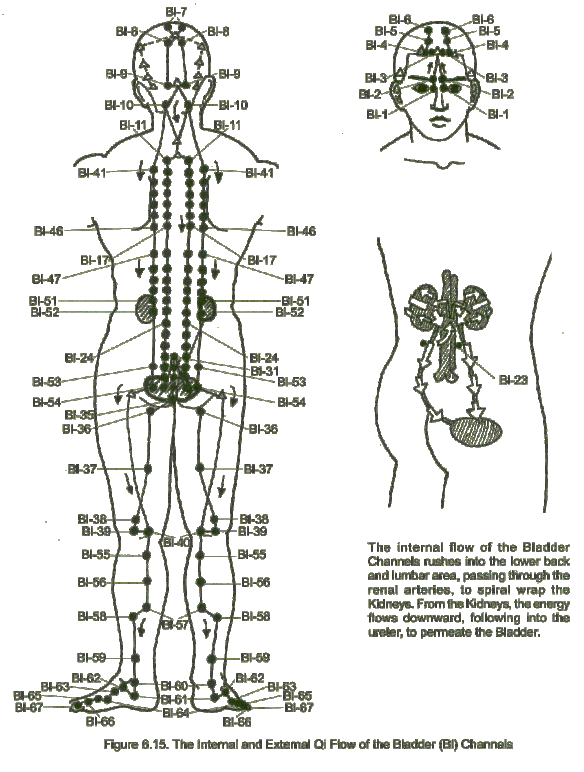
Downdog does our bodies so much good because it activates the bladder meridian, the longest channel in the body, running from the inner eye, up over the top of the head, down the back and the backs of the legs, ending at the pinkie toe. It even doubles up on part of its path:

To do downdog is to activate the bladder meridian’s 67 points, more than any other meridian (times two, because there are left and right meridians).

The bladder meridian is yang, meaning it deals with the outer world. The bladder channel is our first line of defense, so activating it boosts immunity. Not only is this meridian related to the urinary bladder, it also relates strongly to (and balances) the sympathetic (fight-or-flight) and parasympathetic (rest-and-restore) nervous systems.

If you are stressed (and most of us are most of the time), stimulating the bladder meridian activates the parasympathetic nervous system, inducing relaxation. It’s why people get so much out of having their backs massaged. Notice all those BL points in the sacrum area? The parasympathetic nervous system is activated by S2, S3, and S4 spinal nerves at the sacrum, and by several cranial nerves as well.

So doing downward-facing dog helps you relax and release tension.

There are also “Back Shu Points” located along the bladder channel. They are associated with organs and with chronic issues like insomnia, asthma, menstrual problems, IBS, anxiety, and so on. Doing downward-facing dog could prevent or alleviate chronic disease.

Downward-facing dog is also an easy inversion for the upper body, refreshing blood to the head and moving lymph.

Plus, you know, it just feels good to stretch like that! Do down dog to stretch the glutes, hamstrings, calf muscles, and Achilles tendons. Even the soles of the feet!

Let it open up your shoulders. Really feel your hands and feet connecting to the ground. Relax your neck and let your head drop toward the ground. Feel your strength. Straighten your legs and work toward lowering your heels to the floor. Do variations (on tiptoes, pedaling your feet, 3-legged dog, wild thing).

Then come down onto your knees, push your butt back toward your heels, and sink into child’s pose to enjoy that relaxation.

Downward-facing dog is a cornerstone of my yoga practice. If I could only do one pose, that would be it! Jai, adho mukha svanasana.

Tao Porchon-Lynch: teaching yoga, ballroom dancing videos

I found more videos of Tao Porchon-Lynch, the world’s oldest living yoga teacher. I just can’t get enough of her! She’s my inspiration, my role model for wellness, because what she can do now is based on what she did when she was much younger: a lifetime of good habits.

She looks, sounds, and feels so healthy! She seems to be wonderfully sweet and so full of vitality! Seeing her living so well is very motivating.

In the first video, she talks about yoga, and you see her teaching a class:

In the second video, she displays amazing ballroom dancing skills. That was filmed in 2009, when she was “only” 91. Her partner looks to be about one-third her age, yet they are well matched on the dance floor.

If you didn’t know, would you ever have guessed she was even over 70?

She has her own website here: http://taoporchon-lynch.com/.

Also, if you missed them, see my earlier posts, The world’s oldest living yoga teacher and More from the world’s oldest living yoga teacher: she tangos!

More from the world’s oldest living yoga teacher: she tangos!

I found this 2006 YouTube video of Tao Porchon-Lynch, whom I posted about recently in The world’s oldest living yoga teacher.

This video was made in 2006, when Tao was “only” 86.

Isn’t she adorable? I aspire to be like her when I’m 86.

Oh, and she also likes to waltz, jitterbug, samba, cha-cha, foxtrot, and tango.

“It lightens up your spirit,” she says.

The world’s oldest living yoga teacher

A Meeting In Central Park With The Oldest Living Yoga Teacher In The World. ~ Photographed by Robert Sturman | elephant journal.

Well, I’m not sure about that — BKS Iyengar is at least a comparable age — but these photos are gorgeous, and it is inspiring to see how yoga can keep a person fit and flexible into their nineties.

And would you look at that smile? Such grace and radiance!

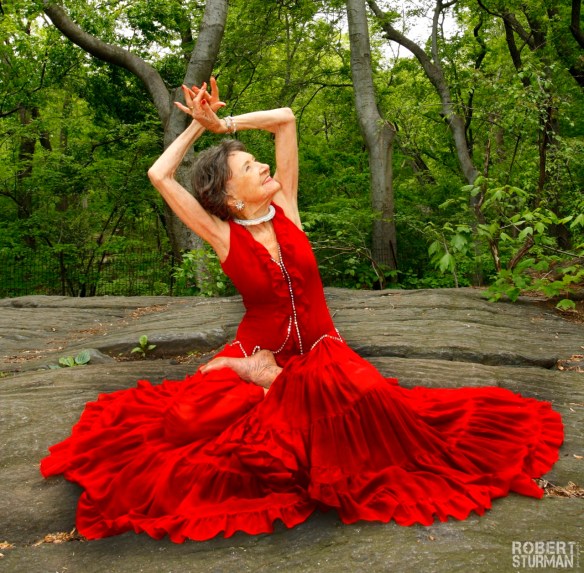
Here’s my favorite photo: