A doctor who uses yoga in his practice

Saw this article in today’s New York Times and thought I’d share.

When patients with rotator cuff injuries do a pose derived from yoga, the results were as good or better than surgery or physical therapy. The yoga pose is headstand with the forearms making a triangle with the head, but you can do it against a wall — inversion is not required. It works by letting a new muscle do the work of the injured muscle.

Another study found that for patients with osteoporosis or its precursor osteopenia, ten minutes of yoga every day for two years built bone density in the hip and spine, while the controls lost bone density.

Yoga is weight-bearing exercise using the body’s own weight, especially in partial and full inversions. In addition, stretching pulls on the bone where muscles attach, and this can build bone density.

Another article is about piriformis syndrome, when the sciatic nerve is pinched by tight butt muscles. It can be caused by prolonged sitting.

Pressure-point massage can help. Some home exercises can provide relief in the majority of sufferers.

Free day of yoga class at Thrive Fitness

I’m teaching Yoga for Stress Reduction for Free Day of Yoga on Labor Day, September 5.

The location is Thrive Fitness (formerly NiaSpace), 3212 South Congress, Austin 78704.

Time: 6 to 7:30 pm. Class size is limited to 15, and the doors close at 6 pm sharp (so we can get on with the relaxation!). Bring your mat and water bottle.

If you’ve never experienced restorative yoga and think you might like to try it or if you have experienced it and want to make it a regular part of your life, please join us if you can for a deeply relaxing experience!

Although details are still being worked out, it looks like I will be teaching this class regularly on early Friday weekends, sort of a yoga happy hour/release-the-work-week/relax-for-the-weekend/gather-for-healthy-dinner afterwards type of class.

I’m very pleased and excited about that!!! Thank you, Universe, for coming through, because I’d been hoping for a Friday evening restorative class! Thanks, Donna, Becky, and Todd, for making me feel welcome.

The Five Tibetans plus one

My training to become a massage therapist includes training my own body. We practice and are graded on our own biomechanics when delivering massage. After just a few weeks (and considering there are students who are right out of high school and from very conventional backgrounds), the teachers are beginning to convey that massage therapists transmit their own health and well-being through their hands — the energetic connection.

Just this past week, my class’ primary practical massage teacher, Cindy Anderson, introduced us to the Five Tibetans.

I’ve encountered this series of exercises before, years ago. Cindy says we will be doing them regularly and that past students often thank her for teaching them — and tell of practicing them on mountaintops and other unusual places!

Curious Mind here googled “Five Tibetans” to learn more (especially to learn that they may not always be taught well on videos), and then headed over to Wikipedia to read about them.

Highlights: The Five Tibetan Rites are reputed to be at least 2,500 years old. The origins are unknown. They predate modern yoga (asana). Some of the exercises bear some similarity to certain asanas, so perhaps they influenced yogasana. Who knows?

They are done in order as a vinyasa (flowing sequence) and are said to stimulate the chakras. Many other claims have been made as well — they are a fountain of youth, reversing the aging process, and such. I think you can safely say they build strength, flexibility, and balance, and they will give you more energy.

You start by doing a small number of repetitions — 1, 3, or 7, depending on your comfort and ability level, but no more to start. You add repetitions slowly until you can do 21 of each. Add repetitions so slowly that you do not feel sore the next day. Never do more than 21. (Although apparently some yoga geeks do 108 of each! Make up a rule that works for you, is what I say.)

The Wikipedia description is good, including that you stand erect and take two deep breath cycles between each. Cindy has us exhale through rounded lips with eyes open wide.

There’s a whole blog about them: The Five Tibetans — Expert Advice, Support, and Information. It offers free downloads of the original English description of the exercises, posters of the exercises and warm-ups (should you need them), and a PDF showing 7 undulations to relieve office tension that will be helpful to readers with desk jobs who are concerned about their health.

The blog is connected to a website that offers DVDs showing you how to do the exercises and even Five Tibetans teacher training.

However, if you just want to see them, here’s a pretty good animated description.

If you do them for the first time from reading this blog, and if you don’t already have a regular yoga practice, please please please do each one very slowly and mindfully, tuning into what’s happening in your body, and never go beyond what’s comfortable for you. Be very gentle, especially with your neck and back.  Be mindful and err on the side of caution!

If you are not in shape, please download the warm-up exercises mentioned above and do them first.

Right now, I think of them as an alternative to a morning sun salutation — and that’s just where I’m coming from now. Both sun salutations and the Five Tibetans build strength and flexibility. They work the major muscles and joints of the body. They are fun to do, as well, at least for me. I’ll mix them in with my daily sun salutations, and perhaps later I’ll write a post about what I like about each practice.

The sixth Tibetan rite is a breathing practice. It is not usually taught in the US (our culture tends to frown on celibacy) but is recommended only for those living a monastic or committed celibate life. Wikipedia included a brief description and a link here. You do this exercise only to transfer the energy of the sexual urge up into the spiritual centers of the body.

Why massage, yoga, shaking medicine, and movement make you feel so good

One of the coolest things I’ve learned in my first two weeks of massage school, besides that I actually know something from my years of experiencing bodywork and that my hands love connecting with people, is about fascia.

If you don’t know, fascia is the name for a type of connective tissue, a thin membrane. It is labeled superficial when it is right under the skin and deep when it surrounds, binds, and separates muscle. It’s really all the same — these terms just differentiate the location.

The semi-transparent membrane on an uncooked chicken breast is fascia.

Here’s a new word: thixotropism, from the Greek for touch and turning. It refers to the fascia’s ability to change from one state to another. Fascia has two states: a thin fluid (sol) and a thicker gel. In its thin state, it is fluid, pliant, and elastic, offering a wider range of movement. In its gel state, it is tougher, more inflexible, and restricts movement.

When the body is out of alignment, such as when the head is jutting forward, the fascia supporting those straining neck muscles become more gel-like, stiffer, and supportive.

When you feel stiff, it’s because the fascia is in its gel state.

Through touch, exercise, and/or stretching, fascia “melts” from gel to sol and becomes looser, more flexible, and elastic. This allows the muscles to be manipulated in massage, increases joint range of motion, and frees the body from restrictions in movement.

When you move fluidly and freely in your body, your fascia are in the sol state. And of course, that feels fantastic.

This is at least one piece of the physiology of why it feels so good to get a massage, do yoga, warm up your muscles through work or exercise, and do the movements of TRE and shaking medicine.

They literally transform stiffness into fluidity.

Conversely, this is why it feels bad to sit for prolonged periods, and why we need to stretch after the stillness of sleeping.

If you want to feel free in your body, move, shake — and get massages.

Anusara yoga’s revelatory spiral; trailer arriving my first day of massage school

For the past week, I’ve been taking some yoga classes at Castle Hill Fitness, courtesy of a one-week pass I unexpectedly was given back in February. Most of my yoga training has been by Iyengar-certified teachers, and I like that emphasis on alignment because alignment just happens to be one of my major issues in this body, and I can use yoga as an awareness practice instead of just keeping fit.

At Castle Hill, I’ve been taking Anusara classes. If you don’t know, Anusara yoga is an offshoot of Iyengar yoga. Anusara yoga’s founder, John Friend, was a senior Iyengar teacher until he parted ways with B.K.S. Iyengar and created Anusara yoga.

Anusara is not that different from Iyengar yoga. In fact, it’s pretty similar but has Universal Principles of Alignment that everything is based on.

(If you’re interested in seeing a visual aid that groups the types of yoga, click here to see Alison Hinks’ awesome graphic, Kissing Cousins: The Wheel of Yoga. You’ll see that Iyengar and Anusara are right next to each other, way on the opposite site from Ashtanga and power yoga.)

These classes have challenged me in a really good way. My deep lower abs are still a bit sore from classes a week ago, and I’m feeling my shoulders and hips in a different way.

I’ve done Warrior 1 in nearly every class and gotten better at it. It takes a lot of strength and balance for me.

Most exciting, I finally got “the spiral”  that is a signature of Anusara yoga. Got it in my body, that is. Felt a shift. It was a revelation, widening the sacrum area, the back of the second chakra, creating a nice energetic opening.

Since this is a part of my body that has had troubles, it was awesome. How can I incorporate this into my life? 

I don’t know how to maintain it in various poses, so I’ll continue to take Anusara classes. My teacher today, Brigitte, steered me toward the Anusara Teacher Training manual, which I’ve ordered. I’m looking forward very much to reading about the principles of alignment and learning what I can learn from a book while my body learns experientially.

Also, Brigitte is beautiful, with the buffest body of any white-haired woman you’ll ever see. I’m so pleased to take yoga from a teacher with white hair who knows what she’s doing. She read a Mary Oliver poem at the beginning of class today with a message that served the class. I loved that.

Yogis can show the world what it looks like to age with grace.

~~

My trailer should be here Monday morning! I’ve been looking at cork and Marmoleum samples. Decided not to do radiant heated floors until I’ve lived in the trailer through a winter and seen how cold it really gets.  Contacted my handyman Ian and emailed him a list of things to do. Requested that the electricity be turned on — apparently can’t happen until Wednesday…

Still need to research air conditioners. Lot to learn there. Metal skins, condensation, ventilation, and so on…

It just so happens, with all the waiting for the title and then for flood waters to recede over the last few months, that my trailer is arriving on my very first day of massage school! I don’t even know what meaning to assign to that coincidence in the big scheme of things!  On a practical level, I can’t be in two places at once.

I don’t want to miss any of my massage education, but I think I need to be there when the trailer arrives. I’ll email the school and let them know and plan to get there as soon as I can.

Hello, major life changes. Good to see you! 

Tips to counteract a sedentary job

If you have a desk job that requires a lot of sitting and you’re concerned about the health risks now being associated with prolonged sitting, here are some things you can do that require no expense:

  • Use a timer to remind you to stand up and stretch and walk around every 30 or 60 minutes. Google “timer” to find a virtual timer you like. Aim for a few minutes of non-sitting movement every hour.
  • Find ways to walk more: Place your phone away from your desk, so you have to stand up and walk to it to make or answer calls. Use a small cup for your drinking water or beverage of choice (or fill your regular cup partway), and when it’s empty, get up to refill it. Don’t use the restroom that’s closest to your office — walk to a more distant one. Instead of emailing colleagues, walk to their offices to talk, when feasible.
  • Breathe fully and deeply, using your abdomen, moving your ribs front, sides, and back. Do 5 of these breaths, then return to normal breathing.
  • Take a yoga class on your lunch hour. Or do desk yoga (Google “rodney yee 4 minute”  to see videos of Rodney Yee doing seated sequences). You can evendo cat-cow ever so often while sitting: curl your spine forward and back a few times, exhaling when you curl forward, inhaling when you arch your back.
  • Close your door or put on your headphones, turn on your iPod or a music video, and dance!
  • Fidget and wiggle. Especially move your legs.

When you’re not at work, avoid sitting as much as you can:

  • If you drive to work and your car has no lumbar support, place two tennis balls inside a piece of pantyhose with a knot in the middle and at the ends. Put it behind your lumbar vertebrae and press into it as you drive. It will feel great — and you’ll know when you’ve had enough.
  • If you watch television in the evenings or on weekends, stand, use your treadmill, or bounce on an exercise ball while watching. If you sit, get up and move during commercials.
Sit on an exercise ball at work instead of a desk chair. It strengthens your core, improves balance, improves flexibility, burns more calories, and requires you to use your legs. You can get them for under $20. Get a 75 cm for the most height. 

All of these tips can make a difference, helping to lower blood sugar, triglycerides, cholesterol, and waist size; improve posture, breathing, and metabolism; and decrease back pain.

“If there’s a fountain of youth, it is probably physical activity,” says Yancey, noting that research has shown benefits to every organ system in the body.

Next: standing desks.

Ecstatic shaking dance

On Sunday morning, I was driving to Castle Hill and dancing in my car as I drove. On the way, I realized I didn’t want to do yoga — I wanted to dance. So I drove to the Austin Yoga School and danced with Ecstatic Dance of Austin.

It was a homecoming of sorts. I started doing ecstatic dance (Sweat Your Prayers, 5 rhythms, Gabrielle Roth) in 1995. That group evolved into Body Choir, whom I danced with, while continuing with 5 rhythms when available.

A few years ago (four? five?), I started feeling conflicted about going to dance, any kind of so-called ecstatic dance. When I went, my body didn’t want to dance, it wanted yoga! I felt some attachment to people in the community of dancers and kept going for a while, but my attendance tapered off. I felt less and less joy at dance and finally I stopped going. It felt unsafe, it was too crowded, and the community was too political. And my body really wanted yoga.

I entered into a peaceful time of pulling in my energy, a time of healing my body. I did more yoga, committed to a home practice, and later trained as a teacher. I began meditating. I did two rounds of NLP training. I began seeking and finding great healers — starting with Nina Davis doing cranio-sacral therapy and Patrice Sullivan doing acupuncture and myofascial release (plus Patrice’s unique magic!).

I had NUCCA chiropractic, which got my head straight on my spine, which unwound my scoliosis. That was awesome. Then because I was still having pain in my left sacro-iliac joint, I found Dr. Chandler Collins for applied kinesiology and Bo Boatwright, DC, another creative and effective bodyworker, and I began working with Fran Bell this year.

I learned that I had probably had a birth injury to my S2 nerve. Maybe that’s where the scoliosis came from. And the SI joint pain could be related to the IBS-like symptoms I had before I went gluten-free several years ago. It’s complicated.

Anyway, my body is feeling pretty good these days. I still have some aches and pains, but is that not common at age 58? I don’t know! I notice stiffness when I’ve been still for a while and then stand up and move. It takes longer to warm up and move fluidly than it used to. But I get there!

What’s new is that my left and right sides are more balanced than ever, in body and brain and energy field.

While I was away from dance, lots of change happened. Body Choir became Dancing Together, then Body Choir came back. (I’m not sure I have the story straight.) Then Ecstatic Dance of Austin started up, and when Lakshmi Jackman was telling me about it in Whole Foods, I started thinking about returning to dance. I got a “no” a couple of Sundays ago after meditating, but I knew a “yes” was coming.

It felt good to be back in a large dance studio with a sprung floor, plenty of space, and rhythmic music. Also, no puddles of sweat on the floor! It felt safe, and the energy felt really clean.

I had changed so much over the time I was gone, I needed to get acquainted with my dancing body again. I did some shaking (yes, I can shake while standing now and can induce shaking when I want to) and found that my dancing edge was surfing between voluntary and involuntary movements, letting the shaking arise where I needed to shake, and then surrendering to the beat in dance.

Several times I felt energetic rushes of pure ecstasy move from my center out! Chills, thrills, goosebumps, GUS (God Universe Spirit) bumps — totally that howling-at-the-moon feeling of abandoned joy.

It was a real breakthrough for me, a joy, a homecoming.

I’ll return.

7 things to remember when teaching yoga to kids

Last fall I had an opportunity to teach yoga once a week to 20+ fifth graders for a few months. We didn’t have mats or much space to work in, so after they removed their shoes and gathered on the carpet, I focused on mostly seated and standing poses for 15 minutes.

Very few of them had much experience with yoga. I wanted the students to love yoga as much as I do, and to create a program that might result in them later continuing to practice yoga.

Here are my take-aways from the experience:

1. Keep it simple. Om means “everything that is”. Namaste means “I honor you.” Don’t overwhelm them with Sanskrit and anatomy.

2. Teach them belly breathing. It will serve their lives well to learn it now. Ask about it now and then. After a couple of months, it may become a habit.

3. Leave them wanting more. Keep sessions short and make it fun. Let them experience the joys of yoga. So their downward-facing dog isn’t perfect. They’re 10! Let it be, and let them howl or bark like dogs! There’s plenty of time later for them to perfect their poses if they choose.

4. Pay attention and ask for feedback. Can everyone see? Did everyone hear that? Where do you feel that pose the most? What is hard about that pose? Yoga is about awareness. Foster it.

5. Be inclusive. As with adults, some kids take to yoga more than others. Praise all effort lavishly, and tell them it’s not a contest — yoga is good for every body. After a couple of months, ask them to remember what it was like the first time they did tree or eagle pose. They’ll get it.

6. Ask for volunteers to demonstrate poses after you’ve taught them a few times, and over time, give everyone a chance to demo a pose. They will learn the poses better, knowing they may be in front of the class, and be eager to get in front of their peers!

7. Let them experience sitting in silence for a minute at the end of the class. That may be a revelation — it was for the kids I taught, who begged to sit longer. (We worked up from one minute to five.) They may not get any silent stillness in their lives other than this — and they may really begin to value it at a young age.

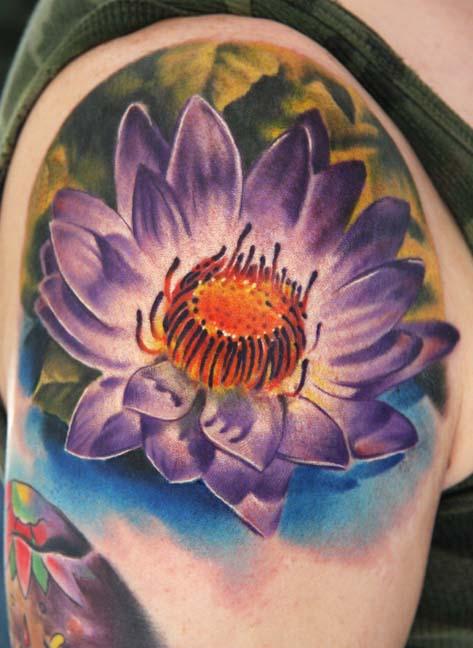
More yoga tattoos!

Alison Hinks, graphic artist and yoga blogger, has a new one up, Some Fun Yoga Tattoos.

Here’s a sample:


Tattoo art on yogis

Loved this NY Times photo piece on tattoos on yogis.

I have a little tattoo on my belly: OM. How about you? Do you have a yoga tattoo?