Working with forward head: myofascial release

Read the first post in this series here. My notes are at the end of this post, along with a link to the following post. ~ MaryAnn

by Cate Radebaugh

So, I had another ‘forward head position’ appointment with Mary Ann. She is very excited about the new Zero Balancing work she’s learned and briefly contemplated adding that to this session, but decided against it. Myofascial release it was.
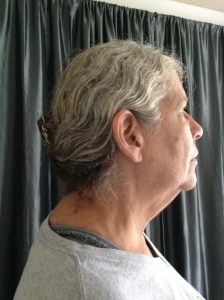
img_4981

Notice that Cate’s ear is in front of the middle of her shoulder. The SCM runs from behind her ear to her chest.

First, she took a picture of my neck so we can all track my progress.

Then, because this is “take some of your clothes off and cover up with a sheet” work, that’s what I did. (Those sheets are so soft. They’re made of microfiber. I suggest you get some for yourself. Or go do work with Mary Ann, because they’re part of the treat. Now back to the forward head thingy.)

One of the advantages of working with Mary Ann is she shares her knowledge about bodies with her clients as she’s working on them. I feel on speaking terms with some of my muscles now.

Two big ones are the sternocleidomastoids, SCMs for short. They run from my mastoid processes – the two bumps behind my ears at the base of my skull – down my neck and attach to my collarbones and sternum, and are what turn and nod my head. Continue reading

Working with forward head posture: Zero Balancing and more

Note from MaryAnn: This is a guest post by someone I’ve known for nearly a decade. Years have gone by without us seeing each other, and then we reconnect, and it’s a happy occasion. She is a wonderful writer with a fascinating and fascinated mind, a perceptive presence, and a wicked sense of humor.

We initially did a 90-minute craniosacral therapy session with Zero Balancing. Then we did a 30-minute Zero Balancing session that she writes about here. This is the first in a series of posts about her experience receiving bodywork from me to help relieve her forward head posture (and the pain and tension that accompany it) and work with anything else that arises.

Forward head posture is becoming more common with our sedentary, screen-gazing habits. Several of the modalities which I’ve trained in and practiced are very effective at relieving forward head posture, including Zero Balancing, myofascial release/Deep Massage, and craniosacral therapy. And Cate will have homework to do as well.

I hope you enjoy reading these posts as we progress. The bottom of the post contains a link to the following post if you wish to read them consecutively.

by Cate Radebaugh

Over the years, I’ve developed forward head posture. Some of it comes from many hours in front of a computer screen, and obesity and self-image issues haven’t helped any. I recently became aware, though, that carrying my head out so far in front of my body is exhausting, and my neck, shoulders, and upper back are so constricted from the constant weight that they never really relax or rest, even in sleep.

So … I went to see my friend MaryAnn Reynolds to find out if she might be able to help. I’ve already said a little about my first visit* and my second was just as interesting. It was a Zero Balancing session. I think Zero Balancing is a really funny name and an even funnier intent, because I already experience moments of what I think of as zero balance and would just as soon not. MaryAnn’s Zero Balancing is different from that. In fact, it seems to be something of antidote. Continue reading

If you want to get better at healing others and/or self, read this blog post

My wonderful craniosacral therapy teacher of the past few years, Ryan Hallford, wrote a blog post entitled Soft Mantras for Hard Lesions. Although specific to biodynamic craniosacral work, in my opinion it applies to so much more – all types of healing work with others and all healing work on self.

ryanSubstitute “stuck places” for lesions and consider his statement that this post is about our mindset when encountering them, and you can understand how applicable this is to all realms of life.

Toward the end of the post, he lists three mantras (internal prayers) that a person intending to heal (self or other) might find helpful to ask.

I’ve read this blog post three times now and decided to write down the questions to carry with me at all times. This is a practice I use when I want to integrate something new into my being. The writing of it helps me commit it to memory as my pen moves across the paper letter by letter, word by word, and carrying the written paper with me signals my commitment to integrate it.  Continue reading

Update on using the sacroiliac belt

It’s been a week since I started self-treatment for SI joint pain. I’ve made some changes after talking with my teacher that I want to share, in case you’re doing this at home. (If you’re just tuning in, you may want to read my first post on this topic.)

First, I am wearing the sacroiliac belt at night while I sleep.

Since we spend about one-third of our life sleeping, and we’re unconscious while we sleep, sleep posture is extremely important when working on alignment issues like an SI joint that has been out of alignment for years.

I decided to sleep with the sacroiliac belt on 24/7 to prevent the alignment occurring during the daytime hours from being undone while I sleep. Of course I take it off to shower and swim.  Continue reading