A doctor who uses yoga in his practice

Saw this article in today’s New York Times and thought I’d share.

When patients with rotator cuff injuries do a pose derived from yoga, the results were as good or better than surgery or physical therapy. The yoga pose is headstand with the forearms making a triangle with the head, but you can do it against a wall — inversion is not required. It works by letting a new muscle do the work of the injured muscle.

Another study found that for patients with osteoporosis or its precursor osteopenia, ten minutes of yoga every day for two years built bone density in the hip and spine, while the controls lost bone density.

Yoga is weight-bearing exercise using the body’s own weight, especially in partial and full inversions. In addition, stretching pulls on the bone where muscles attach, and this can build bone density.

Another article is about piriformis syndrome, when the sciatic nerve is pinched by tight butt muscles. It can be caused by prolonged sitting.

Pressure-point massage can help. Some home exercises can provide relief in the majority of sufferers.

Tips to counteract a sedentary job

If you have a desk job that requires a lot of sitting and you’re concerned about the health risks now being associated with prolonged sitting, here are some things you can do that require no expense:

  • Use a timer to remind you to stand up and stretch and walk around every 30 or 60 minutes. Google “timer” to find a virtual timer you like. Aim for a few minutes of non-sitting movement every hour.
  • Find ways to walk more: Place your phone away from your desk, so you have to stand up and walk to it to make or answer calls. Use a small cup for your drinking water or beverage of choice (or fill your regular cup partway), and when it’s empty, get up to refill it. Don’t use the restroom that’s closest to your office — walk to a more distant one. Instead of emailing colleagues, walk to their offices to talk, when feasible.
  • Breathe fully and deeply, using your abdomen, moving your ribs front, sides, and back. Do 5 of these breaths, then return to normal breathing.
  • Take a yoga class on your lunch hour. Or do desk yoga (Google “rodney yee 4 minute”  to see videos of Rodney Yee doing seated sequences). You can evendo cat-cow ever so often while sitting: curl your spine forward and back a few times, exhaling when you curl forward, inhaling when you arch your back.
  • Close your door or put on your headphones, turn on your iPod or a music video, and dance!
  • Fidget and wiggle. Especially move your legs.

When you’re not at work, avoid sitting as much as you can:

  • If you drive to work and your car has no lumbar support, place two tennis balls inside a piece of pantyhose with a knot in the middle and at the ends. Put it behind your lumbar vertebrae and press into it as you drive. It will feel great — and you’ll know when you’ve had enough.
  • If you watch television in the evenings or on weekends, stand, use your treadmill, or bounce on an exercise ball while watching. If you sit, get up and move during commercials.
Sit on an exercise ball at work instead of a desk chair. It strengthens your core, improves balance, improves flexibility, burns more calories, and requires you to use your legs. You can get them for under $20. Get a 75 cm for the most height. 

All of these tips can make a difference, helping to lower blood sugar, triglycerides, cholesterol, and waist size; improve posture, breathing, and metabolism; and decrease back pain.

“If there’s a fountain of youth, it is probably physical activity,” says Yancey, noting that research has shown benefits to every organ system in the body.

Next: standing desks.

How to recognize that someone is drowning

My good friend Barbara and I went out to Lake Travis on Monday afternoon. She is not a fan of cold water, and that is the warmest water in this area that I could think of. We went to Pace Bend Park. Neither of us had been there before.

We parked. She waded, I swam, then we sat in lawn chairs with our feet in the water and had one of those long, delightfully meandering conversations.

We were kind of away from a knot of people who looked like they were having a big family party.

As we were leaving, we saw a park ranger SUV with lights flashing heading our way. I noticed a man in the knot of people talking on a cell phone and waving his arm at the ranger.

Barbara and I drove up to a nearby picnic spot and ate some watermelon, and while we were there, a helicopter flew in, hovering over the water just past the knot of people.

Barbara said, “This isn’t good. Look. That helicopter isn’t going anywhere. It’s just hovering, stirring up the water. They’re looking for something. I think someone drowned.”

That’s all I could figure too. Our hearts felt heavy.

We headed back into town, taking a different route back to the main road. I heard a siren but didn’t see it.

I read the next day that a 25-year-old man had drowned at Pace Bend. He’d been swimming and didn’t resurface. It’s a heart-rending loss for someone to die so young.

I thought of the link that made the rounds on Facebook recently, about how drowning doesn’t look like the movies show it. I’m sharing that link here.

Everyone needs to know how to recognize that someone is drowning. 

To get an idea of just how quiet and undramatic from the surface drowning can be, consider this: It is the number two cause of accidental death in children, age 15 and under (just behind vehicle accidents) – of the approximately 750 children who will drown next year, about 375 of them will do so within 25 yards of a parent or other adult. In ten percent of those drownings, the adult will actually watch them do it, having no idea it is happening (source: CDC).

Prison yoga: stories and photos, and local prison work

I read this Elephant Journal article, Yoga at San Quentin: Prisoner Interviews and Photos, liked it, discovered it had a Part 1 (Do Prisoners Deserve Yoga?) and a Part 2 (Know about yoga & meditation for at-risk and incarcerated youth? Serving where it matters most), and liked those articles as well.

At its best, prison is a place that transforms lives.

I’ve had an opportunity several times to go into the state prison at Lockhart and take part in the graduation ceremonies of Truth Be Told, which works with women behind and beyond bars. They have been the most moving, heart-opening, compassion-building experiences I’ve ever had. 

Please note on Truth Be Told’s website that a couple of upcoming opportunities to witness graduation ceremonies in both Lockhart and Gatesville are happening later this month. Respond quickly if you’re interested. I just got confirmation for attending the May 26 graduation in Gatesville’s Hilltop unit, my first time there.

I don’t know if there’s still space or if the deadline has passed. You have to be pre-approved by the Texas Department of Criminal Justice.

If you are interested in waking up to more of the world we live in, being moved, and finding a way to be of service (even if just witnessing), I recommend connecting with Truth Be Told and attending one of these ceremonies.

If you can’t go, at least get on their mailing list and make a contribution however you can.

Does anyone know if yoga is being taught in the Travis County State Jail, the GEO prison in Lockhart, the prison in Burnet, or in any of the Gatesville prisons? I’d love to know.

Interview with yoga crone Cora Wen

I only got connected with Cora Wen through Facebook. I forget exactly how. I’ve come to love her posts and her take on yoga.

Now The Magazine of Yoga has published a two-part interview with Cora. This link is to Part 1, where Cora discusses being a yoga crone (along with Angela Farmer, Indra Devi, and other older female yoga teachers), and how they’ve served as role models for how to age well.

As well as race/ethnicity and gender and body differences.

In Part 2 of the interview, Cora talks about being a yoga teacher, chi, and living a life touched by yoga.

Love this quote:

That seems to be the thing my students always say: “You’re just so you.” Well, I want you to be you. I want you to disagree with me. I don’t want you to do what I say. I want you to think for yourself. I want you to be curious. I want you to be playful. I don’t want you just to listen to me. I don’t want you to repeat what I say. I want you to be you. Maybe I can help you see that. Being you is okay.

Read on for Cora’s take on the most important of the Yoga Sutras, and why.

Starting the process of brainwave optimization

Yesterday I did something I’ve wanted to do ever since I learned about it. I had an assessment of how my brainwaves are working.

I learned that I still have traces of fight-or-flight activity stemming from PTSD. Forty something years after the trauma, after nearly 20 years of yoga, psychotherapy, releasing the traumatic energy block a la Waking the Tiger, over 5 years of meditation, learning NLP, and doing the trauma releasing exercises, this pattern (although much less than it was) is still present in my energy field. All of those healing modalities have helped and been completely worthwhile, to be sure.

Fight-or-flight is a wonderful instinct to have — when there’s something to fight or flee from. The problem is when there’s nothing in the environment to fear, but I am still tense or jumpy. It’s a brainwave pattern.

I’ve wondered how can I know I’ve completely recovered from trauma. The trauma happened when I was young, so I don’t have an adult baseline of well-being to compare to. I’d really like to know that I’m over it and don’t need to spend any more energy on it. Ever.

The aftereffects of a trauma can last a lifetime. I’d like to experience what it is like to be untraumatized. I can’t change the past, but I can change my brain wave patterns and therefore my life.  

Here’s how the process has gone so far. I made an appointment with Gigi Turner at NeuroBeginnings. That is one of three Austin affiliates offering brainwave optimization using the equipment and software and training provided by Brain State Technologies (BST).

The founder of BST, Lee Gerdes, has written a book, Limitless You: The Infinite Possibilities of a Balanced Brain. I have just gotten the book myself. One of the testimonials on the back cover mentions “restoring … humans to a joyful and highly functional state in their daily life.” Yeah.

All of these companies are staying busy, from what I hear, and I’m sure they are all very competent at doing what they do. I connected well with Gigi on the phone and identified with her as a working woman, so I chose her. She’s also the most highly trained BST certified technician in town.

At my first appointment, she had me fill out an extensive online questionnaire. I’m pretty sure they ask about so many issues because BST wants to collect as much data as it can. All in the name of compassionate science. This is a fascinating frontier that I’ve blogged about before.

At the end of the questionnaire, I identified my top reasons for wanting to do this. I listed well-being and happiness first. And, oh yeah, I wouldn’t mind having better spiritual development and meditation, cognitive improvement, social interactions, etc.

Gigi had me sit in a recliner. She put some electrodes on my earlobes and scalp. She then asked me to close my eyes for 2-3 minutes. Then she asked me to open my eyes partially. Then she asked me to open my eyes completely. With eyes open, she had me do an exercise like repeat strings of numbers.

Meanwhile, a big computer monitor with a split screen is showing my left and right hemisphere activity as colors — blues, green, red, each color representing a range of brainwaves like beta, alpha, theta, delta — streaming by.

Pretty and fascinating. I wonder what this means.

Then she’d move the electrodes and repeat the process for a different area of my brain, getting readings for the frontal lobe, parietal, temporal, occipital, cingulate gyrus, and midline, if I remember accurately.

With my eyes open, I’d do a different exercise for each area. I solved math problems aloud, read to myself and answered a question, listened to Gigi reading and answered a question, and just looked around the room.

At the end, she removed the electrodes and showed me a summary on the computer of my assessment. (It’s proprietary, so I didn’t get a copy. Darn! I love looking at data, seeing what pops out.)

Basically for each area of the brain, there’s data about the left and right hemispheres, about each brainwave type, and about ratios between types (such as between beta and theta), as far as I could tell. I bet there’s also data about the brain’s flexibility in moving from eyes closed, partly open, to wide open, and how well it functions doing each assigned task.

From experience, the BST-trained technicians have come to recognize “brainwave signatures” for various conditions like PTSD, ADHD, and so on. But it’s really not meant as a diagnostic tool. It’s meant to be used to harmonize and balance the brain, and this is the starting place.

They also can tell what range the numbers “should” be in for optimal functioning. Not that there’s necessarily anything wrong with being out of range. I imagine some gifts and talents that people have developed (math prodigy, psychic) rely on being out of normal range while doing that activity. The question is, are they happy and healthy? Can their brainwaves change to meet the situation, or are they in a dysfunctional pattern?

Even if you don’t have anything like PTSD, you can probably benefit from tuning up your brain. The literature says it can help with addictions, anger, anxiety, chronic fatigue, chronic pain, compulsive behaviors, eating disorders, learning difficulties, obsessive thinking, panic attacks, poor memory, sleeping difficulties, stress, and a host of other issues.

So it is possible that with the training, I can completely retrain my brain to operate as if I never had PTSD.

I can be less jumpy and experience even more well-being. I’m looking forward to that.

I can also learn to focus better on reading material that is, ahem, less than compelling. Like textbooks and other dry material.

I’m a pretty good sleeper, but Gigi says that optimizing my brain waves will help me sleep even better, waking up even more refreshed. Wow. I’ve had insomnia before and have great compassion for people with sleep problems. I’m looking forward to sleeping more restfully.

BST affiliates can also do things like increase beta in the left hemisphere and increase alpha in the right hemisphere. Yeah, let those hemispheres specialize even more! I imagine this would make someone more cognitively adept when they need to be and happier the rest of the time. I’ll have some of that, too!

So I’m going to do it later this month, when my contract job is completely done. You need to be able to come in for a couple of hours a day every day, or even twice a day, which is why I’ve waited until now.

I understand the process uses sound, and that you actually “observe” your brain waves and optimize them yourself, creating the balance and harmony you desire, rather than matching an external norm.

I will report back here at Well:bodymindheartspirit.

Resentment and poison, failure and feedback

Readers, I am processing something that happened this week, and I beg your indulgence as I move through my stuff. Maybe you find other people’s processing interesting. If not, skip reading this post.

Resentment is like taking poison and waiting for the other person to die. – Malachy McCourt

Social work professor and authenticity researcher Brene Brown posted this quote on Facebook yesterday. (No, I don’t know her in person, but her work is pretty awesome, as are her TED Talks.) The timing for me to encounter this quote was perfect. On Monday night I had a meeting with someone who told me he has resented me for a year, since we both came onto the leadership team of a social and educational organization.

Suddenly I got insight into the tension I’d felt coming from him and how he related to me as if I were a bad employee to be corrected or micromanaged, his dissatisfaction and hypercritical attitude toward any mistakes I made, and a lack of support, gratitude, and appreciation for anything I did, even to the point of undermining me (which was why I wanted to meet with him, to tell him I didn’t like that a bit, you jerk).

It had the ring of truth to it. I also felt horrified. Frankly, it’s creepy to have someone tell you that they’ve resented you for a year. A year!

I left after about 20 minutes. Clear that I don’t want to work with him any more, I ended our “conversation” by resigning. I felt disappointed, but also that there was no real choice. Interest has tapered off. I don’t have hope that the organization will survive.

Later that evening, I found out another person on the leadership team had resigned that morning. And yet another person — also a supporter who has shared his gifts with this organization — soon decided after fruitless and frustrating conversations with this person to take his talents elsewhere. After learning this, I quit as a member.

I just wanna say this:

Hey, dude. Maybe it’s not me. Maybe it’s you.

Maybe members sensed your hidden resentment and decided not to come back. You probably think that’s too woo-woo. But maybe there’s a whole field of awareness that you’ve been blind to.

You were a real pill to work with, and as much as I loved doing my role, even imperfectly, I’m okay with severing our association. Relieved. Let me get away from your poison. I came away with many new relationships with people I do like. I even liked you sometimes, but not as a leader.

Here’s a beef: You don’t use the skills this organization promotes to resolve problems! When I asked you what the outcome was that you wanted, you avoided answering my question. Others have noticed that you have difficulty answering a clear, direct request with a clear, direct answer. The meaning of communication is the response you get.

You went off on a tangent but actually got the outcome I think you wanted — my resignation — without ever directly asking for it.

So, um, you could have just asked for my resignation at any time without all the drama, you know. So why didn’t you?

Dude, where’s your well-formedness?

I don’t even think this has much to do with me. It’s more about his ego.

I understand that he’s working out something karmic in his life. This is not about what he thinks it’s about. It’s about self-revelation. He doesn’t seem to know himself very well or be effective in a leadership role. If people don’t trust him or have confidence in him as a leader, then he’s not a leader, no matter what title he has.

I’ve been thinking a lot this week about what good leadership is. It seems clear to me that it’s situational. People talk about leadership style, but the style has to match the situation.

What works in an employer-employee relationship where you pay someone to fulfill your agenda will not work in an organization composed of volunteers. That is much more about relationship skills and consensus building, rapport and responsiveness, not command and control.

New awesomeness arises out of the ashes. I am free to pursue my best interests, and that’s already taking shape in a very satisfying way.

~~

Update a week later: Everything is perfect just the way it is. When this guy is my age and looks back on who he was at this current time in his life, he will have great perspective on how much richer his map of the world got. His identity, his role in creating this, his ability to be congruent, his skills in relating to people and in leading people will all be vastly more developed and nuanced.

Tibetan monks in Austin

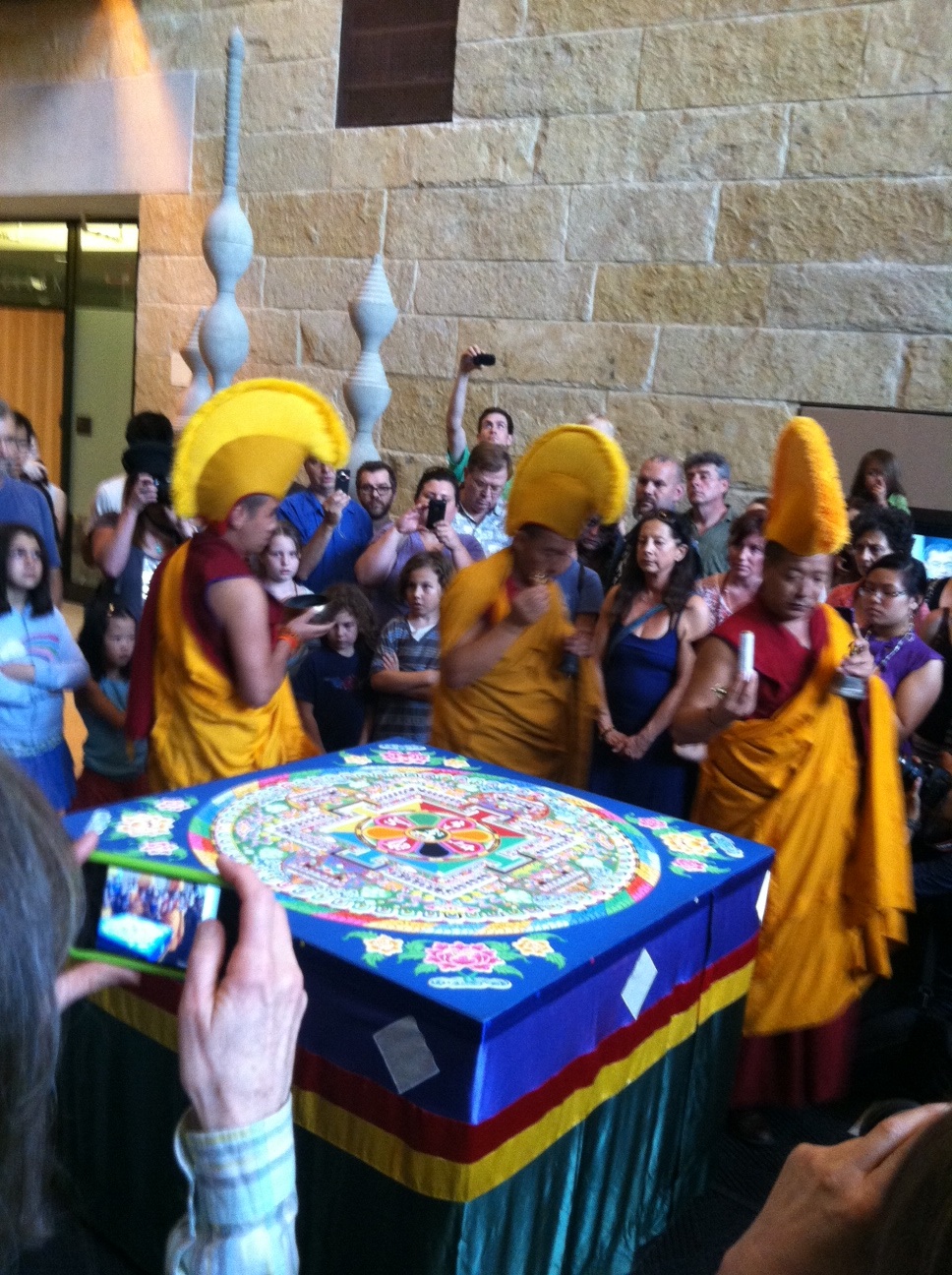
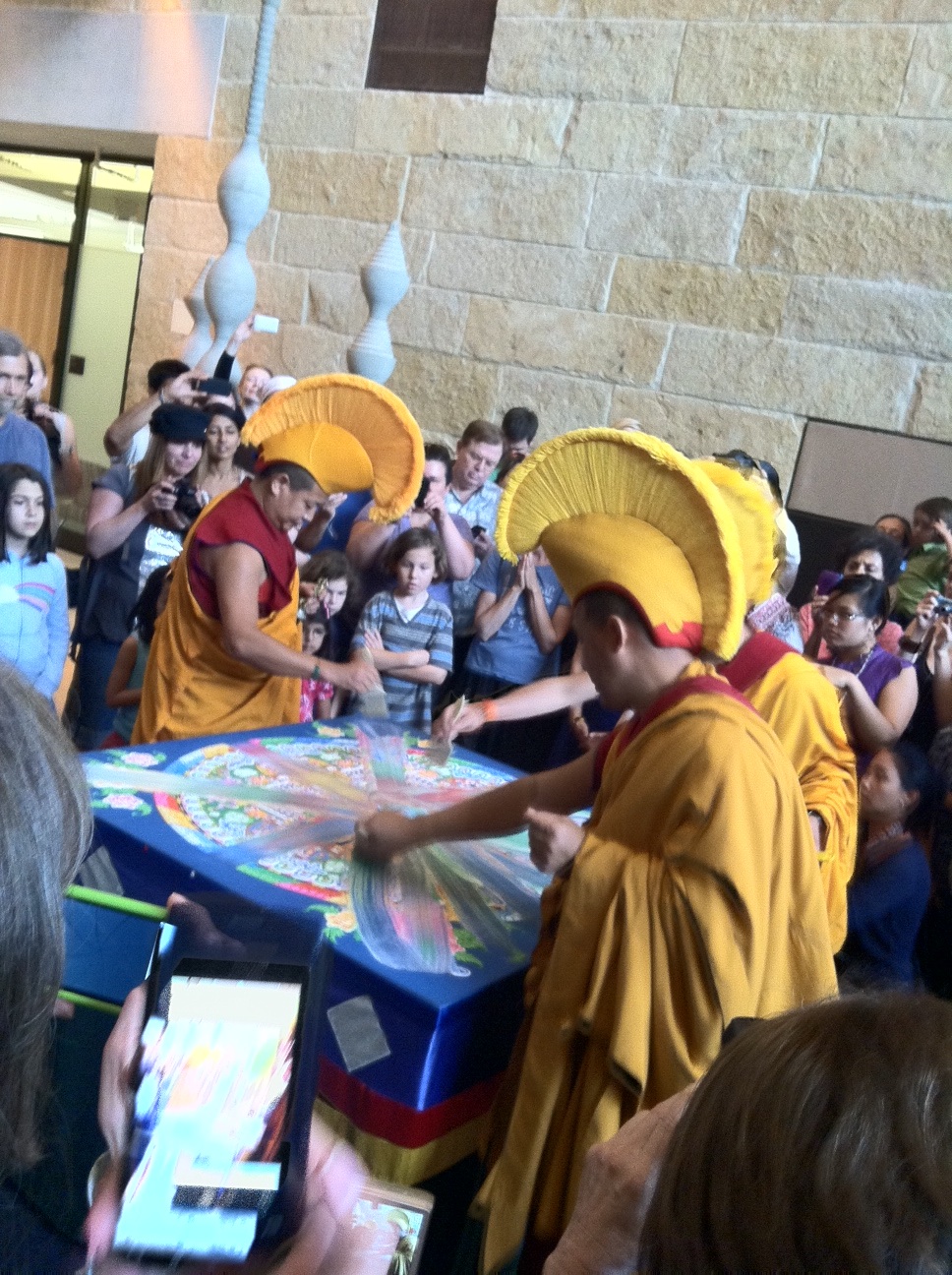
Some Tibetan monks from the Gaden Shartse monastery are visiting Austin. They made a sand mandala at City Hall over the past week, and yesterday they held a ceremony in which they destroyed it. My friend Tom and I went to see it.

Quite a crowd had gathered at City Hall, with people on the stairs and balconies, gazing down. Bumped into old friends Rebecca and Jutta.

One of the monks was American and explained things well. He said one monk was a geshe and described what it takes to become a geshe (20 years of monastic academic studies and a lot of winning debates with other monks). Another was a lama, a title indicating an honored dharma teacher.

You can see their wonderful hats.

They chanted for a long time. I couldn’t understand a word, but I liked it. I recorded it on my iPhone but can’t figure out how to upload a voice memo to my blog, so you can just imagine the chanting.

After destroying the sand mandala with paint brushes, they gave each person attending a small bag of the sand and suggested it was good for two things — to sprinkle on the four corners of your property as a blessing for your home, and to rub a bit of it into the crown chakra of a dying person to ensure a good rebirth.

I couldn’t resist making the final photo my new masthead photo!

So what is this ceremony about? Nonattachment. A visual lesson about creating something of beauty, intricacy, and special meaning, with highly focused, meticulous, and lengthy labor, and then destroying that creation — because life is change and nothing is permanent — and releasing it back to the Source. The practice of presence. Equanimity.

I loved their energy. One of the monks in particular just radiated so much intelligent alive awareness in his mostly silent presence (and no, he wasn’t the geshe or the lama). I felt connected energetically to them all. They radiated such deep well-being.

Here’s a link to their activities for their remaining time in Austin.

Circling the sand painting

Destroying the sand painting

Chanting at the lake...

...as a monk pours the sand into the lake

Ceremony over, posing for photos

Claiming some me time

Like the Energizer bunny, I’ve just kept going and going, with work and training and teaching and transitioning toward a new home, and then things started to go not so well. Low back-ache, fatigue, muscle tension, losing things, not handling a situation well, emotional sensitivity, feeling close to overwhelm.

As in, “If one more difficult thing happens, I’m going to lose it, and it’s not going to be pretty.”

As much as I like to meet life from a place of strength and resilience, sometimes that isn’t what’s real.

So I declared this afternoon as me time. You know. Solitary unpressured time — several hours of it — to rest, ruminate, and recover.

I even cancelled my restorative yoga class, which I try not to do, because I know when you need it, you need it, and it’s disappointing if it’s not available.

Yogis and yoginis, namaste. It’s savasana time for me, and for you if you need it! And, I am changing our class time to 7:30-9 pm so we can all have more “day” to enjoy on Sundays, then eat lightly, do the class, drive home, and go to bed all relaxed.

How does that sit with you?

We all need time to be active, time for sleep, and time for rest. In this case, I have not been getting enough rest.

Rest is when I check in with myself and get back on track, reconnect with myself and recenter.

It’s actually one of the best parts about being human. That we can do this!!!

And now, I’m going within, to get in touch with my feelings, breathe, maybe cry a little, curl up with Mango, and get some rest. And plan how to intervene with myself a little bit sooner so this doesn’t happen again. I hate disappointing people! I believe it may be time to restart my regular sitting practice, which has become irregular.

Yep. This is what happens when I don’t meditate. Yep, I’m really remembering that now.


In the Light of Love: A Tribute to Japan

If you read my earlier post containing the beautiful letter from Japan written by the American woman Anne who taught school in Sendai, please watch this video.

https://www.youtube.com/watch?v=zGWAZVZG1TA&feature=player_embedded#at=13

Deva Premal and Miten made it in loving tribute to the Japanese people affected by the earthquakes and tsunami. They write:

The earthquake happened while we were working on a remix on this song. Later we put images to the music in an attempt to portray the elevation of the human spirit in times of such overwhelming and inconceivable destruction. It is our tribute to the brave hearts of the Japanese people.
The letter at the end of the clip is a first hand account of a friend of a friend, living in Japan.

With love

Miten and Deva

…ps… we just received this message and thought you’d like to know: “And in case you don’t know — the baby in the pink snuggly being smiled at by the soldier was found in the wreckage 2-3 days after the tsumani and was reunited with her father….one of the biggest miracles to date…”