“People dance like little kids here!”

That’s what my 12-year-old granddaughter said about Ecstatic Dance Austin this morning. We arrived during warmup. She sat in a corner and watched. I danced. The space was full.

She sounded surprised and delighted when she made this observation. I had to agree. We do dance like little kids at ecstatic dance. Only we have better rhythm and more grace, and maybe some of us feel a bit more stiffness until we get warmed up. From what I remember, little kids don’t need to warm up.

We definitely have the playfulness, the wholeheartedness, the joy, the abandon, and the presence of little kids when we’re on that dance floor.

We’ve gotten pretty good at connecting with each other and respecting boundaries, completely nonverbally.

We’ve gotten pretty good at keeping the space safe, of moving into the empty spaces instead of colliding. We keep our eyes open.

We’re pretty good at spontaneity and going with the flow.

You could say we dance like nobody’s watching, and that’s because no one is. They’re paying attention to their own dance, dancing with one or more partners, maybe even dancing with the whole room. We’re there to dance, not judge.

I had a blast today, making some sweet connections, and my pulled soleus muscle is working well. I did some jumping and leaping, and it felt strong and capable. It’s just a little stiff. I believe that in another week, the healing will be complete.

Hurray for healing my own injuries!

We also got the good news that the development project that was going to tear down our dance space at the Austin Yoga School on South Lamar has fallen through, and the tenants can stay in their spaces.

That news was very welcome.

And so she danced a dance with me. For one song, we boogied and swung and jumped and played and grinned and laughed and got silly together.

Life is good.
What would you do if … ? Stories of conflict resolution.

What would you do in the following situations?

  • You’re a psychiatrist working in a mental hospital. A homicidal patient has hidden in the elevator. Without seeing him, you enter and close the door, which locks. The patient announces that he’s been waiting for you while everyone is at the other end of the ward, and now he’s going to kill you.
  • An illiterate punk robs your uncle, a beloved doctor who has a heart attack and dies, and the DA wants to charge him with a capital crime. The punk plans to plead guilty. The defense attorney asks your family for justice, not vengeance.
  • You’re a kindergarten teacher who learns that a student is ashamed of her father, who speaks with an accent, after you’ve invited the children to bring a parent to school to teach something they do.
  • A woman comes to you alone for couples counseling. She and her husband live together “for the sake of the children” but are estranged, embittered, and distant in every other way.
  • You’re asleep in your bed when a strange man kicks open the door to your bedroom. You’re a woman, home alone, unarmed, and the phone is downstairs.

These are just a few of the 61 real-life stories in the new book Sweet Fruit from the Bitter Tree by Mark Andreas. I highly recommend reading this book if you like being resourceful in situations of conflict and desire more peace in your life and in the world.

By the way, the psychiatrist asked the homicidal maniac exactly where he planned to kill him—in this spot or in that spot. While the would-be killer thought it over, the psychiatrist pulled out his key and unlocked the elevator. Calmly stepping out into the hallway, he points to a chair that the killer could sit in afterward. Then he points out another chair, and another at the end of the hallway.

Eventually they arrive at the station where the attendants are gathered.

The psychiatrist was Milton Erickson.

If you want to find out what happened in the other situations, order the book!

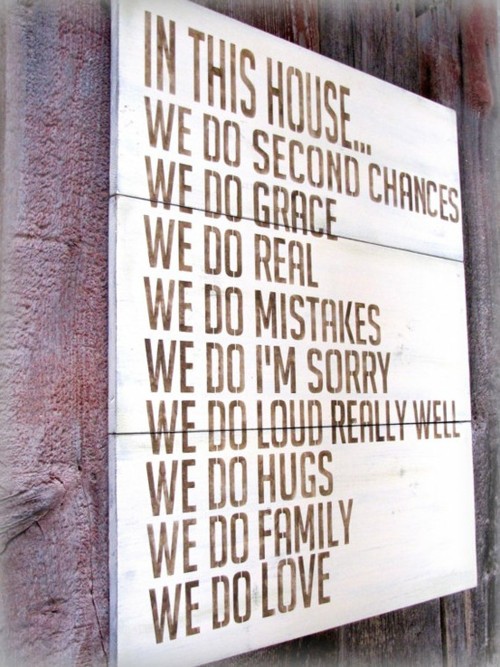
In this house…we do love

Sharing an image I saw on Elephant Journal. I dedicate this to all my families—past, present, future, blood-related, my ohana, the communities and tribes I belong to, including the animal members. (Waylon Lewis’ family is his dog.)

And, okay, so maybe I’d substitute laughter for loud and my grace may a silent gratitude, but the rest of it stands. What would you add or subtract?

It’s available (in slightly different form) as a vinyl wall sticker decal here on Etsy.

in this house...we do love

The 12 Symptoms of Spiritual Awakening

Image

The 12 Symptoms of Spiritual Awakening

Making the rounds on Facebook, worth sharing here.

The questions of the heart; seeking the sound of a normal heartbeat

I beg you, to have patience with everything unresolved in your heart and to try to love the questions themselves as if they were locked rooms or books written in a very foreign language.

Don’t search for the answers, which could not be given to you now, because you would not be able to live them. And the point is to live everything. Live the questions now.

Perhaps then, someday far in the future, you will gradually, without even noticing it, live your way into the answer. ~ Rainer Maria Rilke, Letters to a Young Poet

I have a friend who just had a second surgery on his heart in two weeks. His heartbeat has not had a regular rhythm for some time now.

I’m searching the internet for a sound file or an iPhone application that is just simply the sound of a normal heartbeat. The longer the better, and if he can loop it to listen to all night with headphones as he sleeps, fantastic.

At a minimum, it will be soothing, because if you can imagine, heart surgery is a pretty nerve-wracking big deal, especially when the problems aren’t fixed the first time.

At best, listening to the sounds could entrain his heart into a normal rhythm, which he did experience briefly after the first surgery.

If you know of anything, please comment or email me. Thank you.

Meanwhile, remember that besides the brain in your head (headquarters for the nervous system that runs throughout your entire body), you also have two other centers of intelligence: your heart and your gut.

I believe Rilke is onto something about the intelligence of the heart.

I have learned to sit with the questions in my heart and let them transform me, and I am a much better, broader, deeper person for it. I get perspective on my own fear-driven behaviors. I get insight into the behaviors and possible motivations of others.

I don’t know that I have answers. Perhaps the only answer is to be willing to sit with the feelings that are unresolved and allow them to change, not forcing or judging, just allowing and noticing.

It does seem to me that gradually healing occurs. Gradually forgiveness comes. Gradually lightness replaces heaviness. Gradually clarity replaces confusion. Gradually …

This is another rhythm of the heart.

Please say prayers for Marco. Thanks.

Photos from Tom Best memorial

Scroll all the way down to the bottom of the right column and click the More Photos link (or just click this link) to view the photos I posted from Tom’s memorial service yesterday.

If you didn’t know him, maybe you can tell from the pictures how special he was.

I am happy I got to have him for a teacher and a model.

Many, many people helped make this happen, especially Katie Raver and Linaka Hana. Kudos, you two!


One happy introvert

I just spent three days—from Friday afternoon until Monday afternoon—with other people, on retreat, then preparing for and holding a celebration of the life of my dear teacher, Tom Best, who died about a month ago, and cleaning up afterwards.

I was with some of the dearest people I know. Smart, good, resourceful people. Beautiful, fun, funny, loving, adorable, competent, capable people. I met new people I’d love to know better. People came in from Serbia, Germany, Arizona, New York, Florida, and elsewhere.

Since nearly everyone there had at least taken NLP practitioner training (Tom taught NLP, but he really taught love), and some much more advanced training, the quantity and quality of resourcefulness present in the circle honoring him was probably more than I’ve ever experienced. Maybe more than I’m likely to experience again. Of course, I leave room for unlikely possibilities. I don’t know the future. But that was one illustrious company to be part of.

And finally, I am home, by myself, and it feels so expansive and relaxing to have this solitude.

I cherish this time to sort through my impressions, understand people more deeply, absorb and integrate the experience at my own pace.

The simplest way to improve your posture

If you’re at all familiar with this blog, I bet you think I’m going to say meditation. Guess what? Ha ha, I’m not!

It’s way simpler than that:

Whenever you’re doing something that does not require use of your hands, turn them so that they’re palm-side up (see the picture above). You also can do it while standing or walking, leaving your arms down at your sides and turning your palms so that they face outward in the direction you’re facing.

This palms-up position may be familiar to committed meditators and yogis who practice shavasana, but it’s foreign to those of us who spend a lot of time at a computer, behind the wheel of a car, holding babies, making lattes, or doing pretty much anything else that requires constant hand use. Even when we’re not using our hands, it’s just habit to sit, walk or stand with our hands facing down or behind us.

Wait for it — there’s a meridian connection: 

In acupuncture, the meridians that run along the inside of the arm, from the chest/underarm to the palm, are Heart, Pericardium and Lung….

Here is just a smattering of the functions each meridian is involved in (there are many more):

  • Heart: breathing, cardiac function, sleep, emotional balance and heat regulation.
  • Pericardium: breathing, blood circulation and upper digestive function.
  • Lung: breathing, immune function, perspiration, body temperature and urination.

…our lifestyles force our hands and arms into an almost constant downward/backward position, creating a tendency to slouch forward. This causes us to cave our upper bodies inward, crunching the Heart, Pericardium and Lung meridians.

Allowing these meridians to flow more freely optimizes their ability to perform their respective functions.

These three meridians are all yin meridians, flowing from the torso to the fingertips.

This is a mudra (energetic gesture in Hinduism and Buddhism). The palms-up mudra, you might have guessed, has to do with receiving energy from spirit or the universe, with allowing. It has to do with being open and surrendering yourself to the Mystery.

Try it when you think about it. Let one or both palms rest facing up, or outward if you’re on your feet. Notice the subtle but significant changes in posture.

Then make it a habit.

Thanks to Sara Calabro for this article.

Video: Baby being bathed in love. Happy YOU day from a mother.

Many of us are not mothers.

Many of us no longer have our mothers.

All of us were born of a mother, have been loved by our mothers (I fervently hope).

This video of a very young infant being bathed gives me pleasure, watching the baby’s response to the water and being held and the caregiver’s gentle touch and attentive nurturing. Notice that not only is the baby calm throughout, it falls asleep!

I like imagining that all infants everywhere receive love like this, and that we carry it forward with us the rest of our lives.

Enjoy.

Tom gets an idea

Just wanted to share with you something that a dear friend of Tom Best’s created. It’s called “Tom Gets an Idea.” David Moerbe is the artist.