Prescriptions and modern medicine

I was just reading an article in the New York Times about the effects of exercise on depression, and this sentence caught my eye:

His investigation joins a growing movement among some physiologists and doctors to consider and study exercise as a formal medicine, with patients given a prescription and their progress monitored, as it would be if they were prescribed a pill.

Hallelujah. I am so glad to hear that the medical profession is broadening what it prescribes.

The word prescribe comes from the Latin pre (before) + scribere (to write). It basically means to direct in writing.

Somehow we’ve come to interpret the word prescription as synonymous with pharmaceutical drug. Glad to know it ain’t necessarily so.

Gee, before you know it, doctors may be prescribing not just exercise, but also massage, diet, and rest, changes that have improved health for millenia without corporate profit.

What a concept.

Oh, exercise was found to be helpful for depression.

A doctor who uses yoga in his practice

Saw this article in today’s New York Times and thought I’d share.

When patients with rotator cuff injuries do a pose derived from yoga, the results were as good or better than surgery or physical therapy. The yoga pose is headstand with the forearms making a triangle with the head, but you can do it against a wall — inversion is not required. It works by letting a new muscle do the work of the injured muscle.

Another study found that for patients with osteoporosis or its precursor osteopenia, ten minutes of yoga every day for two years built bone density in the hip and spine, while the controls lost bone density.

Yoga is weight-bearing exercise using the body’s own weight, especially in partial and full inversions. In addition, stretching pulls on the bone where muscles attach, and this can build bone density.

Another article is about piriformis syndrome, when the sciatic nerve is pinched by tight butt muscles. It can be caused by prolonged sitting.

Pressure-point massage can help. Some home exercises can provide relief in the majority of sufferers.

“I am only satisfied when I am thriving”

Part of learning to be a good massage therapist is learning about setting professional boundaries. When the therapist is clothed and upright and the client is naked and prone, obviously there’s a power differential, and good trust-building boundaries are essential.

My training packet included a one-page checklist for relationship boundaries. I liked it and hadn’t seen it before. You might like reading it too. One column is the unhealthy, co-dependent, lack-of-appropriate-boundary way of doing things. The second column describes what a person whose healthy boundaries are intact would behave.

I see areas where I can improve. I really took this one to heart:

When your boundaries are intact in a relationship, you are only satisfied if you are thriving.

I love that. Instead of being satisfied by merely coping and surviving, I can upgrade my standards for myself in relationship. I now include the core question, “What might it take for me to thrive?” into my relationships and new partnerships, ventures, collaborations, agreements, negotiations, and so on.

And of course, others I relate to may have the same standard! In fact, I hope they do!

Here’s a link to the whole list. It just might make a good daily checklist.

The source is The Center for Human Potential. Check out their other great resources too.

Your meditation cushion is your body

I’m sharing a link to an Elephant Journal article, an interview with meditation master Reggie Ray. It’s part 1 of 3, and after reading this, I will be looking for the rest of it.

This section of the interview particularly caught my attention. See if it catches yours.

When I found out that I was going to do this interview with you, I sat down and listened to some other interviews you had done. On your website I found an interview entitled, “The Body As The Guru.” In it you were talking about the spiritual path and daily life.  The host of the show said, “We have to take our practice off of the cushion,” which I have heard a thousand times. But your response was a new one on me. You said, “Or we have to redefine what it means to sit on a cushion.” You didn’t really go into what you meant in that interview… So, I am asking you to do elaborate on it now.

Reggie Ray: When we’re sitting on the cushion we are actually extending our awareness into our bodies. We are in a way present within the totality of our being, which on the surface is a somatic being. The information we need for our life arises within us, it becomes clear.

If you get up off the cushion and there is a transition into something else, which might be a lot heavier or disembodied that means you are not present in your life. Your cushion is your body. That happens whether you are sitting on a zafu or you are in your daily life.

You mentioned the transition from the cushion to the front door, so to speak. Basically, one is meditation, but the other is not. Is it fair to say that if there is a transition taking place, not only is there something off about the way that you are being present in your daily life, but also in your sitting practice? Is it possible that in such situations meditation is contrived? Is the transition happening because we are trying to zone out on the cushion or create some sort of meditative trance? Or are we present in the body while we are on the cushion, and then migrating into our head as we walk out of the door?

Reggie Ray: That’s a good point. If you sit down to meditate with some idea about a state of mind you are trying to get to, or have memory of some pleasant experience from the past, then you’re not doing anything different than sitting in a meeting and trying to make a good presentation, trying to impress the people around you. Only in this case, you are trying to impress yourself. That is not meditation. Meditation is when you sit and let go of all your effort, and allow yourself to be present.

That’s what meditation is.

So, as you’ve mentioned, joining your practice with your daily life—9 to 5, wife or husband, kids, and work—from the vajrayana’s point of view, this is the ideal situation. These aspects of our daily life have a capacity to break through our defenses, push our buttons, and invite us to unfold. You’ve said that spirituality is the unfolding of human personality towards its perfection. I am assuming that by “perfection” you do not mean some static idea about perfection. So what exactly do you mean when you say “perfection?”

Reggie Ray: Actually, instead of the term perfection, I would rather say, “fulfillment” or “realization.” In the same way that an animal goes through it’s life-cycle—from being an embryo, all the way to death—at the moment of death the biological, and I would say, spiritual imperative of being a lion or a worm is fulfilled.


So with human beings, we could use the analogy of initiation in indigenous societies. In indigenous societies, at a certain point people go through an initiation, which introduces them to the fact that life is much bigger than what they might have thought when they were children or even during adolescence. Our natural human awareness is limitless. Everything in creation has a life-cycle, and when people are allowed to unfold—when they are allowed to follow the natural, biological, and genetically driven cycle of what it means to be human—our understanding and awareness becomes bigger and bigger. We have more appreciation for other people’s points of view, for the world beyond our world—the animal world, the plant world, and the universe. That is what I am talking about.

There is a natural tendency towards what Buddhist call “enlightenment,” but it can also be seen in the indigenous societies. That is really what we are talking about.

In Buddhism we call it buddha-nature, but buddha-nature isn’t simply an established state. It is a process of being in the river of spiritual maturation that goes on-&-on, never reaching a static point. Perfection, in this case, refers to fulfilling the journey of the human life. When are fully and completely with what it means to be human, we have let go of any attempt to pin ourselves down, solidify ourselves, or encrust ourselves at any stage. It is an unending, open process. When we have completely let go of any attempt to withdrawal from life or freeze ourselves, that’s what I mean by perfection.
What you need to know about standing desks

To counteract the ill effects of sedentary (from the Latin sedentārius: sitting) jobs, manufacturers are beginning to offer standing desks. Actually, they aren’t new. According to Wikipedia, standing desks were popular in the 18th and 19th centuries in the homes of the rich.

Furthermore, some of the world’s most talented writers wrote/write while standing. We’re talking Hemingway, Nabokov, Lewis Carroll,  and Thomas Wolfe.

Novelist Philip Roth, a great living writer, stands at a lectern to write and paces while he thinks, claiming to walk half a mile for every page he writes.

Who knows? Maybe writing is the one thing they did differently that helped them manifest their genius. It certainly seems to be better for the brain than sitting (see my previous post mentioning that movement of the sacrum pumps cerebro-spinal fluid, which nourishes the brain).

Perhaps before making the switch, you’re wondering how many more calories you would burn by standing instead of sitting. Here’s a calculator where you enter your weight and hours worked to find out the extra calories burned in a workday at a standing desk versus sitting. I’d burn 221 more calories per day. That’s very significant. I could lose a few extra pounds and then eat a little more!

Hmm. Could desk jobs be the real reason for the obesity problem in our society?

Adapting to a standing desk may take a week or so. Your feet may hurt from standing all day. You may be extra tired at first. Some people who’ve made the switch swear by a cushioned mat, like this writer, who had an adjustable IKEA Jerker desk (unfortunately discontinued) and switched it to standing mode. She writes about adjusting to it, which took her three days, and later using a mat and a footrest.

Of course, the least expensive way to create a standing desk is to simply put boxes, crates, or shelves on top of your regular desk and arrange your computer on them. You can create different levels for your monitor and keyboard if you like.

Personally, I’d put my big monitor at eye level and place an external keyboard at elbow level or slightly lower.

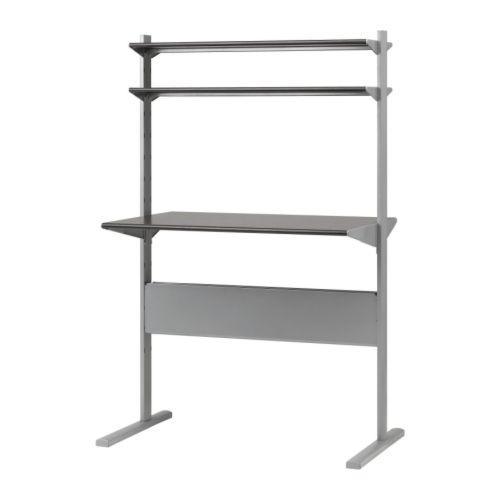
IKEA sells the least expensive standing desk that I found online, the Fredrik workstation for $119, shown below. There’s a wider version for $149. Assembly is required, of course.

Then there are the IKEA hackers — people who repurpose IKEA products to make what they want. Here’s an inexpensive conversion using PVC pipe.

Here’s another hack, the wide standing desk.

This article shows a couple of adjustable-height desks that allow users to flip a switch to adjust the height. This sounds great, for $700+.

Finally, here is a website devoted to creating your own treadmill desk. If you already have a treadmill, apparently you can do this for as little as $39, a significant savings over buying the top-of-the-line Steelcase Walkstation at $4,399, shown below.

Graphic showing why prolonged sitting is unhealthy

Here’s a graphic showing the health risks of prolonged sitting, which I’ve blogged about before:

Besides the reasons shown here and described in the NY Times article link, here are a couple of more reasons why prolonged sitting creates dis-ease and why movement is good for you:

  1. The lymphatic system aids the immune system in destroying pathogens and filtering waste, and it delivers nutrients, oxygen, and hormones to the cells. It has no central pump, like the circulatory system. Instead, the lymphatic system depends on muscular movement, breathing, and gravity to move lymph throughout the body. Frequent movement is critical to move lymph. 
  2. Walking moves the sacrum, which acts as a pump for cerebro-spinal fluid, the fluid that surrounds the brain and spinal cord. Cerebro-spinal fluid nourishes, removes toxins, and cushions the brain and spinal cord. 

Next, tips if you have a job that requires sitting.

Meditation and creativity

A lot has been written about how the practice of meditation helps people become calmer and more centered. Here’s a link to an article about how it can help people become more creative.

…can intelligence and creativity really be as “neuroplastic” as memory and motor skills? Intelligence, much less creativity, has not been conclusively linked with any one area in the brain. The closest analogues are the so-called executive functions, brain systems involved in planning, integrating of sensory information, and abstract thinking, that are thought to be concentrated in the prefrontal cortex. There is, says Aronson, a way to improve executive functioning, and it’s the very same practice prescribed by Alexander: mindfulness meditation.

I particularly liked the description of creativity:

It involves the ability to make unexpected connections, to move fluidly among concepts, to consolidate past memories, ideas, or impressions and arrive at new insights.

How to recognize that someone is drowning

My good friend Barbara and I went out to Lake Travis on Monday afternoon. She is not a fan of cold water, and that is the warmest water in this area that I could think of. We went to Pace Bend Park. Neither of us had been there before.

We parked. She waded, I swam, then we sat in lawn chairs with our feet in the water and had one of those long, delightfully meandering conversations.

We were kind of away from a knot of people who looked like they were having a big family party.

As we were leaving, we saw a park ranger SUV with lights flashing heading our way. I noticed a man in the knot of people talking on a cell phone and waving his arm at the ranger.

Barbara and I drove up to a nearby picnic spot and ate some watermelon, and while we were there, a helicopter flew in, hovering over the water just past the knot of people.

Barbara said, “This isn’t good. Look. That helicopter isn’t going anywhere. It’s just hovering, stirring up the water. They’re looking for something. I think someone drowned.”

That’s all I could figure too. Our hearts felt heavy.

We headed back into town, taking a different route back to the main road. I heard a siren but didn’t see it.

I read the next day that a 25-year-old man had drowned at Pace Bend. He’d been swimming and didn’t resurface. It’s a heart-rending loss for someone to die so young.

I thought of the link that made the rounds on Facebook recently, about how drowning doesn’t look like the movies show it. I’m sharing that link here.

Everyone needs to know how to recognize that someone is drowning. 

To get an idea of just how quiet and undramatic from the surface drowning can be, consider this: It is the number two cause of accidental death in children, age 15 and under (just behind vehicle accidents) – of the approximately 750 children who will drown next year, about 375 of them will do so within 25 yards of a parent or other adult. In ten percent of those drownings, the adult will actually watch them do it, having no idea it is happening (source: CDC).

Noticing space, chunking up

This dharma talk by Ajahn Sumedho, published in Tricycle, brings attention to something we often ignore: space. It is one of the first steps in seeing things differently.

The space in a room is peaceful. The objects in the room can excite, repel, or attract, but the space has no such quality. However, even though the space does not attract our attention, we can be fully aware of it, and we become aware of it when we are no longer absorbed by the objects in the room. When we reflect on the space in the room, we feel a sense of calm because all space is the same; the space around you and the space around me is no different. It is not mine. I can’t say “This space belongs to me” or “That space belongs to you.”

Space is always present. It makes it possible for us to be together, contained within a room, in a space that is limited by walls. Space is also outside the room; it contains the whole building, the whole world. So space is not bound by objects in any way; it is not bound by anything. If we wish, we can view space as limited in a room, but really, space is unlimited.

Noticing the space around people and things provides a different way of looking at them, and developing this spacious view is a way of opening oneself. When one has a spacious mind, there is room for everything. When one has a narrow mind, there is room for only a few things. Everything has to be manipulated and controlled; the rest is just to be pushed out.

Noticing space reminds me of a concept in NLP called “chunk size”. Noticing space would be a relatively large chunk size. Just noticing objects and ignoring space would be relatively small.

Many of the characteristics of becoming enlightened, from what I can tell, have to do with viewing the world with a larger chunk size. Big Mind. Big Heart. NLP calls that “chunking up”.

To move in that direction, begin to notice space. Notice that it’s empty. Notice the space between thoughts, between breaths.

Notice that space connects us all.

Healthy lifestyle turns off disease-causing genes

An important new study from Dr. Dean Ornish shows that changes for the better in diet and exercise, plus adding daily meditation, can create rapid and dramatic changes in genetics.

After three months, 30 men who had avoided conventional treatment for prostate cancer had 48 genes that were turned on — and ten times as many (453) that were turned off. Disease-preventing genes increased activity, while disease-causing genes shut down.

Read it for yourself. Healthy lifestyle triggers genetic changes: study.

It makes sense. We’ve all heard of people who recover their health seemingly miraculously. It may have a lot to do with their belief (or suspension of disbelief) that it is possible to influence their health through changing their basic daily habits — simple changes in food and activity choices.

Thanks to Tim Ferriss for posting a link to this article on Facebook.

And…here’s a link to an abstract that found that just the basic “relaxation response” is enough to trigger positive changes in genes, in both short-term and long-term practitioners.

These studies of course will beget more studies, but no longer can you resign yourself to believing your fate is all in your genes. What you do can activate and de-activate the genes you were born with. DNA doesn’t change, but gene expression does.