Many different flavors of joy

Today’s post centers on a quotation I received this morning via email from Tricycle magazine’s Daily Dharma subscription service. I subscribe to several of these — The Universe, Tricycle Daily Dharma, and Ocean of Dharma are the main ones, and I’m currently testing one for my Enneagram type that I’ll write about later.

I enjoy opening my inbox in the morning and finding words of wisdom.

This is what I found this morning:

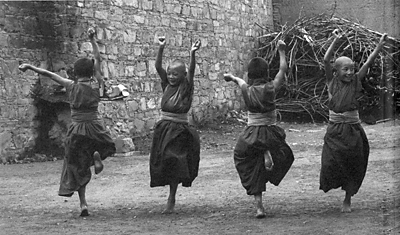
Joy has many different flavors. It might overflow from us in song or dance, or it might gently arise as a smile or a sense of inner fullness. Joy is not something we have to manufacture. It is already in us when we come into the world, as we can see in the natural delight and exuberance of a healthy baby. We need only release the layers of contraction and fear that keep us from it.

The author is James Baraz in Lighten Up! 
Joy. I seem to be in a groove in my life in which I often experience joy. It’s delightful and welcome.

Here are some ways joy has shown up for me recently:

  • Singing along with remastered Beatles songs in my car brings me joy.
  • Responding to an invitation to improvise my movements to music (aka dancing ecstatically); to seek a groove, release it, and find  another groove; continually discover the balances between ease and stamina, attention inward and attention outward, and staying in one place and circulating through the space; of connecting with others and choosing how much to engage; lying in a circle on the floor afterward in silent community.
  • Laughing with a certain friend whose laughter is loud, full, wild, and raucous. Her laugh makes me laugh.
  • Taking two road trips with dear friends recently. Road trips engender good conversation while barreling down the highway and exploring the destination.
  • Making chicken soup for my visiting grandchild who had a fever and sore throat and being comfortably together sharing our lives while it cooked.
  • Attending a house blessing for my friend who is bringing her aged parents to live with her until they pass or need more assistance, and literally filling the house with didgeridoo and rainstick and human sounds, filling every room, closet, and space with our presence and love and joy, decorating altars, and inviting our parents and grandparents, living or dead, and others with similar caretaking responsibilities to benefit from our work together.
  • Massaging people, experiencing the difference between before and after, and knowing I made a difference.
  • Waking to the sound of rain on the roof of my trailer.
  • Having Mango curl up on my chest and purr and put his “hand” on my face when I visit, knowing that my friends who gave him a home love us both. Yeah, kitty reiki!
  • Experiencing a long close embrace with someone special, breathing joy.

Being present and allowing life to unfold as it will inevitably brings moments of joy in some way, shape, or form. Letting joy go when it’s over instead of trying to hold onto it invites it back.

May your day hold many moments of joy, and may you savor each one fully, and let it go.

Go Easy on Yourself, a New Wave of Research Urges – NYTimes.com

Go Easy on Yourself, a New Wave of Research Urges – NYTimes.com.

I love this new research about self-compassion. Our culture often gives us the message that we need to be tough and disciplined with ourselves, yet many aspects of our culture are not very healthy, from obesity, diabetes, and the standard American diet (SAD) to politics, greed, and the environment.

How can we as individuals change this? How do we get healthier? You can start with yourself.

A cutting edge of psychological research shows that giving yourself a break may move you toward better health instead of away from it.

Kristin Neff’s book, Self-Compassion: Stop Beating Yourself Up and Leave Insecurity Behind, is on my to-read list.

People who score high on tests of self-compassion have less depression and anxiety, and tend to be happier and more optimistic. Preliminary data suggest that self-compassion can even influence how much we eat and may help some people lose weight.

Dr. Neff, a professor at the University of Texas at Austin, distinguishes between self-compassion and self-indulgence. A key question is whether you treat yourself as well as you treat the people you care about. Would you tell your child or best friend what you tell yourself when you are struggling?

Also, having compassion for your own suffering does not mean that nothing needs to be done. You can take a moment to feel what you’re feeling, have compassion for yourself, and then consider what you can do to make it better.

This is one of the reasons I like doing and teaching the Emotional Freedom Technique (EFT) using the method I learned from Dene Ballantine.

  1. You accept your own not-so-great emotional experience with compassion.
  2. You bring your focus into the present and onto yourself, without judgment, by forgiving yourself and others. You let go of the story.
  3. You create a direction for movement toward a more pleasant emotional experience.

Pins and needles: Austin Hakomi practitioner tames anxiety gorilla | CultureMap Austin

Pins and needles: Austin Hakomi practitioner tames anxiety gorilla – 2011-Nov-21 – CultureMap Austin.

Rupesh Chhagan, Hakomi acupuncturist and zendo and Facebook friend, profiled in CultureMap Austin.

Beauty.

Neurosculpting: Mapping the Mindscape | elephant journal

Neurosculpting: Mapping the Mindscape ~ Lisa Wimberger | elephant journal.

Given the new discoveries that our brains are elastic and regenerative, rather than hardwired and fixed, what can you do to improve your mindscape? Writer Lisa Wimberger writes that first, we must do something about our stress:

Unfortunately, many of us function in low levels of stress most of the time. Getting our stress under control is extremely important, as it’s both a precursor and a result of remapping or sculpting. We cheat ourselves of all potential transformation when we ignore our stress.

She gives 10 practical tips, including exercising, reframing situations positively, consuming brain foods and supplements, and getting yourself into the alpha state.

Click the link to read all 10 tips.

Dana Foundation Blog: Using Mirrors to Reduce Arthritis Pain

Dana Foundation Blog: Using Mirrors to Reduce Arthritis Pain.

I find it fascinating that by showing people a healthy limb in a mirror, they can remake their maps of their own bodies and gain functionality. Before now, mirror therapy has been useful for amputees. Now it’s being extended to those with osteoarthritis and rheumatoid arthritis.

I wonder what other kinds of mirror therapy are waiting to be discovered.

Arjuna Ardagh: What Is the Spiritual Meaning Behind Occupy Wall Street? | Huffington Post

Arjuna Ardagh: What Is the Spiritual Meaning Behind Occupy Wall Street?.

This writer looks at the Occupy movement from a spiritual standpoint and finds separation and disconnection from one another and the planet at the heart of why it’s happening.

I agree.

Then he writes:

The way that the Occupy movement can be a revolutionary revolution instead of a run-of-the-mill ordinary revolution is if we start with ourselves. We can start by dropping our attention deeper than thoughts, rigid beliefs, reactive emotions and prejudice. We can start by discovering the dimension within each of us, not so far away, which is limitless and free, which needs nothing, but offers everything. Then you become a spiritual activist, an empowered mystic. You take a stand not against something or someone, but for something. You take a stand for life, for celebration, for generosity, for values that make everybody stronger.

Amen, brother.

Wouldn’t it be cool to have a revolutionary revolution, instead of an ordinary run-of-the-mill revolution where nothing really changes except who’s on top?

Hot buttons, EFT, and self-compassion

Ever get a whiff of your own craziness, the things you do or say that are less than kind? I did today. I caught it myself — I see myself writing that like I caught some kind of fish. Yeah, a stinky fish.

In an attempt to be thoughtful, I actually was thoughtless. When I perceived that, I felt so remorseful my heart ached.

Then I found this quote from Tricycle Daily Dharma in my inbox. I’d saved it for several weeks, not knowing why.

We all have personal sensitivities—“hot buttons”—that are evoked in close relationships. Mindfulness practice helps us to identify them and disengage from our habitual reactions, so that we can reconnect with our partners. We can mindfully address recurring problems with a simple four-step technique: (1) Feel the emotional pain of disconnection, (2) Accept that the pain is a natural and healthy sign of disconnection, and the need to make a change, (3) Compassionately explore the personal issues or beliefs being evoked within yourself, (4) Trust that a skillful response will arise at the right moment. – Christopher Germer, “Getting Along”

I want to add step 2.5 to the above. If you are feeling the pain, and you know there’s a need to make a change but the feeling is so sticky, you can’t detach enough to explore your issues, you can do the Emotional Freedom Technique (several times if needed) to reduce the pain enough to get to step 3. It helps us feeling types move on.

In step 3, I discovered that I projected something onto another that was really about me. I’m looking at a big owie in my life head on.

I’m not to step 4 yet but it feels good to just know it’s there waiting, whatever the outcome. All I can do is trust.

Steve Jobs’s Real Genius | The New Yorker

Steve Jobs’s Real Genius : The New Yorker.

I’ve posted several stories about Steve Jobs. Well, I’m typing this on my MacBook Air while my iPhone is charging. His life had an impact on mine.

Some of the qualities I admired about Steve were his open admission to having taken LSD and how that experience shaped him (name another CEO who’s gone public with that information!), his practice of Zen, and his love of good design.

Here, Malcolm Gladwell (Blink, The Tipping Point, Outliers) writes about Jobs’ dark side — his perfectionism — and puts his gift into historical context.

The Biology of Meditation. | elephant journal

The Biology of Meditation. | elephant journal.

Lisa Wimberger provides a Cliff’s Notes version of the book Power Up Your Brain: The Neuroscience of Enlightenment, by David Perlmutter and Alberto Villoldo.

Excerpt:

Stress, trauma and the health perils associated with those states all begin and get perpetuated in the limbic brain, which is comprised of the hippocampus, hypothalamus and amygdala. These are responsible for making our emotional connections outside of logic, taking snapshots of life, creating our dream state experiences, turning on our fight-or-flight response, and storing and delivering emotional information independent of time. The limbic system cannot discern past, present, or future — each “picture” it accesses is experienced by the body as though it’s current.

Fasting and/or a low-calorie diet, antioxidants, voluntary exercise, and meditation are key ways to turn down the limbic brain.

About meditation, she says…

…it is found that those who meditate or enter states of trance have increased blood flow to their pre-frontal cortex (PFC). This area of the brain is the executive decision maker, but is not quite the same as the neo-cortex “logic” mind. The PFC is activated on EKGs during states of compassion, inspiration, motivation and love. It has the ability to project and envision a future reward. It is the part of the brain responsible for motivating us to attain our goals and dreams. Blood flow to the PFC decreases when blood flow to the limbic brain increases.

The Yoga of Protest. | elephant journal

The Yoga of Protest. | elephant journal.

Here’s a yogic take on the Occupy Wall Street movement. Excerpt:

In the midst of all this muddle, a yogic concept called ananda popped into my head. Ananda is Sanskrit; it is one of the highest purposes of Anusara Yoga, and can be translated as deep joy, deep expressiveness, or bliss. It can also be understood as “loving acceptance of what is.”

It hurts to think about practicing this idea in relation to what the Occupy Wall Street protesters are pointing at. It hurts to think about lovingly accepting the deep dysfunction and suffering that is occurring in this world. If I imagine doing that, my heart feels like it might stretch and break. Yet it is what the mystics call for us to do, to love what is hurting us, to empathize with our torturers. Not blindly, naively or passively, but powerfully, radiantly and compassionately.

All of us, 99% and 1%, need to be loved. We need to be seen in our wholeness. Our suffering, yes, our greatness.