The fear of emotional overwhelm

Ann, a new reader of this blog, recently sent me a message on my MaryAnn’s Bodywork and Changework Shop Facebook page that she is doing the trauma releasing exercises, and I thought I would move the discussion here so more people can participate:

hi maryann!

i have just discovered your blog online. thank you for sharing your story and advice to the world. i feel a kinship to you, as i am in the third month of my trauma releasing process.
i practice spring forest qigong (5 yrs)

i have done tre exercises 3 or 4 times a couple of months ago and now i can do them at will.

as fear and anxiety are aspects of myself that i am reclaiming/ integrating… i tend to stop the tremors that seem to want to happen a lot now because my mind wants to understand what is actually happening and will this clear the messages from the subconscious. i have apprehension that the amount i release will then need to be felt consciously afterwards and maybe i shouldn’t do them a lot so i can maintain a balance/ keep up with the processing of the emotions…. or do they just go away?…i saw that you posted to do them as much as they want to come out at first. any thoughts?

i have read that the symptoms come back if you stop…so how do they clear?

maybe they get pushed out in a continual cycle that allows you to consciously release what you can… the release just keeps them suspended for a time?

well, that’s enough thinking… any thoughts?

you are lovely.

heartfelt gratitude.

ann 

p.s. the other day i tremored, kicked, wailed, spoke in about 6 different languages… very grateful i have read waking the tiger as i guess you do need to release the things you would have done when you froze. in the english parts i said “no, i said no!” and i didn’t just “say” it. and at the end of it i went back into english and i said “NO. YOU GET OUT OF ME!” it felt awesome.

A little later, Ann sent the following message:

in re-reading this i could sum it up as : fear of emotional overwhelm 

Well put, Ann. To Ann and everyone else who has ever feared being overwhelmed emotionally, whether by grief, anger, or some other emotion (even bliss), I just want to say that this is very, very common.

We all have emotions. Infants and toddlers seem to have a very full range of them and express them freely and with their whole selves.

And at some young age, we begin to receive messages about emotions: which ones are good, which are bad (or positive and negative, if you prefer), which ones are not okay to express in public, maybe which are not okay to even have, which ones are harmful to repress or bottle up.

Maybe we’ve been on the receiving end of someone’s rage, bad boundaries, or lack of feeling, or have felt/not-felt those ourselves. Maybe we’ve felt emotional pain so strongly we’d do anything to avoid feeling it again, including numbing out for years.

No wonder we get messed up emotionally.

It can feel unsafe to let go emotionally, as if we could die or crumble or never come out on the other side. We fear our own emotions, especially the strong ones, because part of us wants to be in control, and emotions can be very intense.

Ann, it seems to me that needing to experience a balance between release and conscious processing is a belief you have acquired. Try on this belief and see if you like it: allowing the emotion/trembling/etc. to flow through you IS clearing the subconscious. You don’t have to understand it for it to work!

And if understanding does come, it will come AFTER you clear the channels and return to a calm state in which other parts of your brain can come online to create whole-brain insight.

I also imagine you experimenting with releasing as much emotionally/physiologically as you feel comfortable with for a few days, letting your conscious mind work at its own pace, and seeing for yourself what happens. That cannot mess you up—it’s just you discovering what mix of emotion and thought, conscious and unconscious works best for you.

I remember feeling rage about 10 years ago for the first time since I was about two, because it wasn’t acceptable in my family or in much of society. I was alone, remembering something I hadn’t thought about in years, when suddenly I had a different understanding of it that brought up hot, intense anger.

I didn’t know what was happening at first, so I kept allowing it to happen because I was curious—and alone. I am sure I got red in the face. There was definitely an upward surge of hot energy toward my head and a stiffening of my posture. I stopped in mid-stride.

Right after I was feeling the most intense anger, my inner witness was marveling, “So this is what rage feels like! I get it how steam comes out of Elmer Fudd’s ears and the grimace and posture he makes!”

It actually had a very, very cleansing effect. It renewed my self-esteem and motivated me to protect my interests. Afterwards, I felt like I had on a cloak of protection. It was actually near the beginning of my trauma recovery process, but I didn’t know that then.

Interestingly enough, fully allowing that rage to flow through me and feeling it completely took maybe 30 seconds. A very slow 30 seconds, to be sure.

Imagine: I had spent years denying/repressing my anger, and when I let it ripple through me, it only took half a minute of intensity, and the benefits were enormous and lasting.

Lesson 1: Emotions have two components. You experience them in your body, and they change you (you resolve an inner conflict, and then you take action: set a boundary, express a concern, reframe your identity, make a decision, right a wrong, and so on).

Lesson 2: You can allow yourself the experience of feeling the emotion fully without having to take action right away. That can come later. Unless the situation is life or death, you can let it settle before doing anything. That provides time for other less emotional parts of your brain to add their gifts on the wisest course of action for you to take. Meanwhile, you’re not bottling up something toxic.

Lesson 3: This is easier said than done. We’re all here in the School of Life. We mess up, we learn, we forgive, we grow.

So this is the thing. I can’t really tell you what’s right for you, but maybe these lessons can help you get through the labyrinth.

I found this quote on Tricycle Daily Dharma, and it’s perfect for this post:

The ebb and flow of life is not unlike the sea. Sure, sometimes it’s calm and serene, but at other times the waves can be so big that they threaten to overwhelm us. These fluctuations are an inevitable part of life. But when you forget this simple fact, it’s easy to get swept away by strong waves of difficult emotions.— Andy Puddicombe, “10 Tips for Living More Mindfully”

I would be remiss if I did not mention one of the best books I’ve read about emotions and their messages, The Emotional Hostage: Rescuing Your Emotional Life by Leslie Cameron-Bandler. It’s an oldie but goodie that helps you decode the purpose of each emotion and use your emotions to live more authentically.
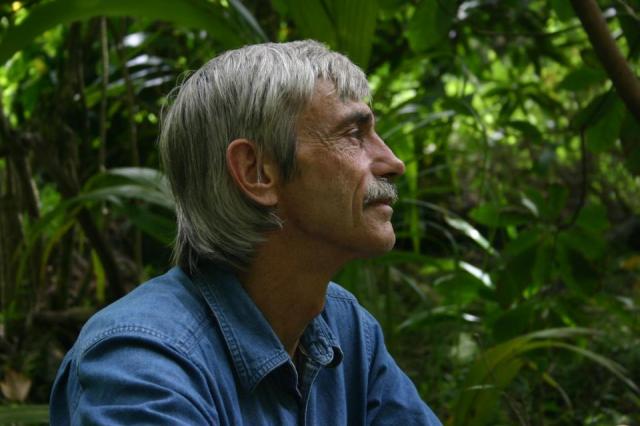
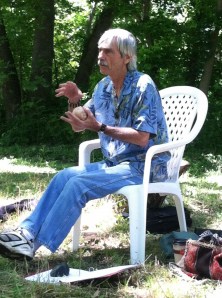
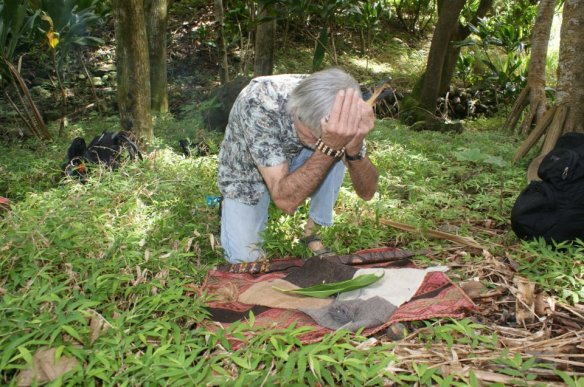
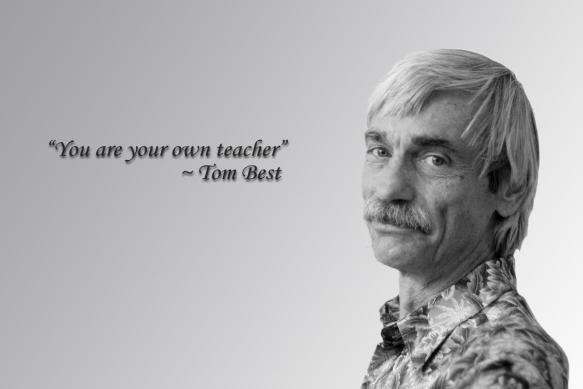
When the teacher is the teaching: Tom Best.

I figure I spent a thousand hours with Tom Best between 2007 and April 21, 2012, three days before his death.

I took NLP practitioner training as a student in Austin. Then evolutionary NLP in Dallas. Nightwalking in Wimberley. NLP master practitioner as a student, Austin. evolutionary NLP in Maui. NLP practitioner as a training assistant, Austin. Nightwalking at Buescher State Park, Smithville. NLP master practitioner as a training assistant, Austin. The Tom Best and Steve Daniel workshop using sound, Austin.

Several times I attended the first weekend and last day of practitioner trainings when I wasn’t a student or training assistant, to see him and Bobbi and my friends who also assisted, and to meet the new students and lend my support, and to re-experience “beginner’s mind” with NLP.

On April 21, I took a day of evolutionary NLP at Alma de Mujer, and he died three days later.

He was my teacher, and he was the teaching, my heart realizes now, after he left.


He was not really my friend, in the sense that we didn’t hang out in our off time and let our hair down together. Outside of teaching, he was a private man, a little shy and reserved, already giving a great deal of himself, a world-traveling teacher seriously devoted to spending his non-teaching time at home with his wife Bobbi and their dogs and cats.

But he was friendly from the start, and I felt love for him and from him.
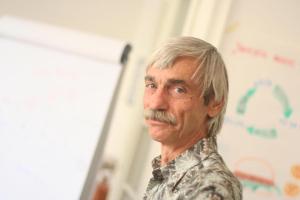
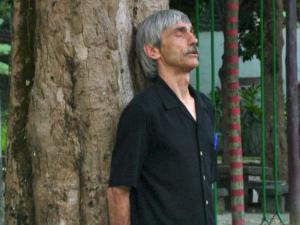
Who knows how he saw me? I don’t think I can even begin to see myself as he saw me in 2007 or how he saw me on April 21. I can tell you that I changed, that his teachings transformed me, and others witnessed that. Among my long-time friends, I am known for having changed.

I have had many teachers in this lifetime. Many were teachers who did not even know they were my teacher because I read their books or watched them on video. Many many many more didn’t know they were teachers — they said or did something I learned from, sometimes what to move away from, and sometimes what to move toward.

I signed up for in-person lessons and cracked myself wide open to take in Tom Best along with his teachings more than I have to any other teacher, besides my parents, in this lifetime. I poured myself into the NLP pot, and he cooked me.

He was at the front of the room, talking, waving his long fingers around, drawing the VAKOG face, telling the Lake Conchas story and so many more, demonstrating a technique, explaining concepts, giving instructions, telling us to take an 11 minute and 17 second break, then ringing a bell to bring us back together…

When I started pract training, I quickly figured out that the academic learning style (dissociated, conceptual) that I had experienced so much of in school and college (and done well with) was not going to work. This NLP required experiential learning, and the only way to do it was to learn with my whole self — to take it in as much as I could, ask for help when I needed it, and then just do it. And then do it again, better. And again and again and again. And to later, to offer my help.

I can hear Tom’s voice right now, explaining the journey from unconscious incompetence, to conscious incompetence, to conscious competence, to unconscious competence.

I can hear him saying, “There’s no such thing as failure, only feedback.”

He gave us permission and encouragement to put ourselves out there, on the line, and do the techniques imperfectly. Just do it. I learned to accept doing something imperfectly, to forgive myself for being less than perfect, and to recognize that repetition creates mastery (along with tape editing).

I now see that that’s what made him such a great teacher, putting himself out there, on the line, over and over again, for years, around the world. He just got better at it, so that on Saturday, April 21, he almost seemed to consist more of pure energy (the energies of his intent, presence, attention, clarity, and love) than of matter or ego.

Some of my notes from that day:

Intention is of the tonal. It’s about your desired outcome.

Intent requires no thought. It is gratitude, alignment, participation, connection. (It is of the nagual.)

“Intend to align with realization,” I wrote.

That is so him! He was that teaching. See what I mean about him being the teaching?

Learning NLP the NLP way was exhausting. I went home from each day of practitioner training drained, needing to do something that didn’t require thinking, like watch a funny movie or just veg out.

When I assisted, some other students experienced that too.

I realize now that NLP training required my focused attention for hours at a time in a way that not much else had required. In school, I had learned quickly and then stared out the window, lost in my own private thoughts, while others struggled.

In the NLP pract classroom, I was not an A student. I struggled and was lost sometimes, which challenged me to become a training assistant so I could take it again.

Little did I know that I was building attentive stamina. 

Energy flows where attention goes. — Huna wisdom taught by Tom Best

I was also practicing intent, aligning with realization. Gratitude, alignment, participation, connection.

I’m very grateful that I served as a training assistant so I could take pract training again. It was much lighter and less exhausting, and I got even more out of it the second time around. I integrated the concepts and experiences more deeply. I was both student and training assistant for master practitioner too.

I had wanted to assist at each level one more time.

So for a thousand hours, my attention was on him, watching him speak and move, hearing his voice, taking him in with my whole self. His skinny, graceful, long-fingered, elegant, story-telling, teaching, sly, aligned, humble, gracious, personable, receptive, gently challenging, channeling, funny, quirky, fluid, congruent, trance-inducing, masterful, realizing self.

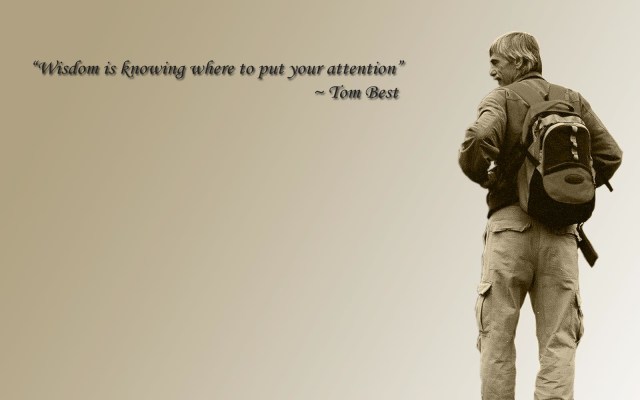
Wisdom is knowing where to put your attention. — Tom Best

I put my attention on you, Tom, over and over again, and it’s like in the grief process where you bring the person into your heart, instead of feeling their absence. You are in here, man. You are so present in my mind and in my heart as I absorb your life and teachings even more and make meaning of it all.

And then you did something a bit surprising and very human. You died. You lived your life well and fully, and then you slipped away, in your sleep, painlessly, quickly, easily.

So I just need to say this one more time, or a thousand more times:

You modeled love, love, love. Mahalo for showing the way.

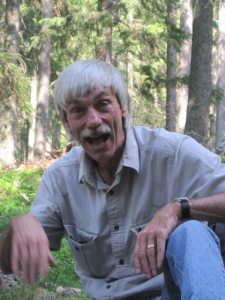
Thanks to the Facebook group The Grace of Tom Best for all of the photos except the small blue one where he’s seated (that’s mine from April 21).

The rainbow-bridge, huayruro seeds, the long body, and the nagual: a tribute to Tom Best

Part of Monday’s reading from The American Book of the Dead by E.J. Gold, which I’m reading for my teacher Tom Best, who died this past week, is this:

If my attention is concentrated and clear, I will merge into the heart of the beloved, in a halo of light called the rainbow-bridge, and attain completion in the region known as Endowed-with-Glory.

The heart of the beloved here refers to an unveiled vision of reality. The clear light and the region known as Endowed-with-Glory are metaphors for the sea of the nagual, to my mind.

So much love, and such clear attention. He is still teaching me.

For the past few days, all the readings (and there are readings for 49 days after death) have mentioned the “rainbow bridge” or the “rainbow light.” When I realized that, I got GUS (god-universe-spirit) bumps because of the following story:

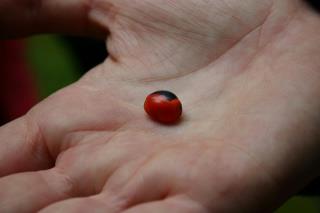
For many years, at the end of many of his trainings and workshops, Tom gave out “rainbow seeds” to his students. They are actually the seeds of the huayruro plant, from Peru. They are beautiful hard seeds of shiny red with a black spot. They are believed to bring powerful good luck and are often strung into necklaces and otherwise made into jewelry.

Tom’s instructions were to give these rainbow seeds away, and to give them to either a person or a place that signified excellence or devastation. In other words, a person or place of exceptional excellence, or a person or place in need of healing. (I am hearing his voice speak these words so clearly as I type, as I often do these days.)

I’ve dropped rainbow seeds in areas that have been ugly or devastated, and in spots so beautiful they took my breath away, and I’ve also given them to many people, for one or the other reason. I have also received one, which I mixed in with the others, and I don’t know which one it is now! I will give them all away.

I actually gave one to Tom once, when he was telling my master practitioner class about losing his beloved dog Dakota (whom I met when I first met Tom in the late 1990s), openly weeping as he spoke, sharing his sudden loss with us–and modeling how to let our emotions flow through us.

Tom gave these seeds out at numerous trainings every year all around the world, and the people he gave them to have also distributed them to people and places they’ve encountered. Tom called this “building rainbow bridges.”

We recipients now connect to each other on this planet, through him, the healed and the in-need-of-healing, the beautiful and devastated (because don’t we all–and this planet–have potential for both, and isn’t such a state always fluid?), and this bridge lives on even though he has transcended his earthly life, continuing its transformation in us. It’s almost as if he foresaw this happening.

Now that is wisdom, living through the long body. What a master.

Tom, you have been building rainbow bridges for years before passing. I realize I am doing these readings mostly for me (and with Bobbi Best when she is able to join me), because I don’t think you need my help at all in this transition.

My emotional body finds it hard to say goodbye, although I moved some heavy grief hucha up and out at ecstatic dance on Sunday. My spirit body feels Tom’s presence within and around me.

You were my teacher and also the teaching in how you lived your life. Mahalo for showing me that. You know how to move into the nagual. Love, just love, love, love, Tom.

(Thanks to my friend from Maui, Erich Wolf, for posting the photo of the huayruro seed above, to Istok Pavlovic, Catharine Stuart Lord, and Nikola Jovanovic for the photos and posters of Tom and his words of wisdom and how to save high-resolution versions, and to Luzia Helena Wittman for sharing the photo of the footprints in the sand–taken by Tom of his own footprints in Portugal–on the Facebook group The Grace of Tom Best. Mahalo, my friends.)

For more about Tom, I wrote a later post that you might also like to read: When the teacher is the teaching: Tom Best.

With sparkling eyes and good posture!

From today’s Ocean of Dharma email, this is who we really are:

THE DIGNITY OF FEARLESSNESS

There is more to fearlessness than merely having overcome fear. Beyond that, when we speak of fearlessness, we are describing a positive state of being full of delight and cheerfulness, with sparkling eyes and good posture. This state of being is not dependent on any external circumstances. It is individual dignity. This joy and unconditional healthiness is the joy, the basic virtue, that comes from being what we are, right now. ~ Chogyam Trungpa Rinpoche

I have to say, the description of sparkling eyes and good posture is how I enjoy living my life, as much as I possibly can. It’s where I return when external circumstances take me out of it temporarily.

Joy and unconditional healthiness is who we are, and I am so grateful to have read this early today, as I woke this morning processing some sad, hurt, disappointed, angry feelings, with tears in my eyes.

This feels more like home, these sparkling eyes and good posture!

Happy Easter!

I want to share this wonderful quote from Jean Houston:

Resurrection is essentially a remembrance of one’s true nature and a waking up to this remembrance.

This Easter, may you wake up and remember who you really are.

What if there is no “normal” to return to after long-term PTSD? Be unfaithful to your sorrows.

I tagged a customer review of a book on Amazon because it moved me and I wanted to track comments on the review. It spoke to me.

(The book is In an Unspoken Voice: How the Body Releases Trauma and Restores Goodness by Peter A. Levine, author of Waking the Tiger, a book that changed my life.)

Fred wrote:

I agree with the comments about this book. I have the book and a couple of his other ones and I learned from them, they were my first knowledge of what trauma could do. I want to make a specific trauma comment and since the author has helped me alot what better place to do it!

At age 60 I am finally and only recently past the terror of early, continuous and prolonged childhood abuse because of the healing work I have done on my own. I recommend books and techniques from Alice Miller, Peter Levine (of course!), David Berceli, Babette Rothschild, EMDR, EFT, PARTS/EGO STATES work, NLP. I am a little leery about unsupervised guided imagery and meditation because they can be so close to dissociation, I sure did.

My comment is that with early abuse in whatever form the child has to create coping and defensive mechanisms to be able to survive mentally. These PARTs then prevent the child from growing naturally like all children should. As an adult these PARTS drew me to abusers and perpetuated actions which continued to retraumatize me. I didn’t know any better.

People who experience trauma as adults can use the techniques the author describes and those listed above to get back to normal. I have come to the awful realization that I have no NORMAL to go back to! My former desires and reasons for living no longer exist. They were based on avoiding reality, lessening the pain and terror, and plowing through dissociation to be able to function. While I don’t have the terror anymore I am still trauma parallyzed (Freeze, surrender) as I have been for most of these 6 decades and I don’t have the NORMAL interests and motivations which would help me get past that. “I” do not exist.

My hope from this review is that this Catch 22 can be added to trauma discussions. I don’t know what can be done to create a resource or if there are even more people like me out there.

I guess a correlary is to emphasize the need to help children who do experience trauma, as early as possible. (Another of the author’s books.)

Fred says there’s no normal to return to because of childhood abuse.

I ask Fred and others who have experienced long-term PTSD who don’t believe they have anything like a “normal” self to return to:

What if “normal” is an illusion? What if there is no normal?

Really, if your trauma began at age 1 or 11 or 21, the “returning to normal” is returning to how you were before the trauma began. What would it look like for a 60-year-old healing trauma victim to return to being a normal one year old? It doesn’t seem to work like that.

Perhaps “normal” is a concept that the mind desires that doesn’t really exist. Even for so-called “normal” people!

If that’s the case, then I say you get to determine what normal means for you.

Maybe normal means being a more present, heart-centered, resourceful person.

Maybe normal means finding what you believe you missed out on: a sense of worthiness, love, inner peace, trust, self-respect, and so on.

Maybe it’s having a strong connection to an enlightened witness. Maybe that enlightened witness is an inner part, Divine Essence, or another person.

Maybe normal is being a valued member of a community and building close relationships.

Maybe normal is being playful and having fun. Maybe it’s setting the boundaries you need to thrive.

Maybe normal is feeling centered in your body and having your energy flow freely, and learning how to return to that state when you become uncentered or blocked.

Maybe it’s wanting to experience the most joy, connection, sanity, and love — both giving and receiving — as you can and having a damn good reason for doing so. Living really well is the best revenge and the best healing you can possibly do.

Imagine that you fully and completely have the experience of being normal. What would that do for you ? Let’s hear it! “Then I’d be…”

And what would that do for you?

Take it as far as you can and enjoy experiencing that staate.

There’s a Zen phrase “unfaithful to my sorrows” that I use on my About me page. To me, it means that no matter what your sorrows are, or how many or deep they are, or how long you’ve had them, there are at least moments when you’re unfaithful to them — times when you forget them and notice something else. A rainbow. Some music. A dream image. A dust bunny. A release of tension.

We tend to believe we’re defined by our sorrows and traumas, but we’re not. We can let these non-sorrow moments become large.

Krishnamurti put it like this:

What can be described is the known, and the freedom from the known can come into being only when there is a dying every day to the known, to the hurts, the flatteries, to all the images you have made, to all your experiences— dying every day so that the brain cells themselves become fresh, young, innocent.

My dear friend Keith Fail says it more simply,

We’re always bigger than we think we are.

Regret, distortion, aging, what’s real, going forward

This quote today from Tricycle Daily Dharma resonated with me fiercely today. I’ve been resuming my sitting practice:

One of the main things that happens when you meditate is that regret starts to surface and you start to think about your life. Meditation neutralizes denial after a while and opens up the circuits and things start to flow in, and then you begin to realize that regret is a distortion of what’s real. What’s real is that this is your life, and it happened, and there’s no going back. There’s only altering your attitude and perception about it so that you can go forward.

The author is Lewis Richmond in Aging as a Spiritual Practice.

Regret is about the past. There’s no going back. You can just be here now and move forward.

I would add that forgiving and accepting yourself are important for letting go of past regrets.

But if you talk candidly to older people, I think they have an intimation that there’s something precious and new about growing old. 

But I don’t think anybody would trade their mind. I think that life is cumulative, and if I look at who I was at 35, it’s clear I know more now. I’m a deeper person. I have a deeper appreciation of other people. I’ve just lived a life—a full life. 

There’s some point in your life, early or late, when it hits you that you and everybody else that you care about and love are not going to be here eventually, so now what? That’s the gate. And when you’re at that gate, life changes on you. It has a different coloration. It’s more precious. It’s more serious. You feel a loss of innocence.

A lot of us nowadays will live to be 90, so part of the gate is, “Yeah, I’m getting old and I’ve got a lot of time left, so what am I going to do?” Play golf?

It’s [meditation is] good for knowing what’s real and what isn’t, and that takes time to emerge. There’s a tremendous actual liberation in knowing what’s real, and increasingly you can discern that in situations, through your meditation, “Well, this is just my stuff.” Or, “This is solid. This is real.”

Regret is the ego trying to distort what is unchangeable, and we have various words for how that happens. One of them is denial, which is very powerful. Research shows that it is largely neurological. The neural circuits simply don’t fire. The brain arranges to protect you from the pain; it’s like you literally can’t get there, and you arrange not to get there in terms of remembering, but I think transforming regret into appreciation is one of the main values of meditation.

Four constructive things to do with your anger

A recent Tricycle Daily Dharma quotation is timely, and I’m sharing. It’s worth exploring anger for what it actually is.

Because we imagine anger is never a good thing, it is easy to think we should practice simply not being angry. But that approach is too general and abstract. It’s important for each of us to be precise, to be real, to be personal and honest, to find out exactly what my anger is. To do that we need to ask ourselves lots of questions about its actual nature.

It is quite a fabulous skill in life to handle anger well — to feel it and not suppress it, and to use it constructively. I’m definitely not saying I’m the most skilled at handling my anger, but I have come to recognize some of its complexity and discovered a key that helps me manage it constructively.

Watch some angry cartoon characters display anger in this video. You may never see anger in humans in the same way again!

First, anger is a body sensation. You can see it in the cartoons. For me, there’s a stiffening, a rigidity that I experience, often in my neck or back. My spine lengthens as I draw myself up to my full height. When it’s more intense, I feel prickly sensations and sometimes heat.

Only rarely have I experienced what Elmer and Daffy do so well, the red face, the steam coming out of ears, the grimace, the fists, the in-your-face stalk, the growl.

I dream about being Bugs Bunny, but when I wake up, I’m Daffy Duck. ~ Chuck Jones

  • Next time you’re angry, if you can, take a moment and notice what you’re feeling in your body, how your state has changed, what your mind is telling you to do. Just notice.

Anger has degrees of intensity. Anger includes a family of emotions that range from annoyance to rage. There’s a huge difference between asserting oneself when annoyed and abusively vomiting one’s rage on someone.

  • How angry are you on a scale of 1 to 10?
  • Can you describe it explicitly — outraged, irritated, mad, hostile, slow burn, furious, exasperated, chagrined, huffy, miffed, pissed, petulant, sullen, piqued?

Anger needs release. Anger builds toward action. This is where I think most of the problem lies. It’s not the anger itself, it’s what people do to release it that can be so destructive. People can emotionally and physically abuse others because they know no other way of releasing their anger. They finger-point and blame — and most of the time, other people are just doing the best they can, unable to read your mind.

When you’re angry, a different part of your brain is operating than the part that is able to have a dialogue, listen respectfully, and negotiate a solution. Respect that. Allow it. Just remember that.

What you do depends on the degree of your anger. If you feel annoyed, irritated, or dismayed, a few concise words can convey that with minimal damage. If you’re feeling really angry, like at least a 4, it’s more about you, not them.

Also, sometimes people feel their anger and recognize its intensity, but then they swallow it because they don’t want to be destructive but don’t know what else to do. That feels really miserable and isn’t a good solution to “the anger problem”.

  • So…here’s a new skill. When you feel so angry that you might say something you’ll regret, don’t even try to converse. Instead, move your body and make noise. Pace, stalk, make fists, punch a pillow, grimace, wave your arms. Dance with your anger. Growl and howl. You can even let loose a nice juicy string of curse words (or fake or foreign curse words) not aimed at anyone.

The other person witnessing your nonverbal anger may find your anger beautiful, or at least entertaining to watch (if they stay out of your way, right?).

Examine your anger later, when you’re calm. What triggered it? I’m guessing it was probably something you didn’t like, an injustice or injury, or a sense of invasion.

  • Ask yourself and the other party (if they’re willing) some good questions. Did someone violate one of your rules? Did they fail to read your mind? Could you have contributed to it? Did you communicate your preferences with clarity? Or could your rule conflict with their rule? Did they assume something about you that wasn’t true? How do you move forward? There’s a lot of room for understanding when you get to this stage of anger.
  • Also, was there another emotion behind the anger, like fear or hurt?

This is the best thing about anger, in my opinion. You learn more about yourself and the other person, and you’ll improve your communication skills. Sounds like a gift, doesn’t it?

~~~

As long as I’m posting about an emotion, I want to recommend a book that I found very helpful for understanding the emotions and the purpose each serves. It’s The Emotional Hostage, by Leslie Cameron-Bandler. It will help you decode your own emotions and those of others, understand the clear messages that each emotion conveys, and resolve your relationship problems more easily.

~~~

1/30/2012. Just encountered this quote from the Dalai Lama about anger:

When we are angry we are blind to reality. Anger may bring us a temporary burst of energy, but that energy is blind and it blocks the part of our brain that distinguishes right from wrong. To deal with our problems, we need to be practical and realistic. If we are to be realistic, we need to use our human intelligence properly, which means we need a calm mind.

Sadie Nardini Responds to “How Yoga Can Wreck Your Body”

Sadie Nardini Responds to “How Yoga Can Wreck Your Body”. | elephant journal.

Here’s yet another response from a well-known yoga teacher to the controversial recent New York Times article. Sadie Nardini recommends that students concerned about the possibility of injuries choose instructors based on how much anatomy training they’ve had. Very little is required for the RYT-200 credential. I think it’s about 20 hours.

She mentions Leslie Kaminoff as being an expert on anatomy. I took a workshop with him today. Nearly half the class of 70 were yoga teachers. He showed us some of the Anatomy Trains cadaver video and a couple of Gil Hedley’s cadaver videos (I posted his video on “fuzz” previously).

Leslie and Amy Matthews have updated their book, Yoga Anatomy, which Sadie recommends.

She makes some good points, especially noting the contradictions in what Glenn Black said to the New York Times and what he said to the Huffington Post about his own yoga injuries and whether yogis should do headstand.

It’s your body–don’t trust it to just anyone. Ask any prospective yoga teacher what, if any yoga injuries they’ve had, and if, for example, they’re about to go into spinal surgery from years of severely over-expressing themselves in yoga posture, then move on.

In addition, each student has a responsibility to check themselves before they wreck themselves in class. You might not know everything about yoga poses or anatomy, but you do know the feeling when you’re pushing too hard.  So when the urge to go all agro on a pose arises, whether it’s to strain toward strength or flexibility, it’s ultimately up to you to resist the ego’s siren song–something that leads even more experienced yogis to push their limits, then act mystified at the fact that this supposedly ‘healing’ practice hurt them instead.

What if awareness is a quality you are inside of?

Indeed, the ineffability of the air seems akin to the ineffability of awareness itself, and we should not be surprised that many indigenous peoples construe awareness, or “mind,” not as a power that resides inside their heads, but rather as a quality that they themselves are inside of, along with the other animals and the plants, the mountains and the clouds. – David Abram, The Spell of the Sensuous

Thank you, Gioconda, for sharing that quote at the beginning of your yoga class a few weeks ago, and thanks for sending me the actual text and source. The profundity of this quote has been playing with me.

I invite you in this transitional week leading to the new year to play with this concept, to try it on. Ask yourself these questions.

Better yet, pull some questions out of thin air!

What if mind, or awareness, is something we walk around in and live our entire lives inside of, like the air?

What if our entire bodies — torsos, limbs, skin, bone, muscle, organ, connective tissue — are as immersed in this mind as our heads are? Can you experience yourself that way? Can you know with your toes? Discern with your liver? Learn with your heart? Understand with your hand?

What if mind is an element like air? Among the elements, air does represents mind — what if it is mind? We breathe it in for nourishment and exhale into it for release? Does that give new significance to your breathing? And because everyone is doing this all the time, what if the quality of Mind changes by what you and others put into it and take out of it?

Is this the illusion or is it real? Is this consensual reality?

What if expanding your mind, or if you prefer, expanding your awareness, is nothing more than more sensitively experiencing yourself and your surroundings?

And, what if there is no limit to how sensitively you can do this?

What if the boundary between self and environment is just a convenient construct for communication purposes but actually doesn’t exist?

For more on David Abram, here’s a chapter from The Spell of the Sensuous. Excerpt:

For none of the several island sorcerers whom I came to know in Indonesia, nor any of the djankris with whom I lived in Nepal, considered their work as ritual healers to be their major role or function within their communities. Most of them, to be sure, were the primary healers or “doctors” for the villages in their vicinity, and they were often spoken of as such by the inhabitants of those villages. But the villagers also sometimes spoke of them, in low voices and in very private conversations, as witches (lejaks in Bali)–dark magicians who at night might well be practicing their healing spells backward in order to afflict people with the very diseases that they would later cure by day. I myself never consciously saw any of the magicians or shamans with whom I became acquainted engage in magic for harmful purposes, nor any convincing evidence that they had ever done so. Yet I was struck by the fact that none of them ever did or said anything to counter such disturbing rumors and speculations, which circulated quietly through the regions where they lived. Slowly I came to recognize that it was through the agency of such rumors, and the ambiguous fears that such rumors engendered, that the sorcerers were able to maintain a basic level of privacy. By allowing the inevitable suspicions and fears to circulate unhindered in the region, the sorcerers ensured that only those who were in real and profound need of their [healing] skills would dare to approach them for help. This privacy, in turn, left the magicians free to their primary craft and function.

A clue to this function may be found in the circumstance that such magicians rarely dwell at the heart of their village; rather, their dwellings are commonly at the spatial periphery of the community amid the surrounding rice fields, at the edge of the forest, or among a cluster of boulders. For the magician’s intelligence is not circumscribed within the society–its place is at the edge, mediating between the human community and the larger community of beings upon which the village depends for its nourishment and sustenance. 

For more on Gioconda Yoga, click here. She’s got some cool workshops coming up!

(By the way, this is my 500th blog post. When I started this blog two years ago, I had no idea I’d post 500 times or post about this topic. Yay life for creating itself anew every day!)