What if there is no “normal” to return to after long-term PTSD? Be unfaithful to your sorrows.

I tagged a customer review of a book on Amazon because it moved me and I wanted to track comments on the review. It spoke to me.

(The book is In an Unspoken Voice: How the Body Releases Trauma and Restores Goodness by Peter A. Levine, author of Waking the Tiger, a book that changed my life.)

Fred wrote:

I agree with the comments about this book. I have the book and a couple of his other ones and I learned from them, they were my first knowledge of what trauma could do. I want to make a specific trauma comment and since the author has helped me alot what better place to do it!

At age 60 I am finally and only recently past the terror of early, continuous and prolonged childhood abuse because of the healing work I have done on my own. I recommend books and techniques from Alice Miller, Peter Levine (of course!), David Berceli, Babette Rothschild, EMDR, EFT, PARTS/EGO STATES work, NLP. I am a little leery about unsupervised guided imagery and meditation because they can be so close to dissociation, I sure did.

My comment is that with early abuse in whatever form the child has to create coping and defensive mechanisms to be able to survive mentally. These PARTs then prevent the child from growing naturally like all children should. As an adult these PARTS drew me to abusers and perpetuated actions which continued to retraumatize me. I didn’t know any better.

People who experience trauma as adults can use the techniques the author describes and those listed above to get back to normal. I have come to the awful realization that I have no NORMAL to go back to! My former desires and reasons for living no longer exist. They were based on avoiding reality, lessening the pain and terror, and plowing through dissociation to be able to function. While I don’t have the terror anymore I am still trauma parallyzed (Freeze, surrender) as I have been for most of these 6 decades and I don’t have the NORMAL interests and motivations which would help me get past that. “I” do not exist.

My hope from this review is that this Catch 22 can be added to trauma discussions. I don’t know what can be done to create a resource or if there are even more people like me out there.

I guess a correlary is to emphasize the need to help children who do experience trauma, as early as possible. (Another of the author’s books.)

Fred says there’s no normal to return to because of childhood abuse.

I ask Fred and others who have experienced long-term PTSD who don’t believe they have anything like a “normal” self to return to:

What if “normal” is an illusion? What if there is no normal?

Really, if your trauma began at age 1 or 11 or 21, the “returning to normal” is returning to how you were before the trauma began. What would it look like for a 60-year-old healing trauma victim to return to being a normal one year old? It doesn’t seem to work like that.

Perhaps “normal” is a concept that the mind desires that doesn’t really exist. Even for so-called “normal” people!

If that’s the case, then I say you get to determine what normal means for you.

Maybe normal means being a more present, heart-centered, resourceful person.

Maybe normal means finding what you believe you missed out on: a sense of worthiness, love, inner peace, trust, self-respect, and so on.

Maybe it’s having a strong connection to an enlightened witness. Maybe that enlightened witness is an inner part, Divine Essence, or another person.

Maybe normal is being a valued member of a community and building close relationships.

Maybe normal is being playful and having fun. Maybe it’s setting the boundaries you need to thrive.

Maybe normal is feeling centered in your body and having your energy flow freely, and learning how to return to that state when you become uncentered or blocked.

Maybe it’s wanting to experience the most joy, connection, sanity, and love — both giving and receiving — as you can and having a damn good reason for doing so. Living really well is the best revenge and the best healing you can possibly do.

Imagine that you fully and completely have the experience of being normal. What would that do for you ? Let’s hear it! “Then I’d be…”

And what would that do for you?

Take it as far as you can and enjoy experiencing that staate.

There’s a Zen phrase “unfaithful to my sorrows” that I use on my About me page. To me, it means that no matter what your sorrows are, or how many or deep they are, or how long you’ve had them, there are at least moments when you’re unfaithful to them — times when you forget them and notice something else. A rainbow. Some music. A dream image. A dust bunny. A release of tension.

We tend to believe we’re defined by our sorrows and traumas, but we’re not. We can let these non-sorrow moments become large.

Krishnamurti put it like this:

What can be described is the known, and the freedom from the known can come into being only when there is a dying every day to the known, to the hurts, the flatteries, to all the images you have made, to all your experiences— dying every day so that the brain cells themselves become fresh, young, innocent.

My dear friend Keith Fail says it more simply,

We’re always bigger than we think we are.
A reader shares her awesome trauma releasing experience; another TRE video

I checked my email this morning right before work and saw one saying that someone had posted a blog comment. It was in response to my very first post on the Trauma releasing exercises, posted way back in May of 2010, close to two years ago.

Jen wrote:

Learnt the TRE technique from a friend. After my 4th session (last night) I got up and my body started swaying at the hips, then shoulders went mad, neck went into awesome neck rolls (felt a lot like yoga) and then an intense feeling from the centre of my belly, rolling upwards. Went on for at least an hour before I eventually went to bed to sleep. Just the one hand kept doing a little shake.

This morning on my way to work, my neck started rolling. Once at work I was standing telling my friend about this when my entire body started swaying and all morning (at least the last 4 hours) have been spent with my neck going into involuntary neck rolls, shoulder rolls, back stretches. It has finally stopped, but I am just a bit concerned. What does this mean?

I got really excited reading this! The trauma release process is working for Jen very well. To have this response after only four sessions is excellent. Her body is releasing trauma! To have a release from the hara (belly center) like that is very liberating. Maybe her yoga helped.

When I was first experimenting with the TRE exercises, I remember feeling some fear around the idea of “letting go”. What exactly is being let go of, and if I let go (i.e., lose control), will I get my self-control back?

Then once I started shaking, trembling, rocking, and rolling, I wondered: Would I be able to stop? What if it was embarrassing?

I needn’t have worried.

I responded right away:

It means you are unfreezing and coming alive, Jen! Do it as much as you can when it feels right. Enjoy and know it will eventually slow and become “more voluntary” when you’ve released more of your stress. Awesome to hear from you!

She wrote back:

Wow, thanks for getting back to me so soon – you have put my mind at ease. My friend and I were laughing hysterically this morning as it just wouldn’t stop and then we started getting a little worried that it would NEVER stop. But this afternoon has been fine and when it starts again I will know it is normal and let it out!

Keep well
Jen

I haven’t blogged about the trauma releasing exercises for a long time, but I haven’t forgotten them. Once I learned them and began shaking, the process deepened. I released long-held tensions, especially in my shoulders. Every time I did them was different. I did them frequently for a while.

Sometimes nowadays when I am at Ecstatic Dance Austin or at home, I release tension in my legs and occasionally my arms/shoulders. I don’t think about it too much; if the thought pops into my mind, I never second-guess it. I just allow the release to happen. I’m standing, and my legs are shaking or my arm is writhing — something is moving, for sure.

And when I’ve had enough (again, without thinking about it), I dance (or rather, I do a more intentional dance, becaus release is dance) or go onto the next activity.

I’ve considered doing the training to become a TRE facilitator and may still do that when the time and money come together. For now, I’m happy to answer any questions that readers may have based on my experience and what I’ve seen and read of Berceli’s work.

I’m also happy to watch the exercises on video and do the exercises with anyone who wants to try them and prefers to have an experienced companion. There is something contagious about doing them with someone who already releases. It’s like permission to your body. (And a few people don’t need this; in my experience, it’s helpful to most newbies because releasing goes against the grain of what we’ve been taught, to be “in control” at all times.)

Also, I viewed David Berceli’s 2004 video, Mitchell Jay Rabin’s A Better World presents David Berceli Trauma Release, and I don’t think I posted anything about it.

Berceli tells Rabin the story of how he began developing the exercises, which I’ve read in abbreviated form but had not heard from Berceli before.

He was a Catholic missionary in the Middle East, living in Beirut during a civil war in the late 1970s. He was working with war refugees, and he himself became traumatized.

When he came back to the U.S., he was suffering from PTSD. He went to counseling (the only thing he knew to do) for two years, and at the end he realized he was still suffering very severely from PTSD, but it seemed to be more in his body than in his psyche.

That started him on the journey of exploring what PTSD is, how it affects us as human beings, how it affects the psyche and the body differently, and what healing processes need to occur to effect a complete resolution of trauma recovery.

He learned that the body holds in memory the contractions from trauma as a defensive behavior. He studied bioenergetics, tai chi, yoga, and other modalities, but was seeking a quick, body-based method of trauma release that could be taught in any cultural context to a large number of people even without knowing the language. 

Berceli then worked all over Africa and the Middle East with people traumatized by conflicts and civil wars. He discovered that conflict resolution is useless unless the underlying emotions can be released, that trust is impossible as long as the body holds the memory from trauma.

He worked with 150-200 people at a time, teaching the exercises to create neurogenic tremors and release the terror, anxiety, hurt, and fear of trauma, and then people would feel their bodies letting go of trauma behaviors embedded in their musculature.

Berceli relates the same knowledge that Peter Levine discovered and wrote about in Waking the Tiger, that animals don’t get PTSD because when they get out of danger, they shiver and shake and release the trauma from their bodies.

People tend to stifle the trembling after a trauma, and it remains embedded in the musculature. Berceli developed exercises to target the core muscles deep in the body affected by trauma (the psoas major, which impacts the energetic centers of the root and sacral chakras, the dan tien, the hara). Release of the psoas ripples throughout the body.

I love the psoas. It connects the legs to the torso and is the “fight or flight” muscle. We palpated it in massage school, getting to it through the lower abdomen.

I know that doing the trauma releasing exercises has been instrumental in releasing more trauma and defensive armor from my body. TRE has freed up my body and my dance! And in case of being retraumatized, however slightly, these exercises are good to do again.

There are more good stories on this video, even praise of dance as release, release, release. It’s inspired me to do the TRE exercises more frequently. Who knows what else can be released?

Dance: finding the play in the moment

Psychology Today has posted a slew of articles under the heading The Last Dance? You’ll shed stress, forget pain, amp up your brain–and your sex drive!

Now we know that in addition to all the other benefits of exercise, dance activates the brain’s pleasure centers. It certainly feels like that to me. When I think of the joy I get from dancing, there’s nothing that comes really close, except being in love and having really good sex. Especially when they go together.

Dancing is like joy unleashed. I was at Ecstatic Dance Austin this morning, a bit less energetic than usual because of recent illness but still there, to move, to connect, to get happy.

I took in the whole room — the music, the 60-plus people dancing their hearts out, the wide variety of dancers in age, skill, style — and it felt like being inside a huge heart, pumping bodies, music, laughter, play, freedom, silliness, sweetness, sweat, all with a dance-like-nobody’s-watching attitude.

Some of the dancers are skilled. There are performers, teachers, yogis, and also, people who have issues with their feet, ankles, shoulders, backs. Some dancers stick to very simple moves and pretty much stay in the same place. Some move around the room.

Some dance every dance with a partner (same or different), some dance every dance alone — or with the entire room, who can tell the difference? No one is watching or judging — all dance activates pleasure.

I danced with an old friend, a woman, early on, and it felt like we were the two hottest chicks in the disco. A guy friend shared a yummy, slow, and tender dance with me — thanks so much, my dear. Another man and I playfully played, and he dazzled me again with his joy. I danced alone and with the room, and also was still and wept, and I did some handstands against the wall. It was all good. This dance is a large container.

Below, some excerpts from the articles that I found interesting:

“Dance allows people to experience themselves in ways they didn’t know they could,” says Miriam Berger, a dance professor and dance therapist at New York University. “You can change your internal state through external movement.”

dance boosts mood more than does exercise alone. In a study at the University of London, researchers assigned patients with anxiety disorders to spend time in one of four therapeutic settings: a modern-dance class, an exercise class, a music class, or a math class. Only the dance class significantly reduced anxiety.

Cardiac-rehab patients in a recent Italian study who enrolled in waltzing classes not only wound up with more elastic arteries, but were happier than participants who took up bicycle and treadmill training.

What accounts for the emotional high dancers experience? As a general rule, moving to music activates the brain’s pleasure circuits.

The brain’s structure may explain another important source of mood boost: Dancing bonds people, according to Robyn Flaum Cruz, president of the American Dance Therapy Association. MRI scans show that watching someone dance activates the same neurons that would fire if you yourself were doing the moves. 

For your pleasure and education: 

Berger speculates that the sense of achievement and well-being that comes from expanding and perfecting one’s movement repertoire may carry over into other areas of life. “One of the most important parts of psychotherapy is relearning things you learned wrong,” she says. “With dance, you have a great opportunity to do that on a physical level.”

In a study done at the University of New England, participants who spent six weeks learning tango’s fancy footwork recorded significantly lower levels of depression than a control group who took no classes, and results similar to those of a third group who took meditation lessons. Study author Rosa Pinniger credits the extreme focus—or “mindfulness”—of dance, which interrupts negative thought patterns that contribute to anxiety and depression.

The physically expressive nature of dance also helps people release and thereby recognize pent-up feelings, the first step to dealing with them.

…if conscious communication through motion is the hallmark of dance, then we better call painters like Jackson Pollock dancers too. In his drip paintings, Pollock placed the canvas on the floor and moved around it rhythmically, flinging paint as he went. Painting was, for him, an experience and an expression of the moving body. His paintings might even be considered dance notations!

Dancers exercise every one of the universal thinking skills we explore in Sparks of Genius, The Thirteen Thinking Tools of the World’s Most Creative People (Houghton Mifflin: 1999). They observe the movements of people and things. They image, or mentally manipulate, what they have observed and experienced, seeing with the mind’s eye the movements they wish to make, feeling the feel of these movements before they enact them. Dancers analogize, linking the human body to living forms and inanimate processes around them. They imitate or model the movements of these things. They abstract certain elements of these movements in order to simplify, to grasp the essential. Thinking dimensionally, they form patterns in space and through time. They play with these patterns, altering and improvising. Ultimately, dancers transform stories or pictures or sculptures or games or ideas into dance. They synthesize music, choreography, costume and setting into one coherent spectacle. But most of all and most specially, dancers empathize through role-playing. And in related fashion, they think with the body, exploring what they know about the world with muscle movements, visceral tensions, gut feelings, and emotions.

There are short-cuts to happiness, and dancing is one of them. – Vicki Baum

Dancing: the vertical expression of a horizontal desire legalized by music.  – George Bernard Shaw

If you’re interested in reading why dance is a radical act vital to our survival as humans on earth, read this entire article, which is too difficult to excerpt. Well, except for these:

To dance is to play with the movement that is making us. It is to cultivate a sensory awareness of how this movement is making us, and of how our own movements, as we shape and transmit the energy of life, are making us. To dance is to play with this movement in ways that allow us to discover and exercise our capacity to make our own movements—movements that align with our health and well-being.

One who dances knows: the reason we “exercise” is to play–to find the play in the moment, to release the capacity to play within ourselves. Dancing, we explore the possibilities for movement alive in the moment. We cultivate a receptivity to impulses to move as they arise in our bodily selves. We improvise. We imagine. We allow our bodily selves to guide us in new patterns. We follow a toe, a finger, a nose, the waves of our breathing into new spaces of sensation.

The gifts from telling the truth: a moving story

My friend Carol Waid, co-founder of the nonprofit Truth Be Told: Helping Women Behind and Beyond Bars, tells her story and the story of her work. Very, very moving. Click to read A Co-Founder’s Journey: Carol Waid’s Story.

I served as a board member for Truth Be Told for a couple of years when it was a new nonprofit. I used my writing and technology skills to start a newsletter and help them get organized to track supporters and receive donations so TBT could become stable — which they have!

I have attended several incredibly moving graduations and have gone into the prisons myself to teach writing and the three points of view to the women. I’ve also brought in dear friends who became facilitators. Maybe at some point, I will get to do that too.

Working with Truth Be Told is something I am so honored to have been able to do in this life. It is part of my heart.

Here’s an excerpt from Carol’s story:

I went to treatment some 13 years ago and in treatment I pretty much did the same kind of work that the facilitators guide the women to do, telling the TRUTH about our lives, through a process of using a lifeline to see your life.  I did not even know my own story, much less know how to talk about.  When I did a lifeline I was able to see the reasons I would try to take my own life at 15 and why I would choose the vehicle that I chose.  I began to see why I would choose a violent teenager to fall in love with and obsess over, even beyond his death.  I began to see how depression was in my fabric, and the fabric of my family.  I was shocked to discover that I had moved 32 times in my short 17 years of life and it began to make sense to me why I didn’t know what a friend was, or how to be a friend.

I also began to understand why I was scared to say my name and be seen.  What I didn’t know, for a very long time, and still struggle to accept, is that I am courageous and strong and compassionate and loving and smart and gentle and authentic, but I have to fight off what rules, which is fear and timidity and anger and depression and insecurity and the curse of believing I am nothing and not special.

In treatment I saw my life’s path before me, which gave me a map to work with all these years.  This is the work we do with the women who reside in prison, for many of them they are creating a map of their lives and they are discovering what has been the thread that was sewn into their fabric.  They are then given the tools to pull out threads that do not belong in their tapestry and to appreciate and respect the threads that remain and so beautifully they get to continue creating a new rows….  This work is crucial to healing.  Healing is what opens the door for living a blooming life.  A blooming life includes living in the “free” world and becoming a citizen that can help the world change for better.

How to bounce back

Sometimes in life, things are going well, and then something happens, and before you know it, you’ve gotten off track. Unpleasant surprises having to do with work, love, friendship, money, health, family, whatever we care about, can put us into an experience of suffering (aka “pain with a story”).

So what do you do to get back on track? Here’s what works for me:

  1. Realize it’s a process and there’s probably not an instant fix. Accept that you’re off track instead of pretending that everything is fine. Relax into it.
  2. Take care of your health. Go to bed and wake at the regular times. Eat healthy food, and not too much comfort food. Drink plenty of water. Exercise in whatever form you enjoy. Dance, run, do yoga, shadow-box. Move your body. A little sweat won’t hurt a bit, either. If you need inspiration, listen to this and try some of James Brown’s moves. You know he taught Michael Jackson how to dance:
  3. Let your emotions flow instead of suppressing them. Movement can help with this too. Walk around and make nonsense noises and start moving how you feel. Waaahhhhh! Grrrrrrr! Listen to music that helps you cry if tears feel blocked — this music can help:
     If you don’t feel safe expressing your feelings to another human being, write them out. Or get curious — what is the name of the emotion? Where in your body are you feeling it? How would your body like to move with this emotion? If you could dance it or see it dancing, what would that be like? What kind of music would it be dancing to? What color is it?
  4. Do something that will really make you feel better. There are tons of techniques that can be helpful. The Emotional Freedom Technique (EFT) works for a lot of people. Now, this may seem crazy, but an even simpler technique for restoring emotional equilibrium is to slowly toss a small ball from hand to hand. While tossing it, slowly look toward the ceiling, close your eyes, and return your head to normal position. (It will take some practice to do this.) If you drop the ball, pick it up and start over (it’s easiest to do over a bed or sofa). It induces the feeling of being centered. Even 2 minutes of it shifts me. For theory and details on this, see Mind Juggling on Nelson Zink’s awesome website Navaching.
  5. Set boundaries that work for you. They don’t have to be permanent, but if you need a break from something that drains your energy, just take one. You being drained contributes to no one’s well-being. One of my favorite films of all time is Office Space. Make like Peter and don’t give a damn. You don’t have to drink the Kool-Aid. Savor your own mojo, and don’t give it away to the unappreciative.
  6. Think happy thoughts, imagine happy pictures, feel the good experiences you’ve had again. Do you know someone who has a radiant smile? Imagine their wonderful face. Has someone been particularly kind to you? Remember that feeling. What words do you like to hear? “Everything is going to be all right” is very soothing. Really, who the hell knows how everything is going to be, but saying that to yourself can feel comforting. Also, I have a big envelope full of cards, letters, and photos that people have given me over the past few years. When I pull that out and look through it, I feel reconnected with the good will of these people who’ve cared enough about me to make that effort. (Reminds me to make more of an effort myself toward that end.)
  7. Do something spiritual. Could be meditation, an act of kindness, reading spiritual books or listening to audiotapes, feeling gratitude, forgiving those who’ve hurt you. Even laughing, because laughter is a gift from the gods. Here’s James Altucher’s hilarious blog post on 60 second meditations. (I love washing dishes.)

This has been my favorite blog post to write, because I wrote it to help myself bounce back. So I guess 8. would be to write up your own methods of bouncing back, testing each step.

Before you know it, you’ve returned to your healthy self.

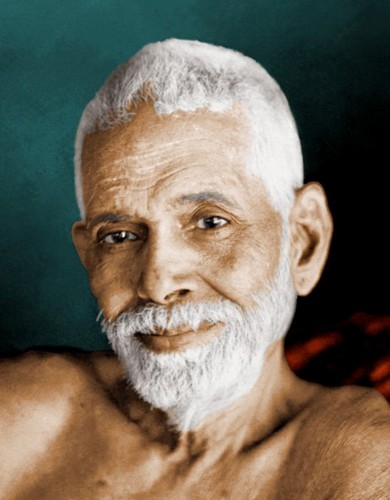
Ramana Maharshi’s eyes

I so love this photograph of Ramana. I love to make eye contact with him. Those eyes exude pure love and peace. I fall right into them.

Who is looking?

Relating to your muses

I’m loving this page by Antero Alli on relating to the muses. Whether you’re a creative, an artist, or a creative artist, you have a relationship with Muses.

The idea (and the experience) of “the Muse” and “the Muses” has vexed, haunted, and inspired the lives and works of artists, poets, musicians, book authors, painters, sculptors, and creatives for eons. Though many myths and concepts swirl around the enigmatic Muses archetype, nothing seems to accurately describe or explain the ineffable phenomena beyond its impact on the human vessels giving expression to its manifest creations.

I want to share what he wrote about the gifts of tragedy:

Around my fortieth birthday, in November 1992, the Muses struck me blind with a different kind of vision forcing a shift from theatre to cinema…, a process that continues to this day. This turning point followed the unexpected death of my second daughter — an unfathomable, devastating loss by any standards. As with many great losses, there sometimes come unexpected gifts. Through the grief and horror of losing my child came an unusual gift that kept on giving. A strange vision, a way of seeing The Tragic in life as the long sunset shadow cast by The Magic in life.  

I could not see that connection in my own life for many years, but I am aware of it now, of receiving gifts from tragedy.

I am not an “artist,” but I’ve been touched by muses, angels, spirits. My product isn’t a thing you can touch or hear or see. My product is my self, or, as Antero puts it,

The payoff is realizing my purpose.

Healing is my purpose, healing is my product, healing transforms the tragic into the magic. Healing is as much art as science. And it’s a mystery as to who is healed and who is healer at any given time.

Like Antero, to invite the muses back, I make this note to myself:

Without gratitude, I am fucked.

Click here to read Random Notes on the Muses Dialogue.

Dance, ecstasy, Pina, play

Today I had three dance experiences, which made it a wonderfully memorable day.

  1. I participated in Ecstatic Dance Austin this morning.
  2. I saw the film Pina by Wim Wenders, about the late German dancer/choreographer Pina Bausch, her work, and her dancers.
  3. My friend Peggy and I walked and played our way around Town Lake.

There is a shortcut to ecstasy. It’s called dance. ~ Gabrielle Roth

I am in love with Ecstatic Dance Austin, feeling so grateful that I have two hours every Sunday morning as an outlet for my energy, movement, physicality, playfulness, experimentation, and connection.

Today it occurred to me that if I didn’t have this, I’d curl up in a ball and die, or at least be really depressed. When I’m struggling over relationships, finances, work, decisions, politics, life, this is a place where I can give all that heaviness over to Spirit and just move, feel, connect, play, and be present. Life becomes a dance.

It is joy to walk into a big dance studio with a great sound system playing the kind of music that invites movement. I move out onto the floor. I begin moving.

Because there’s no talking, I connect with people using eye contact, smiles, and sometimes hugs. Sometimes I create my own space by closing my eyes and dancing.

I smile a lot because I feel so radiant and happy. There’s joy in the present moment, of course. My more personal joy is that I’ve worked on my health for years with bodywork, yoga, and a clean diet, and I feel great. My stamina is good — I stay moving, even through the burning fire of dancing all-out chaos. My creativity is good — there’s no end to discovering rewarding movements that morph into new grooves. My capacity for living and dancing from joy is good — although I have moments when heavy thoughts arise in my awareness during dance, I can move through them and return to joy.

I find ecstatic dance to be a great healing antidote. If I’m suffering relationship woes, I can dance with men who appreciate me, move with me, play with me, honor me. They don’t know my story, and I don’t know theirs. We just dance. A couple of dances can restore my sense of being valued as a woman by the other sex.

And for days when I’m fed up with male egos, I can have playful, fun dances with women.

And of course, I can have dances with men or women, or men and women, any time for no reason at all except that we’re together in the studio, there’s some great music playing, and we share the joy.

The physicality of it, the improvisational nature of ecstatic dance, the freedom and goodness I feel in my body, the wave of rhythms that peaks somewhere in the middle just clear me out until nothing is left but sweat, breath, and oneness.

Afterward we sit or lie spent in a big circle on the floor and give ourselves a couple of minutes of silence. We say names. We have announcements. We mingle and leave.


Dance, dance, otherwise we are lost. ~ Pina Bausch

Pina, the film written, directed, and produced by Wim Wenders (Wings of Desire, Buena Vista Social Club), is showing at the Violet Crown in downtown Austin. The film has been nominated for Best Documentary for the Academy Awards. (Click the link to view the awesome trailer.)

Pina Bausch worked with Tanztheater Wuppertal in Berlin from 1973 until her sudden death in 2009. Rather than being a biographical documentary, Pina shows her choreographic work and the dancers who danced her work speaking about her.

Here’s a clip (it’s in 3D, by the way — first dance film in 3D, that I know of — thanks, Wim Wenders!):

And here’s another:

And another:

She painted with dancers, movement, costumes. Her dances are not ecstatic dance — they are choreographed — but from what I could tell, she started with improvisation, asking for instance for a dancer to show her joy. Although some of the dance is highly structured, it retains its aliveness.

The film is a revelation — about life, love, pain, loneliness, longing. And creativity and playfulness.

WIM WENDERS ABOUT PINA BAUSCH
No, there was no hurricane that swept across the stage,
there were just … people performing
who moved differently then I knew
and who moved me as I had never been moved before.
After only a few moments I had a lump in my throat,
and after a few minutes of unbelieving amazement
I simply let go of my feelings
and cried unrestrainedly.
This had never happened to me before…
maybe in life, sometimes in the cinema,
but not when watching a rehearsed production,
let alone choreography.
This was not theatre, nor pantomime,
nor ballet and not at all opera.
Pina is, as you know,
the creator of a new art.
Dance theatre.

I loved seeing the dances, dancers, costumes, settings. This film inspires me. I want colorful, flowing, sexy evening gowns to dance in. I want to play with movement, to experiment, to have fun.


I can trust my friends. These people force me to examine, encourage me to grow. ~ Cher

Peggy is a dancer and choreographer and a dear friend of mine for years. Having just seen the film and danced our way out of the theater, we walked around Town Lake incorporating playful movements — stepping stylishly between two trees, walking on benches, doing asana on bridges, mimicking the arm gestures we saw in the film, striking poses, waving arms, adding twirls and hops into our walk.

We made our walk into a dance, and you know I’m such a sucker for dancing in unlikely places. The hike and bike trail is as good a place as any, maybe better than most.

It was a beautiful cloudy cool winter afternoon, and people were out enjoying themselves on the trail, walking, running, biking. Our play gave them a little extra enjoyment. People can be so serious, it’s like an illness. We put smiles on their faces.

As we played, we talked about creating dances. We shared some hilarious, outrageous, fun, engaging ideas for dances.

I hope we do them. I’m moved!

Daily email inspirations

I subscribe to several daily email services that enrich my well-being as I begin each day. I receive joy, encouragement, wonder, food for thought, and catalysts for expansion from these emails. I feel grateful for the people who thought these up and deliver day after day. It makes a difference.

For several years, I got a poem a day in my inbox from Panhala. That stopped a few months ago, and I don’t know why. Joe Riley did a great job of sharing some wonderful poems, and I hope he’s well. No one seems to know. I miss the poems. The link above is still a great repository of poems.

I also get quotes from Tricycle Daily Dharma about Buddhist practice. (Click the link, then the Your Daily Dharma Sign Up Now link to subscribe.) Here’s today’s quote:

Fear is not the Enemy
There are many ways to meditate on fear. One is to wait until it appears adventitiously. Another is to invite it in — when we send out invitations we can be a little better prepared for who shows up at the party. Perhaps for both methods of approach the first thing to bear in mind is that fear is not the enemy — it is nature’s protector; it only becomes troublesome when it oversteps its bounds. In order to deal with fear we must take a fundamentally noncontentious attitude toward it, so it’s not held as a problem, but as a visitor. Once we take this attitude, we can begin to work with fear. ~ Amaro Bhikkhu, “Inviting Fear”

Fear is a visitor to the guesthouse. Allow it in — it protects. Ask what it is protecting me from; ask what needs protection. It is only troublesome when it oversteps its bounds. Got it!

I get quotes from Chogyam Trungpa Rinpoche, the flawed but wise Tibetan Buddhist teacher, from Ocean of Dharma as well. Here’s the most recent:

THE THINKER. No one can stop or control your thought process or your thinking. You can think anything you want. But that doesn’t seem to be the point. The thinking process has to be directed into a certain approach. That does not mean that it should be in accord with certain dogma, philosophy, or concepts. Instead, one has to know the thinker itself. So we are back to square one, the thinker itself: who or what thinks, and what is the thought process?

Right now playing with how thoughts bubble into awareness, disappear, and new thoughts arise…the flowing mind, the full mind, the empty mind, the nature of mind to think.

The Universe (Mike Dooley) sends me a message of support, encouragement, humor, and expansion every day. I especially enjoy how playful The Universe often is. Playful has become one of my favorite energies.

What if every wrinkle, scar, or gray hair only made you more beautiful? What if every tear you’ve shed, mistake you’ve made, and challenge you’ve faced, only drew you closer to the light? And what if, MaryAnn, for every breath you’ve taken, every sentence you’ve spoken, and every path you’ve chosen, your fans in the unseen multiplied?

Well, I’d say it’s about time you found out.

Be proud, we are –
The Universe

Universe, I must be really beautiful and close to the light, with a multiplicity of unseen fans! Recently had an angel reading with Russell Forsyth, my first, and am feeling more aware of the angels around me than ever before.

Creative catalyst Lynn Scheurell sends me a Daily Catalyst quote each day. Here’s what Lynn sent today:

“God will not look you over for medals, degrees or diplomas, but for scars.” ~ Elbert Hubbard

Wow. Well, as my About Me page says, I’ve got ’em, scars. I do believe that life’s wounds can become spiritual currency and mistakes are for growth, so no matter what, you can’t lose.

The latest addition to my daily email habit is “EnneaThought for the Day,” a message for people of my Enneagram type, Five. Sometimes the messages are very inspiring, as today’s was:

Remember that at your best, you become an intrepid discoverer and explorer, broadly comprehending the world while penetrating it profoundly.

I’m really liking that description of the directions I move toward — broad comprehension and profound penetration. I enjoy using my mind and awareness in these ways.

Winter Alps, speed flying, dancing in beauty

One of my astrological mandates for 2012 is to surround myself with physical beauty.

In that light, I am sharing this video.

Watch and surrender to grace.

The earth has disappeared beneath my feet,
Illusion fled from all my ecstasy.

Now like a radiant sky creature
God keeps opening.

God keeps opening
Inside of Me.

Hafiz