Buddha’s Brain supplements: an update

My October 2010 post about the supplements recommended in the book Buddha’s Brain now has links so you can order these supplements online from Amazon.com (which offers discounts for subscription shipping) if you wish.

Some of these supplements are difficult to find in stores, meaning Whole Foods doesn’t carry them.

Here’s the original post with the new links. None of the data has changed except an error about the recommended dosage of huperzine A. I changed mg to mcg after further research.

Tao Porchon-Lynch: teaching yoga, ballroom dancing videos

I found more videos of Tao Porchon-Lynch, the world’s oldest living yoga teacher. I just can’t get enough of her! She’s my inspiration, my role model for wellness, because what she can do now is based on what she did when she was much younger: a lifetime of good habits.

She looks, sounds, and feels so healthy! She seems to be wonderfully sweet and so full of vitality! Seeing her living so well is very motivating.

In the first video, she talks about yoga, and you see her teaching a class:

In the second video, she displays amazing ballroom dancing skills. That was filmed in 2009, when she was “only” 91. Her partner looks to be about one-third her age, yet they are well matched on the dance floor.

If you didn’t know, would you ever have guessed she was even over 70?

She has her own website here: http://taoporchon-lynch.com/.

Also, if you missed them, see my earlier posts, The world’s oldest living yoga teacher and More from the world’s oldest living yoga teacher: she tangos!

More from the world’s oldest living yoga teacher: she tangos!

I found this 2006 YouTube video of Tao Porchon-Lynch, whom I posted about recently in The world’s oldest living yoga teacher.

This video was made in 2006, when Tao was “only” 86.

Isn’t she adorable? I aspire to be like her when I’m 86.

Oh, and she also likes to waltz, jitterbug, samba, cha-cha, foxtrot, and tango.

“It lightens up your spirit,” she says.

Meditation develops your brain

Role of Meditation in Brain Development Gains Scientific Support – NYTimes.com.

This New York Times article reports on new research findings about the effects of long-term meditation on the brain.

The role that meditation plays in brain development has been the subject of several theories and a number of studies. One of them, conducted at the Laboratory of Neuro Imaging at the University of California, Los Angeles, found that long-term meditators like Ms. Splain had greater gyrification — a term that describes the folding of the cerebral cortex, the outermost part of the brain.

No one knows exactly what that means. “You could argue that more folds mean more neurons,” said Dr. Eileen Luders, the recent study’s lead author, who practices meditation herself. “These are the processing units of the brain, and so having more might mean that you have greater cognitive capacities.”

Previous studies found that the brains of long-term meditators had increased amounts of so-called gray and white matter (the former is believed to be involved in processing information; the latter is thought of as the “wiring” of the brain’s communication system.)

So basically, meditation, over time, creates more folds and creases in the brain, and your brain functions better through more gray and white matter for processing and communication with other parts of the brain.

What I really liked about this article is what one long-term meditator was able to accomplish.

Ms. Splain’s practice of meditation has, over the years, deepened into something far more than a way to flex her cognitive muscles…

In 2005, at age 57, she embarked on a rigorous graduate program in the interdisciplinary approach to schooling known as Waldorf education. Working full time and taking classes at night, she finished the program at Sunbridge Institute in Spring Valley, N.Y., in three years. She retired from her United Nations job in 2008 and teaches in the early childhood program at the Waldorf School of Garden City on Long Island. She credits the discipline developed through four decades of meditation for her ability to handle the intellectual workload of graduate school — and begin a second career at age 60.

“The mentor of our master’s program acknowledged the challenge of doing this while working full time,” she said. “But when I was able to hand in an 80-page thesis well ahead of the class, he attributed it to the fact that, quote, ‘She’s a meditator.’ ”

So…if you want to do something extraordinary, or even if you just want to live your “normal” life but to experience better brain functioning (and who wouldn’t want that?), it’s like planting a tree.

The best time to do it was 20 years ago. The second best time to start is now.

More on the power of standing

Stand Up, Walk Around, Even Just For ’20 Minutes’: NPR.

Terry Gross interviews Gretchen Reynolds (see my previous post  The easiest shortcut to health you can make) about her new book, The First 20 Minutes.

Reynolds recommends standing for two minutes every 20 minutes while desk-bound — even if you can’t move around your office. “That sounds so simple,” she tells Fresh Air‘s Terry Gross. “But that actually has profound consequences. If you can stand up every 20 minutes — even if you do nothing else — you change how your body responds physiologically.”

Reynolds says prolonged sitting affects diabetes, weight, heart disease, and brain function.

She talks about other new wisdom in regard to health and fitness, including stretching before a workout, warming up, running, walking, hydration, and more.

The world’s oldest living yoga teacher

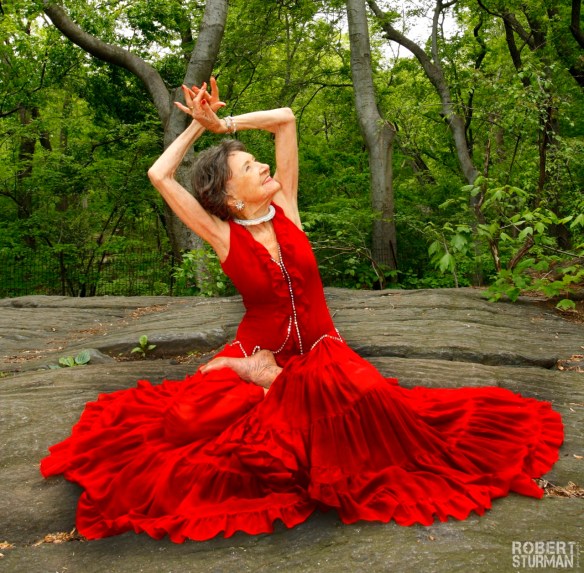
A Meeting In Central Park With The Oldest Living Yoga Teacher In The World. ~ Photographed by Robert Sturman | elephant journal.

Well, I’m not sure about that — BKS Iyengar is at least a comparable age — but these photos are gorgeous, and it is inspiring to see how yoga can keep a person fit and flexible into their nineties.

And would you look at that smile? Such grace and radiance!

Here’s my favorite photo:

The easiest shortcut to health you can make

Gretchen Reynolds on ‘The First 20 Minutes’ – NYTimes.com.

Loved this article about Gretchen Reynolds’ (no relation) new book, The First 20 Minutes: Surprising Science Reveals How We Can Exercise Better, Train Smarter, Live Longer.

Reynolds, a New York Times health and fitness columnist, looks at what you can do to makes the most difference for your health with the least effort. It’s surprisingly easy. Exercise trumps diet, and it only takes 20 minutes a day, and it doesn’t have to be anything more than standing.

This interview reinforces the new knowledge that prolonged sitting is unhealthy. I now use a timer to remind me to stand up and move when I’m doing anything that requires long hours at a computer.

Here are some good bits:

The first 20 minutes of moving around, if someone has been really sedentary, provide most of the health benefits. You get prolonged life, reduced disease risk — all of those things come in in the first 20 minutes of being active.

If someone starts an exercise program and improves his fitness, even if he doesn’t lose an ounce, he will generally have a longer life and a much healthier life. 

But the science shows that if you just do anything, even stand in place 20 minutes, you will be healthier.What would be nice would be for people to identify with the whole idea of moving more as opposed to quote “exercise.”

There is a whole scientific discipline called inactivity physiology that looks at what happens if you just sit still for hours at a time. If the big muscles in your legs don’t contract for hours on end, then you get physiological changes in your body that exercise won’t necessarily undo. Exercise causes one set of changes in your body, and being completely sedentary causes another.

I really do stand up at least every 20 minutes now, because I was spending five or six hours unmoving in my chair. The science is really clear that that is very unhealthy, and that it promotes all sorts of disease. All you have to do to ameliorate that is to stand up. You don’t even have to move. 

The human body is a really excellent coach. If you listen to it, it will tell you if you’re going hard enough, if you’re going too hard. If it starts to hurt, then you back off. It should just feel good, because we really are built to move, and not moving is so unnatural. Just move, because it really can be so easy, and it really can change your life.

“It’s the sitting, stupid.”

Stand Up for Fitness – NYTimes.com.

Exercise only slightly lessened the health risks of sitting. People in the study who exercised for seven hours or more a week but spent at least seven hours a day in front of the television were more likely to die prematurely than the small group who worked out seven hours a week and watched less than an hour of TV a day.

So to paraphrase Bill Clinton on the economy, “It’s the sitting, stupid.” Make that uninterrupted sitting:

In an inspiring study being published next month in Diabetes Care, scientists at the Baker IDI Heart and Diabetes Institute in Melbourne, Australia, had 19 adults sit completely still for seven hours or, on a separate day, rise every 20 minutes and walk leisurely on a treadmill (handily situated next to their chairs) for two minutes. On another day, they had the volunteers jog gently during their two-minute breaks.

When the volunteers remained stationary for the full seven hours, their blood sugar spiked and insulin levels were out of whack. But when they broke up the hours with movement, even that short two-minute stroll, their blood sugar levels remained stable. Interestingly, the jogging didn’t improve blood sugar regulation any more than standing and walking did. What was important, the scientists concluded, was simply breaking up the long, interminable hours of sitting.

Find a way to break up sitting into chunks punctuated by standing and walking. Keep exercising too. You’ll feel better and live longer.

Also, when you do sit, make some of it sitting. That is, seated meditation. Just sit and be.

It’s spring cleansing time! Liver/GB cleared, reduced allergies, reduced anger

I’m reblogging a post about spring cleansing from last March because it got a lot of views back then and it still applies! I’m currently nearing the end of this year’s spring cleanse, which I started a couple of days after the solstice.

Last spring, after doing the colon/parasite cleanse, I finally cleared my liver and gallbladder of hardened bile (green stones). This may seem like not a big deal, but it is. There appears to be a link between the health of the liver and allergies.

In Chinese and Ayurvedic medicine, there’s also a link between the health of the liver and the emotions — specifically the emotion of anger and its relatives, irritability, exasperation, annoyance, outrage, hatred, fury, and so on. You can google “liver anger” to learn more.

Since clearing those organs of stones, anger appears less often and dissipates more quickly in my life. Of course anger is part of a full, healthy range of emotions, but have you ever noticed that some people are inordinately angry (at others or themselves)? That is not pleasant to experience or be around!

If you go through life feeling angry, consider that your organs play a big role in your biochemistry, including emotional, and you can change your emotional makeup toward less anger and more happy feelings by cleansing those organs.

Here’s the original post, dated March 30, 2011:

I started the colon/parasite cleanse today. It’s spring! Time to clean out the system! I do this twice a year.

I wrote about this last fall. You can click this link to my earlier post, which contains instructions for the colon/parasite cleanse, which is fairly simple, and information about the liver/gallbladder flush, which is more complex but worth doing.

I didn’t provide instructions for the flush because it’s complicated, and in my opinion, if you’ve never done it before, it’s best done under the supervision of an expert, experienced health care practitioner who’s quickly available should you have any questions or problems.

One new bit of information to note: The company that makes Paracidin, which rids the body of parasites in the liver, gallbladder, spleen, and pancreas, has changed the name of that product to Paratosin. The labels, including dosage and ingredients, are identical except for the name.

Another new bit of information that I’ve heard or read from several sources: allergies are related to liver toxicity. I’m not sure about this, but thought I’d put it out there. If you have experience or information on this, please share.

My respiratory allergies have decreased dramatically over time. I had NAET acupuncture treatment in 2000 (when I moved back to Austin, allergy capital of the world), and it made a substantial difference.

Before NAET, Seldane or Claritin every day, year round, plus at least one sinus infection per year requiring antibiotics.

After NAET, I’d take an occasional Claritin, and I’ve had only one sinus infection in the 10 years since, when I walked to and from work on a windy day last spring after a long dry spell — exposing myself to lots of pollen. Acupuncture helped me recover from that.

NAET worked pretty well for me.

I’ve done the liver/gallbladder flush twice a year (two nights in a row each time) for about 3 years. I rarely take medication for allergies any more. I feel unpleasant side effects if I take Claritin, so if I’m having nasal congestion and sneezing, I take a homeopathic remedy, Histaminum hydrochloricum, and that does the trick. I use it maybe once a week at peak pollen times. My body doesn’t respond to allergens like it used to. (Another day I’ll post on the NLP allergy cure, which has probably also made a difference.)

So it’s possible that the flush has improved my liver’s health and reduced my allergies. They haven’t gotten worse. (This does not apply to my gluten sensitivity, just to airborne allergens.)

Here’s a link to an article I found with much more information on the liver/gallbladder cleanse, including what actually happens in those organs.

The instructions are pretty close to what my acupuncturist says. She has me test my pH before doing the flush to make sure my body is clearly alkaline, and she has me do it two nights in a row. She also suggests taking magnesium malate when it’s difficult to make fresh, organic apple juice in quantity.

More about my trauma recovery process (my hero’s journey)

Whew. I am going through a period in which I am feeling rather slammed — commuting several days a week 30 miles for a temp job, pet- and house-sitting, running errands after work, trying to do at least a couple of massages a week, and get in a little bit of fun and socializing. I’m squeezing time to get this post done! Oh, the life of a blogger….

I was talking with some friends over dinner last night, and the topic turned to trauma recovery. I want to write more about what that process involved for me.

I don’t believe that everyone else’s recovery process is like mine. Each person’s is different. Some might be shorter or longer, depending on the level of commitment to healing, the quality of help available, how much/how long ago/how suppressed, your self-discovery abilities, and your available time.

I did the majority of my processing over about two years, with the first nine months being most intense. The trauma happened when I was a child, occurred once, and was suppressed for many years. I had access to a psychotherapist for the first six months, and she was not a specialist in trauma recovery. I ended up doing a lot of work on my own using journaling and reflection and talking to people, and I did the most intense work during a three-month period when I was between jobs when I could put all my resources into it.

Of course, the healing process continues even now, but it’s on an as-needed basis.

Today recovery would be faster because the tools have gotten better and I know more now.

During that recovery period, trauma processing was my biggest commitment, besides working to put a roof over my head. Which was good, because trauma recovery requires self-absorption. I had neglected developing myself in this way for years, in hindsight, and I was motivated because I did not want to have PTSD. I was engaged in the recovery process, sometimes emotionally exhausted from putting the pieces back together. It was gratifying and satisfying inner work.

My social life was sporadic while processing. I benefitted greatly from the support of my friends and family, who were tolerant that I was actively involved in remembering and reframing my past. I am still deeply grateful for this. They put up with hearing me say “When Margaret was murdered…” a lot when the revelations were coming quickly and thickly, and only one person told me she was tired of hearing about it. Bless her heart.

I was not interested in dating and would not have considered it during this time. It never crossed my mind that a prospective partner would have been interested in me while I was integrating some emotionally gruesome memories, and if one had been, it would not have been a balanced, healthy relationship. I simply didn’t have the energy to put into a new relationship while I was actively recovering from trauma, and I needed more from others than I could give back.

After, yes. I was a lot juicier after!

During those two years, I accessed a lot of suppressed memories, brought them into consciousness, re-felt the emotions, and sorted these memories into some kind of coherent chronological order, which people traumatized as children often must do. I reframed my life.

I filled well over a dozen composition books with my journaling, including writing down the most vivid dreams I’ve ever had. Those dreams kept me on the path, told me I was moving in the right direction even though sometimes it was difficult. They promised me light at the end of the tunnel, and so it came to pass.

I learned how to tell my story and include not just the dissociated facts, but also my actual experience — what my tender young self saw, heard, and felt. Some of the “felt” part of my experience, and some of what I saw and heard, had been missing from my story before.

I read a lot about trauma recovery and PTSD. The most significant book was Waking the Tiger. I’ve written about this book several times. I understood for the first time that trauma affects the body and mind, the heart and spirit, that humans really are animals no matter how we try to elevate or distance ourselves above the other species, and recovery must include releasing energy blocks in the body as well as cognitive work, social/relational/emotional work, and spiritual work.

I’ve mentioned before that I spontaneously released the trauma from my body one day after reading most of the book.

During recovery, I gained perspective that I had not had before. My view of myself and my life became larger than it had ever been. I understood myself in a new way. I made more sense to me.

I remember sitting on my front porch, journaling and experiencing what I call “brain clicks”. The best way I can describe them is that I was remaking my map of the world, especially updating the parts that had stayed frozen from when I was 11. I literally felt something happen inside my head that was like reality clicking into place. Maybe it was me getting congruent.

I contacted people who’d known my family back then and listened to what they had to say. It was good to reconnect and get a bigger picture of how it affected them.

I planned and held a long-overdue celebration of my sister’s short life.

One of the most momentous days in my life was the day I learned the name of the murderer and that he (as of 2002) was living in Austin, not that far from where I’d lived for 10 years. We could have stood in line next to each other at the grocery store and never known our relationship.

I grew up that day. I developed compassion, not just for him, but for myself. Neither of us were any longer the people we were back then, me at 11, him at 15. I understood that he’s had to live with knowing his young self murdered a little girl for all these years and devastated her family. Not an easy burden to carry. I wish him peace.

All this makes it sound like I undertook a deliberate process. That would be wrong (except for the celebration). Traumatic memories began erupting, I went to therapy, got a diagnosis and a start on processing, and from then on, I just surrendered to the process. I couldn’t have stopped it if I had wanted to, and it was very compelling to have those great dreams, to recover lost memories (even if unpleasant) and know more of my story, to experience those brain clicks, and most of all, to become more and more present, once my past was in order.

When I committed to recovering from my childhood trauma, I made a commitment to my health, which is still in place.

It’s not that I’m the healthiest person around. I am fairly healthy, although I can still be triggered, especially when stressed and presented with an unexpected negative surprise. I am committed to move in the direction of health as best I can, making the happier, healthier choice when I know what that is. Happier does not always mean doing cartwheels, either. It can mean letting go, and it can mean allowing the big picture to unfold over immediate gratification.

I am not a great person but a human one. I feel stupid after I realize I’ve been triggered. Embarrassed. Foolish. You are not that person.

Sometimes I’m at a loss as to what to do, if anything. I just wait, listening and looking for a clear sign. Sometimes needing a lot of space does not mean total disconnection.

I send support to everyone who finds the courage to face themselves and rewrite their story in this way. It requires great valor. It’s truly a hero’s journey, and I recommend learning as much about the hero’s journey as you can, through books and film and reflection on your own journey. Joseph Campbell, Carol Pearson, and Stephen Gilligan provide enlightenment about this process.

You are the hero of your own life, and I honor your path and your courage.

Namaste.