Massaging levator scapula

I’m a massage therapist making sense of what I discover working on clients — the most common issues I encounter, why people have these problems, and what to do about them (massage-wise and making minor but meaningful lifestyle changes that result in more well-being).

Recently I posted about massaging the upper trapezius muscles. In that same shoulder/neck area, another muscle, levator scapula, gives some people a lot of problems.

As I mentioned in my earlier post, the upper trap issues seem to be from working with the hands out in front of the body, such as using a keyboard, cutting hair, chopping vegetables, operating a cash register, and so on.

If the bulk of your time is spent with  your arms just hanging down, surrendered to gravity, you wouldn’t have issues with your upper traps.

I don’t think there are many jobs like that! Irish dancer, perhaps?

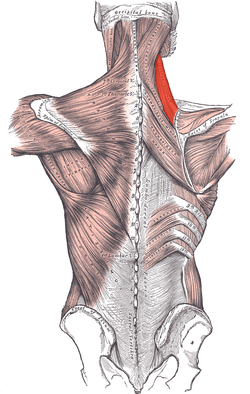
Levator scapula (sometimes called just levator) attaches to the upper inner corner of the shoulder blade and to the transverse processes of the top four neck vertebrae (the bony parts that stick out on the sides of your neck under your ears). Levator lies underneath the upper trap and other muscles.
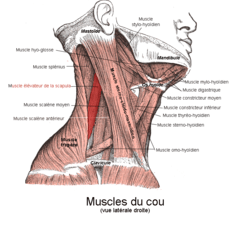
250px-Muscle_élévateur_de_la_scapula

250px-Levator_scapulae

I notice that some folks just have upper trap issues, and some have both upper trap and levator scapula issues. Trap issues come from working with the hands out in front. Levator issues come from raising the shoulders up toward the ears. In fact, levator scapula means “elevating the shoulder blade”. This is often accompanied by the “head-forward” posture.

If you rub across the top of your shoulder between your neck and shoulder joint and feel your fingers crossing over a tight but tender lump of a muscle, it’s your levator.

People who have pain in levator are raising their shoulders toward their ears, and they are most likely unaware they are doing this. They just notice the pain.

Sometimes it’s one-sided pain. The cause is often cradling a telephone receiver between the ear and shoulder to have the hands free while talking on the phone. If you work in an office and talk on the phone for much of the day, you can avoid levator pain by using speakerphone or a device that sits on your shoulder and holds the phone receiver up to your ear….

When it’s two-sided pain, the cause is usually an unconscious, habitual tension, a response to stressors of raising the shoulders toward the ears (“turtling”).

As a stress response, this would protect the vulnerable neck area, but since our modern stressors are usually not predators out to have us for dinner, the solution is to start catching yourself doing it and consciously retrain yourself to lower your shoulders. Your body will eventually catch on, and lowered shoulders will become your new habitual posture! (Also practice moving your head slightly back, if you have the “forward head” posture.)

You can lengthen the levitator muscle by standing and letting your shoulders drop downward, surrendering to gravity. You can hold a light weight — 1 or 2 pounds, or a can of soup — to help pull your arms and shoulders down and let the levator lengthen.

It also feels good to make forward and backward circles with the shoulders. Spend more time where it does the most good.

You can also stand and lower your ear to your shoulder, alternating sides. I think slow is good.

Another good practice is letting the head float up, as if it were a helium balloon. You can release all kinds of neck tension this way.

For massaging the levator, it usually feels awesome to press on the end of the muscle that attaches to the top of the shoulder blade. This is a magical point on almost every body that feels terrific to have pressed!

If you have a hard time finding that corner of the shoulder blade, put the client’s hand behind their back to make the shoulder blade pop out. You will feel that upper corner more easily. Static pressure and rubbing the corner area both feel great.

Because levator is deep to the upper trap and neck muscles, it’s difficult to knead the way you can knead the upper trap. I like to work my fingers around the inner part and bottom corner of the shoulder blade. Then, standing at the head of the table, I pull on the edge of the triangle that’s opposite that upper inner corner, leaning back and pulling it toward me. (You can also push this edge toward the head when standing at the client’s side.)

This allows levator to go slack and shorten, taking the pressure off it. I usually hold this for about 15-30 seconds.

Then I do the opposite. Standing at the head, I place both thumbs on that upper inner corner of the shoulder blade and lean into it. This gives levator a nice stretch. I hold this for 15-30 seconds too. The entire shoulder blade will have more mobility.

And yes, I can shorten and lengthen levator scapula during Ashiatsu barefoot massage sessions, using my feet!
Massaging the upper traps

I’m going to begin sharing some thoughts from doing massage…

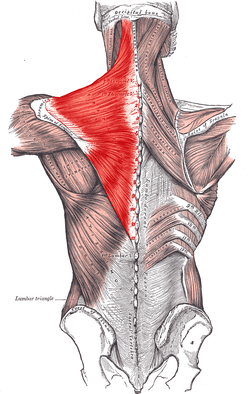
The trapezius is an interesting muscle. It’s big, shaped like a kite (a trapezoid), covers a large area of the back from T12 up and out to the shoulders, and then attaches to the back of the skull.

Unlike a bicep, the belly of the trapezius is not in the middle of the muscle. The belly is in the soft part of the shoulder, between the shoulder joint and the neck. This part is nicknamed the upper trap. The rest of the muscle is rather flat.

250px-Trapezius_Gray409

The upper traps hold a lot of tension on most people’s bodies. It’s rare to work on someone who doesn’t have tightness there. Often the upper trap is overdeveloped or unevenly developed. Usually one side is worse than the other (and it’s often but not always related to handedness).

Now, I could be wrong about this, but it seems to me that a lot of why this muscle is such a problem is because many of us work with our hands out in front of our torsos, and that muscle supports those lifted arms. I notice it on people who use a keyboard a lot. Also hairdressers, chefs, pianists, an interpreter for the deaf. Hands out in front, right?

Oh, yeah, and massage therapists.

When I do Swedish massage, I love working on the shoulders. My favorite part is the testing I do when I finish working on the first shoulder. I give both upper traps a gentle squeeze. I can really tell the difference between the shoulder that’s been massaged and the one that hasn’t. The upper trap that’s been massaged has tissue that feels lean and pliable, like a racehorse ready for a race. It seems to sparkle with energy.

The upper trap not worked on feels stiffer, more swollen, and congested.

That’s the difference that massage makes.

When I do Ashiatsu barefoot massage, I do a lot of work on the shoulders with my feet, both seated behind the client’s head and standing on the table. It makes a big difference. If you haven’t had Ashiatsu, you might be amazed at how I can work the shoulders with my feet. Loosening the shoulder blade, working the between-the-shoulder-blade area, pressing into the upper trap…

If a client needs extra attention to their shoulders (and we have time for it), after I finish the Ashiatsu, I manually work on the shoulders. Kneading is something I can do with my hands that I can’t do with my feet. Sometimes that’s the main thing the upper trap needs, to be kneaded repeatedly to really get the blood flowing throughout the upper traps. It’s that squeezing out of stale blood so it can be replaced by fresh blood bringing oxygen that changes the quality of the muscle tissue, at least in my understanding.

Wondering what to do about upper trap pain in between massages? One remedy available for office workers is to sit in a chair with arm rests that support your forearms comfortably while you use your keyboard. If you don’t use the existing armrests, then it’s not comfortable. Find out if you can adjust them to become comfortable.

That will take some of the load off the upper traps.

Also, even though putting heat on sore muscles feels good, ice is better. Too much heat for too long makes the tissue feel sluggish. If you feel like you just gotta use heat, alternate heat and cold, doing no more than 5 minutes of each. That will get your circulation going.

Don’t forget, there’s always arnica and epsom salt!

Coming soon: the levator scapula. Many people with upper trap issues also have levator scapula issues.

Developing attentional flexibility: the 12 states of attention

I just took four more days of training in biodynamic craniosacral therapy, and what I learned about practicing it has made me want to revisit the 12 states of attention.

Attentional flexibility is a skill that has many uses. Here’s an example: Someone has a chronic pain in their left leg, sciatica. Let’s say the person is seeking professional help in the field of alternative medicine and doesn’t want to take painkillers or see surgery as a solution, but meanwhile, there’s the pain, which can be wearisome, frustrating, and debilitating.

What if the person could transform the pain felt specifically in the left leg by diffusing it all over their body, so there was less pain spread more widely?

What if the person could then move the pain out to the skin, and then outside of their body?

What if the person could find a place on their body that was not feeling any pain and focus their attention fully on that place? What would happen to the pain?

What if the pain had a color or sound, and it changed to a healing color or sound?

These are examples of attentional flexibility, which can be a useful skill not only in managing pain, but also for dealing with any kind of state that we’d rather not be experiencing – depressive thoughts, negative self-talk, any kind of “stuckness”.

Attentional flexibility may not be a “permanent” solution to some problems, but it can create a sense of spaciousness around problems, provide options, and allow one to have a broader experience of life.

In biodynamic craniosacral therapy, a practitioner can use attentional flexibility to bring attention to his/her own body and specific sensations of biological and energetic processes, to his/her connection with the client, to the client’s processes, to the unit of client/practitioner, to the space inside the room, out to the horizon and beyond, to intuitive thoughts that arise, and more.

Attentional flexibility can be learned by practicing the 12 states of attention. For more, read my original post on the 12 states from October 2010.

Touch: Louder Than Words? | Psychology Today

Check out this article in Psychology Today about the power of touch. I just learned something new:

Field’s research has revealed that a person giving a massage experiences as great a reduction in stress hormones as the person on the receiving end.

It makes sense.

via Touch: Louder Than Words? | Psychology Today.

Gift certificates and referrals

A massage makes a great gift. We all know someone who would be incredibly grateful to receive one.

If you’d like to give the gift of massage, you can purchase gift certificates from me in any denomination (and you can also buy a package and give some or all of the sessions as gifts).

If you refer someone to me who then receives a full-price massage, you get 30 extra minutes of table time whenever you’d like to use it! I love it when you tell your friends, co-workers, neighbors, and family members about the great massage you received from me.

Your satisfaction and positive word of mouth are the best possible ways to build my business.

To return to the home page for The Well Ashiatsu Barefoot Massage Austin, click here.

Massage outcalls

I do outcalls only for established clients with whom I feel comfortable who have a massage table set up in their homes. There’s a fee for my travel time, usually $25 in the Austin area.

Having a massage therapist come to your home is a great luxury. You can really savor the refreshment and relaxation after your massage without having to deal with the stress of driving. You can relax in your own home, prolonging the benefit.

One great way to take advantage of this service is to schedule 2-4 people (household members, friends, relations) to receive consecutive massages, splitting the travel fee.

At this time, I am only offering integrative massage on outcalls.

If you’re interested but don’t yet have a table, you can buy massage tables in person at the Morningstar Trading Company in Austin or online from many places.

To return to the home page for The Well Ashiatsu Barefoot Massage Austin, click here.

Pay-what-you-wish days and massage email list

I occasionally offer pay-what-you-wish Ashiatsu days. If you haven’t experienced pay-what-you-wish bodywork, you balance what you can afford with the value you receive.

This allows people with irregular income or suffering a temporary financial setback to get the attention they need when they need it — and often the increase in well-being receiving bodywork helps the money energy start flowing favorably again.

I do appreciate your positive word-of-mouth, glowing written testimonials ;-), and referrals as forms of reciprocity. And if you can afford to pay extra to help subsidize someone else, fantastic. Otherwise, you can pay it forward.

Pay-what-you-wish sessions average about $50 per hour, if you’re curious about that, and they’ve ranged from $20 to $100 per hour.

And if the whole idea disturbs you, you can always pay my regular rate of $65 per hour.

To find out when I schedule pay-what-you-wish days, please send me an email request (mareynolds27 at gmail dot com) to be added to my massage email list. I send no more than one email per month.

For more about The Well Ashiatsu Barefoot Massage Austin, see my home page.

Time, money, and massage packages

At The Well Ashiatsu Barefoot Massage Austin, I always give you the full time you pay for, and if I run over a few minutes, it’s on me.

You can take your time getting off the table and getting dressed afterward, because I don’t book sessions back to back. I schedule in some recentering and renewal time for myself between massages because it’s important to me to be rested, fresh, and present with each person I work on.

My regular rate is $75 per hour. 

Getting regular massage is beneficial for great health and well-being. To that end, I offer packages with discounts, which you can view on my online booking site.

I take cash, checks, and Visa, Mastercard, American Express, and Discover cards. I can also process payments via HSA (health savings account) cards — your plan may require your doctor’s approval first. 

Gratuities are always welcome, of course! 

For more about The Well Ashiatsu Barefoot Massage Austin, see my home page.

What clients say about integrative massage

One recipient of an integrative massage (which combines Swedish massage, Lauterstein deep massage, acupressure points, foot reflexology, body mobilization techniques, muscle testing, stretching, trigger point therapy, and craniosacral work, as needed and desired) wrote afterwards:

Just a note to say I really enjoyed our conversation and my massage. The massage you gave me has allowed me to sleep soundly two nights in a row. My stress level also feels much lower than usual. Thank you for enhancing my life with your friendship and magical/healing massages! Sending happiness & blessings & love your way.

Here’s a testimonial for an integrative massage I gave to a dear friend suffering from insomnia.

I sit here at my computer after the best night’s sleep I’ve had in weeks. I am so deeply grateful for your loving energy yesterday. Your integrity, touch, and presence were exactly what I needed to break open the clogged dam of emotions that’s been keeping me from sleep.

All throughout the massage, I could feel and take in your love and healing energy which is abundantly transferred through your hands. When you said ‘How you feel matters,’ my soul got the message that you cared enough to hear, see, and touch me.

When you did the cranial-sacral hold, I felt like I was being cradled by my mother.

You had asked the question, “What happened three weeks ago?” … My insomnia has been “waking me up” to the fact of unfinished business….

Your work allowed me to dive through the opening and swim the turbulent waters on top of a still well. I’m not quite at the still well yet, but I have faith that I’ll get there.

Another client wrote to say:

MaryAnn has a special gift to connect with you and gently nurture your entire being. She is unique in that she offers unconditional love so freely. I highly recommend her massage therapy. ❤

For more about The Well Ashiatsu Barefoot Massage Austin, see my home page.

Who just loves Ashiatsu?

When I first learned Ashiatsu, I thought that really large men who like a lot of pressure and can’t get it any other way would seek it out. That is definitely one type of Ashi fan! Men with big muscles tend to really like it.

But that is a stereotype. I’ve also worked on small women who love the deep pressure. I’ve even worked on a couple of women smaller than I am, using carefully controlled pressure to their liking. Larger-breasted women find that deep pressure on their backs can feel more comfortable by using my breast pillow.

Ashiatsu is a favorite massage modality of many athletes. Runners like the firm pressure on their leg muscles — every runner I’ve worked on has loved it, both pre-event and post-event. (They hate/love the work on the IT band.) Cyclists like the work on the shoulders, back, and legs. Swimmers tend to love the shoulder work.

I’ve had other health-oriented people including professional dancers and dance teachers, yogis and yoga teachers, massage therapists, acupuncturists, martial artists, and people who work out regularly request Ashiatsu sessions.

But many seek Ashiatsu for the stress relief it provides. I’ve worked on airline pilots, chefs, coaches, college students, day traders, dentists, engineers, executives, firemen, government employees of all kinds, investors, judges, musicians, nurses, police, private eyes, many clients working for technology companies, teachers, trainers, waitstaff, and writers (so far, and I’ll keep adding to this list as I work on more professions!).

Also, massage therapists who learn Ashiatsu love it because delivering deep pressure with your feet is w-a-a-a-y less stressful on your body than using your hands. You let gravity work for you, avoiding repetitive strain injuries. You can work more hours with less wear and tear on your body while giving a deeply satisfying massage. That sure put the fun back into giving massage!

If you want to learn more, check out my home page for The Well Ashiatsu Barefoot Massage Austin.