Reframing trauma recovery as detoxing the whole system

These days I’m thinking of trauma recovery more and more like detoxing.

We all know people — or even do this ourselves — who do fasts or cleanses to rid their bodies of toxins from too much sugar or alcohol, meat, or junk food, after taking drugs, after food poisoning, and so on. I’ve written about the colon/parasite cleanse and the liver/gallbladder flush on this blog. I’ve also done the Master Cleanse, once.

There’s a lot to be said for cleansing for getting rid of recent toxins as well as those that have accumulated in our systems over the years. The proof is feeling better afterwards. If you don’t feel better after doing a cleanse, don’t do it again. Try something else. Be good to your body. It works hard so that you may live and is taken for granted a lot.

Well, trauma recovery is like detoxing your entire system. It’s not so much getting rid of the toxins in your digestive system as letting the harsh, non-nourishing behavior and events that your whole system took in make their way back out of your system.

It may not be pretty, but it’s actually a good sign — it’s so much healthier than keeping it locked up inside, repressed, frozen.

I’m thinking now that there is a natural period after you are safe when you detox, unless you get stuck in a situation with no support for your detoxing, and that’s another story. You have a basis of comparison — safe versus non-safe — now. Because you are safe, you can start to relax. You might want to think, “Whew, that’s it. I’m safe now and can get on with my life.”

Well, that is true, and you will start to bloom. But you might not be prepared for stuff from the past unpredictably sneaking into the present and biting you on the butt. You might not be prepared for intense emotions that may arise. You might not be prepared for the cognitive reframing that occurs as your identity changes from victim to hero of your own journey.

You may sometimes feel pulled in various directions. It is unsettling.  It’s good to find a physical outlet that grounds you. Yoga, bicycling, and walking were all helpful to me. Those things are healthy to do anyway, but it really helps to feel like you have control of some part of your life (your body) at a time when your mind/heart/spirit are in such flux. Exercise/movement is grounding, and the sweat help you detox. Your system wants to release that stuff.

You may reach equilibrium that feels like a few days of inner peace, and then something else — a memory, a dream, a trigger — may come up for you to experience and integrate, bringing you to a new equilibrium, and that cycle repeats, with the periods of equilibrium getting longer and longer. Actually, it’s life.

You  eventually reach a state where the past pretty much stays in the past unless you decide to delve in.

My advice: Let it arise as it arises, because it will do that anyway. It’s a process; it takes time. Notice and honor it. Document it, even — at least write down your dreams.

And it might be good to let a few people know. Ask for help if you need it, and definitely ask for support. You have mine.

Downward-facing dog and the bladder meridian: why it feels (and does) good

The Real Reason Downward-Facing Dog Is So Good for You. | elephant journal.

The connection between yoga and Traditional Chinese Medicine (TCM) fascinates me. When we do yoga poses, we activate various meridians in the TCM system, usually without awareness that we are doing so.

Here’s why doing downward-facing dog pose (adho mukha svanasana) feels so good (once your shoulders open up and the muscles in the back of your legs lengthen) and why it’s so good for your health.

Downward-facing dog  is arguably the most common pose in yoga. It’s done in Iyengar, anusara, vinyasa, ashtanga, bikram, and other styles of hatha yoga. It’s a cornerstone of sun salutations. It’s considered a resting pose in post-beginner yoga classes.

It’s so well-known, even many non-yogis recognize it: palms and soles flat on the floor several feet apart, buttocks high, back and legs straight.

Downward-Facing Dog

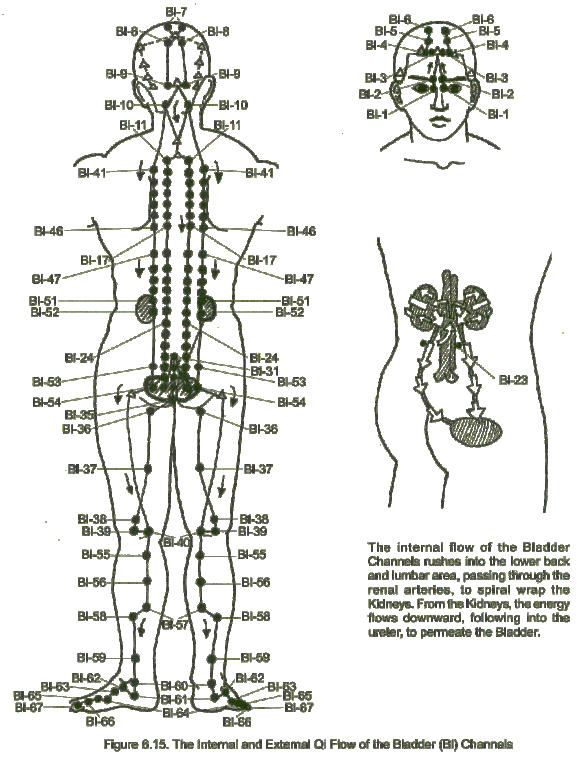
Downdog does our bodies so much good because it activates the bladder meridian, the longest channel in the body, running from the inner eye, up over the top of the head, down the back and the backs of the legs, ending at the pinkie toe. It even doubles up on part of its path:

To do downdog is to activate the bladder meridian’s 67 points, more than any other meridian (times two, because there are left and right meridians).

The bladder meridian is yang, meaning it deals with the outer world. The bladder channel is our first line of defense, so activating it boosts immunity. Not only is this meridian related to the urinary bladder, it also relates strongly to (and balances) the sympathetic (fight-or-flight) and parasympathetic (rest-and-restore) nervous systems.

If you are stressed (and most of us are most of the time), stimulating the bladder meridian activates the parasympathetic nervous system, inducing relaxation. It’s why people get so much out of having their backs massaged. Notice all those BL points in the sacrum area? The parasympathetic nervous system is activated by S2, S3, and S4 spinal nerves at the sacrum, and by several cranial nerves as well.

So doing downward-facing dog helps you relax and release tension.

There are also “Back Shu Points” located along the bladder channel. They are associated with organs and with chronic issues like insomnia, asthma, menstrual problems, IBS, anxiety, and so on. Doing downward-facing dog could prevent or alleviate chronic disease.

Downward-facing dog is also an easy inversion for the upper body, refreshing blood to the head and moving lymph.

Plus, you know, it just feels good to stretch like that! Do down dog to stretch the glutes, hamstrings, calf muscles, and Achilles tendons. Even the soles of the feet!

Let it open up your shoulders. Really feel your hands and feet connecting to the ground. Relax your neck and let your head drop toward the ground. Feel your strength. Straighten your legs and work toward lowering your heels to the floor. Do variations (on tiptoes, pedaling your feet, 3-legged dog, wild thing).

Then come down onto your knees, push your butt back toward your heels, and sink into child’s pose to enjoy that relaxation.

Downward-facing dog is a cornerstone of my yoga practice. If I could only do one pose, that would be it! Jai, adho mukha svanasana.

Tao Porchon-Lynch: teaching yoga, ballroom dancing videos

I found more videos of Tao Porchon-Lynch, the world’s oldest living yoga teacher. I just can’t get enough of her! She’s my inspiration, my role model for wellness, because what she can do now is based on what she did when she was much younger: a lifetime of good habits.

She looks, sounds, and feels so healthy! She seems to be wonderfully sweet and so full of vitality! Seeing her living so well is very motivating.

In the first video, she talks about yoga, and you see her teaching a class:

In the second video, she displays amazing ballroom dancing skills. That was filmed in 2009, when she was “only” 91. Her partner looks to be about one-third her age, yet they are well matched on the dance floor.

If you didn’t know, would you ever have guessed she was even over 70?

She has her own website here: http://taoporchon-lynch.com/.

Also, if you missed them, see my earlier posts, The world’s oldest living yoga teacher and More from the world’s oldest living yoga teacher: she tangos!

More from the world’s oldest living yoga teacher: she tangos!

I found this 2006 YouTube video of Tao Porchon-Lynch, whom I posted about recently in The world’s oldest living yoga teacher.

This video was made in 2006, when Tao was “only” 86.

Isn’t she adorable? I aspire to be like her when I’m 86.

Oh, and she also likes to waltz, jitterbug, samba, cha-cha, foxtrot, and tango.

“It lightens up your spirit,” she says.

The world’s oldest living yoga teacher

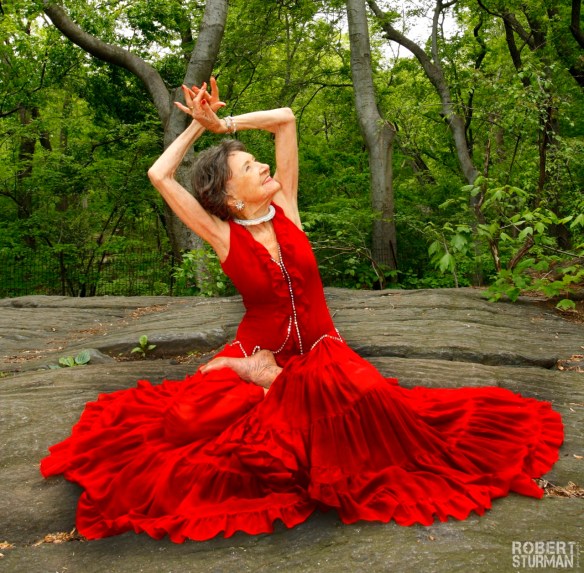
A Meeting In Central Park With The Oldest Living Yoga Teacher In The World. ~ Photographed by Robert Sturman | elephant journal.

Well, I’m not sure about that — BKS Iyengar is at least a comparable age — but these photos are gorgeous, and it is inspiring to see how yoga can keep a person fit and flexible into their nineties.

And would you look at that smile? Such grace and radiance!

Here’s my favorite photo:

Self-soothing activities that involve reclining

I just had a brainstorm. What do these things have in common?

  • Lying in a hammock.
  • Soaking in the bathtub.
  • Floating on a raft in a pool or natural body of water.
  • Star-gazing.
  • Watching clouds.
  • Taking a nap.
  • Getting a massage.
  • Sunbathing.
  • Doing restorative yoga poses.

All of them are done either lying down or reclining, and all of them are restful, restorative, self-soothing activities.

Lying down/reclining probably activates our neurology and chemistry to induce relaxation and create a natural high.

I spent some time this past weekend out in nature, lying on my yoga mat with my head propped enough to see and hear my teacher teach, yet able to gaze up into the gorgeous fresh green canopy overhead.

I found it so much more relaxing than sitting.

If you are really in need of shedding some stress, plan on doing some of these things!

Body by yoga: beautiful video

Love this video of a committed yogi practicing at home, in her underwear, while a man sleeps nearby.

You can read an interview of the yogi in Elephant Journal here. Amazingly, she talks about having body image problems and an eating disorder. She got help through Overeaters Anonymous and yoga.

She’s also a mother.

Kaminoff on Broad: yoga did not start as a Tantric sex cult, you idiot

Leslie Kaminoff once again responds to New York Times senior science writer William J. Broad, who has written sensationally that yoga is killing people (see Kaminoff’s response here) in order to sell his book The Science of Yoga, which Kaminoff reviews and actually recommends without totally buying into it here).

The latest bit of drama is Broad’s assertion (again in a New York Times article and in interviews that I wrote about here) that yoga began as a Tantric sex cult, so no wonder the John Friend/Anusara yoga scandal happened!

Kaminoff points out Broad’s inconsistencies and lack of scholarship and shows the evidence of artifacts depicting yoga poses from ancient times, 4 to 5 thousand years ago, greatly predating medieval Tantric cults, not to mention that yoga is one of 6 well-developed philosophical systems of Hinduism.

Cat yoga

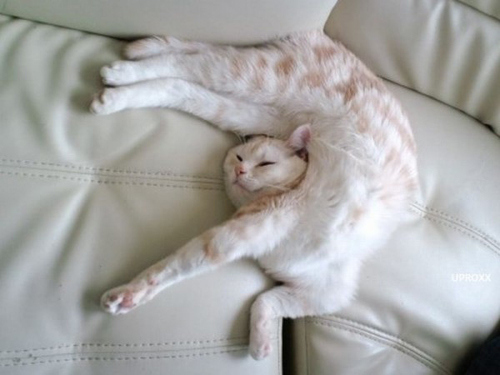
Cats really know how to relax and be flexible. Check this out:


And its mirror:


The full series is here. Enjoy!

Now yoga creates sex scandals!!!!!! OMG!!!!!!!

Ha ha, now the same New York Times writer so focused on how yoga is injuring and killing people has written a new article in which he says that yoga fans the sexual flames, with its roots in Tantric sex cults!!!

William J. Broad writes:

Why does yoga produce so many philanderers? And why do the resulting uproars leave so many people shocked and distraught?

How does he get away with saying that yoga produces “so many” philanderers? I don’t see any data. It’s certainly not as if the majority of philanderers are yogis. A handful of anecdotal examples does not prove his case.

Um, I believe fundamental and evangelical churches have produced way more philanderers per capita than yoga has. Not to mention the U.S. government — from the presidency on down! But I guess those are old headlines. And I don’t have any data either. Does anyone have data on philandering?

And…doesn’t philandering usually end up creating uproars that leave people shocked and distraught no matter what field they occur in?

William J. Broad is riding the Anusara/John Friend scandal to capitalize on the popularity of yoga and sell more of his books. If the New York Times called him “practitioner of make-a-buck sensational journalism whose claim to scientific credibility is undermined every time he confuses causation with correlation” instead of “senior science writer,” well, that would seem to be more accurate.

I cannot wait to read what the awesome Leslie Kaminoff has to say about this article! I will post it here when he puts up another video. Leslie has been a great counterpoint to William J. Broad, with way more credibility in the yoga world, and a voice of reason, common sense, and insight among the recent uproars about yoga. Leslie, write a book! See my recent post of his video about his yoga teacher Desikachar, son of the founder of modern yoga.

My take on it? Yoga improves health, and being healthy means being alive, vibrant, and responsive. That can certainly translate to sexy! Who isn’t attracted to people with those qualities?

And, a lot of activities improve health and libido, not just yoga. Running, biking, swimming, playing basketball, dancing zumba, and many, many more.

I also believe that yoga does more than just improve health — the asanas unblock meridians, allowing life-force energy (chiprana) to flow more freely throughout the body.

Ask anyone who’s had regular acupuncture for years if it’s improved their health, energy levels, and life force/vibrancy/libido, and they will tell you it has made a big difference. Same deal, no yoga.

And, over time and without needles, yoga does the same thing. And not just yoga. Gymnastics, acrobatics, acro-yoga, Pilates, martial arts, tai chi, chi gong, and several types of dance place the body in unusual postures or movements that increase flexibility, build strength and endurance, and require focused awareness. They train the bodymind to be healthier, to function better. Of course that affects sexuality. Health and sexuality are intimate partners.

This has been known for a long time.

Broad totally did not mention that one of the yamas (ethical guidelines) in the Yoga Sutras of Patanjali is brahmacharya, or nonexcess.

In the commentaries on the sutras, brahmacharya is applied specifically to sexual behavior and refers to chastity or even celibacy among advanced spiritual aspirants. Brahmacharya means refraining from sex except in committed relationships, and in that context, engaging in sex in moderation to develop a true spiritual partnership.

The yamas are required reading and discussion in yoga teacher training. And to put that in context, we live in America, which is a hypersexual culture. The porn industry is huge, and sex sells.

I imagine that the majority of people with a serious yoga practice do not misbehave sexually. Those who do, well, it’s more about power or addiction or lack of healthy role models than it is about the yoga.

Broad does share information about science’s interest in yoga and sex. I am not surprised by any of it. He’s fixated on yoga and sex; I’d like to see similar studies on martial arts and sex, and on yoga and the bonding hormone oxytocin.

And by the way, meditation (aka doing nothing) can promote sexual arousal. So can simply relaxing.

In Russia and India, scientists have measured sharp rises in testosterone — a main hormone of sexual arousal in both men and women. Czech scientists working with electroencephalographs have shown how poses can result in bursts of brainwaves indistinguishable from those of lovers. More recently, scientists at the University of British Columbia have documented how fast breathing — done in many yoga classes — can increase blood flow through the genitals. The effect was found to be strong enough to promote sexual arousal not only in healthy individuals but among those with diminished libidos.

In India, recent clinical studies have shown that men and women who take up yoga report wide improvements in their sex lives, including enhanced feelings of pleasure and satisfaction as well as emotional closeness with partners.

So yoga enhances sex. No surprise there, and what’s wrong with that, as long as people are conscious about behaving responsibly with it? Yoga also enhances health, fitness, longevity, equanimity, awareness, and compassion. No data, just my experience.

See Yoga and Sex Scandals: No Surprise Here to read the full article.