Follow-ups to NYT article about yoga injuries

I wanted to post links to several follow-up articles relating to my recent post The dark side of yoga about last week’s New York Times article about yoga and injuries, How Yoga Can Wreck Your Body so that if you are following this controversy through my blog, you can keep up.

Ashtanga Yoga New York posted an article, How the NYT Can Wreck Yoga. This article cites two reasons for the increase in yoga injuries: overzealousness on the part of students and the yoga industry.

The article states that too much zeal is a trait of a particular type of person “no matter what a teacher may caution.” (I just wonder if some of the people with this trait become bad yoga teachers themselves.)

The second reason is about the $5 billion per year yoga products and services industry and a value system that is based on economic incentive. The author argues that quality declines when the potential for making money is great, resulting in yoga becoming “McDonafied”. Therefore, more injuries occur because teachers and studios are more into making money than teaching quality yoga that prevents injuries.

Some good data are included, and the writer brings up injury rates in other physical activities, like basketball or football.

A balanced, serious, and accurate scientific report on the risks of yoga would have, at a minimum, explicitly stated that no one actually knows the injury rates for yoga, as is actually the case.

Click the link above to read the whole thing and all the comments.

Another article was published on Yogadork’s excellent blog. Is the New York Times Wrecking Yoga? The Community Responds includes the response mentioned above as well as a letter by Roger Cole, senior Iyengar teacher and Ph.D., to the New York Times, setting the record straight:

‘The article incorrectly states that yoga master B.K.S. Iyengar “insisted” that students practice shoulder stand in a manner that dangerously hyperflexes the neck. In fact, he insists on exactly the opposite. Mr. Broad cites a Yoga Journal column I wrote describing a method of “reducing neck bending in a shoulder stand by lifting the shoulders on a stack of folded blankets…” This safer method was invented by B.K.S. Iyengar and he has long been adamant that all of his certified teachers must teach the pose this way. Mr. Iyengar, who recently celebrated his 93rd birthday, still maintains a vigorous yoga practice that includes long holds in headstand (without support) and shoulder stand with his shoulders lifted on a prop.

The column describing Mr. Iyengar’s safer shoulder stand technique, entitled “Keep the Neck Healthy in Shoulderstand,” is at http://www.yogajournal.com/for_teachers/1091. The original version of Mr. Broad’s article supplied an incorrect link.

This is the way I was taught to do and teach shoulder stand by my teacher and trainer Eleanor Harris, as I mentioned in my previous post on this topic.

The third (so far) article was posted by Charlotte Bell on the blog of Huggermugger, a company that sells yoga supplies. In Youch! Yoga Injuries: How Not to Wreck Your Body, this 30-year yoga practitioner says matter of factly that any time you take your body out of its normal range of motion, there’s the potential for injury.

She wishes the NYT had examined modern versus traditional yoga teacher training. Me too. The traditional way has a teacher training students individually.

This is the model I chose. I was one of two students in my seven-month-long teacher training by Eleanor, who trained in the Iyengar tradition as well as other styles and who has over 20 years of experience. The other student, Kandice, and I had both been in Eleanor’s yoga classes for a good period of time before beginning her teacher training. She was aware of our practices and could address our needs individually.

The modern way of teacher training is often one-size-fits-all, for up to 40 students at a time, sometimes in a short amount of time.

Which do you think is going to produce better yoga teachers and reduced injury rates?

Bell also makes the point that yoga is not just poses:

We all know that yoga is not just poses, but asana remains the centerpiece of most Western practice. I wonder if the rise of yoga-related injuries might also be related to the fact that asana has been taken out of its original context. When the physical practice for its own sake becomes the be-all, end-all, it is much easier to become forceful and competitive, which IMO is the source of many yoga injuries. Consider how practicing the eight limbs tempers asana practice:

  • Yama:  The yamas teach us to approach practice with honesty, generosity and the spirit of non-harming.
  • Niyama:  The niyamas teach us about contentment, self-study (so that we know how poses affect us), and that our practice is not just about ourselves, that our practice is for the benefit of all beings.
  • Pranayama:  Giving our breath primacy in asana practice, as Donna Farhi teaches, shows us how to practice with the continuity of our breath in mind, so that we don’t move beyond the limits of our body’s ability to breathe freely.
  • Pratyahara:  Pratyahara teaches us to not become attached to the pleasant—or unpleasant—sensations we feel in practice.
  • Dharana:  Dharana steadies the mind so that we can see more clearly what is happening in our bodies as we practice.
  • Dhyana:  Dhyana refines our awareness of the experiences of each passing moment.
  • Samadhi:  Gives us a taste of the settling of the mind into silence—the true definition of yoga.

Well said, Charlotte Bell.
The dark side of yoga

This article should be required reading for all yogis: How Yoga Can Wreck Your Body – NYTimes.com.

I have been lucky in that I’ve never been injured from doing yoga since I started practicing in 1982. I’ve only had muscle soreness, but never severe or lasting more than a day. Doing yoga from a book was risky, but it taught me to pay attention to my own experience.

I’ve been lucky to have had good teachers. Eleanor Harris would never have students do shoulder stand with the neck bent ninety degrees to the torso, as described in this article.

Instead, we would fold blankets and our mat to create an elevated cushioned ledge for the shoulders to rest on with the head resting on the floor a couple of inches below. Afterwards, we would rest on our backs with support under our necks. We also did prep poses before attempting sarvangasana.

Let your awareness of your body’s limits be your primary guide, and beware of any teacher who would override you.

Some people naturally have very flexible bodies. It seems that a lot of these people, to whom yoga comes easily, become yoga teachers and end up setting the bar for the rest of us.

I am fairly flexible but am unable to do lotus pose, arm balances, and several other advanced poses. I’m okay with that. I don’t feel like I have to prove anything by doing advanced poses. Still, after working toward it for an hour (or a lifetime), it is a thrill to finally do hanumanasana. I understand the desire to deepen one’s yoga practice.

I’m happy with the yoga I can do, happy to make small  increments of progress, which these days has as much to do with my own body awareness as it does with achieving an external form.

Most of my yoga studies for the past few years have been with Iyengar-certified and Anusara-inspired teachers, who tend to focus on anatomy and form.

I like how yoga keeps me flexible enough, how the poses open up my meridians so that my energy flows with more ease. I simply feel better during my off-mat life because of yoga, and if the day ever comes that I don’t, that’s the day I stop doing it.

Besides reading this article, I also recommend that yoga students and teachers watch the video Anatomy for Yoga with Paul Grilley, which clearly shows the range of flexibility in the bodies of yogis. It will make you feel better if you can’t get your arms straight in wheel pose.

An excerpt is available on YouTube:

Yoga + politics: a good match?

It’s All Yoga, Baby has named “The Protester” 2011 yogi of the year.

So how do you feel about yogis being involved in politics? Yoga has been part of the Occupy movement from the start, mostly in the form of yoga classes for the Occupiers.

Some prominent yogis have gotten involved, while many have stayed out of it completely.

Is yoga political? I say clearly, yes, if you understand that yoga is a philosophy and not just exercise. Patanjali’s yamas are one of the eight limbs of yoga, asanas being another. Yes, yoga is actually so much more than asanas.

The yamas are the first of the eight limbs, guidelines for ethical social conduct, or moral principles that initiate the practice of yoga. They are: nonviolence, nonlying, nonstealing, non-sexual excess, and nonpossessiveness. In other words, kindness, honesty, trustworthiness, responsible relating, and nonattachment.

It’s hard to understand how any yogi following the yamas could fail to  clearly see their connection to the issues of the Occupy movement.

Some of you know me personally, and some of you only know me through this blog. I write about wellness, not about politics so much, although I did visit Occupy Austin earlier this year and blogged about it.

I am a yogi. I’ve been one for a long time. I practice yoga because it helps me be whole in body, mind, heart, and spirit. I teach yoga because I want to share its goodness. I study yoga because it is good, and it pleases me to grow. I am more awake because of yoga.

Another way of saying I am awake is to say I occupy myself. I live in the world. I am an activist. I sign petitions. I send letters. I vote. I donate. I want to make a difference for the better, and for sure, I can’t if I do nothing, so I do something.

I’m not that public about it. If you’re my Facebook friend or Twitter follower, you probably see a little more of my activism. There is more to me than being an activist, for sure, but heck, I like peace. I like justice. I like freedom. I like goodness. And I will work for them.

I understand the power of the 99% slogan in protesting corruption, heartlessness, inequity, greed. I also believe we are all part of the 100%. Yoga is about union, yoking, bringing together. Attacking people creates hardness and resistance, just like forcing the body into a pose it’s not ready for is a recipe for injury. Instead, think of the prep work and the softening and melting that allow changes to occur on the mat.

This can happen in the world.

I’m so proud of Occupy for adhering to nonviolence, showing and telling the truths about the occupiers’ lives, and confronting behaviors of stealing, irresponsibility, and greed, both within the movement and in the larger society. This is yoga!

I like respectful dissent, thoughtful protest, free speech, freedom of assembly, clarity. I’d love it if the Occupy movement could get the voters of this country focused on getting money out of politics, i.e., campaign finance reform would be one really meaningful, revolutionary change to focus on. In my opinion, accomplishing that would be taking the people’s power back from those who would subvert democracy out of greed. They know not what they do, and they can change.

I wonder if they ever wonder what their grandchildren will think of them, when today is history.

This activist yogi advocates occupying your body, your mind, your heart, and your spirit. Occupy yourself, live in the world, follow the yamas, and change it for the better.

Cadaver video showing the importance of stretching, massage, and yoga

Warning: This video may be gruesome to some viewers. It features a cadaver. If you think that it will upset you, then don’t watch it.

Why am I featuring it here? It shows why you need to move your body to your full range of movement to maintain your freedom of movement as you grow older, and why you may need yoga and/or bodywork to restore freedom of movement after periods of inactivity.

Freedom of movement is something that I intuitively believe is related to having healthy energetic meridians. If you can move freely, then the energy in your body is flowing well.

I’m sure there’s a lot more to it than that, but you can feel it, can’t you?

The Yoga of Protest. | elephant journal

The Yoga of Protest. | elephant journal.

Here’s a yogic take on the Occupy Wall Street movement. Excerpt:

In the midst of all this muddle, a yogic concept called ananda popped into my head. Ananda is Sanskrit; it is one of the highest purposes of Anusara Yoga, and can be translated as deep joy, deep expressiveness, or bliss. It can also be understood as “loving acceptance of what is.”

It hurts to think about practicing this idea in relation to what the Occupy Wall Street protesters are pointing at. It hurts to think about lovingly accepting the deep dysfunction and suffering that is occurring in this world. If I imagine doing that, my heart feels like it might stretch and break. Yet it is what the mystics call for us to do, to love what is hurting us, to empathize with our torturers. Not blindly, naively or passively, but powerfully, radiantly and compassionately.

All of us, 99% and 1%, need to be loved. We need to be seen in our wholeness. Our suffering, yes, our greatness.

The acrobat and the meditator

Here is today’s quote from Tricycle Daily Dharma, to which I subscribe.

We are so used to projecting our attention out into the world around us, it is a noticeable shift when we face inward and feel the subtle swaying of the head on the shoulders, along with all the muscular microcompensations keeping our body centered in gravity. The acrobat, like the meditator, is bringing conscious awareness to a process that is always occurring but is generally overlooked, which is a vital first step to learning anything valuable about ourselves.

Andrew Olendzki, “Keep Your Balance” (my bolding)

Might as well say “the yogi” rather than “the acrobat”.

From what I’ve read and understand, the very simple act of shifting one’s attention from “out there” to “in here” actually changes one’s brainwaves from beta state to alpha, from stressed to more relaxed.

So you can try this right now, if you like. You’re reading this blog post, which is an “out there” experience.

Read the following sentence, do what it says, and notice how your experience changes:

Bring your attention to the space between your eyes.

What happened when you did that? Did your breathing change? Did your sense of pleasure change? What else did you notice?

It could be your left pinkie finger or the top of your head or the soles of your feet or the center of your belly. Anywhere on or in your body suffices.

It’s not about how far you can back-bend, it’s about harnessing your attention within, which is, as Olendzki says above, “a vital first step to learning anything valuable about ourselves.”


Yoga for stress reduction

When talking to my former yoga teacher, who not only taught me but trained me to be a yoga teacher, last week, I told her I’d like to get more people attending my restorative yoga classes.

She gave me a tip on marketing: don’t call it Restorative Yoga, call it Yoga for Stress Reduction.

I have a lot to learn.

Yes, restorative yoga is yoga for stress reduction. That is completely the point of doing it.

Yoga in general and especially restorative yoga do something that many of us have a hard time doing for ourselves otherwise: moving out of fight-or-flight mode. We all need activity, rest, and sleep (and sleep doesn’t substitute for rest). In our busy lives, rest is usually the first thing to be discarded, followed by a full night’s sleep. We’re goin’ and blowin’ from the time we get up until we hit the pillow at night, reacting to crises large and small, and maybe, if we’re lucky or plan for it, slowing down a little at lunch or after we get home from work.

Years of this will take a toll. A two-week-per-year vacation is not enough. We need to rest every single day.

The human body has an autonomic (meaning automatic) nervous system with two branches, sympathetic (fight or flight) and parasympathetic (rest and digest). Yoga stimulates the parasympathetic nervous system, which calms us, aids in digestion, stimulates sexual arousal, broadens our perspective, and restores energy.  

These branches of the nervous system allow us to survive (sympathetic) and thrive (parasympathetic).

The problem is that the sympathetic nervous system is activated a whole lot more now than it was back when the occasional saber-toothed tiger came our way. Survival has gotten complex. Slamming on the brakes in rush-hour traffic, working at and keeping a high-pressure job,  and juggling family responsibilities with work can leave us depleted.

Restorative yoga slows you way down. Way down. For 90 minutes. You do very little, except change poses every once in a while. Oh, and chant OM and maybe do some breathing exercises at the start.

It’s a way to commit to getting some rest into your life.

In a restorative class, I bring props like bolsters, blankets, and blocks. Maybe eye pillows, depending on the class size. We set the props up for each pose and then lie on them passively, holding the poses for anywhere from a minute to 15 minutes.

Time and gravity do the work of relaxing the muscles. If you want to quiet your mind as well, bring your attention to the sensations of breathing. Notice the rhythm, evenness, length, temperature, sound, movement, location, and so on.

Even though it is called restorative yoga, no yoga experience is required. The only requirement is the desire to relax deeply.

How long has it been since you relaxed deeply while awake? What do you remember about that state? Could you use more of that?

Feet report, planting a tree

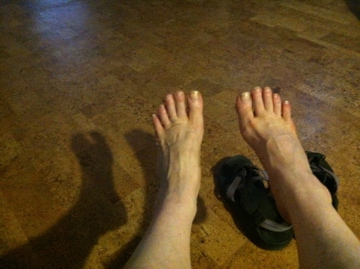
Well, my feet did not take me to Barton Springs after all on Saturday. I woke and remembered it was a day of honoring my feet, of letting them lead. I put my attention into my feet, feeling into them.

While still in bed, I did some exercises that Fran Bell gave me to increase my ankle and hip range of motion. Out of bed, I did the Z-Health foot exercises that Patrice Sullivan gave me to open foot meridians.

After that, my feet felt alive and glowing! They took me to the shower. I love washing my feet, especially between the toes.

You can say to yourself:

Oh, those are my ordinary feet, and they look clean. I feel them resting on the floor.

Or you can think:

Wow, my feet are tingling with life force, energy, chi! I wonder how far the energy would extend if I could see it. Seriously, if this energy produced light, you could read by it!

Well, those feet took me to my yoga mat! I did a leisurely round of sun salutions, paying special attention to my feet in tadasana, lunge, plank, down dog, and so on, feeling the mat and pressure and stretch and strength and position and air currents.

Then my feet walked me over to the zafu and zabuton. I turned on a timer for 30 minutes and sat. I wanted to spread the aliveness of my feet into the rest of my body.

That was a great start to my day.

The rest of Saturday, I checked in periodically with my feet without thinking too much. They wanted me to make monkey tea. They wanted me to do some more unpacking and arranging at the trailer. They led me to set up my hummingbird feeder.

Then we ran errands. We went to Home Depot, and among other items I bought a soaker hose. My landscape architect friend/writing client Merrie told me I need to water the ground under my trailer, where there are big cracks in the bare soil from the drought.

I came home and soaked the parched earth.

Feet, connect us to the earth, pachamama, terra firma.  Connect us to our big blue marble. Keep us grounded in what we do. Let us be of service to you.

In the evening, my feet served me well when I gave my daughter her first massage from me, the first of many, I hope.

I danced for 90 minutes on Sunday morning. My feet felt free, loved, and joyous. After lunch, I stopped at The Natural Gardener. I needed some potting soil and bought some basil, thyme, and peppermint. The garden center was nearly deserted. Most people give up on gardening in August around here. I’m just getting started in a new place.

And then I wandered through the tree section. Thirty percent off a tree is substantial, and they had quite a few $24.99 trees before the discount. Half my trailer is unshaded, and since I can’t plant a tree 10 years ago, now is the next best time.

I thought I was going to get a cedar elm but felt pretty ho-hum about it. After discussing various oaks, I was drawn to an arroyo sweetwood (new to me), and one of The Natural Gardener’s plant-loving helpers showed me a mature one next to the parking lot that had been planted about 7 years ago.

Wow. These trees grow fast, are native to northern Mexico so can take heat and drought, and are fragrant, smelling like cinnamon and vanilla. They are multi-trunked, and have spring flowers, a dense canopy, and autumn foliage. Something wonderful for every season, plus scent. How perfect can a tree be?

So that’s what I bought, for just under $18. The cashier said my tree looked like a happy tree! I was a happy customer.

On my way home, I saw a sign:

I bought a tree to plant on the hottest day of the hottest month of the hottest year on record.

Yes, you can plant trees at the end of August if you are willing to check the dampness of the soil several inches down every couple of days. They’ll tell you how at The Natural Gardener.

Got home, picked a site that will perfectly frame a view of the tree from inside a nearly-floor-to-ceiling window, and watered the ground. Water, let it soak in, dig, repeat.

I finished digging this morning and planted the tree. When I came home this evening, my new little tree was having its branches gently jostled by the warm wind.

Next up: mulch.

So that’s what happened from letting my feet lead. I got so connected to the earth, I bought a tree and planted it! I took care of the ground under my trailer. I gave my daughter a massage. I did yoga and sat.

Grounded.

Thank you, feet.

A doctor who uses yoga in his practice

Saw this article in today’s New York Times and thought I’d share.

When patients with rotator cuff injuries do a pose derived from yoga, the results were as good or better than surgery or physical therapy. The yoga pose is headstand with the forearms making a triangle with the head, but you can do it against a wall — inversion is not required. It works by letting a new muscle do the work of the injured muscle.

Another study found that for patients with osteoporosis or its precursor osteopenia, ten minutes of yoga every day for two years built bone density in the hip and spine, while the controls lost bone density.

Yoga is weight-bearing exercise using the body’s own weight, especially in partial and full inversions. In addition, stretching pulls on the bone where muscles attach, and this can build bone density.

Another article is about piriformis syndrome, when the sciatic nerve is pinched by tight butt muscles. It can be caused by prolonged sitting.

Pressure-point massage can help. Some home exercises can provide relief in the majority of sufferers.

Body presence and awareness

This morning I was standing in line at the post office, and I could not stop making small movements as I stood. Shifting my weight from one foot to the other, letting my spine ripple up from the sacrum up, I became deeply aware of my muscular body, how muscles and connective tissue wrap around the bones and each other, and my body’s relationship with gravity and movement.

Today I have a sense that I have moved into my body more fully and become more physically present, more alive with more awareness. 

I like it.

I’m guessing this is a benefit of going to massage school and receiving/giving several massages a week as well as the last few years of working on my physical body with multiple healing modalities including yoga and shaking medicine.

The brain training I did in June could also be a factor, since changes continue for several months afterwards.

I’ve been lucky enough a couple of periods in my life to be able to afford a monthly full-body massage, and for several years to receive 15- to 30-minute massages at work once or twice a week. Massage is a great antidote for tension and stress, and it’s so beneficial if you can receive it regularly. 

We were told early on at massage school that we will receive 70 or so massages during the six months of training, and that that will change us.

I believe it. I feel more connected and present in my body already.

~~

Today another HVAC expert looked at my Spartan trailer. I think I’ve found someone who can fix me up with a central heat and air unit using the existing closet and ductwork. He’s emailing me a bid, and once I crunch the numbers, I can make a decision and move forward.

It’s been so hot, it’s hard to work more than a few hours early in the day before needing some relief.

I’m making decisions today about the bathroom — tub surround, wall covering, vanity, sink, faucets, and more.

Progress is slower than I thought, and the decisions are worth getting right.