Click this link to go to a page that clearly delineates the various styles of yoga.
Seriously. Click the link.

Click this link to go to a page that clearly delineates the various styles of yoga.
Seriously. Click the link.

If you’re at all familiar with this blog, I bet you think I’m going to say meditation. Guess what? Ha ha, I’m not!
It’s way simpler than that:
Whenever you’re doing something that does not require use of your hands, turn them so that they’re palm-side up (see the picture above). You also can do it while standing or walking, leaving your arms down at your sides and turning your palms so that they face outward in the direction you’re facing.
This palms-up position may be familiar to committed meditators and yogis who practice shavasana, but it’s foreign to those of us who spend a lot of time at a computer, behind the wheel of a car, holding babies, making lattes, or doing pretty much anything else that requires constant hand use. Even when we’re not using our hands, it’s just habit to sit, walk or stand with our hands facing down or behind us.
Wait for it — there’s a meridian connection: 
In acupuncture, the meridians that run along the inside of the arm, from the chest/underarm to the palm, are Heart, Pericardium and Lung….
Here is just a smattering of the functions each meridian is involved in (there are many more):
- Heart: breathing, cardiac function, sleep, emotional balance and heat regulation.
- Pericardium: breathing, blood circulation and upper digestive function.
- Lung: breathing, immune function, perspiration, body temperature and urination.
…our lifestyles force our hands and arms into an almost constant downward/backward position, creating a tendency to slouch forward. This causes us to cave our upper bodies inward, crunching the Heart, Pericardium and Lung meridians.
Allowing these meridians to flow more freely optimizes their ability to perform their respective functions.
These three meridians are all yin meridians, flowing from the torso to the fingertips.
This is a mudra (energetic gesture in Hinduism and Buddhism). The palms-up mudra, you might have guessed, has to do with receiving energy from spirit or the universe, with allowing. It has to do with being open and surrendering yourself to the Mystery.
Try it when you think about it. Let one or both palms rest facing up, or outward if you’re on your feet. Notice the subtle but significant changes in posture.
Then make it a habit.
Thanks to Sara Calabro for this article.
The Real Reason Downward-Facing Dog Is So Good for You. | elephant journal.
The connection between yoga and Traditional Chinese Medicine (TCM) fascinates me. When we do yoga poses, we activate various meridians in the TCM system, usually without awareness that we are doing so.
Here’s why doing downward-facing dog pose (adho mukha svanasana) feels so good (once your shoulders open up and the muscles in the back of your legs lengthen) and why it’s so good for your health.
Downward-facing dog is arguably the most common pose in yoga. It’s done in Iyengar, anusara, vinyasa, ashtanga, bikram, and other styles of hatha yoga. It’s a cornerstone of sun salutations. It’s considered a resting pose in post-beginner yoga classes.
It’s so well-known, even many non-yogis recognize it: palms and soles flat on the floor several feet apart, buttocks high, back and legs straight.

Downdog does our bodies so much good because it activates the bladder meridian, the longest channel in the body, running from the inner eye, up over the top of the head, down the back and the backs of the legs, ending at the pinkie toe. It even doubles up on part of its path:
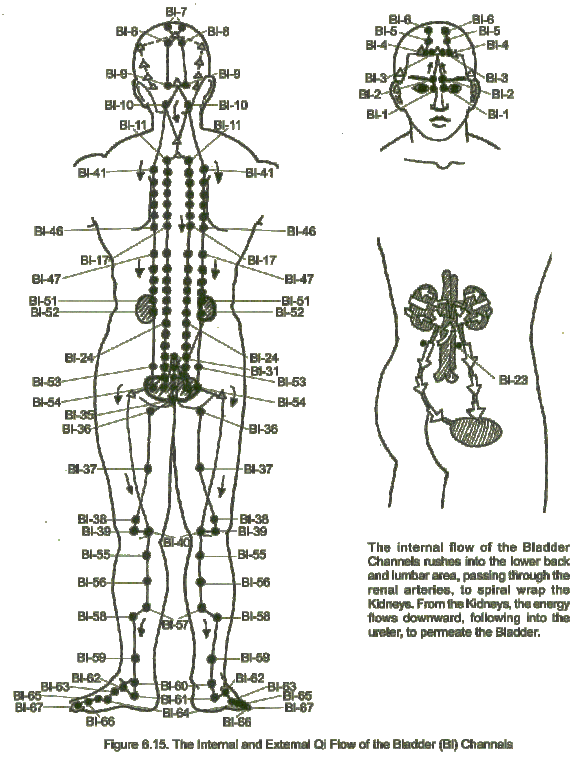
To do downdog is to activate the bladder meridian’s 67 points, more than any other meridian (times two, because there are left and right meridians).
The bladder meridian is yang, meaning it deals with the outer world. The bladder channel is our first line of defense, so activating it boosts immunity. Not only is this meridian related to the urinary bladder, it also relates strongly to (and balances) the sympathetic (fight-or-flight) and parasympathetic (rest-and-restore) nervous systems.
If you are stressed (and most of us are most of the time), stimulating the bladder meridian activates the parasympathetic nervous system, inducing relaxation. It’s why people get so much out of having their backs massaged. Notice all those BL points in the sacrum area? The parasympathetic nervous system is activated by S2, S3, and S4 spinal nerves at the sacrum, and by several cranial nerves as well.
So doing downward-facing dog helps you relax and release tension.
There are also “Back Shu Points” located along the bladder channel. They are associated with organs and with chronic issues like insomnia, asthma, menstrual problems, IBS, anxiety, and so on. Doing downward-facing dog could prevent or alleviate chronic disease.
Downward-facing dog is also an easy inversion for the upper body, refreshing blood to the head and moving lymph.
Plus, you know, it just feels good to stretch like that! Do down dog to stretch the glutes, hamstrings, calf muscles, and Achilles tendons. Even the soles of the feet!
Let it open up your shoulders. Really feel your hands and feet connecting to the ground. Relax your neck and let your head drop toward the ground. Feel your strength. Straighten your legs and work toward lowering your heels to the floor. Do variations (on tiptoes, pedaling your feet, 3-legged dog, wild thing).
Then come down onto your knees, push your butt back toward your heels, and sink into child’s pose to enjoy that relaxation.
Downward-facing dog is a cornerstone of my yoga practice. If I could only do one pose, that would be it! Jai, adho mukha svanasana.
I found more videos of Tao Porchon-Lynch, the world’s oldest living yoga teacher. I just can’t get enough of her! She’s my inspiration, my role model for wellness, because what she can do now is based on what she did when she was much younger: a lifetime of good habits.
She looks, sounds, and feels so healthy! She seems to be wonderfully sweet and so full of vitality! Seeing her living so well is very motivating.
In the first video, she talks about yoga, and you see her teaching a class:
In the second video, she displays amazing ballroom dancing skills. That was filmed in 2009, when she was “only” 91. Her partner looks to be about one-third her age, yet they are well matched on the dance floor.
If you didn’t know, would you ever have guessed she was even over 70?
She has her own website here: http://taoporchon-lynch.com/.
Also, if you missed them, see my earlier posts, The world’s oldest living yoga teacher and More from the world’s oldest living yoga teacher: she tangos!
I found this 2006 YouTube video of Tao Porchon-Lynch, whom I posted about recently in The world’s oldest living yoga teacher.
This video was made in 2006, when Tao was “only” 86.
Isn’t she adorable? I aspire to be like her when I’m 86.
Oh, and she also likes to waltz, jitterbug, samba, cha-cha, foxtrot, and tango.
“It lightens up your spirit,” she says.
Role of Meditation in Brain Development Gains Scientific Support – NYTimes.com.
This New York Times article reports on new research findings about the effects of long-term meditation on the brain.
The role that meditation plays in brain development has been the subject of several theories and a number of studies. One of them, conducted at the Laboratory of Neuro Imaging at the University of California, Los Angeles, found that long-term meditators like Ms. Splain had greater gyrification — a term that describes the folding of the cerebral cortex, the outermost part of the brain.
No one knows exactly what that means. “You could argue that more folds mean more neurons,” said Dr. Eileen Luders, the recent study’s lead author, who practices meditation herself. “These are the processing units of the brain, and so having more might mean that you have greater cognitive capacities.”
Previous studies found that the brains of long-term meditators had increased amounts of so-called gray and white matter (the former is believed to be involved in processing information; the latter is thought of as the “wiring” of the brain’s communication system.)
So basically, meditation, over time, creates more folds and creases in the brain, and your brain functions better through more gray and white matter for processing and communication with other parts of the brain.
What I really liked about this article is what one long-term meditator was able to accomplish.
Ms. Splain’s practice of meditation has, over the years, deepened into something far more than a way to flex her cognitive muscles…
In 2005, at age 57, she embarked on a rigorous graduate program in the interdisciplinary approach to schooling known as Waldorf education. Working full time and taking classes at night, she finished the program at Sunbridge Institute in Spring Valley, N.Y., in three years. She retired from her United Nations job in 2008 and teaches in the early childhood program at the Waldorf School of Garden City on Long Island. She credits the discipline developed through four decades of meditation for her ability to handle the intellectual workload of graduate school — and begin a second career at age 60.
“The mentor of our master’s program acknowledged the challenge of doing this while working full time,” she said. “But when I was able to hand in an 80-page thesis well ahead of the class, he attributed it to the fact that, quote, ‘She’s a meditator.’ ”
So…if you want to do something extraordinary, or even if you just want to live your “normal” life but to experience better brain functioning (and who wouldn’t want that?), it’s like planting a tree.
The best time to do it was 20 years ago. The second best time to start is now.
15 Things You Should Give Up To Be Happy.
I was so impressed by reading 15 Power Things Happy People Do Differently that I checked out more of Purpose Fairy’s website and found another jewel.
This one, as the title says, is about things you can give up to increase your level of happiness.
These are things we often do without thinking, such as believing we cannot do something, talking negatively to ourselves, making excuses, being afraid. All are makers of unhappiness.
It seems easy to say something like “give up your need for control”. Hoo boy, this is a big one! We all would like to have more control over what happens to us! I know I would.
So here’s a way to examine it. Think of something that bothers you. Is it something you yourself do? Then you have some control over it.
If it is something another person does, then you don’t really have control. You might as well give up the needing to control them and just let them be them. Serenity Prayer and all. You will have less inner and outer conflict in your life and more inner and outer peace.
I want that.
You can make this list work for you by first noticing something that makes you feel unhappy. Go down the list. Are you blaming? Complaining? Criticizing? Trying to impress someone? Odds are, it’s on this list.
Now imagine what it would be like if you didn’t do that. How would your life be changed? What if you no longer had the ability to do that?
Try that on and see how it feels. See how you feel.
The beauty is, once you imagine it, you are changed. Your brain now has a choice that you may not have recognized before.
The more you train your brain to be happy, the more it starts behaving in a happy way.
Before you know it, you’re a lot happier.
Stand Up, Walk Around, Even Just For ’20 Minutes’: NPR.
Terry Gross interviews Gretchen Reynolds (see my previous post The easiest shortcut to health you can make) about her new book, The First 20 Minutes.
Reynolds recommends standing for two minutes every 20 minutes while desk-bound — even if you can’t move around your office. “That sounds so simple,” she tells Fresh Air‘s Terry Gross. “But that actually has profound consequences. If you can stand up every 20 minutes — even if you do nothing else — you change how your body responds physiologically.”
Reynolds says prolonged sitting affects diabetes, weight, heart disease, and brain function.
She talks about other new wisdom in regard to health and fitness, including stretching before a workout, warming up, running, walking, hydration, and more.
I loved this video that describes the reason for seeking structural integration bodywork, which is the official term for Rolfing, after the creator, Ida Rolf.
It frees you up from habitual patterns of restriction. It heightens bodily experience, as if you are “painting with more colors.”
I’ve had this work done, and I recommend it. I was told that being Rolfed was the equivalent of doing yoga for five years in terms of how much lighter and freer you feel afterwards.
Thanks so much to David Lauterstein for sharing it on Facebook.
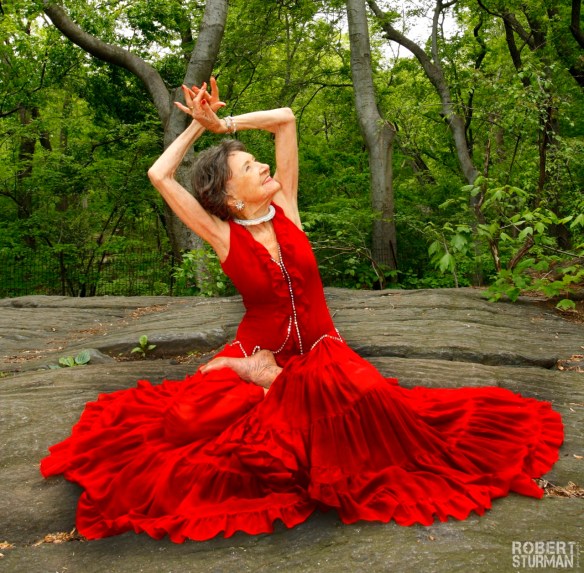
Well, I’m not sure about that — BKS Iyengar is at least a comparable age — but these photos are gorgeous, and it is inspiring to see how yoga can keep a person fit and flexible into their nineties.
And would you look at that smile? Such grace and radiance!
Here’s my favorite photo:
 The Well: bodymindheartspirit