A reader shares his TRE/shaking medicine experience

In case you don’t read the comments on this blog but are interested in the trauma releasing exercises and shaking medicine, I’m posting a long comment from a reader as a regular post in order to reach more people.

Thank you so much, Richard, for sharing your experience.

Thank you, David Berceli, for bringing the world TRE.

Thank you, Bradford Keeney, for writing and sharing so much about shaking medicine.

I love the fluid body.

Hey Mary –

Been doing TRE for a few months now (think I commented here before possibly), and have taken a free workshop with one of the London trainers. I also notice I can allow it to come on at will, even standing up – the TRE trainer likened it to a hosepipe, and you can inhibit/disinhibit the flow, e.g. as if you were putting your foot on/off it. The explanation given was that humans generally walk around in constant inhibit-mode, and once you’ve done TRE a few times you gain the flexibility to allow it through. It took me about 4-6 weeks of daily practice to get to that point personally.

Btw, in terms of progress… it’s been plateaus with spurts of growth. Some things have changed drastically, others havent changed yet. The tension in my body has changed, and “getting stressed” now feels different in terms of the intensity and location of the tension that arises in my body.

I notice it never quite goes “how I want”… always how it wants. Some parts just shake for weeks, over and over, the same pattern, then suddenly shift in one session. Sometimes I think some things shifted and it comes back to that location for more, and sometimes new muscles start going at it that had previously been holding.

From what I understand TRE is a wildly individual process; very much a function of your personal trauma, your personal locations of chronic tension, and what emotions are entangled up with all of that. For me it’s very much about the abdomen, chest, and anxiety. For some people it’s depression, anger, etc.

What I do know for sure is a) it’s the only thing that gets me “unstressed” daily on a physiological level (and I’ve tried a lot), and b) I’ve gradually become much more the person I want to be; the person I feel I truly am; since starting with TRE.

Hope you and others are finding similar benefits!
Thanks
Richard

I notice that Richard started out with the TRE exercises and has transitioned to shaking medicine. My distinction is when you can stand up and shake at will, TRE has become shaking medicine.

I have a strong hunch that the vast majority of people need to learn TRE first, to learn how to allow shaking to happen. Once your body learns to trust the trembling and lets it move into various parts besides the legs (and of course that will take different time periods for different people), try it with your legs flat. Try it standing up. Try it sitting.

I agree that it’s like a pipeline you can turn on and off at will.

Eloquently said, Richard, that you’ve become much more the person you want to be, the person you truly are. This is truly energy medicine.

What you need to know about standing desks

To counteract the ill effects of sedentary (from the Latin sedentārius: sitting) jobs, manufacturers are beginning to offer standing desks. Actually, they aren’t new. According to Wikipedia, standing desks were popular in the 18th and 19th centuries in the homes of the rich.

Furthermore, some of the world’s most talented writers wrote/write while standing. We’re talking Hemingway, Nabokov, Lewis Carroll,  and Thomas Wolfe.

Novelist Philip Roth, a great living writer, stands at a lectern to write and paces while he thinks, claiming to walk half a mile for every page he writes.

Who knows? Maybe writing is the one thing they did differently that helped them manifest their genius. It certainly seems to be better for the brain than sitting (see my previous post mentioning that movement of the sacrum pumps cerebro-spinal fluid, which nourishes the brain).

Perhaps before making the switch, you’re wondering how many more calories you would burn by standing instead of sitting. Here’s a calculator where you enter your weight and hours worked to find out the extra calories burned in a workday at a standing desk versus sitting. I’d burn 221 more calories per day. That’s very significant. I could lose a few extra pounds and then eat a little more!

Hmm. Could desk jobs be the real reason for the obesity problem in our society?

Adapting to a standing desk may take a week or so. Your feet may hurt from standing all day. You may be extra tired at first. Some people who’ve made the switch swear by a cushioned mat, like this writer, who had an adjustable IKEA Jerker desk (unfortunately discontinued) and switched it to standing mode. She writes about adjusting to it, which took her three days, and later using a mat and a footrest.

Of course, the least expensive way to create a standing desk is to simply put boxes, crates, or shelves on top of your regular desk and arrange your computer on them. You can create different levels for your monitor and keyboard if you like.

Personally, I’d put my big monitor at eye level and place an external keyboard at elbow level or slightly lower.

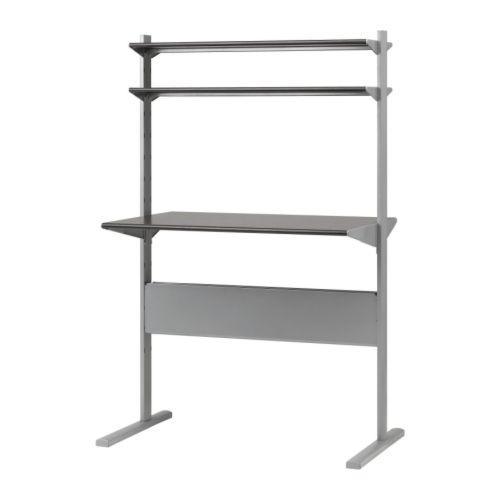
IKEA sells the least expensive standing desk that I found online, the Fredrik workstation for $119, shown below. There’s a wider version for $149. Assembly is required, of course.

Then there are the IKEA hackers — people who repurpose IKEA products to make what they want. Here’s an inexpensive conversion using PVC pipe.

Here’s another hack, the wide standing desk.

This article shows a couple of adjustable-height desks that allow users to flip a switch to adjust the height. This sounds great, for $700+.

Finally, here is a website devoted to creating your own treadmill desk. If you already have a treadmill, apparently you can do this for as little as $39, a significant savings over buying the top-of-the-line Steelcase Walkstation at $4,399, shown below.

Tips to counteract a sedentary job

If you have a desk job that requires a lot of sitting and you’re concerned about the health risks now being associated with prolonged sitting, here are some things you can do that require no expense:

  • Use a timer to remind you to stand up and stretch and walk around every 30 or 60 minutes. Google “timer” to find a virtual timer you like. Aim for a few minutes of non-sitting movement every hour.
  • Find ways to walk more: Place your phone away from your desk, so you have to stand up and walk to it to make or answer calls. Use a small cup for your drinking water or beverage of choice (or fill your regular cup partway), and when it’s empty, get up to refill it. Don’t use the restroom that’s closest to your office — walk to a more distant one. Instead of emailing colleagues, walk to their offices to talk, when feasible.
  • Breathe fully and deeply, using your abdomen, moving your ribs front, sides, and back. Do 5 of these breaths, then return to normal breathing.
  • Take a yoga class on your lunch hour. Or do desk yoga (Google “rodney yee 4 minute”  to see videos of Rodney Yee doing seated sequences). You can evendo cat-cow ever so often while sitting: curl your spine forward and back a few times, exhaling when you curl forward, inhaling when you arch your back.
  • Close your door or put on your headphones, turn on your iPod or a music video, and dance!
  • Fidget and wiggle. Especially move your legs.

When you’re not at work, avoid sitting as much as you can:

  • If you drive to work and your car has no lumbar support, place two tennis balls inside a piece of pantyhose with a knot in the middle and at the ends. Put it behind your lumbar vertebrae and press into it as you drive. It will feel great — and you’ll know when you’ve had enough.
  • If you watch television in the evenings or on weekends, stand, use your treadmill, or bounce on an exercise ball while watching. If you sit, get up and move during commercials.
Sit on an exercise ball at work instead of a desk chair. It strengthens your core, improves balance, improves flexibility, burns more calories, and requires you to use your legs. You can get them for under $20. Get a 75 cm for the most height. 

All of these tips can make a difference, helping to lower blood sugar, triglycerides, cholesterol, and waist size; improve posture, breathing, and metabolism; and decrease back pain.

“If there’s a fountain of youth, it is probably physical activity,” says Yancey, noting that research has shown benefits to every organ system in the body.

Next: standing desks.

Ecstatic shaking dance

On Sunday morning, I was driving to Castle Hill and dancing in my car as I drove. On the way, I realized I didn’t want to do yoga — I wanted to dance. So I drove to the Austin Yoga School and danced with Ecstatic Dance of Austin.

It was a homecoming of sorts. I started doing ecstatic dance (Sweat Your Prayers, 5 rhythms, Gabrielle Roth) in 1995. That group evolved into Body Choir, whom I danced with, while continuing with 5 rhythms when available.

A few years ago (four? five?), I started feeling conflicted about going to dance, any kind of so-called ecstatic dance. When I went, my body didn’t want to dance, it wanted yoga! I felt some attachment to people in the community of dancers and kept going for a while, but my attendance tapered off. I felt less and less joy at dance and finally I stopped going. It felt unsafe, it was too crowded, and the community was too political. And my body really wanted yoga.

I entered into a peaceful time of pulling in my energy, a time of healing my body. I did more yoga, committed to a home practice, and later trained as a teacher. I began meditating. I did two rounds of NLP training. I began seeking and finding great healers — starting with Nina Davis doing cranio-sacral therapy and Patrice Sullivan doing acupuncture and myofascial release (plus Patrice’s unique magic!).

I had NUCCA chiropractic, which got my head straight on my spine, which unwound my scoliosis. That was awesome. Then because I was still having pain in my left sacro-iliac joint, I found Dr. Chandler Collins for applied kinesiology and Bo Boatwright, DC, another creative and effective bodyworker, and I began working with Fran Bell this year.

I learned that I had probably had a birth injury to my S2 nerve. Maybe that’s where the scoliosis came from. And the SI joint pain could be related to the IBS-like symptoms I had before I went gluten-free several years ago. It’s complicated.

Anyway, my body is feeling pretty good these days. I still have some aches and pains, but is that not common at age 58? I don’t know! I notice stiffness when I’ve been still for a while and then stand up and move. It takes longer to warm up and move fluidly than it used to. But I get there!

What’s new is that my left and right sides are more balanced than ever, in body and brain and energy field.

While I was away from dance, lots of change happened. Body Choir became Dancing Together, then Body Choir came back. (I’m not sure I have the story straight.) Then Ecstatic Dance of Austin started up, and when Lakshmi Jackman was telling me about it in Whole Foods, I started thinking about returning to dance. I got a “no” a couple of Sundays ago after meditating, but I knew a “yes” was coming.

It felt good to be back in a large dance studio with a sprung floor, plenty of space, and rhythmic music. Also, no puddles of sweat on the floor! It felt safe, and the energy felt really clean.

I had changed so much over the time I was gone, I needed to get acquainted with my dancing body again. I did some shaking (yes, I can shake while standing now and can induce shaking when I want to) and found that my dancing edge was surfing between voluntary and involuntary movements, letting the shaking arise where I needed to shake, and then surrendering to the beat in dance.

Several times I felt energetic rushes of pure ecstasy move from my center out! Chills, thrills, goosebumps, GUS (God Universe Spirit) bumps — totally that howling-at-the-moon feeling of abandoned joy.

It was a real breakthrough for me, a joy, a homecoming.

I’ll return.

Each moment, life as it is, the only teacher: quotes from Joko Beck

Charlotte Joko Beck died yesterday, very peacefully, at the age of 94. She was a Zen teacher who made a major impact on American Buddhism.

Here’s a quote from an article that puts her work into perspective (no longer available online):

The Ordinary Mind School was among the first Zen communities to consciously engage the emotional life and the shadows of the human mind as Zen practice. The late Charlotte Joko Beck and her dharma heirs  adapted elements of the vipassana tradition — a relentless inquiry into the contours of the human mind—as unambiguous Zen discipline.

Here are some quotes from her:

With unfailing kindness, your life always presents what you need to learn. Whether you stay home or work in an office or whatever, the next teacher is going to pop right up.

Caught in the self-centered dream, only suffering;
holding to self-centered thoughts, exactly the dream;
each moment, life as it is, the only teacher;
being just this moment, compassion’s way.

Enlightenment is not something you achieve. It is the absence of something. All your life you have been going forward after something, pursuing some goal. Enlightenment is dropping all that.

One idea that really hampers us is to believe that people get ‘enlightened,’ and then they’re that way forever and ever. We may have our moments, and if we get sick and have lots of things happening, we may fall back. But a person who practices consistently over years and years is more that way, more of the time, all the time. And that’s enough. There is no such thing as getting it.

Wisdom is to see that there is nothing to search for. If you live with a difficult person, that’s nirvana. Perfect. If you’re miserable, that’s it. And I’m not saying to be passive, not to take action; then you would be trying to hold nirvana as a fixed state. It’s never fixed, but always changing. There is no implication of ‘doing nothing.’ But deeds done that are born of this understanding are free of anger and judgment. No expectation, just pure and compassionate action.

Practice is just hearing, just seeing, just feeling. This is what Christians call the face of God: simply taking in this world as it manifests. We feel our body; we hear the cars and birds. That’s all there is.

Life always gives us exactly the teacher we need at every moment. This includes every mosquito, every misfortune, every red light, every traffic jam, every obnoxious supervisor (or employee), every illness, every loss, every moment of joy or depression, every addiction, every piece of garbage, every breath. Every moment is the guru.

So a relationship is a great gift, not because it makes us happy – it often doesn’t – but because any intimate relationship, if we view it as practice, is the clearest mirror we can find.

Practice can be stated very simply. It is moving from a life of hurting myself and others to a life of not hurting myself and others. That seems so simple — except when we substitute for real practice some idea that we should be different or better than we are, or that our lives should be different from the way they are. When we substitute our ideas about what should be (such notions as “I should not be angry or confused or unwilling”) for our life as it truly is, then we’re off base and our practice is barren.

We have to face the pain we have been running from. In fact, we need to learn to rest in it and let its searing power transform us.

We learn in our guts, not just in our brain, that a life of joy is not in seeking happiness, but in experiencing and simply being the circumstances of our life as they are; not in fulfilling personal wants, but in fulfilling the needs of life.

Meditation is not about some state, it is about the meditator.

Zen practice isn’t about a special place or a special peace, or something other than being with our life just as it is. It’s one of the hardest things for people to get: that my very difficulties in this very moment are the perfection… When we are attached to the way we think we should be or the way we think anyone else should be, we can have very little appreciation of life as it is…whether or not we commit physical suicide, if our attachment to our dream remains unquestioned and untouched, we are killing ourselves, because our true life goes by almost unnoticed.

I’m going to massage school at Lauterstein-Conway!

I was taken with this quote in a book I’m reading.

The leading contemporary philosopher of the body, Don Hanlon Johnson, also underscores how the invention of different body therapies arises from the originator’s own spontaneous movements, which too easily become rigidified when they become formalized and taught to others in an authoritative manner. The most promising future for body therapy will be in the direction of returning us to an experience of basic, natural movements that take place effortlessly and spontaneously.

This quote is taken from the book Shaking Medicine: The Healing Power of Ecstatic Movement, by Bradford Keeney. I’m nearing the end of reading it. (Okay, I’m slow sometimes and usually have four or five books going at once.)

Keeney reports on his first-hand experience with Kalahari Bushman ecstatic shaking practices, shaking medicine on the Caribbean island of St. Vincent, the ecstatic “holy rolling” of the African-American church, the Japanese shaking medicine called seiki (not to be confused with reiki), kundalini, and his own Life Force Theater.

More to come on that…

The quote above fits with the practices of some of the bodyworkers I’m working with, who, although they trained in a rigidified method, have evolved their work in the direction of moving and healing naturally, using their intuition, familiarity with the body, and healing skill to facilitate rapid change and healing.

I’m feeling more solid, aligned, and at ease than ever — and that’s something for someone who’s had nerve damage, PTSD, scoliosis, and serious injuries. (Some of this great feeling of health and wellness may be due to the brainwave optimization process I undertook last week as well. There’s no separation between mind and body.)

Bodywork is a very inspiring area of learning and practice that I want to pursue. I’ll be starting my training later this month in The Lauterstein-Conway School of Massage in Austin, Texas.

There are three more spots to be filled in this class — click the link to learn more.

Buddhist tattoos

Expanding on my previous posts about yoga tattoos, I’m sharing a link to a blog post, Getting a Buddhist Tattoo, on The Buddhist Blog (new to me).

The image below is from that blog post. I find this tattoo to be incredibly beautiful.

The post and the comments are well worth reading if you have an interest in tattoos and Buddhism.

7 things to remember when teaching yoga to kids

Last fall I had an opportunity to teach yoga once a week to 20+ fifth graders for a few months. We didn’t have mats or much space to work in, so after they removed their shoes and gathered on the carpet, I focused on mostly seated and standing poses for 15 minutes.

Very few of them had much experience with yoga. I wanted the students to love yoga as much as I do, and to create a program that might result in them later continuing to practice yoga.

Here are my take-aways from the experience:

1. Keep it simple. Om means “everything that is”. Namaste means “I honor you.” Don’t overwhelm them with Sanskrit and anatomy.

2. Teach them belly breathing. It will serve their lives well to learn it now. Ask about it now and then. After a couple of months, it may become a habit.

3. Leave them wanting more. Keep sessions short and make it fun. Let them experience the joys of yoga. So their downward-facing dog isn’t perfect. They’re 10! Let it be, and let them howl or bark like dogs! There’s plenty of time later for them to perfect their poses if they choose.

4. Pay attention and ask for feedback. Can everyone see? Did everyone hear that? Where do you feel that pose the most? What is hard about that pose? Yoga is about awareness. Foster it.

5. Be inclusive. As with adults, some kids take to yoga more than others. Praise all effort lavishly, and tell them it’s not a contest — yoga is good for every body. After a couple of months, ask them to remember what it was like the first time they did tree or eagle pose. They’ll get it.

6. Ask for volunteers to demonstrate poses after you’ve taught them a few times, and over time, give everyone a chance to demo a pose. They will learn the poses better, knowing they may be in front of the class, and be eager to get in front of their peers!

7. Let them experience sitting in silence for a minute at the end of the class. That may be a revelation — it was for the kids I taught, who begged to sit longer. (We worked up from one minute to five.) They may not get any silent stillness in their lives other than this — and they may really begin to value it at a young age.

My experience with brainwave optimization

Last week I did brainwave optimization, aka brain training, at NeuroBeginnings.  I did the baseline assessment in May and wrote about it here. It’s an astounding new technology with huge potential to alleviate suffering and help people’s brains function optimally without spending a minor (or major) fortune on health care.

Gigi Turner, owner of NeuroBeginnings, likes to schedule the training to start within two weeks of the initial assessment, but we had to work around finishing my 3M contract, which was hard to pin down. You need a full week as free of demands as possible so you can integrate the brain training. It’s a wonderful activity for a vacation (or stay-cation if you live in Austin). 

By the way, Gigi is hard-working, personable, and adorable. She’s easy to relate to, and you know she’s working for your best interests. She’s a woman after my own heart, fascinated with the brain and its workings, making the world a better place one brain at a time.

I did two sessions per day, Monday through Friday, one at 9 am and another at 12:30 pm, each lasting about an hour and forty-five minutes.

Between the morning and afternoon sessions, I hung out at the Zilker Botanical Gardens or walked along Barton Creek. It felt great to move after being still, and being outdoors in scenic nature was refreshing. I’d get lunch at the Daily Juice or Whole Foods, something light and very healthy.

During each session, I sat in a special recliner and either watched a computer monitor or just relaxed doing nothing. Gigi attached electrodes to my head and moved them to various places — frontal, temporal, parietal, and occipital lobes.

There were several exercises I did in every session: sitting and watching a bar move to a lower position,  reclining with the lights off and relaxing deeply, imagining/remembering an activity that uses all the senses, and visualizing a guided meditation.

During all the exercises, I heard musical notes playing. Gigi said you actually want them to stay in the background and not think about it too much. They are random notes, not playing a tune, not rhythmic, not even music — just random notes. There are a variety of musical sounds. You might hear the random notes played on a guitar, xylophone, steel drum, bells, or piano.

I am a thinker. I have a very active mind, and I’m gaining facility in switching from that active, inquiring, analytical state to more relaxed states.

I noticed that I liked it when a lot of notes played fairly densely, and I didn’t like it when one note played over and over, or when there was a long silence. I wanted the “music” to be pleasing to my ears.

A couple of times I would recognize a fragment of a song in a string of 3 or 4 notes and smile to myself. I noticed that if I was getting one note repeatedly, I could move my eyes, and the sound would shift. That’s an NLP trick!

The sounds reflect current brainwave activity, allowing the brain to “see” itself, as Lee Gerdes says in his book, Limitless You. You do occasionally view your brain activity on the monitor, but mostly the brain is hearing itself, and the more in harmony and cohesive the brain gets, the more the sounds reflect that.

You don’t have to do anything. The brain adjusts itself. At least, that’s how I think it works.

Watching the bar was hardest for me. I tried too hard, and it strained my eyes (I wear contacts and need to blink often — did you know your brainwaves change when you close your eyes, even to blink?). I stopped drinking green tea in the morning and brought eyedrops, attempting to make this exercise easier to accomplish.

I finally started getting the hang of it on Friday when I imagined that the sound of the air conditioning was a waterfall that was very nearby. When my attention was split between listening to the “waterfall” and gazing beneath the bar (rather than staring intently at it), I made progress.

I believe that exercise was about my “thinking” mind — aka bringing down my beta waves.

I went into brain training wanting to get rid of any remaining dysfunctional patterns from my childhood trauma and years of PTSD. Most of the changes took place in the frontal and occipital lobes — the center for executive functioning and the visual cortex, respectively. After my last session, Gigi gave me printouts showing how my brainwaves in those lobes had changed over the week of training. She got my left and right hemispheres more in sync in those lobes.

I loved the relaxation exercises. It turns out I’m very good at going into alpha! As I got used to the process, I got pretty good at dropping into theta and good at noticing the difference between alpha and theta. (Theta is where deep healing occurs.) I dropped into delta (sleep) a few times, especially after lunch, at first, but as the week progressed, I was able to stay awake in theta for longer periods.

I really loved the task of imagining I was entering a house, walking upstairs, and entering three rooms. Each day I created different rooms. Here are some juicy ones:

  • A room full of guides — lamas, teachers, angels, masters, buddhas and boddhisattvas, yogis, healers, shamans, seers — who included me and gave me gifts, laying their hands on me.
  • A room of possibilities that I’d like to manifest — travel, prosperity, success, joy, gifts and talents and skills, love, creativity, equanimity, health, goodness.
  • A room containing my fears and obstacles, with wonderful resources to address each one.
  • A room of gratitude for past, present, and future.
  • A room where I gave my gifts and resources to those who needed them.
  • A room of beginner’s mind.
  • A room for my future sage elder self.
  • A room of intuition.

Also, the Jean Houston guided meditation of cleansing the senses works well here. Having NLP training was useful!

During the five days of training, I didn’t experience any sudden or drastic changes in brain functioning, but each day I felt a little bit sharper, more present, more centered.

I learned that my brain operations were actually in pretty good shape to start with, and with a few tweaks it will operate even better. The changes will continue to manifest over a period of months after the training.

To get the most from it, the instructions are that for at least the next three weeks, I need to avoid alcohol and recreational drugs, exercise/walk daily, eat a lot of protein, and drink plenty of water.

It would be helpful to practice awareness through progressive relaxation, visualization while listening to a CD Gigi gave me (I liked the sound of a stream during some of the sessions, which has become an anchor), and doing breathwork.

I also need to postpone appointments for other therapeutic modalities until three weeks have passed, so I’ll need to make some phone calls on Monday.

If you’re interested, I recommend calling NeuroBeginnings for a baseline assessment. Her number is 512-699-6593. The baseline assessment currently costs $160. The entire cost, at present, is $1,635, if I remember correctly. Compared to doctor visits and medication, brain training could actually save you time, money, and side effects. 

I’m going to wait at least three months before going back for a tune-up unless something drastic happens, and then I hope to try one of their new gamma wave protocols.

I look forward to noticing improvements in my brain’s functioning and sharing them with you!

Healthy lifestyle turns off disease-causing genes

An important new study from Dr. Dean Ornish shows that changes for the better in diet and exercise, plus adding daily meditation, can create rapid and dramatic changes in genetics.

After three months, 30 men who had avoided conventional treatment for prostate cancer had 48 genes that were turned on — and ten times as many (453) that were turned off. Disease-preventing genes increased activity, while disease-causing genes shut down.

Read it for yourself. Healthy lifestyle triggers genetic changes: study.

It makes sense. We’ve all heard of people who recover their health seemingly miraculously. It may have a lot to do with their belief (or suspension of disbelief) that it is possible to influence their health through changing their basic daily habits — simple changes in food and activity choices.

Thanks to Tim Ferriss for posting a link to this article on Facebook.

And…here’s a link to an abstract that found that just the basic “relaxation response” is enough to trigger positive changes in genes, in both short-term and long-term practitioners.

These studies of course will beget more studies, but no longer can you resign yourself to believing your fate is all in your genes. What you do can activate and de-activate the genes you were born with. DNA doesn’t change, but gene expression does.