Whole lotta shakin’ goin’ on

And trembling, quivering, rocking, shivering, rolling, flapping…

Just got down for day two of my every-even-numbered-day-in-February practice of the trauma releasing exercises.

If you’ve done these exercises, I’d love to hear from you.

Several people have expressed an interest in learning how to do these, and I’m checking into teaching a class. I’d like to find a health-oriented office or clinic to sponsor and help publicize a class. Not everyone has access to (or learns best) from a book or video.

Anyone else interested?

I’ve realized several things:

  1. Before this challenge started, the trembling didn’t start for me until I got to Exercise 7. Upon closer reading, the trembling is supposed to start in Exercise 6! Now, after reading that, that’s when it starts for me. That shows how suggestible my mind is to another person’s authority!
  2. I realized that I had been suppressing my own body’s trauma/stress release response! That’s something to definitely get more aware of. How often do we disrespect our bodies and make them do what our minds will have them do? Often it’s for the sake of convenience or decorum! This is pretty huge.

What might the world be like if people recognized the effects of stress on their bodies felt compelled to release it so that it never built up and resulted in illness and discord?

World peace through the trauma releasing exercises!

Today my legs began to quiver about 35 seconds into Exercise 6. I noticed that sometimes I pressed my sacrum into the wall, and sometimes my thoracic vertebrae were pressing into the wall. The back of my head is constantly into the wall.

Also, it’s important in Exercise 6, Step 1, that your feet are further away from the wall than your knees. This makes sense to me as a yoga instructor. Protect your knees.

Note: In Exercise 6, Step 2, when you do a forward bend, you do not need to touch the floor with your hands, as shown in the illustration on page 184. This is impossible for many people. If you can’t do it, don’t be discouraged. You can rest your hands on yoga blocks, a coffee table, a chair seat.

At first in Exercise 7, I had a lot of leg shaking. A lot. Then hands and forearms — and my right arm is shaking almost as much as my left, after months of nothing happening there.

I did some circular movements with my hands.

(It’s weird saying “I did…” because this is really involuntary movement. It was more like this: “At times my hands made movements that I recognized as circular.”)

And then my body went into gentle, rhythmic pelvic rocking. It felt soothing and comforting. Experiencing my body as this out of control is disconcerting, but I am getting more comfortable with it because of the relaxed emptiness that follows.

Then the leg quivering would return for a while. I cycled between these two patterns for a long time. I even stopped moving completely for a few seconds several times, and then my legs began trembling again.

Finally, I just knew I was finished for today. From the start to the end of Exercise 7 took about 12 minutes.

Right now I feel pleasantly relaxed and empty and slightly fatigued. Since it’s a snow holiday, I think I’ll take a little nap.

Measuring your stress level

I want to have a baseline measure of my stress level at the start of this two-month Chronic Stress and Trauma Recovery Challenge.

  • My immune system is functioning well. I haven’t suffered from allergies or colds since last May.
  • I’ve never had high blood pressure. It’s usually about 100/70.
  • I usually sleep well. I take melatonin and Rescue Remedy Sleep when I don’t, and they work.
  • If negative emotions start to run away with me in the form of anxiety, fear, anger, or guilt, I do EFT and t-a-p them away.

Still, in the last six months, since August 3rd:

  • I completed yoga teacher training.
  • I left a job that was stressful to me.
  • I started doing new types of work (NLP coaching, teaching yoga), moving toward a new livelihood.
  • I downsized my stuff and put my house on the market.
  • My house was burglarized and my laptop and some other stuff stolen.
  • I had a collision that left my car in the shop for over a month, without rental coverage.
  • I started a three-month technical writing contract at a large corporation with a long but scenic commute.

All of this is stressful, according to the WebMD Life Change Stress Test. You’ve probably read before now that major life events, both negative and positive, are stressful. Now  you can measure your stress level online.

Stress can interrupt sleep and make you cranky. Chronic stress can raise your blood pressure, weaken your immune system, and affect physical and mental health. Wikipedia has a long list of the symptoms of chronic stress.

I took the test, and the results showed I have moderate stress. How are you doing on stress?

I believe that doing the trauma releasing exercises for the next two months will help keep me healthy. I just need to keep doing more of what I’m already doing (meditation, yoga, EFT). In addition, I’d like to get more aerobic and weight-bearing exercise.

And I will! I’m getting a kettlebell!

Please share this post about the Chronic Stress and Trauma Recovery challenge!

In an effort to reach as many people as possible who can benefit from the Chronic Stress and Trauma Recovery Challenge, may I ask that you please share this post — by emailing it to friend who could benefit and/or by sharing on Facebook, retweeting on Twitter, sharing on Stumbleupon, Digg, Reddit — using whatever social media programs you like?

There’s even a little +SHARE icon below the post that you can use. I’m trying to get some momentum going here!

The all-time daily high for people viewing this blog was 89 views on Feb. 3, 2010 — a year ago tomorrow. Right now I’m at 15 views for today — would love to beat that record!!!

I’m including the links to all my posts about this challenge below to make it easier to catch up on the info.

In order from oldest to newest, please read these three posts:

These posts will get anyone caught up with the challenge, which starts today. You don’t have to do it like I do it, but please try them at least once.

Doing these exercises can help anyone release stress and trauma. If enough people do them, we could co-create a world with more peace and love, and less violence, substance abuse, and suffering. Would you like that?

If you don’t think you can benefit, I ask you to try them just once. If you do these exercises and don’t tremble, I’ll kiss your feet and tell the world!

If you’re in Austin, Texas, I’ll be glad to teach you how and do them with you, at my home, your home, or maybe a more public place.

Thank you for sharing this.

Welcome to the Chronic Stress and Trauma Recovery Challenge!

Good morning! It’s a lovely 18 degrees F. here in Austin, TX, with rolling blackouts occurring around the state as I write this due to the extreme demand for electricity. My old house is chill, and I’m lucky to be bi-powered, with gas and electricity.

If you don’t have the book, The Revolutionary Trauma Release Process: Transcend Your Toughest Times, or the video, or if you’re completely lost about this work,check out these videos on YouTube:

  • Trauma & Tension Releasing Exercises, 1:37. This silent video first shows a captured polar bear trembling to release shock and stress from its body, and then it shows several people doing the same in a deliberately induced process (because we humans have mostly forgotten how to do this). You can get a sense from seeing the variety of ways that people tremble, shake, and rock that there’s not a “right way” to do it. Your body finds its own way to release stress and trauma, and that can look a bit different from person to person. If your body does something else, just surrender (but please keep yourself safe.)
  • Trauma Releasing Exercises, 3:58. This video shows a group of women at a workshop testifying about their experience, as well as some bits showing them doing the exercises. If you haven’t done them before, check out what the trembling can look like. Really clears out energy blocks in the lower chakras!
  • There are also a series of six videos, interviews with David Berceli, author of the book above, who developed these exercises. I haven’t seen them all yet.

I’m getting out my book and turning to page 144. Here goes!

Ahh. I stopped after 30 minutes so I could finish this post before my chiropractor appointment. Had a sense I could have gone for 5 more minutes.

Noticings:

  • I have been holding off on doing these, noticing stress in my body and wanting to really be ready to do these exercises for this challenge!
  • The floor was cold, even on a yoga mat, so I spread yoga blankets on it.
  • I do Version B of Exercises 2 and 3. What do you do?
  • I have to do Exercise 2 longer to feel stress in my calf. But then I can squat with flat feet, so my calves are pretty stretched out. Do you find that you need to do more of any exercise to feel the stress in your muscles?
  • I believe that Exercise 6 is really the tough core of the process. Today the trembling started just before I went into the third minute. I hung in there for five minutes! (I wonder if you were in a hurry and just did this one exercise, would your legs begin trembling? I will probably check that out at some point!)
  • Exercise 7 is the release! Whee! Today, mostly my legs trembled, but my hands shook at times as well, and when the trembling stopped, my body began to rock. I alternated, trembling and rocking, for 15 minutes.
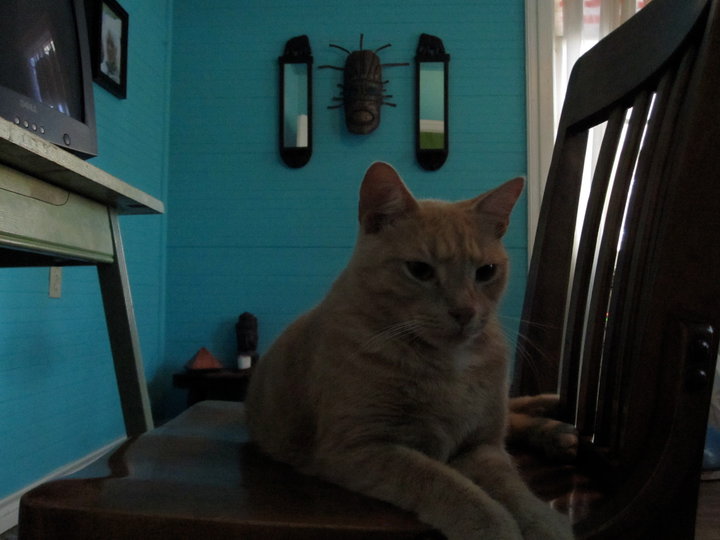
  • My cat Mango curled up next to my side while I was on the floor trembling. Cats are very sensitive to good energy! Thank you, Mango!

All in all, today was a good start.

If anyone reading this in Austin, TX, is interested in doing these with me, please get in touch. I’d love to teach you or do these with you. If enough people are interested, I will look for a place to teach these for free or very low cost.

Meanwhile, until Feb. 26, there’s my house!

Since I’m doing these on even-numbered days in February, until Friday! (It may be an everything-closed-because-of-snow-and-ice day here in Austin, Texas!)

The end of gratitude!!!

Not really. Made you look, didn’t I? Ha!

Today’s the last day of my 21-day gratitude challenge. Several others that I know of have participated in some way — thanks, Katie and Michael and Victoria, I appreciate your support — and I hope that others of you have been inspired to explore gratitude in your own lives.

Today I understand that gratitude is a powerful connecting force. It’s simply recognizing the interconnected nature of your life.

We truly are connected. We are interdependent. To not feel gratitude is to experience walls around your self. To feel gratitude is to let the walls down. We are one.

Remember, gratitude is a habitual bias that you can cultivate by consciously experiencing it. If you ever have a hard time feeling gratitude, think on this:

At this moment, the vast majority of human beings on this planet don’t have it nearly as good as you do.

Just recognize that you have comfort and freedom and connections beyond the imaginations of much of the world. You don’t have to feel guilty about that, either.

But you might want to do something, like at least have some compassion for the homeless, hungry, malnourished, ill, lonely, hurting, hating, suffering, dying people in this world. And these people aren’t necessarily in Third World countries, in case that image flashed into your mind. They are here among us. They are us.

And every single one of us, until we draw our last breath, has the capacity to grow up and wake up.

As Byron Katie said,

I’d say “bless your heart, sweetheart,” but I’m too late. You’re already blessed.

She also said,

Who would you be without your story?

What is the story that keeps you suffering? Can you consider just giving it up and opening to what actually is?

When I first posted about this challenge, I asked you to consider this, from Wikipedia:

A large body of recent work has suggested that people who are more grateful have higher levels of well-being.

Grateful people are happier, less depressed, less stressed, and more satisfied with their lives and social relationships.

Grateful people also have higher levels of control of their environments, personal growth, purpose in life, and self-acceptance.

Grateful people have more positive ways of coping with the difficulties they experience in life, being more likely to seek support from other people, reinterpret and grow from the experience, and spend more time planning how to deal with the problem.

Grateful people also have fewer negative coping strategies and are less likely to try to avoid the problem, deny there is a problem, blame themselves, or cope through substance use.

Grateful people sleep better, and this seems to be because they think less negative and more positive thoughts just before going to sleep.

I’m closing this challenge with one more quote from Byron Katie. Consider this radical, revolutionary thought:

It all happens for your awakening, enlightenment, and joy. There is nothing that is not for us.

Love you!

~~~

Tomorrow is the first day of the Chronic Stress and Trauma Recovery Challenge! Accept the challenge, check in, contribute to the discussion, and support us by following!

An open invitation to join an experiment in well-being

A reader, Martie in South Africa, commented on an older post, Holotropic breathwork compared to trauma releasing exercises, and said:

I first heard about TRE last year Sept. Since then I have bought the book “The Revolutionary Trauma Release Process: Transcend Your Toughest Times” by David Berceli; spend hours and weeks on the internet reading up as much as I can (actually the info is few and far between and quite hard to find!). I have met up with other people who have done the course, and we have swapped some stories and experiences. I would like to learn as much as I can about this process ;-) . Sadly I think the course prices are way over priced (for my budget anyway), so I am going the DIY route.

I invited Martie to participate in the Chronic Stress and Trauma Recovery Challenge that starts Feb. 2, which I announced yesterday on this blog.

And now I’m inviting you. Here are the criteria for participating:

  • you want to enhance your well-being
  • you’ve been under prolonged stress at some point in your life
  • you’ve experienced trauma at some point in your life
  • you like discovering what really works
  • you’d like to contribute to the body of knowledge about a technique designed to help people recover from trauma by releasing it from their bodies
  • you’re interested in finding out if this technique works for releasing chronic stress

If any of those criteria inspire you, please consider participating for any or all of this challenge. You can’t do it wrong! I’m doing it a certain way, but anyone who does these exercises even once is welcome to participate and comment on your experience.

I’m trying to build a body of knowledge here, because as Martie and many others and I have found, there’s not a lot of anecdotal information available in one place about using this technique to release trauma and stress and improve well-being. It holds great promise, if you can imagine a world where no one is overly or chronically stressed or traumatized.

All it costs is the price of the book or video, you doing the exercises at least once (but hopefully several times or even as often as I do) in February and March, and reporting on your experience in the comments on this blog.

When it’s over, I’ll compile all our experiences into one long, organized blog post (or maybe a page) that anyone can find when they google “trauma releasing exercises”.

Announcing the Chronic Stress and Trauma Recovery Challenge

On February 2, after completing the 21-day gratitude challenge, I am starting a new challenge, the Chronic Stress and Trauma Recovery Challenge.

One topic that consistently draws people to this blog is David Berceli’s trauma releasing exercises, as described in his book, The Revolutionary Trauma Release Process: Transcend Your Toughest Times, and seen in his video, Trauma Releasing Exercises Step by Step Video Instruction and Demonstration.

I’ve posted about them several times and done them at least a dozen times.They aren’t hard to learn or do — you just have to be able-bodied.

Although I have experienced trauma in my distant past, my take on these exercises is that they are very helpful for releasing chronic stress, which is much more common than trauma in today’s world.

It’s been estimated that as many as 90 percent of doctor’s visits are for problems related to stress. So let’s do something to decrease stress!

Besides, I need to do these exercises consistently, and I want to make it fun and useful for others, so I’m inviting you to join me in creating an online resource of anecdotal reports about the effects of doing these exercises. I would love to have your input!

  • Ever had a job you disliked or got burned out on and couldn’t just leave because of your mortgage/insurance/retirement? That’s chronic stress.
  • Ever had a difficult colleague/customer/boss/partner who seemingly loved to make your life miserable, whom you couldn’t just tell off because you’d get fired/dumped? That’s chronic stress.
  • Ever tried to work and take care of your spouse, kids, and aging parents, putting yourself last? And throw in a difficult commute or special-needs family member? That’s chronic stress.
  • Ever been consumed with worry, so that your health suffered? That’s chronic stress.

Ask yourself this:

How relaxed am I?

Is relaxation a distant memory?

Is relaxation something I only experience with alcohol or an expensive vacation or pharmaceuticals?

What can I do to release tension from my body in a healthy way?

Do I do this often enough to experience life for most of every day in a relaxed state?

If any of these questions hit home, please consider participating in this challenge. Your participation doesn’t have to exactly match mine. Do what you can, and I’d love to hear about your experience.

Trauma recovery experimenters are welcome to take part and report too. That is what this process is designed for.

Here’s how the challenge works (and if I am the only one, I will happily be the lone nut curious enough to do this and learn something useful to share):

  1. If you don’t have the book or video, order them now. The links above will take you to Amazon.com.
  2. On February 2, do the exercises. They take 20-30 minutes. I’ll be doing them and reporting here, and you can share your experience in the comments.
  3. For the rest of February, do the exercises on even-numbered days. Report as needed.
  4. In March, do them twice a week on your own schedule. Report significant changes in the comments.
  5. At the end of March, notice what has changed in your body, attitude, sense of well-being, emotions, vices, and other aspects of your life that may be attributable to doing these exercises and letting go of stress. Share in the comments!
  6. Learn to recognize what your unstressed body feels like and what the signals are that you need to do the exercises. This is a skill.

That’s it! This is qualitative research, health and well-being improvement, and community service, folks. I’d love to receive and share your contributions. Maybe we can make the world a better place while benefitting ourselves!

Any questions before we start? Feel free to email me at mareynolds27 at gmail dot com.