About MaryAnn Reynolds

I practice advanced bodywork in Austin, TX, specializing in Craniosacral Biodynamics and TMJ Relief.

Making a difference: An invitation to try Kiva and get $25 to lend

I’ve been making microfinance loans for several years now through Kiva. It gives me an amazingly good feeling to lend $25 along with a bunch of other people from around the world to help someone struggling in poverty get ahead and to receive updates on their repayment status.

I could be in their shoes. After all, isn’t every person just another version of me?

I’ve made 15 loans so far, to people in Benin, Ecuador, several in Peru, Kenya, Paraguay, Costa Rica, Pakistan, and Nigeria. The one to Pakistan took a long time to repay, and I could infer from reading the news why. That country was in quite a bit of turmoil right after I made that loan.

I’ve lent to individuals and groups, men and women of various ages. One was to a Costa Rican mother of four and grandmother, very stylish, who is a talented seamstress and dressmaker. Maria also teaches sewing classes. Her loan, now repaid, was for a better sewing machine for making alterations. Here’s her photo. Doesn’t she look competent?

I am discerning about the reason they want a loan. I’d rather lend money to someone who is creating something or offering a skilled service than if they are reselling Pepsi. Who needs Pepsi?

Several of my loan recipients have done embroidering, weaving, sewing, and tailoring — which require real skills. Others have been in food and agriculture — food stalls, dairy, livestock, fruits and vegetables.

Aside: I wish Kiva would identify the people who are raising livestock, dairy animals, and crops organically. I’d like to encourage that kind of agriculture. That food might end up on my table someday, or yours. Wouldn’t you  prefer organic? Couldn’t the whole world return to growing our food organically?

When loans are repaid, I relend the money. You can also take it out of Kiva if you want. I usually give Kiva a little extra for their operating expenses. That part is tax-deductible as a charitable donation.

Anyway, this is by way of inviting you to make a loan through Kiva. Right now, if any friend of mine joins Kiva for the first time, we both get $25 to  lend. 

All you have to do is click this link to go to my personal invitation page. Find a borrower you like, click “Lend $25,” and follow the instructions from there.

I just used my free $25 to lend Zilola in Spitamen, Tajikistan, some of the $600 needed for her to buy a computer. This mother of three, who works at  a sewing workshop, plans to offer computer services to generate more income for her family. She’s had a little training in business and computer use. Her children will benefit and will help her with this business.

Sounds like a forward-thinking, savvy mom to me.

Actually, the money has been pre-disbursed by a local microfinance operation that works with Kiva as a field partner. The nuts and bolts of microfinance are sophisticated.

IMON International has a four-star risk rating, has partnered with Kiva for over 4 years, and has made over 6,000 microloans totaling $7.5 million in Tajikistan with a default rate of 0.03%.

That seems pretty sound to me.

My loan actually goes to IMON to replace the money they’ve already lent to Zilola. I will get updates on Zilola’s repayment. (Note: The recipient I originally chose, Hout, worked with a Kiva field partner that did not meet Kiva’s standard for participating in this special offer, so if you read this post twice, I’ve replaced Hout’s info with Zilola’s.)

However the money flows, it is doing good, and I feel more connected to this amazing planet we call home.

I make microfinance loans through Kiva because it makes me feel good to help others. My heart connects to their lives and their dreams of lifting themselves and their children out of poverty, of living fuller, more satisfying lives in their families, communities, and world. I want that too.

Their stories become part of my story.

If you’d like to participate in Kiva and start with a gift of $25 to lend, just click this link.
The Goddess in Prison, by Peggy Lamb

The Goddess in Prison.

My friend Peggy Lamb wrote this blog post for Truth Be Told, a nonprofit working with women behind and beyond bars where we both volunteer.

She works with bodies, movement, dance, helping these wounded women heal from the traumas and tragedies they’ve experienced in their lives.

“I never heard anybody refer to God as a woman.”

Peggy replies, “Something to think about,” and leaves it at that.

She writes:

Feelings, traumatic events, images, joys and sorrows are danced. The bandages get ripped off, blood flows, and channels are opened in all of us as we witness a woman uttering the unspeakable with her dance; her body expressing what she has no words for.

In a sense I am a missionary for the Goddess. Without saying her name I invite these women to meet the Goddess in their belly.

Testing the FitDesk: an update

Last week I posted on testing the FitDesk. Here’s an update.

I discovered I had mounted the desktop backward. I had assembled it intuitively and then thought the velcro for attaching the electronic monitor was missing. I held the laptop in place with the giant rubber bands the company provided.

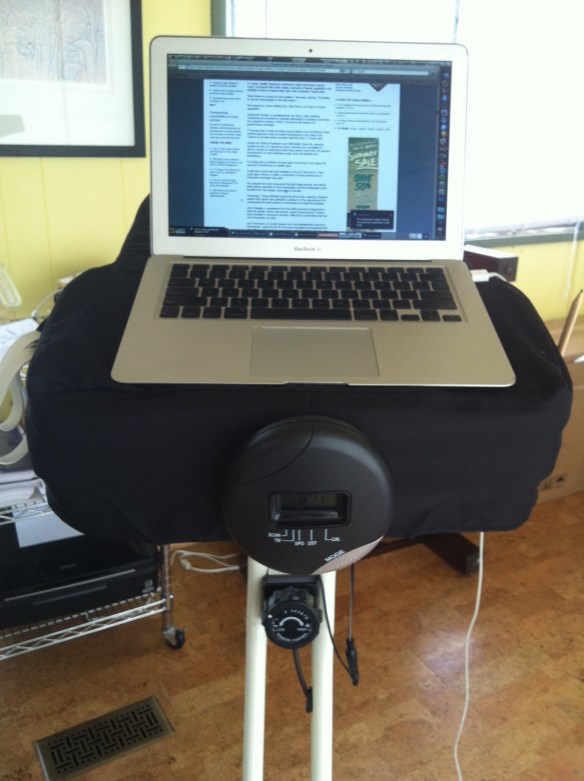
Later, I saw a piece of velcro on what I thought was the wrong side, and the little wheels in my mind started turning. I got out the instructions, looked at the photo, and sure enough, the fat end of the desktop is closer to the rider.

Here’s a photo with it mounted correctly, electronic monitor attached:

FitDesk

This way, there’s a slight ledge that you can’t really see but can feel on the desktop (which is made of dense foam covered with cloth) that will keep your laptop from sliding off. Although giant rubber bands are included, I did not find them necessary to hold my laptop in place with the desktop mounted correctly.

Note: I didn’t really use the electronic monitor. I just looked at the clock or set a timer on my iPhone and pedaled for a set length of time. Since I’m not using it to meet fitness goals, I found it more of a bother.

FitDesk pocketThis way of mounting the desktop also places the pockets closer to the rider. I used my iPhone to take these photos, but when not in use, I store it in one of the pockets, with Post-Its and writing instruments in the other pocket.

My friend Edward Spurlock tested it out. He adjusted the seat to fit his leg length. He is a cyclist and concurred with me that the FitDesk is not comparable in quality with exercise bikes at the gym (which are built for heavy, nearly constant use mimicking hills and so on). But for simply keeping your legs active while doing computer work, it’s great.

(Note: I took the photo below before figuring out the right way to mount the desktop!)

Edward monitored calories burned using an app called BodyBugg and reported the following:

I spent the entire interval from 12:42 PM to 12:48 PM turning the pedals on the FitDesk and burned 23 calories total during that time.

By comparison, I highlighted and selected the interval from 1:06 to 1:12 PM, when I was sitting in stop-and-go traffic on IH35 on my way home. The ‘Bugg registered a total of 8 calories burned for the interval, or around 1.4 calories / minute.

I usually burn 1.2 – 1.4 calories per minute on a normal workday sitting at my desk. If I used the FitDesk for a longer period, I might have slowed down a bit – but I think it’s fair to assume that one would burn at least twice as many calories turning the pedals and holding one’s body upright using the FitDesk than sitting still in the standard office chair with backrest.

Two to four calories per minute is pretty good compared to 1.2 – 1.4. You could definitely lose weight/eat more delicious food using a FitDesk regularly!

And finally, I want to report that the FitDesk does seem very feasible for use in an actual office wearing actual office clothing. I rode it for 30 minutes with the pedal tension set to 1 (no tension). You may remember that my first test was for an hour with the tension set midway at 4. I got sweaty then.

I did not sweat using the lowest setting, which is pretty remarkable considering I keep my trailer a bit warmer than the typical 72 degree setting found in most offices, closer to 76.

So I would say that the FitDesk is a desirable option in an office setting as well as for working at home.

Check out my tips for improving your health while sitting less (written while pedaling on a FitDesk)!

12 ways to improve your health by sitting less (written while pedaling on a FitDesk)

If you commute (usually sitting) to a desk job (mostly sitting) and then go home and watch television (sitting) and/or spend a lot of time on your computer (sitting), even if you manage to work in an hour at the gym, your health is at risk.

You can Google to learn more about the science of this — and they’re just beginning to learn. I’m just here to give free advice on behavioral changes you can make.

To counteract all the sitting, you could consider:

  1. Cutting the car commute and work from home as much as possible. Seriously. Present this option to your manager as a way to cut their costs, improve your health, and therefore make you more productive!
  2. If you can’t avoid car commuting, every time you’re at a red light or stop sign or gridlocked in a traffic jam, stretch your legs, and tense and relax them several times. Really pull the muscles to the bone. (Okay, that’s the yoga teacher in me talking.) Point and flex your feet and rotate your ankles.
  3. Take public transportation and stand during your commute, a la New York City subway riders.
  4. Bicycle to and from work, or combine biking with riding the bus or light rail. Many now have bike racks available. You may want to request that your workplace provide showering facilities.
  5. At work, take frequent breaks (1-2 minutes every 20 minutes) to stand up and walk around. Set a timer and do it. Go get a drink of water, go to the bathroom, stretch, shake the tension out of your body, do a forward bend to stretch the backs of your legs. Walk to the best view from your building and partake of it to refresh your spirit.
  6. Sit on an exercise ball. You have to use your legs to balance. You can also bounce when no one is watching. It will strengthen your core muscles because there’s no back — you have to hold your torso up. This will burn more calories, if you’re interested in doing that.
  7. Instead of emailing, texting, or phoning, walk over to a colleague’s office to communicate with him/her. I know, I know, this is really analog, but it’s also refreshing. Think of how much more information you get from seeing their face and hearing their voice in person. You might even learn something about them from seeing their office decor.FitDesk
  8. Persuade your office to invest in a FitDesk. One FitDesk shared among eight employees sounds like a great start. I imagine 30 minutes in the morning and 30 in the afternoon would make a big difference in the health and longevity of those eight employees, especially if they’re doing some of these other things when not pedaling. Of course, if your office can afford it, get a FitDesk for every employee! If you can’t afford it, you could phase this in over time as finances allow, as employees using it report they’re feeling better, missing less work, being in better moods, and being more productive, improving the company’s bottom line. Hey, maybe this is the key to the economic recovery and the obesity epidemic! FitDesks for every employee!
  9. When you get home, turn off the TV and computer and do something that uses your legs: cook, go for a walk, clean house, garden, do yard work, do yoga, lift weights, kick box, have sex, play with the dog, take a shower, swing your kids around, give them piggy-back rides, roughhouse, dance, put on a show. Also known as “living life” and “being embodied”.
  10. If you can’t eliminate TV or video games or Facebook or whatever is so compelling on your computer (okay, blogging and Facebook for me), limit it to an hour (with a break every 20 minutes; see #5 above) and get up during commercials unless you are on your feet while watching. Or…
  11. Get a FitDesk for your home so you can move your legs while watching TV and being on the computer.
  12. Do this with other people. It will be more fun.

Making the world a healthier place, one blog post at a time…

Altucher on oxytocin and polyvagal theory, with humor

10 Unusual Ways to Release Oxytocin Into Your Life Altucher Confidential.

I love this guy. He’s so real. I can only wish I was as good a writer as James Altucher.

He tells about being caught shoplifting as a kid, his disgust for going to the bathroom, cortisol, stress, the vagus nerve, a photo of a woman’s tattoo of “Fight or Flight”, and oxytocin.

There’s another photo of a foot with the chemical formula for oxytocin tattooed on it.

Then he lists 10 ways to increase your oxytocin levels.

One of the ways happens to be shooting guns. I don’t think that one would work for me. Loud sudden noises like gunshots make me really jumpy. That’s cortisol, not oxytocin. Maybe that’s a guy thing?

I would replace that one with getting a massage. I notice that with almost everyone, receiving massage decreases their cortisol. I can tell from feeling their energy before and after, gauged by how they move and their voices.

For others, especially those who are accustomed to regular massage, an hour or so of good bodywork vastly increases their oxytocin. They are all soft and mellow and receptive and happy afterwards.

I would also add rocking a sleeping baby, but you might have had to nurse your own baby first to get that feeling.

The rest of Altucher’s recommendations for increasing oxytocin work. Even using Facebook! And I especially like his strategy for dating.

I will tell you my pre-date secret. In the brief period when I was single in between separation and re-marriage I had a technique before every date. I would watch either Michael Cera doing comedy or Louis CK doing standup. This would get me laughing, make my oxytocin hormones go on fire, and then I’d go right into the date, with all my sex hormones raging. Plus. I would be temporarily funnier, with a half-life of about two hours. I knew after four hours I would be boring again so the date would have to be over by then. I do this before talks also.

The anatomy of lying: An interview with Sam Harris

Anatomy of Lying | Brain Pickings.

This repost from Brain Pickings is worthwhile reading, very good food for thought. It’s an interview with Sam Harris, author of Lying, which is available as a free ebook on Amazon through August 5.

As one who has valued tact over honesty in the past, I’m rethinking that stance. I have opinions, biases, associations, memories, judgments, emotions, rules, blind spots, and an internal bullshit detector, like everyone else (I assume). Redefining “the truth” as accurately communicating one’s subjective experience (and presenting it as such) motivates me to be more honest.

Why not share our subjective realities? Why not put my integrity first, instead of protecting someone else’s feelings so they’ll like me? Every interaction between people creates a bit of consensual reality. Why not share what’s really going on? Honesty is liberating. I love those people with whom I can really be myself.

And yes, maybe not everyone needs to hear your truth. For instance, telling your mom’s boss at a Catholic school that you’re an atheist will not go over well, especially when her job is putting food in your belly. But what about your friends and those you’re closest to? Do they know the real you?

At least one study suggests that 10 percent of communication between spouses is deceptive. Another has found that 38 percent of encounters among college students contain lies. However, researchers have discovered that even liars rate their deceptive interactions as less pleasant than truthful ones. This is not terribly surprising: We know that trust is deeply rewarding and that deception and suspicion are two sides of the same coin. Research suggests that all forms of lying — including white lies meant to spare the feelings of others — are associated with poorer-quality relationships…

But what could be wrong with truly ‘white’ lies? First, they are still lies. And in telling them, we incur all the problems of being less than straightforward in our dealings with other people. Sincerity, authenticity, integrity, mutual understanding — these and other sources of moral wealth are destroyed the moment we deliberately misrepresent our beliefs, whether or not our lies are ever discovered.

And while we imagine that we tell certain lies out of compassion for others, it is rarely difficult to spot the damage we do in the process. By lying, we deny our friends access to reality — and their resulting ignorance often harms them in ways we did not anticipate. Our friends may act on our falsehoods, or fail to solve problems that could have been solved only on the basis of good information. Rather often, to lie is to infringe upon the freedom of those we care about.

What do you think? How do you feel about this issue?

What percentage of the population do you think is mentally healthy?

I came across this quote that I hadn’t seen before, courtesy of Terry. The quote is by Thomas Stone (author of Cure By Crying):

About 10% of the population is mentally healthy. They are confident and full of energy.  They don’t understand why the rest of us have so much trouble.

Another 20% is almost mentally healthy. They may have a few bad habits, but they can overcome them by making a firm decision, “Just do it”.

The remaining 70% struggle with low energy, shyness, headaches, addictions, bad tempers, sleep problems, failed love, sex problems, difficulty reading, talking and selling.  They attempt to solve their problems by positive thinking, astrology, pills, support groups, subliminal learning, and religion, but their lives always stay the same because they never find the real cause of the problem, blocked traumatic memories. This book is dedicated to the 70%, and to their children.

I haven’t read this book, but I’m curious about the statistics. I don’t know the source, but the rounded percentages sound like a guess. Not that it’s untrue! He could be spot on right. I just don’t know. I don’t believe I could imagine a random representative sample of 100 people well enough to be so sure about the percentages.

What do you think about these percentages?

Which category would you place yourself in? I’ve been in all three categories in this lifetime. I feel like right now, I’m struggling between the 10% and the 20% categories.

Do you believe that blocked traumatic memories are the real cause of poor mental health? I know firsthand that blocked traumatic memories caused my poor mental health. I just don’t know (or know how anyone could really know) that they cause poor mental health in 70% of the population. Especially since the memories are blocked…

That said, if you don’t feel mentally healthy, would it be worth your while to examine (with skilled support, of course) whether you have blocked any traumatic memories?

It might take getting acquainted with yourself in a new way, but if the payoff was better mental health, would you do it?

Just curious.

My trauma recovery manifesto: the deepest compassion, the strongest boundary

I originally posted this earlier this year. Yesterday I received this comment:

Well said! I’m a clergy person with PTSD who can handle almost any trauma while in the collar thanks to good training and very clear boundaries, but when traumatized people insinuate themselves into my personal life, it sends me into a tailspin even after decades of hard therapeutic work. Caring does not involve being receptacles for others’ misery. Setting limits and sending them for the help they need is the very best thing any of us can do.

It inspired me to repost the original. I feel the same way as the commenter: Tell me up front you’re traumatized, and our relationship will be good. I will set the boundaries I need to keep it healthy.

If you fail to disclose your trauma, we’re probably not going to have a healthy, trusting relationship, and when I find out, it could send me back to a place I worked really, really hard to get out of. I don’t take kindly to that. It’s irresponsible and very unfriendly on your part.

Traumatic symptoms have a way of showing up in behaviors beyond your control until you face and heal the trauma, and specialized professional help (Somatic Experiencing and the like) is almost always required. I guessed you had been emotionally abused from your behavior because you were so weird. I just didn’t know the extent of it until I had that clairvoyant experience after seeing you be triggered that sent me into major fight-or-flight mode. The truth will come out.

I empathize with where you are. If you ever want to be a real friend to me, and not an unhealthy co-dependent, I need you to actively work on your recovery and “get on the other side of it”. I know it probably seems harsh, but I know whereof I’m speaking, having been there myself. You getting well is the best thing you can do for yourself and the quality of your future relationships. I wish you well.

~

Occasionally people who have been traumatized have gravitated to me because I’m open about having experienced a serious trauma and (mostly) recovered, but they don’t seem to realize how deeply their past still affects them. They haven’t done any trauma recovery work, and they show up in my life.

I believe they show up because their unconscious is seeking healing. Or perhaps angels bring these people to me so they can see for themselves that recovery is possible. You know, I don’t mind being a role model for recovery from trauma. I’ve come a long way in 10 years. I’ve worked at it.

It’s not like traumatized people wear signs stating that. The sudden discovery that a friend or love interest has been traumatized can create a huge amount of distress for me. Even though in hindsight, their craziness now makes more sense (“oh, of course, that weird behavior was a trauma response”), it can still really be a shock.

So I just want to put this message out there:

If you’ve been traumatized and feel attracted to me because I’m open about having experienced trauma and having done a lot of work on my recovery, first of all, please tell me clearly and up front (or as soon as you realize) that you’ve been traumatized, emotionally abused, get triggered, have flashbacks or nightmares, are shell-shocked, or whatever history or symptoms are affecting you.

There’s no shame in it — you didn’t ask for it. I’d rather know than not, and I just might be able to proceed with appropriate boundaries. I will help you find good help and support you emotionally — in a way that is healthy and not co-dependent.

If that’s what draws you to me, just own it. Do not be asking me out on dates and withholding information about your untreated trauma. That’s creepy. You may naively think you can hide it, but it seriously disregulates your autonomic nervous system, which means it’s beyond your control. Your trauma-related weird behavior will show up in your most intimate relationships sooner or later.

Having untreated trauma is like ignoring an elephant in your living room whose shit is piling up. It will stay there until you see what it’s doing to your life and determine to get it out of your house. Which takes help.

Secondly, if you’re not getting professional help, please do that — get professional help. And let me know that too, because I’m going to worry about you if you don’t, and I’d rather be happy than worried.

Please do not look to me to help you beyond being a cheerleader for your recovery work. I am a blogger who’s open about having experienced trauma and having done a lot of work on recovery. This blog (read About me, and do a search on PTSD or trauma to find related posts) describes some of my recovery experiences. Please feel free to ask me about them or try them yourself.

There is absolutely no need for you to just show me your wounds without any verbal warning. Seeing you suddenly be triggered by your past trauma triggered painful memories of my long struggle of not knowing I had PTSD and finding out, and then spending months processing, healing, and putting my life back together in a new, healthier way.

Your behavior freaked me out badly. It took acupuncture, herbs, and therapeutic assistance to start to get over it (at my expense, I might add, which you have ignored, which also makes me think less of you), and I really don’t trust you now.

Recovery from trauma doesn’t mean being bulletproof. It means being more embodied, emotionally present, and energetically open than before recovery, while still being an ordinary person who cannot read minds. I have more compassion now and am more of a whole person, and I need to set clear boundaries to take care of myself. I do know the difference between friendship and co-dependence.

It breaks my heart more than you can imagine that the innocent gesture I made triggered fear in you. It’s not anything I take casually or lightly. It’s emotionally disturbing to witness someone with their wires crossed, whose body mind mistakes someone who has never emotionally abused them with someone who did.

With help, you can heal your poor damaged nervous system and experience peace and stability and aliveness in your life. I am recommending Somatic Experiencing to people these days.

Please find your way to help. I wish you well.

So this is for everyone: if you know that I have had PTSD and you have had untreated trauma in your life, and you come around seeking a relationship, please tell me up front, do your own recovery work (I’ll be rooting for you), and get yourself in decent emotional and relational shape before you seek friendship or dating from me, for both our sakes.

I look forward to talking with the healthy you.

Ruth Reichl on how to make better lemonade

How to Make Better Lemonade.

lemonade

Ruth Reichl is the food goddess. I worship her. Here she divulges the secrets of making great lemonade, including using the zest of the lemon and making simple syrup. Also there’s this:

Lemonade takes a lot of juice, so you don’t want to waste a drop. A good juicy lemon will give you a quarter cup of liquid. But they are not all so succulent, and if you have unfortunate lemons you might need to squeeze as many as six to get a cup of juice.  Increase your odds by rolling the lemons around on the counter beneath your palm. This will break down the cells inside the fruit and give you more juice. If your lemons seem hard and unforgiving, microwave them for 20 seconds.  This will shock them into relaxing, just a little.

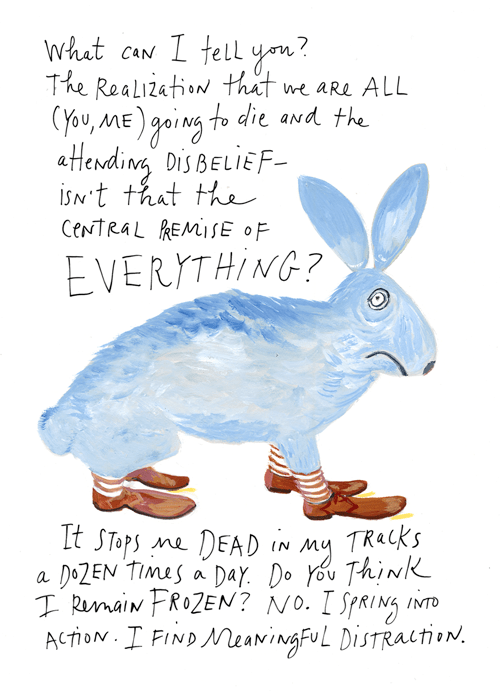
From Brain Pickings: Maira Kalman on identity, happiness, and existence

The awesome website/newsletter Brain Pickings features a video, with quotes and illustrations below, of the fabulous artist/writer Maira Kalman.

Maira Kalman on identity, happiness, and existence

How do you know who you are? There are many parts to who you are, so there isn’t one static place. And then, the other part of that is that things keep changing.