About MaryAnn Reynolds

I practice advanced bodywork in Austin, TX, specializing in Craniosacral Biodynamics and TMJ Relief.

How to get grounded: the first energy

Somatic Experiencing (SE) is a training program for professionals assisting individuals in trauma recovery that was developed from the work Peter Levine, author of Waking the Tiger and many more books on trauma recovery. You can learn more about Somatic Experiencing here.

If you’ve read much of my blog, you know that reading Waking the Tiger was instrumental in my trauma recovery, that I spontaneously released blocked energy from a major childhood trauma while reading the book decades later, which not only was amazing but initiated a huge paradigm shift toward health and well-being for me.

I’ve been fortunate enough to attend several trainings and workshops with Brian D. Mahan, who’s a Somatic Experiencing Practitioner (SEP). Brian teaches SE to help people learn to help others with trauma recovery. Check out his website here: Brian Mahan, Body Centered Therapist.

(I particularly love his blog post When Is Prayer, Yoga, and Meditation No Different Than Sex, Drugs, and Rock and Roll? Because you and I know people who are addicted to prayer, yoga, and meditation, trying to bliss out while avoiding feeling what they’re actually feeling!  I think I may have been one of them….)

Back to Brian’s workshop. It had the longest title of any workshop I’ve ever attended, and the title conveys the content: Imagine feeling present, grounded, centered, boundaried, embodied, empowered, in the moment, safe and joyful!  It was so much fun! I recommend this if you ever get the chance!

Also, schedule an SE session with him next time he’s in Austin or remotely via Skype. (You can email him at BrianDMahanSEP@gmail.com and view his Facebook page. Here’s a link to his YouTube videos. Here’s an offer for a 5-minute meditation video. To set up a session, his phone number is 323-459-1845, and he’s on Skype as SomaticExperience.)

I’m going to write about what attending that workshop brought up for me about some of these energies, with Brian’s artful facilitation in directing our attention to the body and using the “felt” sense. This content is universal (we all have bodies and awareness) and I’m running it  through my personal filters (writing, yoga, NLP, massage).

This felt sense is available to everyone with a nervous system. My NLP training is that we represent the world through visual, auditory, and kinesthetic channels, often favoring one at the expense of another. Therefore many people do not develop the felt sense (kinesthetic awareness for you NLPers), and they don’t know they don’t know—until someone starts talking about something they’re unfamiliar with, like boundaries, energy flowing in a certain direction, internal sensations/emotions (both kinesthetic).

I had a doctor once who had never heard of chakras. You get the idea.

Using and developing this felt sense is actually very significant to your overall well-being, and if you don’t experience much kinesthetic awareness, you can benefit from learning about it and experiencing it. I’ve been there. I know.

Many forces conspire to get us to numb out, to go to sleep, to not know who we really are. Think of TV, food,  alcohol, drugs, work, sex, busy-ness, perfectionism, emotional drama—the things people get addicted to serve the purpose of distracting us from experiencing our real, essential selves and all those feelings.

You know what? You don’t have to give any of those things up, right now or ever. Follow along if you’d like to add a new dimension to your aliveness, to wake up a little more, to put a little more life in your life.

If you are someone who wonders what the heck people are talking about when they say things like “I’m not feeling very grounded right now,” “He’s not his body,” or “Wow, that really threw me off center,” this is for you. If you’ve felt grounded before but feel ungrounded now, this is for you.

Being grounded refers to your body’s energetic connection to the planet, to the earth, to the ground. This energy always flows in the same direction in your body:

To experience this, do an exercise (and you may want to have someone read this to you):

Right where you are, without doing anything else, check in with your body. Scan it from head to toe and notice the sensations and lack of sensations.

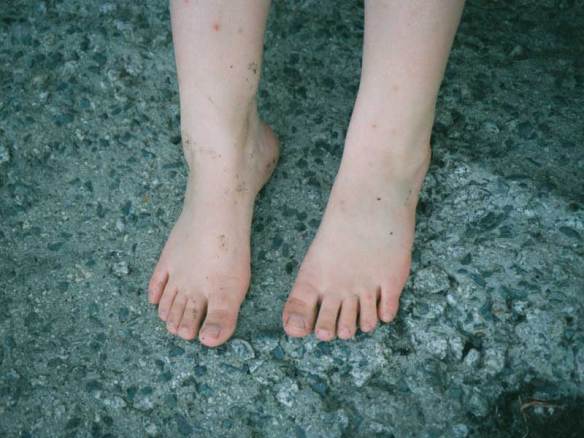
Now take your shoes and socks off and stand up. Put your attention on the sensation of your feet against the floor. Take your time and really feel.

Feel the entire weight of your body squishing the skin cells on the soles of your feet into the floor.

Feel your heaviness. Just walk around and feel your weight.

Now stop and feel as if your feet have suction cups on them holding you in place.

Feel as if each leg is a tree, sending roots down deep into the earth. 

Now roll more of your weight onto one foot and feel the strength in that leg. Now lift the other heel ever so slightly. Switch sides and repeat. Now lift each foot higher. You’re rocking from foot to foot!

Do you feel a sticky sensation on the sole of the lifted foot? Can you sense its desire to return to the floor? Can you imagine invisible elastic between each foot and the floor?

Now stand still, evenly on both feet. Imagine the earth’s energy field embracing you, pulling you toward it with a gentle hug. Imagine mother Earth, Terra, Gaia, Pachamama holding you closely like a mother holds her baby. You can even prostrate yourself and surrender to it, hugging the earth back if you like. (If not, that’s okay too.)

Stand back up and imagine there’s an opening in the top of your head that opens to the sky/spirit/God/the cosmos. Imagine this energy flowing into your head and going down through the center of your body and down each leg and out your feet and into the earth.

This is you, fully grounded. Check in again, fully.

End of exercise.

Notice that our language has many ways of describing this energy: being grounded, feeling ungrounded, holding your ground, standing your ground, standing on your own two feet, without a leg to stand on, being sure-footed, steady on your feet, sticking a foot in the door, getting in on the ground floor.

Being grounded gives you a position on this planet, a space, a place that belongs to you and no one else, and it also connects you to this planet. You belong to the earth.

What does it feel like to be grounded? Remember what you felt like before the exercise, and compare that to feeling grounded. How would you describe the difference?

More importantly, when could feeling grounded be useful in your life? When might you particularly want to feel grounded? What ungrounded you?

Just for this moment, bring your attention back to your feet. Notice if you feel any shift of energy in your body.

Realize you can play with this, enjoy this, practice this as often as you like until it comes effortlessly (because the body is attracted to joy and pleasure, even the subtle ones). Then you can forget about it, knowing that whenever you need it, the resource of being grounded belongs to you.

Next: how to get centered.

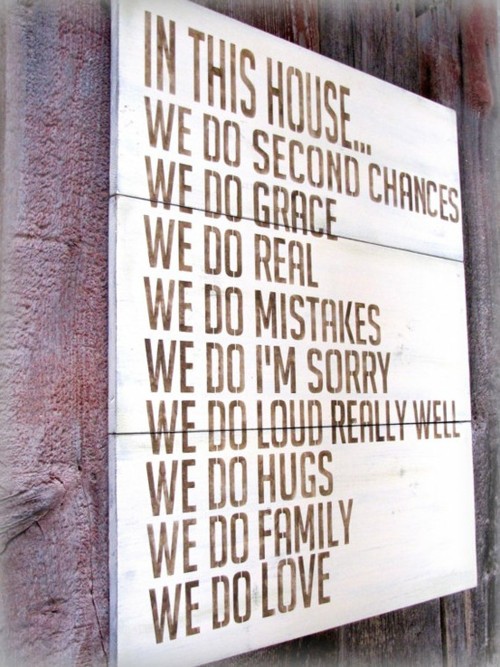
In this house…we do love

Sharing an image I saw on Elephant Journal. I dedicate this to all my families—past, present, future, blood-related, my ohana, the communities and tribes I belong to, including the animal members. (Waylon Lewis’ family is his dog.)

And, okay, so maybe I’d substitute laughter for loud and my grace may a silent gratitude, but the rest of it stands. What would you add or subtract?

It’s available (in slightly different form) as a vinyl wall sticker decal here on Etsy.

in this house...we do love

Recovering from a pulled muscle, I apply my massage skills and heal. Voila!

A couple of weeks ago, I started self-training in running, and I was walking/running on the trail, building up endurance while avoiding fatigue and injury (so I intended). I’d done the warmups recommended by my trainer and felt really good in my running—lifting my knees, almost sprinting, feeling that great-to-be-alive, heart-pounding, hard-breathing experience of really challenging my body in a healthy way. I was loving the run!

Then, running up a hill, I pulled my left calf muscle. I immediately slowed to a walk, walked for about 10 minutes, and then (ruh roh), I decided it wasn’t so bad and ran some more.

Afterwards, I could feel the pull, but it seemed pretty minor. I could walk fine, without a limp. However, I did wisely decide not to run again until it felt really fine.

Six days passed, and I went to ecstatic dance, where everyone dances like no one is watching. I love this practice, moving to music, going with the flow, connecting with others, letting go, being part of the tribe. I can get pretty wild, jumping around with a big grin, leaping from foot to foot, being danced.

If you have no clue what I’m talking about, it’s like this:

The Power Wave

So anyway, while leaping about, I suddenly felt strong pain in my left calf. I limped to the side and did not feel like dancing any more.

Thinking it was my gastrocnemius (the superficial calf muscle), I had a massage therapist work on it that afternoon. I was still limping badly afterwards, although definitely more relaxed. I went home and iced it, and then…

 A massage magazine I’d been reading was next to my bed. I picked it up and saw there was an article by Dr. Ben Benjamin on the soleus, the deeper calf muscle. It included diagnostic tests, and I verified that it was my soleus muscle that was injured. (The image shows it without the gastrocnemius.)

Guess what? It could take 4-6 weeks to fully heal. That was depressing.

Benjamin (who also wrote the fantastic reference book about muscle injuries that belongs in the home library of every athlete (in my opinion), Listen to Your Pain) gave instructions for “friction therapy” massage, stretching, and strengthening. I also put ice on it, several times a day at first and now just once a day right after I do the clinical protocol.

My leg went from maybe 15 percent to 85 percent functional within a week. My limp gradually lessened, day by day. The calf still feels just a bit tight and tender. My hunch is that the last 15 percent of healing will happen more slowly.

Anyway, I feel really empowered about using clinical massage on my own injury and seeing (and feeling) rapid improvement.

I am ready to apply that to others.

Awareness through hearing: a three-minute exercise

All experience is embodied!

I feel like shouting that from the rooftop right now after several days of learning from and working with Bryan Mahan, Somatic Experiencing Practitioner.

There is no separation of body and mind except the one that the mind makes. When that happens, it’s called “not being in your body”. It’s also beginning to dawn on me that perhaps that is what “ego” is—and that is my mind playing and making busywork!

This may be a complete no-brainer (hah!) to you, but I can tell you that most people do not fully inhabit their bodies.

So here’s a three-minute experiment that could be quite profound in you experiencing life-as-it-is:

Use a timer. Spend one minute listening to actual sounds in your external environment. Notice whatever sounds enter your ears, even the background noises like the air conditioning that you usually tune out, as well as voices, TV, whatever, in the foreground. Notice sounds coming in your left ear and sounds coming in your right ear and sounds coming in both ears. Notice changes in sounds, rhythms and silence and pitch, as well. If your attention wanders, quickly bring it back to just listening.

After the minute is up, check in. What is the state of your bodymind?

Now spend one minute listening to your internal sounds. Swallow and notice the sound. Notice the sounds of your breathing, inhaling and exhaling. Notice your stomach rumbling. Is there a constant internal background noise? Do you have a sense of hearing your heartbeat or pulse? Notice pauses and rhythms.

Check in. What are you feeling? How are you experiencing yourself?

Now spend a minute letting your mind operate as it usually does. Notice your internal dialogue. Notice the quality of the dialogue. Is it wandering? Choppy? Inquisitive? Doubtful? Opinionated? Judgmental? Are there pauses, or is it constant? Is there a voice? If so, whose?

Check in. What’s happening?

I can tell you what my experience was.

After the first two exercises, I felt calm and present in my body. My mind thought, “I like this really hearing. There’s a lot of richness there. I feel happy.”

After the third exercise, I felt separate from my environment, with very little body awareness. I felt not present. I felt caught up in the future (“What’s for dinner?”—even though I’m not hungry at all) or the past (“Whoa, that was a bad experience”). My mind evaluated, “I don’t feel very calm or happy when I’m in my head like that.”

Now I could certainly write a long blah-blah-blah about this experience and what it “means”. I’m not.

I’d rather that you just let your experience speak to you itself. What literally makes you happy?

Some thoughts on mapmaking: A cameleopard made me write this post!

Thanks to my lovely subscriber, kissingthecockroach, for her inspiration!

She read a previous post, The 12 Symptoms of Spiritual Awakening, and commented that she had problems with #9, A loss of interest in interpreting the actions of others.

You know what? I also have problems with this one. That got me thinking.

I make mental maps of other people. Since I can’t be them, I try to understand them. I want to put myself in their shoes, to see the world through their eyes, to understand what makes them tick. And I can’t do that entirely, although I have found this effort worthwhile because it helped me develop my compassion for others’ experiences of life.

I notice someone do or say something that’s puzzling to me, and I become aware there’s a hole in my map of them, or an error that needs to be corrected.

My mind comes up with an explanation: “Oh, they said that because they were feeling insecure.” Sometimes I ask myself, after observing some very puzzling new behavior, “What probably happened to them that would explain that behavior?” (I’ve gotten clairvoyant hits on another’s experience that made me wish I had never been curious.)

I imagine that other people do the same with me. In fact, I believe it’s very difficult for human beings not to do this with each other. People are weird sometimes—strange, puzzling, nonsensical, difficult. Map-making, or interpreting the actions of others, is a major hobby for a lot of people. We like explanations, reasons, causality. We like to peg people, typecast them, make them fit our maps.

It’s a good practice to keep your map loose, ready to be redrawn at any time. You can take it for granted that any map has holes in it, and shortcuts and inaccuracies. Else it wouldn’t be a map, it would actually be the person, impossible to carry around in your head.

People are infinitely more alive and complex than anyone’s map could ever depict. Actually, people are infinitely more alive and complex than their own maps of themselves depict, much less those of others.

Also, time is an illusion, a useful convention we’ve devised. There is no past or future, only the present. Does the past explain the present, which explains the future? Maybe it works in reverse. Who can really say? We make these maps to create a consensual reality, and it falls way short of the real thing.

Who really knows why anyone does anything? The simplest explanation I know of is to attribute it all to chi, life force, moving vital energy. That’s how their chi flows in the present moment. Perceive it with wonder.

The most playful way of understanding the puzzles of living with others is to make like the medieval mapmakers and fill in the blank spots with images of beasts such as sea monsters, unicorns, and cameleopards.

In case you were wondering, here’s what a cameleopard looks like:

It makes me smile so much that just for the pure experience of more joy, when I don’t understand someone (or myself), instead of heavily puzzling on the reasons for their (my) behavior, I’m just going to attribute it to a cameleopard. Yes, a cameleopard made them (me) do it!

Doesn’t that feel lighter?

Four steps for discovering your Enneagram type

The Enneagram is a system that classifies people by type, like personality typing. It’s kin to the Myers-Briggs Type Indicator. But it’s about more than personality—it’s based on fixation.

According to Enneagram theory, we are either born with or acquire in the earliest years of life a fixation that deeply influences our identity: who we believe we are and how we view life. The fixation is what keeps you from experiencing your essential (healthy) self. It’s how you get in your own way. It’s a filter that in some ways has worked for you, but it can eventually limit you into a habitual way of living that feels too small. You may suspect there’s more to you than that. You can transcend your fixation to find more essence, more freedom, more joy.

Maybe this is what enlightenment is.

There are nine Enneagram types. Each type has two wings and three subtypes. Furthermore, each type moves toward two different types when you are stressed and when you feel secure. Plus, your development level changes with age, experience, and your desire and ability to grow. So it’s a fairly dynamic model, even though (according to theory) people remain their type their entire lives.

To illustrate, my type is Five. Other names: The Investigator and The Observer. We Fives are classic nerds: bookish, shy, avoiding conflict, private, attracted to minimalism, curious, alert, intense, innovative, insightful, cerebral, having a rich inner life, seeking mastery.

I also have a Four wing. Nickname: The Iconoclast. I am interested in people and healing. The Four wing adds sensitivity.

Would you believe that part of the path to my essential self is exercise? Living in my body connects me to a vitality and presence that I could never experience just living in my head. It took the painful aftermath of a car wreck in my 40s—and the subsequent healing journey—to really understand this.

Daily yoga, the outdoor activities I love like snorkeling and kayaking, dance, meditation, giving and receiving massage, hugs, touch, and sex all help me more fully occupy my body, and be more present in my full vitality, my essential energy that radiates joy, love, peace, and happiness.

So if you knew me as a child, you’d have known a shy, bookish, smart, aloof nerd. If you know me now, you’d see some of those qualities at times, but you’d also see someone who has a lot of vitality, who lives with an open heart (and who still really likes to think).

For me, the journey from being immersed in my type to living more from my essence has been like moving from a black-and-white world into a world full of amazing colors of infinite variety. I can’t say it’s all due to knowing about the Enneagram, but it has helped and provided much insight.

If you are interested in using the Enneagram as a tool for personal growth, and you don’t know your type, here’s how to find out. It’s not always easy (but sometimes it’s very obvious). You can definitely narrow it down to a couple of types, and then you’ll get an aha! (And you may change your mind later on.) Plus, you will easily recognize some people you’ve known.

It’s important to first note that we often do not see ourselves as others see us. Therefore, learning your Enneagram type might make you feel uncomfortable. Prepare yourself. The truth often hurts before it sets us free.

  1. The Enneagram Institute offers free and low-cost online tests. The free, brief QUEST takes 5 minutes.
  2. Watch a brief video of each of the nine types and self-identify your type.
  3. Watch the videos with people you trust with the intent to identify each person’s type with compassion. Others who know us can be honest yet tactful and supportive (as you can be with them—agree on this beforehand and don’t invite anyone who is insensitive).
  4. If you’re still confused about your type, read how types are often misidentified.

To learn more about how it works, read books. I suggest The Wisdom of the Enneagram and The Enneagram for beginners. For more advanced students, I recommend The Spiritual Dimension of the Enneagram.

Once you are more or less settled on which type most accurately describes you, you can subscribe to a daily “EnneaThought” email for your type that can support your developmental growth.

Here’s my EnneaThought for today:

EnneaThought example

The 12 Symptoms of Spiritual Awakening

Image

The 12 Symptoms of Spiritual Awakening

Making the rounds on Facebook, worth sharing here.

Color, culture, and language: be warned, this is weird and fascinating!

The crayola-fication of the world: How we gave colors names, and it messed with our brains (part I) | Empirical Zeal.

The NLPer/cultural anthropology nerd in me was fascinated by this article, which looks at the names for colors among various cultures. In NLP, we say “the map is not the territory,” meaning we live through our maps of the world, not so much through the actual world, and language is a huge part of our maps.

Did you know that some cultures have only two words for colors, words that mean light and dark? All light and warm colors—white, reds, yellows, oranges, pinks—are called by the word meaning light, and all dark, shadowy, cool colors—blues, greens, browns, black—are called by the word meaning dark.

The Japanese language did not distinguish between blue and green until the 20th century, and only did so with American influence. (English recognizes 11 colors. It’s a colorful language.)

In studying words for colors across multiple cultures, researchers came up with algorithms for determining exactly where a color fits in with the shades in a color group. (Remember the 64-crayon box that had yellow-green and green yellow? Barely distinguishable, but one was slightly more yellowish and the other was slightly more greenish.)

The blog, Empirical Zeal, that published this publishes posts from several sources and all posts are written using primary sources. (Unlike my blog, obviously. I’m not a scientist, but I can appreciate science sometimes, and I really just like to share some of the amazing stuff I find out there on the inter webs. I think maybe “humanist” is a good description for my angle.)

The spectrum has no natural boundaries, it would seem, and the perception of color is not universal. Languages also change over time, and many have followed the same route. Since most languages have two to 11 names for colors, scientists have determined that the first two color terms will be light and dark, or white and black. The third will be red, and the next will be either green or yellow. Once both those distinctions come into use, green splits into two, and you now have blue. (The Japanese word for blue green is midori. Author’s note: Thanks to Tim for correcting me on this.)

The research done on native speakers of 110 different languages using 400 color tiles was called the World Color Survey. Further research used algorithms to distinguish color groups. The algorithms were fairly predictive of how actual cultures grouped shades.

The picture that’s emerging is that colors aren’t quite random slices of the visual pie. They’re somewhat basic categories that humans from different cultures gravitate towards, and must have to do with how the biology of how we see the world. In other words, rainbows have seams. We can distill a rainbow into its basic visual ingredients, and a handful of colors come out.

If you get to the end of this, click the link for Part Two, about how naming colors messes with our brains!

The easiest, tastiest summer salad imaginable: insalata caprese

Last Sunday, it was my turn to cook dinner for my friend. I wanted to serve food that was healthy, seasonal, and delicious, and I went to the farmer’s market on Saturday for inspiration.

Heirloom tomatoes are in season, and they are exceptionally delicious. However, they don’t keep for a long time like the modern tomatoes do. Eat ’em right up is what I say, and never let them see the inside of your refrigerator. Buy organic, please. Support your health and the growers. Or grown your own.

I have been known to get home with an heirloom tomato and eat it immediately, standing over the sink to catch the juice.

In hindsight, I could have invited my friend to do the same—that would have made the dinner memorable, and it would have been a fun surprise—but alas, that didn’t occur to me at the time.

Instead, I served insalata caprese, which Wikipedia tells me means “salad in the style of the island of Capri.” Capri is an island off the coast of southern Italy (the front of the “ankle” of Italy’s boot). That area, Campania (where Naples and Mount Vesuvius are also located), has a rich gastronomic history, being the birthplace of pizza and spaghetti, as well as being one of the first areas of Europe to fall in love with that New World wonder, the tomato.

Insalata caprese sounds fancy, particularly when you say it with an Italian accent (try it: een-suh-LAHH-tuh kuh-PRAY-say), but it is almost as simple as eating over the sink. Here are the ingredients to assemble:

  • one large, ripe Brandywine tomato without soft spots
  • eight or so large fresh basil leaves
  • mozzarella cheese (I used Whole Foods brand without rBGH)
  • organic extra-virgin olive oil
  • balsamic vinegar (if you’re adventurous, try this version over the supermarket stuff—a little goes a very long way and although expensive, it’s not astronomical like some)
  • freshly ground salt (I love Himalayan pink salt)
  • freshly ground pepper
  1. With a serrated knife, slice the stem end off the tomato and cut the remainder into four thick slices. Put slices on plates (one or two per salad plate, or all four on a dinner plate for a full meal for one greedy tomato lover, ahem).
  2. Being careful not to crush them, slice the basil leaves crosswise and evenly distribute on top of the tomatoes.
  3. Slice the mozzarella and distribute evenly over tomatoes.
  4. Drizzle olive oil over each tomato slice.
  5. Drizzle balsamic vinegar over each slice.
  6. Season with freshly ground salt and pepper to taste.

That’s it. You will need a knife and fork. Now indulge in some summer bliss!

(You will want to drink the juices left on the plate and then lick the plate. I won’t tell.)

New toy: Yoga Teacher Barbie

She Exists: ‘I can be…’ A Yoga Teacher Barbie Doll.

Still with the feet. Bet she can’t do tree pose, and her triangle probably looks really weird.

Plus a chihuahua. Huh?

Get yours today, at Target.

Courtesy of Yogadork.