Ruth Reichl’s delicious deviled eggs recipe

My favorite food writer is Ruth Reichl, former food critic of the New York Times and the Los Angeles Times, editor of Gourmet magazine, book author (Tender at the Bone, Comfort Me with Apples, Garlic and Sapphires, Not Becoming My Mother, and more) and a wonderful tweeter to follow on Twitter.

Her tweets are poetry, jewels of sensual delight. Here’s a recent one:

Late spring. Damp green grass beneath my feet. A flock of tiny yellow birds. Local strawberries, so sweet, drenched in thick Jersey cream.

Doesn’t that make you want to hang out with Ruth, wherever she is? She’s so present, so alive, so appreciative.

She wrote about how to make deviled eggs, and I learned several things:

  • Fresh eggs do not peel well. Get farm or backyard organic eggs from free-range chickens and let them sit in the fridge for a week before hard-boiling.
  • The term “deviled” was used starting in the 18th century to refer to spicy foods, such as deviled eggs and deviled ham. They are also called “stuffed eggs” and “mimosa eggs”.
  • If you want perfectly centered egg yolks, store the eggs on their sides.
  • Bring cold water with eggs in it to a boil, then cover and turn off the heat for exactly 12 minutes.
  • After cooking, immediately chill the eggs in a bowl of ice water to prevent the greenish tinge on the outside of the cooked yolk.

I made deviled eggs yesterday, before I read this article. They are so easy and yummy in summer! I use store-bought mayo (made with olive oil—Ruth provides the recipe for homemade—click the link above) and topped each filled egg with paprika and exactly three capers.

Below, two eggs are store-bought organic, and two are from Hal’s backyard chickens. Guess which is which? Also notice the greenish tinge on one of the yolks. That egg must not have cooled quickly enough!

My granddaughter, who turns 12 today, has a shortcut to get deviled egg flavor without the work: She peels a hard-boiled egg, cuts it in half, and smears a little yellow prepared mustard on it. Pop it in your mouth, and voila! Quick and easy!

Sprouted green lentils in Greek salad

Every once in a while I crave salad for breakfast, especially in summer, and that is what I had today.

Reminds me of following the candida diet about six years ago: no dairy, grains, fruit, sugar, or lots of other forbidden things. It was very, very strict, and I followed it perfectly for nearly three months—if you mess up, you could feed the candida yeast and have to start over. Man, I had never been on a diet before—this was Marine Corps boot camp!

Nothing I had ever eaten for breakfast was on that diet except eggs! I tell you, eggs over easy without toast to mop up the runny yolks just wasn’t the same! I often ate salads for breakfast then. (I did clear the excess candida, by the way.)

Today I made a Greek-style salad using baby spinach and adding chopped red onion, black kalamata olives, cucumber slices, half an avocado, local Pure Luck goat feta, and sprouted green lentils.

greek salad with sprouted green lentils

After taking the photo, I added Sass Green Gaia Undressing, also a local product that may be distributed widely (if it’s available in your area, you’ll find it in the refrigerated salad dressing case). No oil, no dairy, all plant.

The healthy fat in the avocado staves off hunger pangs until mid-day, when I’ll have a smoothie. The lentils and feta add protein.

Health is grand.

Getting healthy: adaptogens, chocolate berry and green smoothies, and sprouted lentil salad

My acupuncturist, who is consistently the healthiest, most vibrant person I know, told me at my last visit that I have a bit of adrenal depletion from the stresses of my 10-week contract editing job in a big technology company, now over. It was a long commute until everything was finally aligned for me to work from home the last two weeks.

When my contract ended, I had plans to swim, hike, and get outdoors, but my energy was low. All I wanted to do was veg out at home.

She told me to take over-the-counter rhodiola (for the endocrine system) and eleuthero (also known as Siberian ginseng). Both are adaptogens, meaning they are metabolic regulators that increase the ability to adapt to environmental factors both physiological and psychological, and avoid damage from such.

That means they help you recover from stress and alleviate its adverse effects.

After a week, I feel better. Yesterday I had a big surge of energy and walked 3.5 miles and kayaked for an hour. Today is a slow day. Tomorrow, I want to do some hiking and swimming. I want my full energy and vibrancy back!

She shared her diet with me:

  • For breakfast, a chocolate berry smoothie made with raw cacao, organic berries, chia and flax seeds soaked in filtered water for a couple of hours, coconut/almond milk, and whatever other kinds of goodies you want to add. I add pomegranate molasses, goji berries, coconut water or fresh grapefruit juice, maca powder, hemp seeds, and peeled ginger. Add other fruit if you like, but berries are awesome for brain health and not that laden with fructose. Filling up my blender yields about 3 servings, and I will sip on one all morning.
  • For lunch, a green smoothie made with something picked fresh from the garden (kale or chard), more soaked chia and flax seeds, and garlic. I add coconut water or grapefruit juice, hemp seeds, maca powder, turmeric, spirulina, ginger. I also added some packaged fresh spinach and lettuce and a leaf of Romaine, plus celery—what I had in the fridge. I will sip on one all afternoon.
  • She eats one regular meal a day, at dinner.
  • She eats some seaweed every day, like a sheet of nori that you’d use for sushi.
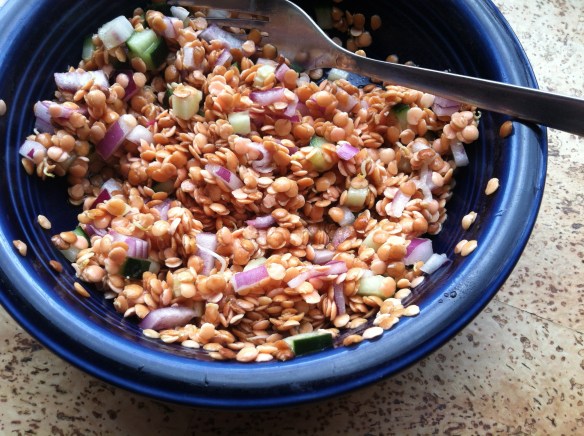
  • She sprouts lentils and finds ways to include them in her diet. I’ve been sprouting red lentils, which are so tiny, they soften and sprout quickly. Sprouting amplifies the nutrients in the lentils as it turns a dormant seed into a living plant.  The legumes become much easier to digest, and more minerals and enzymes become available. By eating them raw, you preserve the enzymes.

Here is my recipe for sprouted lentil salad:

  • Soak red lentils overnight in plenty of filtered water since they triple in size. Drain, rinse, and cover jar with a cloth. Rinse and drain every eight hours. You can use them as soon as they soften—they start releasing their goodness from soaking even before they sprout, or you can wait until they develop little sprouts in a day or two.
  • Give them a final rinse and put in a bowl. Refrigerate what you don’t use—they’ll last up to two weeks.
  • Add some chopped cucumber.
  • Add some chopped red onion.
  • Add 1 tsp of olive oil and 2-3 tsp. of apple cider vinegar or lemon juice, to taste.
  • Add a light sprinkling of good salt to taste and mix well.

sprouted lentil saladYou can tell I’m making this up as I go along, can’t you? : )

Try adding avocado, celery, tomato, green pepper, herbs, green onion, cabbage, beet, greens, carrot, apple, green (brown) lentils—your only limit is your sense of adventure!

Best gluten-free burger in Austin at Hopdoddy’s!

I’m not sure I’ve mentioned this, but my body does not digest wheat well at all. I learned this five or six years ago, and after going without it for a couple of months while on a strict diet to clear excess candida, I noticed a very unfamiliar feeling — I felt, well, well, and I had hardly any fatigue, digestive issues, or feeling like my mood and energy level were on a roller coaster ride. For the first time in, like, forever.

I changed my diet drastically, although it took time for me to really accept that if I ate that piece of pizza, I’d feel bad and “pay for it” later for a few days. I did learn, though. Over time, I learned that I can handle maybe a quarter teaspoon of wheat (such as dusted on blackened fish) without problems.

So being an all-American girl raised in Texas, I missed eating burgers. Not that they were ever a mainstay of my diet, but when you can’t have wheat, you find out what you miss. (Burgers and pizza.)

A couple of times I craved one so badly, I went out and ate one, gluten bun and all, and paid the price for satisfying my craving, which was several days of digestive upset and not feeling too well.

Then I’d make them at home with ground bison patty and toasted Ezekiel bread made from sprouted grains, which my body tolerates. (Toasting it is the only way to make it palatable, in my opinion.) It was good, but I still missed being able to just go out to a burger joint and eat a burger.

Well, today was bliss. I ate lunch with my daughter at Hopdoddy’s, a fairly new and very popular Austin restaurant on South Congress that offers a variety of burgers on a variety of buns — including gluten-free. I’d read reviews about how good their burgers were and that they offered gluten-free buns. I looked forward to tasting for myself.

This is what I had:

That, my friends, is a gluten-free bun, and it was light and kind of crispy on the outside. Toasted! And it actually had some flavor, too.

The Buffalo Bill burger (using bison from Thunderheart Bison, South Texas) came with blue cheese, apple-smoked bacon, “Frank’s hot sauce,” and “sassy sauce.”

All I can say is that it was delicious, and it feels so great to know I won’t feel ill. I’m not a big meat or burger eater, but it’s great to know I can indulge occasionally.

I’ll be back!

~~~

Postscript, 11/17/13: For a down-home, less expensive alternative to Hopdoddy’s, I’d also like to give kudos to Wholly Cow (downtown and South Lamar) for making grass-fed burgers (request Udi’s gluten-free buns) and for their awesome Fit Cross Paleo Burger, served with portabello mushroom caps in place of buns! Both made with local, grass-fed beef.

How do you soothe yourself? Here are some of my favorite ways.

Self-soothing is an activity that nearly anyone can learn and get better at. It encompasses techniques and behaviors that we can use to soothe our emotions when ruffled, disturbed, distressed, overwhelmed — when we encounter difficult situations in life.

Self-soothing means not going to others expecting them to make you feel better. Of course, if we’re lucky, we have healthy loving people in our lives who help us feel better, but what if they’re not around? And…how can you become one of those healthy, loving people?

Self-soothing is a skill that you can cultivate to take better care of yourself.

You start with recognizing when you need soothing. It starts with self-compassion. Maybe you experienced a bad day at the office, an argument with a loved one, an unpleasant bit of news, mistreatment by a clerk, a fender bender, or all of these things.

Can you treat yourself as well as you would treat a friend in these circumstances if you had the resources to treat your friend really well? If you’re not your own best friend, who else is going to be?

You probably already use some self-soothing techniques without thinking about it. What do you do that brings you pleasure? I’m not talking about special techniques like EFT or NLP. This post is about ordinary things that people can do to soothe themselves, by themselves.

Here are some of my favorites –and I believe it’s good to have many self-soothing techniques in your repertoire that you can draw on when you need to. It’s a way of adding richness to your life, and you can share these with others, enhancing their lives as well.

For visual refreshment, I love walking in botanical gardens, especially Japanese gardens. I love looking at landscapes, cityscapes, sunrises, sunsets, and the star-spangled night sky — the big picture.

I buy myself flowers on occasion, and depending on the flowers, the color and shape not only please my sense of sight, the fragrance pleases my sense of smell.

Walking on a scenic trail or kayaking or paddleboarding on water is very pleasant, and the sensations of movement, temperature, and more just add to my pleasure.

Traveling to a beautiful place is awesome! I love Maui and West Texas for the gorgeous — and very different — scenery. Those landscapes feel very friendly to me.

Reading a good story takes my mind off my problems and sweeps me up into some other story.

Music is one of the greatest soothing inventions ever. Hearing a beloved golden oldie, music that you associate with good times and good feelings, or listening to new music that engages and calms — those can shift your comfort level profoundly. A couple of my favorites are Wachuma’s Wave and Chakra Chants.

Listening to a waterfall, rain falling, the ocean — the sounds of water definitely soothe me.

I just love listening to Mango purr. Listening to someone read some good writing aloud is also quite pleasurable.

I adore smelling fragrant flowers, any essential oil, herbs and spices and fresh produce, and teas. I once grew a rose called Souvenir de la Malmaisson that smelled so much like a fine wine, just the fragrance was intoxicating. It was like catnip is to a cat. I wanted to roll in it!

Petrichor is the word for the smell of rain. I wish I could bottle it because it’s always so refreshing!

Soothing touch includes feeling soft, sensual textures in bedding and clothing. Curling up is relaxing. So is tuning into the sensations of just breathing. Of course, you can touch yourself pleasingly, and I need not say more!

To some people, exercise soothes. They love sweating. I love yoga and dance. The movements please me and wake my body up pleasingly.

Be careful about soothing yourself with taste. It is the self-soothing method that many people use to the exclusion of all others, and it can easily result in weight gain and/or an unbalanced diet and dis-ease. Be mindful — take tiny bites, eat slowly, let your taste buds savor — and have lots of other self-soothing techniques.

Another fine thing you can do is to take a happy memory and relive it as fully as you can, re-experiencing the sensations and emotions.

Finally, laughter soothes jangled nerves, aching hearts, hurt feelings, failures, and disappointments. At some point, you’re ready to laugh again.

In that case, watch a good, funny video, listen to a funny audiotape, or read a funny book. To each his or her own. Steve Martin, David Sedaris, George Carlin, Saturday Night Live, Christopher Guest, Ellen deGeneres, Monty Python — there are lots of funny, funny performers, films, and books available that you can bust a gut enjoying.

If you have any favorites not listed here, I welcome you sharing!

Breaking a habit: change the cue and reward first, and the routine will follow

Steve Silberman, science writer (whom I adore and follow on Twitter: @stevesilberman), has just posted a new piece on NeuroTribes: mind, science culture, one of my favorite blogs. It’s a Q&A with New York Times reporter Charles Duhigg on his new book The Power of Habit.

(And I must say that after the William J. Broad experience — “yoga is not only killing us but began as a Tantric sex cult”– it is sweet to learn of a Times reporter who’s really done his homework and offered something very valuable. Kudos, Charles Duhigg.)

Silberman lets us know up front how habitual we are.

Indeed, we spend more than 40 percent of our precious waking hours engaged in habitual actions [PDF], according to a 2006 study at Duke University. Welcome to the machine.

No wonder mindfulness has become something we seek. To connect with someone or something not out of habit, but out of something like our original self — that’s the stuff that peak experiences, connecting to the Source, the most alive life are made of.

It’s as if our brains store habitual behavior in a locked box to prevent tampering by the more mindful angels of our nature…

In his provocative and brilliantly written new book, The Power of Habit, Charles Duhigg … pries open the box with the help of recent research and finds surprising good news: Even the most thoughtless and self-destructive cycles of behavior can be changed, if you understand how habits are formed and stored in memory.

Duhigg breaks down the sequence of ritualized behavior (which he calls the habit loop) into three component parts: the cue, the routine, and the reward. The cue is the trigger that sets the sequence in motion…. The routine is the behavior itself, which can be positive (like a daily running habit) or harmful (like gambling away the family savings). And the third part is the reward — the goal of the behavioral loop, which your brain’s pleasure centers gauge to determine if a sequence of behavior is worth repeating and storing in a lockbox of habit….

Duhigg … maps out a more effective path toward enduring habit change that focuses not on trying to scrap the routine all at once, but on becoming aware of the cues and manipulating the rewards. The encouraging news is that success in making modest alterations in behavior (which Duhigg calls “small wins”) creates a ripple effect into other areas of your life….

We know from studies that almost all cues — the stimuli that elicit the habitual behavior — fall into one of five categories. It’s time of day, or a certain place, or a certain emotion, or the presence of certain people, or a preceding action that’s become habitual or ritualized….

Then you focus on the rewards. The first couple of times you go running, you’re not going to enjoy it. No one enjoys it the first time they run. So you have to give yourself a piece of chocolate when you get back from the run. You have to have some immediate reward.  And we know from studies that within two weeks, the intrinsic reward of running — the endocannabinoids unleashed by exercising — are going to become enough of a reward to create that habit. But you have to trick your brain into it by giving yourself a piece of chocolate the first couple times….

If you want to start running every day, just start by putting on your running shoes at the same time every day. Then you’ll feel more like running. Then you’ll run!

If I want to meditate more regularly, I can tell myself that I just need to sit for 5 minutes each morning, or 2 minutes each evening. Once I actually sit for those small lengths of time, I’m much more likely to sit for 20 or 30 minutes.

These two guys then begin discussing the civil rights movement, the gay marriage movement, and more. To read the whole post, click here.

This blogger’s life…

It’s been a long time since I’ve posted a catch-up post about what is going on in this blogging woman’s life. Rather than blogging about some topic, I thought I’d share a slice of my life. Meet the blogger, if you haven’t already.

Massage school, test, license. You probably know that in my pursuit of health and happiness, I enrolled in massage school last summer. Well, I finished my internship on February 10 and completed the paperwork and fee-paying the following week to get my transcript. Then I holed up with books to study for the National Certification Exam for Therapeutic Massage and Bodywork.

I took the test on Feb. 25. It was very hard. I got to a place where I knew I’d done the best I could. There were maybe a dozen questions out of 160 that I was clueless on and quite a few more that required my best guesstimate.

I turned it in after 2 hours and 10 minutes (20 minutes short of the maximum time), and 5 minutes later learned I’d passed.

Whew and yay! I’ve been a good test-taker in the past, and it had been many years since I took a test of that sort, the GRE for grad school. It’s good to know I still got that mojo, and I sure don’t want to do that again. Immediately after getting the results, my mind began to let go of all that information. Damn, my brain was full! It’s still there in my unconscious mind, accessible when I need it.

I’ve applied for a Texas state license, and it will take a few weeks to get it. Then I become Mary Ann Reynolds, LMT. (If I wish, I can add NCTMB to that.)

I’m continuing to practice massage in my Spartan trailer. Have now done 168. It’s said that it takes 200 massages to really get your hands minimally educated in the art of massage. I’m counting toward that milestone, and then I won’t be keeping track any more.

Going back to work. Meanwhile, my savings are running very low. I’m going to do some contract technical writing for a few months to replenish my coffers and bankroll starting a full-time private bodywork/changework practice. I’ve been looking for a short-term contract job since January and am currently being considered for eight such jobs in the Austin area. It’s been slow hearing back, but finally, I’m online to start a short-term editing contract, possibly followed by a technical writing contract. Thank you, Universe.

I’ve really enjoyed this time of not having to go to work! Of learning and practicing massage being my work. I’m looking forward to the time when that’s all I do. When I asked myself the question of what kind of work would I love to do even if I didn’t get paid, healing touch came to mind. Of course, I will get paid for it, which makes it even juicier!

So even though I am going to back to technical writing for a few months, it’s temporary.

And while I am working as a technical writer, I’ll still be doing a few massages each week during evenings and weekends to keep in practice and segue into my right livelihood.

Getting sick. So… the stress of studying for and taking the test, being broke, and the slow job search took a toll. Add to that some emotional difficulties, and I got sick last week. It’s been up and down — not really ill, but not feeling like my usual buoyant, energetic, resilient self consistently. It’s been part emotional, part energetic, part physical, like a mild stomach virus coupled with a sea change in my life. Times of not being able to get warm enough, of belly aches and no appetite (I’ve lost a few pounds), of needing extra rest, taking naps, going to bed early — mixed with life as usual, running errands, spending the day with my daughter when she had surgery, going to dance.

This past Monday, I went to South Austin Community Acupuncture — my first time there — after a week of illness, to receive sliding scale treatment on short notice. (My regular acupuncturist whom I see every couple of months, Patrice, is rarely able to get me in quickly. They take walk-ins at SACA.)

It was awesome! After the intake and interview, I was led to a room with 9 sheet-covered recliners, dim lighting, and very low soothing music playing. The acupuncturist read my pulses and looked at my tongue. I rolled my pants up to my knees and pulled my shirt up a little. He put some needles in my legs and feet, also at my waistline and key points on my head. Then I just laid back and let the needles do their work.

After about 45 minutes, I felt great. My energy felt healthy and balanced again. The acupuncturist took the needles out, and I felt better than I had in days. That lasted for several days.

Emotional distress. It’s painful but here’s my best shot at being quick, accurate, and kind about my experience: I dated someone for a couple of months. I really, really liked him, and he did some things that shocked me. We broke up (he really scared me), and we tried to be friends (he scared me again).

I put our friendship on hold because I need friends whom I trust, who treat me well, who disclose what needs to be disclosed in a gentle, kind, and trustworthy manner.

I desire to move toward loving relationships with healthy, grown-up men and women. I desire to feel valued and emotionally/physically safe with those who surround me.

I have compassion for what I know of that he’s been through and respect his path toward a healthy life. I know it’s tough. I appreciate how much he did open to up me and all the great qualities he has. I’m grateful for the times we shared that were good. I hope I made a positive difference in his life. I wish him well.

Yesterday I saw a therapist/shaman/friend who worked with me on undoing these emotional disturbances. We did left eye/right eye/cross-hemisphere work using visualizations. We also did some classic NLP. It was  fun, amazing, and effective. We untriggered these disturbing memories. I also decided to learn to stop pointing and use my whole hand as an indicator instead.

This morning I was struggling to awaken, feeling really exhausted. I felt the presence of an angel loving me energetically. A visitation! It was so awesome and so welcome after the difficult emotions of dealing with this. Thank you, angel. Please come back!

Changes to blog. I’m interested in monetizing my work, having started and maintained this blog as a labor of love for free for over two years now and spent many, many, many hours on writing posts.

I’ve decided to join the Internet economy. I added a Donation button after seeing one on some other WP blogs. Why not? If something I share is worth something to you and you’d like to show that monetarily, it’s one way of reciprocating.

I also love your likes and comments and subscriptions!

How to bounce back

Sometimes in life, things are going well, and then something happens, and before you know it, you’ve gotten off track. Unpleasant surprises having to do with work, love, friendship, money, health, family, whatever we care about, can put us into an experience of suffering (aka “pain with a story”).

So what do you do to get back on track? Here’s what works for me:

  1. Realize it’s a process and there’s probably not an instant fix. Accept that you’re off track instead of pretending that everything is fine. Relax into it.
  2. Take care of your health. Go to bed and wake at the regular times. Eat healthy food, and not too much comfort food. Drink plenty of water. Exercise in whatever form you enjoy. Dance, run, do yoga, shadow-box. Move your body. A little sweat won’t hurt a bit, either. If you need inspiration, listen to this and try some of James Brown’s moves. You know he taught Michael Jackson how to dance:
  3. Let your emotions flow instead of suppressing them. Movement can help with this too. Walk around and make nonsense noises and start moving how you feel. Waaahhhhh! Grrrrrrr! Listen to music that helps you cry if tears feel blocked — this music can help:
     If you don’t feel safe expressing your feelings to another human being, write them out. Or get curious — what is the name of the emotion? Where in your body are you feeling it? How would your body like to move with this emotion? If you could dance it or see it dancing, what would that be like? What kind of music would it be dancing to? What color is it?
  4. Do something that will really make you feel better. There are tons of techniques that can be helpful. The Emotional Freedom Technique (EFT) works for a lot of people. Now, this may seem crazy, but an even simpler technique for restoring emotional equilibrium is to slowly toss a small ball from hand to hand. While tossing it, slowly look toward the ceiling, close your eyes, and return your head to normal position. (It will take some practice to do this.) If you drop the ball, pick it up and start over (it’s easiest to do over a bed or sofa). It induces the feeling of being centered. Even 2 minutes of it shifts me. For theory and details on this, see Mind Juggling on Nelson Zink’s awesome website Navaching.
  5. Set boundaries that work for you. They don’t have to be permanent, but if you need a break from something that drains your energy, just take one. You being drained contributes to no one’s well-being. One of my favorite films of all time is Office Space. Make like Peter and don’t give a damn. You don’t have to drink the Kool-Aid. Savor your own mojo, and don’t give it away to the unappreciative.
  6. Think happy thoughts, imagine happy pictures, feel the good experiences you’ve had again. Do you know someone who has a radiant smile? Imagine their wonderful face. Has someone been particularly kind to you? Remember that feeling. What words do you like to hear? “Everything is going to be all right” is very soothing. Really, who the hell knows how everything is going to be, but saying that to yourself can feel comforting. Also, I have a big envelope full of cards, letters, and photos that people have given me over the past few years. When I pull that out and look through it, I feel reconnected with the good will of these people who’ve cared enough about me to make that effort. (Reminds me to make more of an effort myself toward that end.)
  7. Do something spiritual. Could be meditation, an act of kindness, reading spiritual books or listening to audiotapes, feeling gratitude, forgiving those who’ve hurt you. Even laughing, because laughter is a gift from the gods. Here’s James Altucher’s hilarious blog post on 60 second meditations. (I love washing dishes.)

This has been my favorite blog post to write, because I wrote it to help myself bounce back. So I guess 8. would be to write up your own methods of bouncing back, testing each step.

Before you know it, you’ve returned to your healthy self.

Pineapple coconut mango smoothie

I happened to have a ripe pineapple on hand this morning. I love pineapples, especially this time of year. The crazy spiky topknot, the lizard-like skin, the pale yellow color of the flesh, the delicious sweetness of the juice — and pineapple juice is beneficial for Type Os, my blood type.

Combine a pineapple, a blender, imagination, and a few other ingredients, and it’s creation time!

I cut the top, bottom, and sides off the pineapple, sliced it, removed the core, and put about half in the blender, saving the rest for another day.

I covered the chunks with Zico Natural Pure Premium Coconut Water and ran the blender. What a beautiful color! Note: If you like more intense pineapple flavor, use less coconut water — or add pineapple juice!

I had some Brazil Gourmet Premium Mango Nectar in the fridge. It informed me it would like to join the pineapple and coconut water in the blender, so I added about 3/4ths of a cup and started a tropical party!

Then I added a teaspoon of The Ginger People Naturally Pressed Organic Ginger Juice. It wasn’t enough. Need about a tablespoon to taste it. This stuff is good to have on hand when you don’t have fresh ginger or are too lazy to peel it. Click here to read about ginger’s health benefits.

Next I added a couple of tablespoons of Artisana 100% Organic Raw Coconut Butter. Wendy of  Open Heart Foods first told me about coconut butter. It’s made from the meat (i.e., fiber) of the coconut and contains about 60% coconut oil and no other ingredients. It congeals at room temperature or colder, so refrigeration is not recommended. You can stick the jar in a pan of hot water to soften it up. It’s also great as a spread, thus “butter”.

(By the way, Wendy makes raw chocolate treats and raw flax crackers, all delicious. She is starting to sell her handmade-with-love-and-raw-ingredients foods locally. Look for them at Juiceland or Daily Juice, or maybe both! I forget which.)

Of course, I added some flaxseed oil, and some but not all of the usual superfood smoothie suspects: chia seeds, hemp seeds, and maca powder.

This filled my blender nearly to the top and produced about 4 delicious servings.

For some reason, I held back on adding cacao. I feel a little skeptical about chocolate and pineapple together. Maybe next time.

I also want to experiment with adding greens like chard, spinach, or kale to a pineapple smoothie.

The Biology of Meditation. | elephant journal

The Biology of Meditation. | elephant journal.

Lisa Wimberger provides a Cliff’s Notes version of the book Power Up Your Brain: The Neuroscience of Enlightenment, by David Perlmutter and Alberto Villoldo.

Excerpt:

Stress, trauma and the health perils associated with those states all begin and get perpetuated in the limbic brain, which is comprised of the hippocampus, hypothalamus and amygdala. These are responsible for making our emotional connections outside of logic, taking snapshots of life, creating our dream state experiences, turning on our fight-or-flight response, and storing and delivering emotional information independent of time. The limbic system cannot discern past, present, or future — each “picture” it accesses is experienced by the body as though it’s current.

Fasting and/or a low-calorie diet, antioxidants, voluntary exercise, and meditation are key ways to turn down the limbic brain.

About meditation, she says…

…it is found that those who meditate or enter states of trance have increased blood flow to their pre-frontal cortex (PFC). This area of the brain is the executive decision maker, but is not quite the same as the neo-cortex “logic” mind. The PFC is activated on EKGs during states of compassion, inspiration, motivation and love. It has the ability to project and envision a future reward. It is the part of the brain responsible for motivating us to attain our goals and dreams. Blood flow to the PFC decreases when blood flow to the limbic brain increases.