Toxic stress, school discipline, and unconditional love

Lincoln High School in Walla Walla, WA, tries new approach to school discipline — suspensions drop 85% « ACEs Too High.

Thank you, Katie Raver, for sending me this blog post about a principal at a high school for troubled kids who changed the approach to discipline — with amazing results.

Here are the numbers:

2009-2010 (Before new approach)

  • 798 suspensions (days students were out of school)
  • 50 expulsions
  • 600 written referrals

2010-2011 (After new approach)

  • 135 suspensions (days students were out of school)
  • 30 expulsions
  • 320 written referrals

It’s a long article with a lotta good info about chronic trauma and family problems and how they affect learning. It describes a measure of toxic stress called the ACE score.

The two simple rules for creating a school environment that doesn’t retraumatize already-traumatized kids:

Rule No. 1: Take nothing a raging kid says personally. Really. Act like a duck: let the words roll off your back like drops of water.

Rule No. 2: Don’t mirror the kid’s behavior. Take a deep breath. Wait for the storm to pass, and then ask something along the lines of: “Are you okay? Did something happen to you that’s bothering you? Do you want to talk about it?”

I want to learn how to do this.

When the teacher is the teaching: Tom Best.

I figure I spent a thousand hours with Tom Best between 2007 and April 21, 2012, three days before his death.

I took NLP practitioner training as a student in Austin. Then evolutionary NLP in Dallas. Nightwalking in Wimberley. NLP master practitioner as a student, Austin. evolutionary NLP in Maui. NLP practitioner as a training assistant, Austin. Nightwalking at Buescher State Park, Smithville. NLP master practitioner as a training assistant, Austin. The Tom Best and Steve Daniel workshop using sound, Austin.

Several times I attended the first weekend and last day of practitioner trainings when I wasn’t a student or training assistant, to see him and Bobbi and my friends who also assisted, and to meet the new students and lend my support, and to re-experience “beginner’s mind” with NLP.

On April 21, I took a day of evolutionary NLP at Alma de Mujer, and he died three days later.

He was my teacher, and he was the teaching, my heart realizes now, after he left.
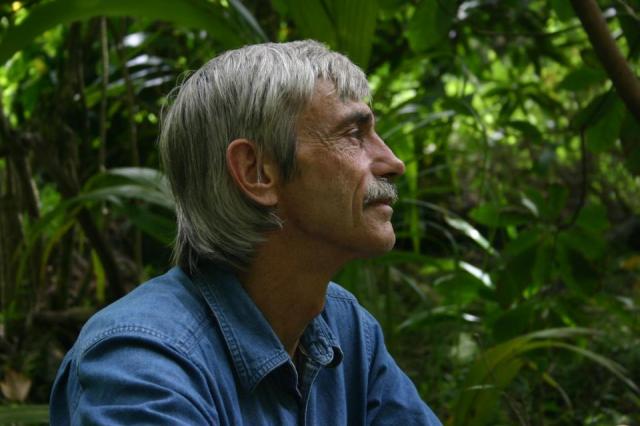

He was not really my friend, in the sense that we didn’t hang out in our off time and let our hair down together. Outside of teaching, he was a private man, a little shy and reserved, already giving a great deal of himself, a world-traveling teacher seriously devoted to spending his non-teaching time at home with his wife Bobbi and their dogs and cats.
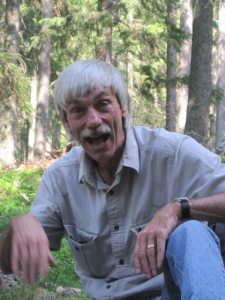
But he was friendly from the start, and I felt love for him and from him.

Who knows how he saw me? I don’t think I can even begin to see myself as he saw me in 2007 or how he saw me on April 21. I can tell you that I changed, that his teachings transformed me, and others witnessed that. Among my long-time friends, I am known for having changed.

I have had many teachers in this lifetime. Many were teachers who did not even know they were my teacher because I read their books or watched them on video. Many many many more didn’t know they were teachers — they said or did something I learned from, sometimes what to move away from, and sometimes what to move toward.

I signed up for in-person lessons and cracked myself wide open to take in Tom Best along with his teachings more than I have to any other teacher, besides my parents, in this lifetime. I poured myself into the NLP pot, and he cooked me.
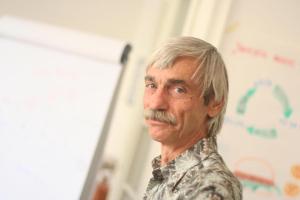
He was at the front of the room, talking, waving his long fingers around, drawing the VAKOG face, telling the Lake Conchas story and so many more, demonstrating a technique, explaining concepts, giving instructions, telling us to take an 11 minute and 17 second break, then ringing a bell to bring us back together…

When I started pract training, I quickly figured out that the academic learning style (dissociated, conceptual) that I had experienced so much of in school and college (and done well with) was not going to work. This NLP required experiential learning, and the only way to do it was to learn with my whole self — to take it in as much as I could, ask for help when I needed it, and then just do it. And then do it again, better. And again and again and again. And to later, to offer my help.

I can hear Tom’s voice right now, explaining the journey from unconscious incompetence, to conscious incompetence, to conscious competence, to unconscious competence.

I can hear him saying, “There’s no such thing as failure, only feedback.”
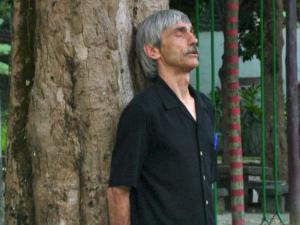
He gave us permission and encouragement to put ourselves out there, on the line, and do the techniques imperfectly. Just do it. I learned to accept doing something imperfectly, to forgive myself for being less than perfect, and to recognize that repetition creates mastery (along with tape editing).

I now see that that’s what made him such a great teacher, putting himself out there, on the line, over and over again, for years, around the world. He just got better at it, so that on Saturday, April 21, he almost seemed to consist more of pure energy (the energies of his intent, presence, attention, clarity, and love) than of matter or ego.

Some of my notes from that day:

Intention is of the tonal. It’s about your desired outcome.

Intent requires no thought. It is gratitude, alignment, participation, connection. (It is of the nagual.)

“Intend to align with realization,” I wrote.

That is so him! He was that teaching. See what I mean about him being the teaching?

Learning NLP the NLP way was exhausting. I went home from each day of practitioner training drained, needing to do something that didn’t require thinking, like watch a funny movie or just veg out.

When I assisted, some other students experienced that too.

I realize now that NLP training required my focused attention for hours at a time in a way that not much else had required. In school, I had learned quickly and then stared out the window, lost in my own private thoughts, while others struggled.

In the NLP pract classroom, I was not an A student. I struggled and was lost sometimes, which challenged me to become a training assistant so I could take it again.

Little did I know that I was building attentive stamina. 

Energy flows where attention goes. — Huna wisdom taught by Tom Best

I was also practicing intent, aligning with realization. Gratitude, alignment, participation, connection.

I’m very grateful that I served as a training assistant so I could take pract training again. It was much lighter and less exhausting, and I got even more out of it the second time around. I integrated the concepts and experiences more deeply. I was both student and training assistant for master practitioner too.

I had wanted to assist at each level one more time.
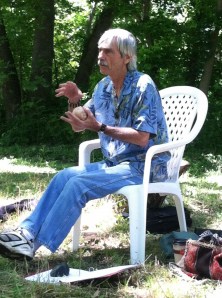
So for a thousand hours, my attention was on him, watching him speak and move, hearing his voice, taking him in with my whole self. His skinny, graceful, long-fingered, elegant, story-telling, teaching, sly, aligned, humble, gracious, personable, receptive, gently challenging, channeling, funny, quirky, fluid, congruent, trance-inducing, masterful, realizing self.

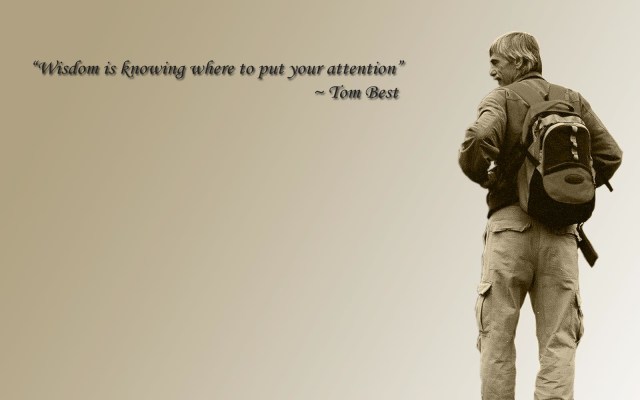
Wisdom is knowing where to put your attention. — Tom Best

I put my attention on you, Tom, over and over again, and it’s like in the grief process where you bring the person into your heart, instead of feeling their absence. You are in here, man. You are so present in my mind and in my heart as I absorb your life and teachings even more and make meaning of it all.

And then you did something a bit surprising and very human. You died. You lived your life well and fully, and then you slipped away, in your sleep, painlessly, quickly, easily.

So I just need to say this one more time, or a thousand more times:

You modeled love, love, love. Mahalo for showing the way.

Thanks to the Facebook group The Grace of Tom Best for all of the photos except the small blue one where he’s seated (that’s mine from April 21).

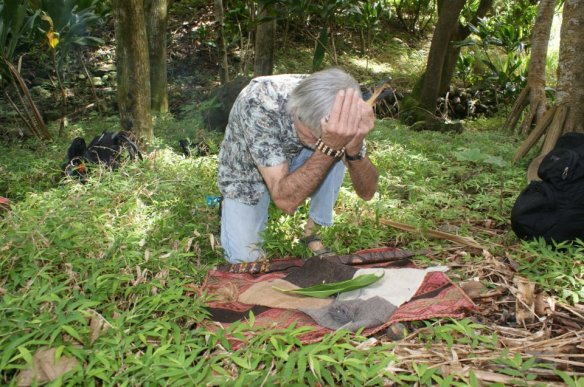
The rainbow-bridge, huayruro seeds, the long body, and the nagual: a tribute to Tom Best

Part of Monday’s reading from The American Book of the Dead by E.J. Gold, which I’m reading for my teacher Tom Best, who died this past week, is this:

If my attention is concentrated and clear, I will merge into the heart of the beloved, in a halo of light called the rainbow-bridge, and attain completion in the region known as Endowed-with-Glory.

The heart of the beloved here refers to an unveiled vision of reality. The clear light and the region known as Endowed-with-Glory are metaphors for the sea of the nagual, to my mind.

So much love, and such clear attention. He is still teaching me.

For the past few days, all the readings (and there are readings for 49 days after death) have mentioned the “rainbow bridge” or the “rainbow light.” When I realized that, I got GUS (god-universe-spirit) bumps because of the following story:

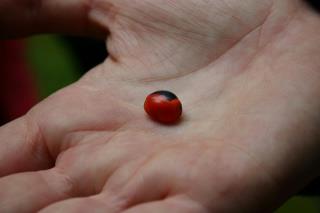
For many years, at the end of many of his trainings and workshops, Tom gave out “rainbow seeds” to his students. They are actually the seeds of the huayruro plant, from Peru. They are beautiful hard seeds of shiny red with a black spot. They are believed to bring powerful good luck and are often strung into necklaces and otherwise made into jewelry.

Tom’s instructions were to give these rainbow seeds away, and to give them to either a person or a place that signified excellence or devastation. In other words, a person or place of exceptional excellence, or a person or place in need of healing. (I am hearing his voice speak these words so clearly as I type, as I often do these days.)

I’ve dropped rainbow seeds in areas that have been ugly or devastated, and in spots so beautiful they took my breath away, and I’ve also given them to many people, for one or the other reason. I have also received one, which I mixed in with the others, and I don’t know which one it is now! I will give them all away.

I actually gave one to Tom once, when he was telling my master practitioner class about losing his beloved dog Dakota (whom I met when I first met Tom in the late 1990s), openly weeping as he spoke, sharing his sudden loss with us–and modeling how to let our emotions flow through us.

Tom gave these seeds out at numerous trainings every year all around the world, and the people he gave them to have also distributed them to people and places they’ve encountered. Tom called this “building rainbow bridges.”

We recipients now connect to each other on this planet, through him, the healed and the in-need-of-healing, the beautiful and devastated (because don’t we all–and this planet–have potential for both, and isn’t such a state always fluid?), and this bridge lives on even though he has transcended his earthly life, continuing its transformation in us. It’s almost as if he foresaw this happening.

Now that is wisdom, living through the long body. What a master.

Tom, you have been building rainbow bridges for years before passing. I realize I am doing these readings mostly for me (and with Bobbi Best when she is able to join me), because I don’t think you need my help at all in this transition.

My emotional body finds it hard to say goodbye, although I moved some heavy grief hucha up and out at ecstatic dance on Sunday. My spirit body feels Tom’s presence within and around me.

You were my teacher and also the teaching in how you lived your life. Mahalo for showing me that. You know how to move into the nagual. Love, just love, love, love, Tom.

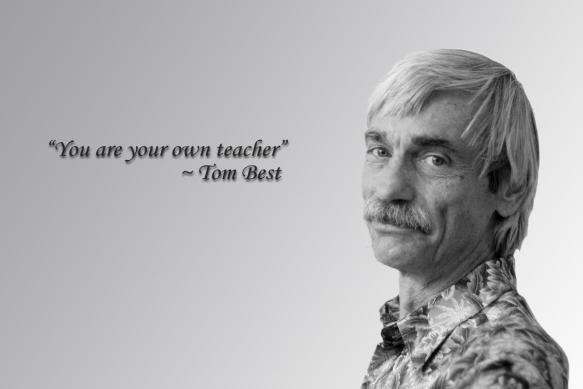
(Thanks to my friend from Maui, Erich Wolf, for posting the photo of the huayruro seed above, to Istok Pavlovic, Catharine Stuart Lord, and Nikola Jovanovic for the photos and posters of Tom and his words of wisdom and how to save high-resolution versions, and to Luzia Helena Wittman for sharing the photo of the footprints in the sand–taken by Tom of his own footprints in Portugal–on the Facebook group The Grace of Tom Best. Mahalo, my friends.)

For more about Tom, I wrote a later post that you might also like to read: When the teacher is the teaching: Tom Best.

Meeting Tom Best, who became my teacher

Whew. I can tell this is going to be some blogging that will take a few days to write, as my experience sifts itself into lasting words, and I’ll probably reread and retouch it a few times after posting as the clarifying process continues its magic. I don’t know now how it will come out, but it’s time to start writing.

Someone who has been important in my life, a teacher primarily and also a friend, since 2007 died, shuffled off his mortal coil, transitioned to a higher plane, passed away, left the planet, shed his body, entered the clear light, or however you like to put it.

I like how my friend Katie broke the news to me:

MaryAnn, I have some sad news to share, but not really.

She told me that our teacher, Tom Best, had had a brain hemorrhage on Monday afternoon. He took a nap, and when his wife Bobbi went to wake him up, he was breathing but didn’t wake up. Their dogs licked him, and he still didn’t wake up.

It sort of gets garbled here but he was taken to two hospitals because the first one couldn’t do a brain scan or something like that, and he looked like he was just sleeping and could just wake up at any moment, and with his wife and dearest friends gathered around him, the doctor didn’t hold out much hope but agreed to leave him on a ventilator overnight to see if his condition changed (it didn’t), and on Tuesday afternoon, he left his earthly body surrounded by loved ones.

People who were there said that as they stood around his bed as he was leaving his body, it was as if they sensed someone entering the room, and that energy seemed to be above them, and then it was gone.

I really want to thank Katie for telling me like that. This has been a really different experience of processing a death/absorbing a loss than I’ve experienced before, and much of it has to do with the person who died, and some of it has to do with me.

I first met Tom Best in 1998 or 1999, when I went to visit my friend Linda in Prescott, Arizona. She was close friends with Tom and Bobbi Best. We went to their place to borrow their new adorable white German Shepherd puppy Dakota and take him for a frolic in the forest. Linda introduced me to Tom, and I remember meeting a slight, wiry man with gray hair, kind of average in beauty, greeting me with a gaze that was really different from what I’d experienced before.

His eyes were very blue, a warm blue, and his attention was totally on me for those few moments of introduction with the best eye contact I’d experienced. I felt that he was genuinely interested in me. I felt an openness, a curiosity, a direct energetic connection, and a feeling of caring emanating from him in those few moments of the typical greeting ritual we all know so well in which names are exchanged and hands shaken.

I felt seen. I felt engaged. I felt cared for. Wow, all that in just a few seconds!

As I would later learn from him, I had just experienced news of difference.

I am pretty sure that was the first time I met anyone who transmitted his presence so clearly and directly to me, and I could not have described our first meeting like I just did had I not had him for a teacher later on.

I tucked that memory away, and in 2007, I was dating a man, Norm Sternfeld, who had studied NLP, and I thought of Linda who had studied NLP, and I thought to myself,

Hmm. People who study NLP use their minds well. I want to study NLP.

So I enrolled in practitioner training here in Austin, Texas, and when I showed up the first day, there was that same guy, Tom Best, whom I’d met in Arizona eight or so years earlier, at the front of the classroom, and in a very short time, I knew I was in the right place.

to be continued…

Moving through a loss

This is just a short post to say that a dear teacher whose trainings and workshops I have been attending and assisting at for the past five years left this earthly life behind on Tuesday. I had just spent Saturday with him, and he was in the finest form I’ve ever seen him.

His name was Tom Best. He taught Neuro-Linguistic Programming officially, but really, he taught love, congruence, presence, playfulness, communication both verbal and nonverbal, life skills, trance, healing, and shamanic practices. He did it clearly and cleanly, with a lot of elegance and very little ego.

He lived his life fully and deeply and from what I can tell, left nothing undone. And so it’s not as sad as some deaths.

I will post more about Tom later after this process of integrating the loss and the gifts has cooked some more.

Love to you all.

The starfish story: making a difference

I’ve heard two people tell this story recently. Each told it a little differently. Wanting to share it with you, I googled and learned the original was called The Star Thrower and was published by anthropologist/philosopher/writer Loren Eiseley as part of an essay in 1969.

The story has been adapted and used by motivational speakers ever since and was also made into a children’s DVD, Sara and the Starfish, in 2008. It was adapted again as a beautifully illustrated children’s book, Starfish on the Beach, in 2012.

I found this version on Wikipedia, and apparently it doesn’t violate anyone’s copyright.

Here it is:

An old man had a habit of early morning walks on the beach. One day, after a storm, he saw a human figure in the distance moving like a dancer. As he came closer he saw that it was a young woman and she was not dancing but was reaching down to the sand, picking up a starfish and very gently throwing them into the ocean.

“Young lady,” he asked, “Why are you throwing starfish into the ocean?”

“The sun is up, and the tide is going out, and if I do not throw them in they will die.”

“But young lady, do you not realize that there are miles and miles of beach and starfish all along it? You cannot possibly make a difference.”

The young woman listened politely, paused and then bent down, picked up another starfish and threw it into the sea, past the breaking waves, saying, “It made a difference for that one.”

The old man looked at the young woman inquisitively and thought about what she had done. Inspired, he joined her in throwing starfish back into the sea. Soon others joined, and all the starfish were saved.

If I adapted it, I would probably leave that last paragraph out. Yes, we love happy endings and want all the starfish to be saved, but that’s not why she did it, or why he joined her. Rather than detaching or being overwhelmed by the task, she took action. She threw one back, and then another, and another.

She made a difference to each one she threw back, even though they may have added up to only a tiny percentage of the washed-up, dying starfish. She did what she could.

How often do we look at some problem and feel paralyzed because it seems overwhelming? How often do we detach and think it’s not our problem? Racism, sexism, war, violence, poverty…the list goes on of seemingly intractable problems. It’s so easy to get stuck in helplessness, passivity, cynicism, separation.

And yet it’s our world.

So instead of thinking about what you can’t do, consider what you can do. What is one action you can take? What is the smallest action you can take? It might even be just to think about the problem differently. Maybe it’s a personal challenge that you need to rock yourself out of complacency.

Maybe you can make a bigger difference than you think.

Look at a problem in your life, one that seems intractable, and think of the tiniest action you can take. It doesn’t even matter what it is, as long as it is in the direction of health and resolution.

Then do it. And yes, I am talking to you.

The universal language of babies

Okay, so this is unrelated to most of the posts on this blog, except for me wanting to be of service by providing new-to-me (and I hope to you) information to improve your quality of life.

It turns out that those little noises that babies make before they really start crying actually have meaning. Babies have been signaling us when they’re hungry, sleepy, feeling general discomfort such as needing a diaper change, feeling lower GI distress like gas, and needing to burp.

Each of these has its own distinct sound.

If we can attend to their needs before they start crying, well, then they cry less! This seems revolutionary. What could it do to a population’s quality of life if all infants had their needs tended to quickly?

This was discovered by a brilliant woman gifted in auditory memory who became a mother, figured this out, and tested it around the world.

Watch this segment from Oprah:

The woman is Priscilla Dunstan. Here’s her website, in case you want to order the DVD: http://dunstanbaby.com/

I find it amazing that this has been right under our noses for millennia, and only now can it be discovered, tested, and widely taught.

It’s also amazing to think about how different the world might be if all parents learned these 5 signals and could tend to their infants’ needs better. Less frustration = more happiness.

It could be revolutionary.

Repost: 12 Life Lessons Learned in 12 Years on the Road

I loved this post from the blog Marc and Angel Hack Life: Practical Tips for Productive Living. Every single post on their blog is a list of tips that begins with a number.

Some of my favorite bits of this post, 12 Life Lessons Learned in 12 Years on the Road, are below:

What you do every day is what’s most important. – The difference between who you are and who you want to be, is what you do. You don’t have to be great to get started, but you do have to get started to be great.  

You can’t always be agreeable.  – That’s how people take advantage of you.  You have to set boundaries.  Don’t ever change just to impress someone.  Change because it makes you a better person and leads you to a better future.  

You DON’T want perfect people in your life. – Even though you probably sometimes get confused, you don’t really want your friends and lovers to be perfect.  What you do want is people you can trust, who treat you right – people you can act silly with, who love being around you as much as you love being around them.  

The truth is always the best choice. – Respect and trust are two of the easiest things in life to lose and the hardest to get back.  Never make a big decision when you’re angry, and never make a big promise when you’re overjoyed.  Never mess with someone’s feelings just because you’re unsure of yours. 

Everyone’s story is more complicated than it seems. – Every passing face on the street represents a story every bit as compelling and complicated as yours.  It’s not always the tears that measure a person’s pain, sometimes it’s the smile they fake.  Not all scars show.  Not all wounds heal by themselves.  You usually can’t see the pain that someone feels.  Don’t judge a person negatively for their past or feelings without a full understanding of their situation.  

You are not alone in being alone. – To lose sleep worrying about a friend.  To have trouble picking yourself up after someone lets you down.  To feel like less because someone didn’t love you enough to stay.  To be afraid to try something new for fear you’ll fail.  None of this means you’re dysfunctional or crazy.  It just means you’re human, and that you need a little time to right yourself.  You are not alone.  

Click the link above to read the whole post.

A model for experiencing and recovering from trauma: Peter Levine’s story

A few days ago, I finally started reading In an Unspoken Voice: How the Body Releases Trauma and Restores Goodness, by Peter A. Levine. This book comes full circle from Waking the Tiger, Levine’s first book, the book that changed my life.

It changed my life by giving me a new understanding of how trauma affects people and how to recover. Trauma is actually stored energetically in the body.

Levine, an ethologist, noticed the shaking that animals who narrowly missed being killed for dinner did, once free of their predators. That shaking allowed them to rejoin the herd not much worse for the wear.

When I read the book in 2002, I was skeptical but open. What Levine said was so different from what any other experts on trauma (psychotherapists) were saying.

One day, feeling exhausted from dealing with difficult emotions and memories, I flopped down on my bed and started to doze off.  The next thing I knew, my body was moving spontaneously, and I knew from having read the description that I was releasing energy blocks from trauma.

In the new book, Levine describes his subjective experience of being hit by a car.

Importantly, he describes PTSD as not an illness but as an injury that can occur from war, rape, sexual abuse, assault, and the like, and also after surgery, serious illnesses, falls, abandonment, receiving shocking or tragic news, witnessing violence, and getting into car accidents. Major shocks to our sense of well-being, in other words.

Some excerpts from his experience:

I can’t figure out what has happened. How did I get here? Out of a swirling fog of confusion and disbelief, a crowd of people rushes toward me. They stop, aghast… Slowly I orient myself and identify the real attacker… A wide-eyed teenager bursts out. She stares at me in dazed horror. In a strange way, I both know and don’t know what has just happened… I sink back into hazy twilight. I find that I am unable to think clearly or to will myself awake from this nightmare.

A man rushes to my side… he announces himself as an off-duty paramedic. When I try to see where the voice is coming from, he sternly orders, “Don’t move your head.” The contradiction between his sharp command and what my body naturally wants — to turn toward his voice — frightens and stuns me into a sort of paralysis. My awareness strangely splits, and I experience an uncanny “dislocation.” It’s as if I’m floating above my body…

…I need to have someone’s comforting gaze, a lifeline to hold onto. But I’m too terrified to move and feel helplessly frozen.

…Finally, I manage to shape my words and speak. My voice is strained and tight. I ask him, both with my hands and words, “Please back off.” He complies.

After a few minutes, a woman unobtrusively inserts herself and quietly sits by my side. “I’m a doctor, a pediatrician,” she says. “Can I be of help?”

Please just stay with me,” I reply. Her simple, kind face seems supportive and calmly concerned. She takes my hand in hers, and I squeeze it. She gently returns the gesture… I feel emotionally held by her encouraging presence. A trembling wave of release moves through me, and I take my first deep breath. Then a jagged shudder of terror passes through my body. Tears are now streaming from my eyes…

I am sucked down by a deep undertow of unfathomable regret. My body continues to shudder. Reality sets in.

In a little while, a softer trembling begins to replace the abrupt shudders. I feel alternating waves of fear and sorrow… I’m afraid of being swallowed up by the sorrow and hold onto the woman’s eyes. Her continued presence sustains me. As I feel less overwhelmed, my fear softens and begins to subside. I feel a flicker of hope, then a rolling wave of fiery rage. My body continues to shake and tremble. It is alternately icy cold and feverishly hot. A burning red fury erupts from deep within my belly.

I hear my shirt ripping. I am startled and again jump to the vantage point of an observer hovering above my sprawling body..The Good Samaritan paramedic reports that my pulse was 170… The paramedics are requesting a full trauma team. Alarm jolts me… As I am lifted into the ambulance, I close my eyes for the first time. A vague scent of the woman’s perfume and the look of her quiet, kind eyes longer. Again, I have that comforting feeling of being held by her presence.

Even though my eyes want to dart around, to survey the unfamiliar and foreboding environment, I consciously direct myself to go inward. I begin to take stock of my body sensations. This active focusing draws my attention to an intense, and uncomfortable, buzzing throughout my body.

…I notice a peculiar sensation in my left arm. I let this sensation come into the foreground of my consciousness and track the arm’s tension as it builds and builds. Gradually, I recognize that the arm wants to flex and move up. As this inner impulse toward movement develops, the back of my hand also wants to rotate. Ever so slightly, I sense it moving toward the left side of my face — as though to protect it against a blow. Suddenly, there passes before my eyes a fleeting image of the window of the beige car… I hear the momentary “chinging” thud of my left shoulder shattering the windshield. Then, unexpectedly, an enveloping sense of relief floods over me. I feel myself coming back into my body. The electric buzzing has retreated…  I have the deeply reassuring sense that I am no longer frozen, that time has started to move forward, that I am awakening from the nightmare

…I feel tremendous relief along with a deep sense of gratitude that my body did not betray me… As I continue to gently tremble, I sense a warm tingling wave along with an inner strength building up from deep within my body.

And it goes on. He gets the ambulance paramedic to tell him his vital signs: heart rate is 74, blood pressure 125/70. Normal. He knows from research that he won’t be getting PTSD.

Thank you, Peter Levine, for providing this fabulous first-person account of the subjective experience of someone who experienced trauma. The body and emotional awareness, the knowledge to tell the paramedic to back off, to receive comfort from the pediatrician, and mostly to allow his body to do what it needed to to — shake and make defensive movements and allow intense emotions to flow — is just brilliant.

I want to be able to witness another’s trauma and not be triggered myself.

What if there is no “normal” to return to after long-term PTSD? Be unfaithful to your sorrows.

I tagged a customer review of a book on Amazon because it moved me and I wanted to track comments on the review. It spoke to me.

(The book is In an Unspoken Voice: How the Body Releases Trauma and Restores Goodness by Peter A. Levine, author of Waking the Tiger, a book that changed my life.)

Fred wrote:

I agree with the comments about this book. I have the book and a couple of his other ones and I learned from them, they were my first knowledge of what trauma could do. I want to make a specific trauma comment and since the author has helped me alot what better place to do it!

At age 60 I am finally and only recently past the terror of early, continuous and prolonged childhood abuse because of the healing work I have done on my own. I recommend books and techniques from Alice Miller, Peter Levine (of course!), David Berceli, Babette Rothschild, EMDR, EFT, PARTS/EGO STATES work, NLP. I am a little leery about unsupervised guided imagery and meditation because they can be so close to dissociation, I sure did.

My comment is that with early abuse in whatever form the child has to create coping and defensive mechanisms to be able to survive mentally. These PARTs then prevent the child from growing naturally like all children should. As an adult these PARTS drew me to abusers and perpetuated actions which continued to retraumatize me. I didn’t know any better.

People who experience trauma as adults can use the techniques the author describes and those listed above to get back to normal. I have come to the awful realization that I have no NORMAL to go back to! My former desires and reasons for living no longer exist. They were based on avoiding reality, lessening the pain and terror, and plowing through dissociation to be able to function. While I don’t have the terror anymore I am still trauma parallyzed (Freeze, surrender) as I have been for most of these 6 decades and I don’t have the NORMAL interests and motivations which would help me get past that. “I” do not exist.

My hope from this review is that this Catch 22 can be added to trauma discussions. I don’t know what can be done to create a resource or if there are even more people like me out there.

I guess a correlary is to emphasize the need to help children who do experience trauma, as early as possible. (Another of the author’s books.)

Fred says there’s no normal to return to because of childhood abuse.

I ask Fred and others who have experienced long-term PTSD who don’t believe they have anything like a “normal” self to return to:

What if “normal” is an illusion? What if there is no normal?

Really, if your trauma began at age 1 or 11 or 21, the “returning to normal” is returning to how you were before the trauma began. What would it look like for a 60-year-old healing trauma victim to return to being a normal one year old? It doesn’t seem to work like that.

Perhaps “normal” is a concept that the mind desires that doesn’t really exist. Even for so-called “normal” people!

If that’s the case, then I say you get to determine what normal means for you.

Maybe normal means being a more present, heart-centered, resourceful person.

Maybe normal means finding what you believe you missed out on: a sense of worthiness, love, inner peace, trust, self-respect, and so on.

Maybe it’s having a strong connection to an enlightened witness. Maybe that enlightened witness is an inner part, Divine Essence, or another person.

Maybe normal is being a valued member of a community and building close relationships.

Maybe normal is being playful and having fun. Maybe it’s setting the boundaries you need to thrive.

Maybe normal is feeling centered in your body and having your energy flow freely, and learning how to return to that state when you become uncentered or blocked.

Maybe it’s wanting to experience the most joy, connection, sanity, and love — both giving and receiving — as you can and having a damn good reason for doing so. Living really well is the best revenge and the best healing you can possibly do.

Imagine that you fully and completely have the experience of being normal. What would that do for you ? Let’s hear it! “Then I’d be…”

And what would that do for you?

Take it as far as you can and enjoy experiencing that staate.

There’s a Zen phrase “unfaithful to my sorrows” that I use on my About me page. To me, it means that no matter what your sorrows are, or how many or deep they are, or how long you’ve had them, there are at least moments when you’re unfaithful to them — times when you forget them and notice something else. A rainbow. Some music. A dream image. A dust bunny. A release of tension.

We tend to believe we’re defined by our sorrows and traumas, but we’re not. We can let these non-sorrow moments become large.

Krishnamurti put it like this:

What can be described is the known, and the freedom from the known can come into being only when there is a dying every day to the known, to the hurts, the flatteries, to all the images you have made, to all your experiences— dying every day so that the brain cells themselves become fresh, young, innocent.

My dear friend Keith Fail says it more simply,

We’re always bigger than we think we are.