The presuppositions of Byron Katie

My NLP practitioner training included the presuppositions of NLP. They are the central principles and ethics underlying the body of work that is NLP. I’ve found them to be very handy guidelines in life.

NLP training does not require anyone to believe them.

Rather, it invites you to try them on as if they are true and discover what happens. If you like the results, you continue to act as if they are true.

For instance, the first six presuppositions as Tom Best taught them are:

  1. People are like mapmakers.
  2. People’s maps are made of pictures, sounds, feelings, tastes, and smells.
  3. The map is not the territory.
  4. People respond primarily to their maps of reality, not to reality.
  5. If you change your map, you’ll change the way you think, feel, and act.
  6. Many of our maps are out of our conscious awareness.

I just attended a workshop with Byron Katie this past weekend, perhaps my fourth or fifth. I thought it might be useful to look at The Work and figure out what its presuppositions are.

This, of course, is a work in progress that I will be revising as I get more clarity, and I invite anyone to add to the list and to clarify anything that isn’t clear. Just post your thoughts in the comments. I am re-reading Loving What Is: Four Questions That Can Change Your Life, and I will be clarifying these presuppositions as I progress.

  • Thoughts flow through the mind because that’s a function of the mind.
  • My thoughts produce my reality.
  • When my mind is silent, it experiences pure awareness.
  • My true nature is pure love.
  • Knowing what is true and real is important.
  • Only I cause my suffering.
  • Suffering is optional.
  • Just because I think a thought doesn’t mean it’s true.
  • When I believe a thought is true, I feel and behave in certain ways.
  • What I believe is what hurts me.
  • Questioning my beliefs is a way to relieve my suffering.
  • I can know whether a thought is really true.
  • I can notice what happens when I believe a thought.
  • When I drop a thought that causes me suffering, I can change my experience of who I am.
  • There are three kinds of business in the universe: mine, yours, and God’s.
  • Suffering comes from living outside of my own business.
  • God’s business includes anything that’s out of my control, your control, and every else’s control.
  • Other people’s thoughts, feelings, and behaviors are their business.
  • My thoughts, beliefs, feelings, and actions are my business.
  • When I pay attention to my business,  my life runs perfectly well on its own.
  • Everyone including me is innocent.
  • Everything that happens is for my own awakening, enlightenment, and joy.

Immobilization/shutdown/dissociation/frozen, a trauma response built into the nervous system

Back in March 2012, I posted that I had started reading Peter A. Levine’s latest book, In An Unspoken Voice: How the Body Releases Trauma and Restores Goodness. My post included excerpts from Levine’s description of being hit by a car and his experience afterwards.

His experience serves as a useful model for being and staying present through trauma and recovery. He knew how to allow his body and emotions to process naturally so that he did not get stuck in a traumatic state (i.e., PTSD).

Well, I am still reading that book. It’s very, very rich. Some parts are rather scientific. I’m taking my time to really understand it.

Levine uses polyvagal theory (I just posted an interview with Stephen Porges, who came up with the theory) to explain the states that people experience and can get stuck in from traumatic experiences.

Because Somatic Experiencing Practitioners and other therapists (as well as astute loved ones) who are helping someone recovery from trauma need to know which layer of the nervous system is dominant at any given time in a traumatized individual, I am going to describe them.

First, the primary job of our nervous system is to protect us. We have senses that alert us to danger. We may react to a perception of a threat in our bodies before it ever becomes conscious in the mind. That’s because the autonomic nervous system (which is not under our control) is involved when trauma occurs. We react instinctually.

This is good to know. It means that your trauma reactions are automatic, not something you can control, so there’s no need to feel shame or blame yourself. You were doing the best you could.

There are two defensive states that occur when encountering trauma: immobility/dissociation/shutdown (freeze) and sympathetic hyperarousal (fight or flight).

I’m going to write about them in separate posts to avoid being too lengthy.

The more primitive nervous system state is immobility. (Primitive in that evolutionarily it comes from jawless and cartilaginous fish and precedes sympathetic hyperarousal.)

It is triggered when a person perceives that death is imminent, from an external or internal threat.

Levine also uses the terms dissociation, shutdown, and freeze/frozen to describe this state. Note: If you’re an NLPer, dissociation means the separation of components of subjective experience from one another, such as cutting off the emotional component of a memory and simply remembering the visual and/or auditory components. (Source: Encyclopedia of NLP)

Keep in mind that Levine is talking about dissociation as an involuntary post-traumatic physiological state that trauma victims can sometimes get stuck with. There may be some overlap. According to Levine, symptoms of being in this state include frequent spaciness, unreality, depersonalization, and/or various somatic and health complaints, including gastrointestinal problems, migraines, some forms of asthma, persistent pain, chronic fatigue, and general disengagement from life.

Levine notes:

This last-ditch immobilization system is meant to function acutely and only for brief periods. When chronically activated, humans become trapped in the gray limbo of nonexistence, where one is neither really living nor actually dying. The therapist’s first job in reaching such shut down clients is to help them mobilize their energy: to help them, first, to become aware of their physiological paralysis and shutdown in a way that normalizes it, and to shift toward (sympathetic) mobilization. 

The more primitive the operative system, the more power it has to take over the overall function of the organism. It does this by inhibiting the more recent and more refined neurological subsystems, effectively preventing them from functioning. In particular, the immobilization system all but completely suppresses the social engagement/attachment system.

Highly traumatized and chronically neglected or abused individuals are dominated by the immobilization/shutdown system.

Signs that someone is operating from this state include:

  • constricted pupils
  • fixed or spaced-out eyes
  • collapsed posture (slumped forward)
  • markedly reduced breathing
  • abrupt slowing and feebleness of the heart rate
  • skin color that is a pasty, sickly white or even gray in color

Brainwise, volunteers in the immobility state exhibited a decrease in activity of the insula and the cingulate cortex. In one study, about 30% of PTSD sufferers experienced immobility and 70% experienced hyperarousal, with a dramatic increase of activity in these brain areas. Most traumatized people exhibit some symptoms from both nervous systems, Levine says.

I feel the deepest compassion for people in this state, because I have experienced it myself: the spaciness, depersonalization, sense of unreality, and passive, disengaged attitude toward life. It was many years ago. If I could, I would reach back in time to that injured woman and give her resources she just didn’t have back then.

I feel so grateful for the trauma recovery work I’ve done, both with a therapist and on my own. I haven’t experienced immobilization for years, except briefly.

Next up: sympathetic hyperarousal/fight or flight.

An interview with Stephen Porges: polyvagal theory, or how the nervous system is affected in autism, ADHD, borderline personality disorder, and trauma

Nexus, Colorado’s Holistic Health and Spirituality Journal.

This interview with Dr. Stephen Porges, whose career is based on understanding the evolution of the human nervous system, outlines some of the basics of polyvagal theory.

This theory is being tested in trauma recovery sessions. It’s exciting because it helps explain how and why people freeze or experience fight-flight reactions in response to trauma — and the route back to normal, healthy functioning, no matter how long ago the trauma occurred or how often it happened.

Polyvagal theory is increasingly becoming part of the training of bodyworkers, therapists, and educators. In a future post, I will describe how to tell which nervous system (freeze, fight or flight, or parasympathetic) is dominant at any given moment.

This theory is based on an in-depth understanding of the vagus nerve, also known as the 10th cranial nerve, which wanders (the Latin word vagus means wandering, like vagabond and vagrant) from the brain stem down through the body, affecting the face, heart, lungs, and gut.

The brain evolved hierarchically in vertebrates, and the neural circuits of the older nervous systems are still present, accessed hierarchically.

RD: So one thing happens then another thing happens then another thing?

SP: Right. This influences how we react to the world. The hierarchy is composed of three neural circuits. One circuit may override another. We usually react with our newest system, and if that doesn’t work, we try an older one, then the oldest. We start with our most modern systems, and work our way backward.

So polyvagal theory considers the evolution of the autonomic nervous system and its organization; but it also emphasizes that the vagal system is not a single unit, as we have long thought. There are actually two vagal systems, an old one and a new one. That’s where the name polyvagal comes from.

The final, or newest stage, which is unique to mammals, is characterized by a vagus having myelinated pathways. The vagus is the major nerve of the parasympathetic nervous system. There are two major branches. The most recent is myelinated and is linked to the cranial nerves that control facial expression and vocalization.

Here’s how it works in action:

SP: Let’s say you’re a therapist or a parent or a teacher, and one of your clients, students or children’s faces is flat, with no facial expression. The face has no muscle tone, the eyelids droop and gaze averts. It is highly likely that individual will also have auditory hypersensitivities and difficulty regulating his or her bodily state. These are common features of several psychiatric disorders, including anxiety disorders, borderline personality, bipolar, autism and hyperactivity. The neural system that regulates both bodily state and the muscles of the face goes off-line. Thus, people with these disorders often lack affect in their faces and are jittery, because their nervous system is not providing information to calm them down.

RD: How will polyvagal theory change treatment options for people with these disorders?

SP: Once we understand the mechanisms mediating the disorder, there will be ways to treat it. For example, you would no longer say “sit still” or punish a person because they can’t sit still. You would never say, “Why aren’t you smiling?” or “Try to listen better” or “Look in my eyes,” when these behaviors are absent. Often treatment programs attempt to teach clients to make eye contact. But teaching someone to make eye contact is often virtually impossible when the individual has a disorder, such as autism or bipolar disorder, because the neural system controlling spontaneous eye gaze is turned off. This newer, social engagement system can only be expressed when the nervous system detects the environment as safe.

There’s much more fascinating information you can read by clicking the link at the top of this post.

A video that could help you sleep

Insomnia is a malady I have rarely had over the last few years. Only when I drink caffeine late in the day (I usually know better), and even more rarely, when I feel so disturbed about some issue in my life that my mind can’t let go of it do I lie awake at night unable to sleep and feel like a zombie the next day.

I have experienced months of insomnia every night in the past, however, and that experience has given me great compassion for those who suffer from it. A good night’s sleep is just essential for well-being.

I’ve posted about various remedies for insomnia occasionally. You can search my blog on “insomnia” to find those posts if you wish.

Cures or relief from insomnia is a topic of great interest. New information emerges. I’m interested in what works. Could it be that there is not a “one size fits all” cure for insomnia?

Today I stumbled across a video purportedly created by scientists to help you sleep. I listened to it (and did not fall asleep, but it’s morning and I am well rested already). I found it very peaceful. I can imagine that it would help me fall asleep.

Here’s the link if you want to give it a try:

http://www.wimp.com/scientistscreated/

The only other information I could find is that the video and music are by a band called Marconi Union. I don’t know if this is a band of scientists or what!

The best help I know of for insomnia (and the most expensive) is brainwave optimization.   I wasn’t experiencing any insomnia when I did the five days of brain training in June 2011. But it has been known to help with insomnia, and a study is underway to learn more about its effects on insomnia.

Even more awesome, Wake Forest Baptist Medical Center is undertaking this study of insomnia, and other studies are planned for migraines, mild cognitive impairment, and traumatic brain injury/concussion later this year!

The Anti-DSM: A compendium of healthy states!

The DSM-IV is the psychiatric profession’s Bible of mental disorders. It’s where experiences like PTSD, borderline personality disorder, and autism are defined. Doctors diagnose, and insurance companies cover prescriptions for diagnoses, according to the DSM-IV. It’s a very powerful book affecting the lives of millions.

Rob Breszny, astrologer extraordinaire, questions why we don’t have such a list of healthy states. He asked his readers to help him compile a compendium of healthy, exalted, positive states of being.

Here are just a few of the responses:

* ACUTE FLUENCY. Happily immersed in artistic creation or scientific exploration; lost in a trance-like state of inventiveness that’s both blissful and taxing; surrendered to a state of grace in which you’re fully engaged in a productive, compelling, and delightful activity. The joy of this demanding, rewarding state is intensified by a sense that time has been suspended, and is rounder and deeper than usual. (Suggested by H. H. Holiday, who reports that extensive studies in this state have been done by Mihaly Czikszentmihalyi in his book, Flow: The Psychology of Optimal Experience.)

* AESTHETIC BLISS. Vividly experiencing the colors, textures, tones, scents, and rhythms of the world around you, creating a symbiotic intimacy that dissolves the psychological barriers between you and what you observe. (Suggested by Jeanne Grossetti.)

* AGGRESSIVE SENSITIVITY. Animated by a strong determination to be receptive and empathetic.

* ALIGNMENT WITH THE INFINITY OF THE MOMENT. Reveling in the liberating realization that we are all exactly where we need to be at all times, even if some of us are temporarily in the midst of trial or tribulation, and that human evolution is proceeding exactly as it should, even if we can’t see the big picture of the puzzle that would clarify how all the pieces fit together perfectly. (Suggested by Meredith Jones.)

* AUTONOMOUS NURTURING. Not waiting for someone to give you what you can give yourself. (Suggested by Shannen Davis.)

* BASKING IN ELDER WISDOM. A state of expansive ripeness achieved through listening to the stories of elders. (Suggested by Annabelle Aavard.)

* BIBLIOBLISS. Transported into states of transcendent pleasure while immersed in reading a favorite book. (Suggested by Catherine Kaikowska.)

To read and be inspired by more of these healthy and delicious possibilities, click this link! This is an excerpt from Rob’s book, Pronoia Is the Antidote for Paranoia: How the Whole World Is Conspiring to Shower You with Blessings, well worth reading if you’d relish subverting the dominant paradigm and confirming more of what’s good and possible in life.

The Goddess in Prison, by Peggy Lamb

The Goddess in Prison.

My friend Peggy Lamb wrote this blog post for Truth Be Told, a nonprofit working with women behind and beyond bars where we both volunteer.

She works with bodies, movement, dance, helping these wounded women heal from the traumas and tragedies they’ve experienced in their lives.

“I never heard anybody refer to God as a woman.”

Peggy replies, “Something to think about,” and leaves it at that.

She writes:

Feelings, traumatic events, images, joys and sorrows are danced. The bandages get ripped off, blood flows, and channels are opened in all of us as we witness a woman uttering the unspeakable with her dance; her body expressing what she has no words for.

In a sense I am a missionary for the Goddess. Without saying her name I invite these women to meet the Goddess in their belly.

Testing the FitDesk: an update

Last week I posted on testing the FitDesk. Here’s an update.

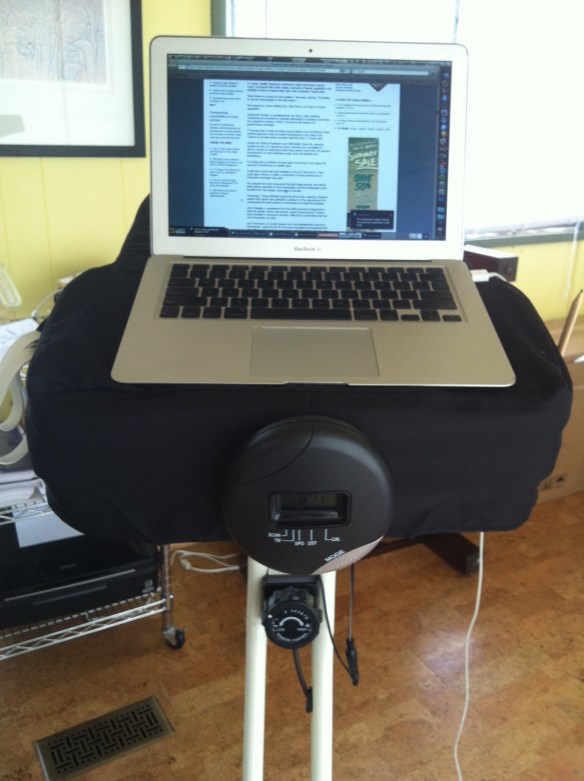
I discovered I had mounted the desktop backward. I had assembled it intuitively and then thought the velcro for attaching the electronic monitor was missing. I held the laptop in place with the giant rubber bands the company provided.

Later, I saw a piece of velcro on what I thought was the wrong side, and the little wheels in my mind started turning. I got out the instructions, looked at the photo, and sure enough, the fat end of the desktop is closer to the rider.

Here’s a photo with it mounted correctly, electronic monitor attached:

FitDesk

This way, there’s a slight ledge that you can’t really see but can feel on the desktop (which is made of dense foam covered with cloth) that will keep your laptop from sliding off. Although giant rubber bands are included, I did not find them necessary to hold my laptop in place with the desktop mounted correctly.

Note: I didn’t really use the electronic monitor. I just looked at the clock or set a timer on my iPhone and pedaled for a set length of time. Since I’m not using it to meet fitness goals, I found it more of a bother.

FitDesk pocketThis way of mounting the desktop also places the pockets closer to the rider. I used my iPhone to take these photos, but when not in use, I store it in one of the pockets, with Post-Its and writing instruments in the other pocket.

My friend Edward Spurlock tested it out. He adjusted the seat to fit his leg length. He is a cyclist and concurred with me that the FitDesk is not comparable in quality with exercise bikes at the gym (which are built for heavy, nearly constant use mimicking hills and so on). But for simply keeping your legs active while doing computer work, it’s great.

(Note: I took the photo below before figuring out the right way to mount the desktop!)

Edward monitored calories burned using an app called BodyBugg and reported the following:

I spent the entire interval from 12:42 PM to 12:48 PM turning the pedals on the FitDesk and burned 23 calories total during that time.

By comparison, I highlighted and selected the interval from 1:06 to 1:12 PM, when I was sitting in stop-and-go traffic on IH35 on my way home. The ‘Bugg registered a total of 8 calories burned for the interval, or around 1.4 calories / minute.

I usually burn 1.2 – 1.4 calories per minute on a normal workday sitting at my desk. If I used the FitDesk for a longer period, I might have slowed down a bit – but I think it’s fair to assume that one would burn at least twice as many calories turning the pedals and holding one’s body upright using the FitDesk than sitting still in the standard office chair with backrest.

Two to four calories per minute is pretty good compared to 1.2 – 1.4. You could definitely lose weight/eat more delicious food using a FitDesk regularly!

And finally, I want to report that the FitDesk does seem very feasible for use in an actual office wearing actual office clothing. I rode it for 30 minutes with the pedal tension set to 1 (no tension). You may remember that my first test was for an hour with the tension set midway at 4. I got sweaty then.

I did not sweat using the lowest setting, which is pretty remarkable considering I keep my trailer a bit warmer than the typical 72 degree setting found in most offices, closer to 76.

So I would say that the FitDesk is a desirable option in an office setting as well as for working at home.

Check out my tips for improving your health while sitting less (written while pedaling on a FitDesk)!

12 ways to improve your health by sitting less (written while pedaling on a FitDesk)

If you commute (usually sitting) to a desk job (mostly sitting) and then go home and watch television (sitting) and/or spend a lot of time on your computer (sitting), even if you manage to work in an hour at the gym, your health is at risk.

You can Google to learn more about the science of this — and they’re just beginning to learn. I’m just here to give free advice on behavioral changes you can make.

To counteract all the sitting, you could consider:

  1. Cutting the car commute and work from home as much as possible. Seriously. Present this option to your manager as a way to cut their costs, improve your health, and therefore make you more productive!
  2. If you can’t avoid car commuting, every time you’re at a red light or stop sign or gridlocked in a traffic jam, stretch your legs, and tense and relax them several times. Really pull the muscles to the bone. (Okay, that’s the yoga teacher in me talking.) Point and flex your feet and rotate your ankles.
  3. Take public transportation and stand during your commute, a la New York City subway riders.
  4. Bicycle to and from work, or combine biking with riding the bus or light rail. Many now have bike racks available. You may want to request that your workplace provide showering facilities.
  5. At work, take frequent breaks (1-2 minutes every 20 minutes) to stand up and walk around. Set a timer and do it. Go get a drink of water, go to the bathroom, stretch, shake the tension out of your body, do a forward bend to stretch the backs of your legs. Walk to the best view from your building and partake of it to refresh your spirit.
  6. Sit on an exercise ball. You have to use your legs to balance. You can also bounce when no one is watching. It will strengthen your core muscles because there’s no back — you have to hold your torso up. This will burn more calories, if you’re interested in doing that.
  7. Instead of emailing, texting, or phoning, walk over to a colleague’s office to communicate with him/her. I know, I know, this is really analog, but it’s also refreshing. Think of how much more information you get from seeing their face and hearing their voice in person. You might even learn something about them from seeing their office decor.FitDesk
  8. Persuade your office to invest in a FitDesk. One FitDesk shared among eight employees sounds like a great start. I imagine 30 minutes in the morning and 30 in the afternoon would make a big difference in the health and longevity of those eight employees, especially if they’re doing some of these other things when not pedaling. Of course, if your office can afford it, get a FitDesk for every employee! If you can’t afford it, you could phase this in over time as finances allow, as employees using it report they’re feeling better, missing less work, being in better moods, and being more productive, improving the company’s bottom line. Hey, maybe this is the key to the economic recovery and the obesity epidemic! FitDesks for every employee!
  9. When you get home, turn off the TV and computer and do something that uses your legs: cook, go for a walk, clean house, garden, do yard work, do yoga, lift weights, kick box, have sex, play with the dog, take a shower, swing your kids around, give them piggy-back rides, roughhouse, dance, put on a show. Also known as “living life” and “being embodied”.
  10. If you can’t eliminate TV or video games or Facebook or whatever is so compelling on your computer (okay, blogging and Facebook for me), limit it to an hour (with a break every 20 minutes; see #5 above) and get up during commercials unless you are on your feet while watching. Or…
  11. Get a FitDesk for your home so you can move your legs while watching TV and being on the computer.
  12. Do this with other people. It will be more fun.

Making the world a healthier place, one blog post at a time…

Altucher on oxytocin and polyvagal theory, with humor

10 Unusual Ways to Release Oxytocin Into Your Life Altucher Confidential.

I love this guy. He’s so real. I can only wish I was as good a writer as James Altucher.

He tells about being caught shoplifting as a kid, his disgust for going to the bathroom, cortisol, stress, the vagus nerve, a photo of a woman’s tattoo of “Fight or Flight”, and oxytocin.

There’s another photo of a foot with the chemical formula for oxytocin tattooed on it.

Then he lists 10 ways to increase your oxytocin levels.

One of the ways happens to be shooting guns. I don’t think that one would work for me. Loud sudden noises like gunshots make me really jumpy. That’s cortisol, not oxytocin. Maybe that’s a guy thing?

I would replace that one with getting a massage. I notice that with almost everyone, receiving massage decreases their cortisol. I can tell from feeling their energy before and after, gauged by how they move and their voices.

For others, especially those who are accustomed to regular massage, an hour or so of good bodywork vastly increases their oxytocin. They are all soft and mellow and receptive and happy afterwards.

I would also add rocking a sleeping baby, but you might have had to nurse your own baby first to get that feeling.

The rest of Altucher’s recommendations for increasing oxytocin work. Even using Facebook! And I especially like his strategy for dating.

I will tell you my pre-date secret. In the brief period when I was single in between separation and re-marriage I had a technique before every date. I would watch either Michael Cera doing comedy or Louis CK doing standup. This would get me laughing, make my oxytocin hormones go on fire, and then I’d go right into the date, with all my sex hormones raging. Plus. I would be temporarily funnier, with a half-life of about two hours. I knew after four hours I would be boring again so the date would have to be over by then. I do this before talks also.

The anatomy of lying: An interview with Sam Harris

Anatomy of Lying | Brain Pickings.

This repost from Brain Pickings is worthwhile reading, very good food for thought. It’s an interview with Sam Harris, author of Lying, which is available as a free ebook on Amazon through August 5.

As one who has valued tact over honesty in the past, I’m rethinking that stance. I have opinions, biases, associations, memories, judgments, emotions, rules, blind spots, and an internal bullshit detector, like everyone else (I assume). Redefining “the truth” as accurately communicating one’s subjective experience (and presenting it as such) motivates me to be more honest.

Why not share our subjective realities? Why not put my integrity first, instead of protecting someone else’s feelings so they’ll like me? Every interaction between people creates a bit of consensual reality. Why not share what’s really going on? Honesty is liberating. I love those people with whom I can really be myself.

And yes, maybe not everyone needs to hear your truth. For instance, telling your mom’s boss at a Catholic school that you’re an atheist will not go over well, especially when her job is putting food in your belly. But what about your friends and those you’re closest to? Do they know the real you?

At least one study suggests that 10 percent of communication between spouses is deceptive. Another has found that 38 percent of encounters among college students contain lies. However, researchers have discovered that even liars rate their deceptive interactions as less pleasant than truthful ones. This is not terribly surprising: We know that trust is deeply rewarding and that deception and suspicion are two sides of the same coin. Research suggests that all forms of lying — including white lies meant to spare the feelings of others — are associated with poorer-quality relationships…

But what could be wrong with truly ‘white’ lies? First, they are still lies. And in telling them, we incur all the problems of being less than straightforward in our dealings with other people. Sincerity, authenticity, integrity, mutual understanding — these and other sources of moral wealth are destroyed the moment we deliberately misrepresent our beliefs, whether or not our lies are ever discovered.

And while we imagine that we tell certain lies out of compassion for others, it is rarely difficult to spot the damage we do in the process. By lying, we deny our friends access to reality — and their resulting ignorance often harms them in ways we did not anticipate. Our friends may act on our falsehoods, or fail to solve problems that could have been solved only on the basis of good information. Rather often, to lie is to infringe upon the freedom of those we care about.

What do you think? How do you feel about this issue?