What I’m reading, April 2013

Taking stock of books I’m currently reading, just read, or soon to start:

The Reality of Being: The Fourth Way of Gurdjieff by Jeanne de Salzmann. My Fourth Way  group undertook reading this book aloud together. De Salzmann was one of Gurdjieff’s long-time students. She wrote about his teachings in a straightforward way, making them understandable and accessible. Her heirs found her undated notes after she died at 101 and published them a couple of years ago.

The book is about waking up the Essential Self. There are many, many passages I could share, but this one is from early in the book:

Gurdjieff taught the necessity of self-observation, but this practice has been mostly misunderstood. Usually when I try to observe, there is a point from which the observation is made, and my mind projects the idea of observing, of an observer separate from the object being observed. But the idea of observing is not the observing. Seeing is not an idea. It is an act, the act of seeing…it is an experience that can take place only if there is no separation between what sees and what is seen….

Next up for my book group is Practical Work on Self, by E.J. Gold. After that, we’ll be reading Beelzebub’s Tales to his Grandson: All and Everything, by Gurdjieff , which will probably take us two years, accompanied by a commentary.

On my own, I’m currently reading Gurdjieff: Making a New World by J.G. Bennett, about Gurdjieff’s searches for ancient wisdom (which has me using Google Maps to get familiar with the geography mentioned — Gurdjieff traveled from the Caucasus region to Egypt, Ethiopia, Tibet, Siberia, Italy, and points between in his searches, done on foot, horseback, and by rail before 1915).

Before starting Beelzebub’s Tales, I plan to  read In Search of the Miraculous: Fragments of an Unknown Teaching by P.D. Ouspensky, an account of his teachings by an early student.

I’m also interested in reading J.G. Bennett’s book Enneagram Studies to learn more about Gurdjieff’s understanding of the enneagram. He used the enneagram symbol extensively, but I’m not sure how it relates to the system of understanding the fixations that keep us asleep.

It’s not hard to understand the attraction of someone who believes wellness must include body, mind, heart, and spirit to the Fourth Way of Gurdjieff. I like the format of my group: We take turns reading, engage in discussion, do exercises.

I’m interested in Gurdjieff’s teachings, but I wouldn’t call myself a follower. I’m more of an explorer seeking wisdom. By the way, although he was fluent in Turkish, Greek, Armenian, Russian, and other languages, Gurdjieff didn’t write in English, and apparently a lot of what he wrote was embellished for teaching purposes and not necessarily straightforward, so to understand his teachings, it helps to read what his students wrote.

I do think he was a remarkable man and urge anyone interested in his life and teachings to at least see the film Meetings with Remarkable Men, or read his book of the same name, an account of his search for ancient spiritual wisdom.

Another book on my nightstand is called mBraining: Using Your Multiple Brains to Do Cool Stuff, by Marvin Oka and Grant Soosalu. It includes recent findings in neuroscience about the head, heart, and gut brains and how using these multiple brains can increase intuition and wiser decision-making. The authors’ background is Neuro-Linguistic Programming (NLP), cognitive linguistics, and behavioral modeling.

Our modern culture emphasizes the head brain. We try to think our way out of problems. Farming and civilization have been around for 12,000 years, and we are still killing each other. We are now ruining the planet we live on. In my opinion,  more intelligences are direly needed! I would surely like to have more resources, to use my multiple brains appropriately and experience less conflict, more intuition, better decisions…

So how do you tell which brain is operating? How do you know which brain is best suited for a given situation? How do you know when they’re not working together? How can you strengthen the brain you use the least? How can you ensure all three brains are in alignment for important decisions, relationships, and well-being?

Read the book and learn!

I’m in a different book group reading a book unrelated to the above books except as it applies to my quality of life. We are reading Your Money or Your Life: 9 Steps to Transforming Your Relationship with Money and Achieving Financial Independence to become knowledgeable and mindful about the role of money in our lives. We use a study guide (available for $5 from The Simple Living Network) developed for groups using the book to start on the path toward financial freedom. We meet seven times.

So far, I’ve added up my lifetime earnings (way more than I thought), started tracking every cent that comes in and out, started an inventory of my possessions, calculated my real hourly wage, and come up with a way to determine whether my spending is fulfilling and aligned with my values.

The authors have gotten feedback that after implementing the nine steps, people have reduced their expenses by 25 percent within 6 months and say their quality of life has gone way up. I’m finding this very helpful since I’ve transitioned from being an employee with a regular paycheck to being self-employed.

I’m also making my way through a couple of bodywork books, which I’ll write about another time.

If you’re reading this, you’re a reader. May you find books that nourish you!
Anne Lamott on how to become yourself

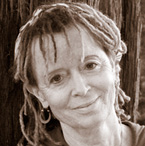
lamottI love Anne Lamott. I follow her on Twitter (oh, my, she’s fierce and funny!) and have read her wonderful Bird by Bird: Some Instructions on Writing and Life and other books. She’s open about being a screwed-up human being, and she has a lot of wisdom to share and the writing skills to convey it truthfully, with humor.

Somehow I stumbled upon a post she’d written for O, The Oprah Magazine (does anyone ever say, “I got my copy of O in the mail”?), that I want to share.

Excerpts:

We begin to find and become ourselves when we notice how we are already found, already truly, entirely, wildly, messily, marvelously who we were born to be. The only problem is that there is also so much other stuff, typically fixations with how people perceive us, how to get more of the things that we think will make us happy, and with keeping our weight down. So the real issue is how do we gently stop being who we aren’t? How do we relieve ourselves of the false fronts of people-pleasing and affectation, the obsessive need for power and security, the backpack of old pain, and the psychic Spanx that keeps us smaller and contained?…

I had to stop living unconsciously, as if I had all the time in the world. The love and good and the wild and the peace and creation that are you will reveal themselves, but it is harder when they have to catch up to you in roadrunner mode. So one day I did stop. I began consciously to break the rules I learned in childhood…

Dealing with your rage and grief will give you life. That is both the good news and the bad news: The solution is at hand. Wherever the great dilemma exists is where the great growth is, too. It would be very nice for nervous types like me if things were black-and-white, and you could tell where one thing ended and the next thing began, but as Einstein taught us, everything in the future and the past is right here now. There’s always something ending and something beginning. Yet in the very center is the truth of your spiritual identity: is you. Fabulous, hilarious, darling, screwed-up you.

Actually, not on purpose, I’ve left out the funniest parts! Read more and enjoy: http://www.oprah.com/spirit/How-To-Find-Out-Who-You-Really-Are-by-Anne-Lamott/

Welcome, reader from Sao Tome and Principe

I just checked on my blog stats and noticed that someone in Sao Tome and Principe had looked at my blog yesterday. I had heard of it before and knew of it as a very tiny nation, but I wasn’t sure where it was.

I marvel at the reach of the Internet. Chances are I will never go there or meet someone in person from there, but there is now a connection between me, in Austin, Texas, USA, and some unknown person hailing from Sao Tome and Principe. Who could ever have guessed?

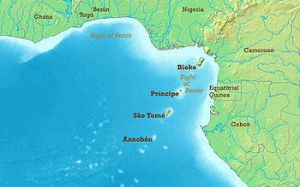
By hovering over the name, the map on the blog stats page showed that it’s a tiny island off the west coast of Africa. So of course I had to look up this exotic, enchanting place (where someone has read at least one of my blog posts!) in Wikipedia…

saotomemapIt’s actually a group of islands. Sao Tome and Principe are the two main islands formed from an extinct volcanic mountain range. (I bet the geology is fascinating. I love tropical volcanic islands.) This is the second-smallest African nation, after Seychelles.

The largest island was discovered by Portuguese explorers on the feast day of St. Thomas in 1471, hence the name (Sao Tome is St. Thomas in Portuguese.) The islands were uninhabited, and the Portuguese explorers decided they would make a good base for trade with the mainland.

The volcanic soil was good for growing sugar. Sadly, they imported slaves to work on the sugar plantations (not enchanting), but it became Africa’s largest exporter of sugar…until the Caribbean islands began outproducing it.

In the 19th century, coffee and cocoa were introduced. At one time it was the world’s largest producer of cocoa, still its most important crop. The landowners employed slaves, both legally and later illegally, and its history was marked by labor unrest and riots.

The islands became independent of Portugal in 1975 and is now a democracy.

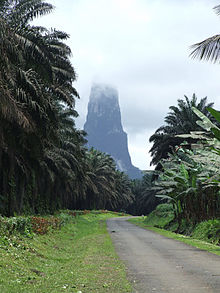
saotomepeakAnyway, these islands have mountains as high as 6,000 feet! Here’s a photo of one. Yes, it is exotic with fascinating geology! Also tropical, with the average temperature of 80 degrees F. and a rainy season.

About 164,000 people live there, including someone who read a blog post here! (Hello there!)

Demographically it is also fascinating. Populated by mixed blood descendants of the Portuguese colonists and African slaves, there is also a group said to descend from African slaves shipwrecked in 1540 (!) who earn their living from fishing, as well as descendants of freed slaves, contract laborers from the African mainland, Portuguese and Sephardic Jews, and Chinese.

Cesaria Evora’s lovely song Sodade is about longing to return home to Sao Tome.

Body self-care tools: the spine aligner and a workbook on trigger points

Aside

My two best self-care friends right now in my career as a bodyworker are a tool and a book that anyone can use. One of them provides daily relief from tight, achy back muscles caused by bending over slightly to massage clients. (I do Swedish and integrative massage, along with Ashiatsu and the biodynamic craniosacral therapy practice sessions I’m doing.)

Ma Roller (aka the spine aligner)

I’ve mentioned it before on this blog, and it bears mentioning again: daily use of a spine aligner keeps my back in shape. (Along with yoga, of course — even just a couple of sun salutations a day). I use it in bed, placing the center knobs between two vertebrae, somewhere between my shoulder blades, and lying back on it. When the muscles between those two vertebrae feel stretched and released, I move it down my spine one vertebrae at a time, all the way down to my sacrum.

spine aligner

My back feels so much better when I do this in the morning than when I don’t that I’m motivated to do it nearly every day, especially on days when I’ve got a lot of work.

I hesitate to lend my spine aligner out because once people try it, they want to keep it for themselves!

Plus, it tickles me that the first tool of this type is called the “Ma Roller”. That somehow gives it a worshipful quality to my mind. Ma Roller truly is a divine tool for keeping backs feeling good and flexible. (There are simpler versions without the foot ridges and single end knobs that mine has. You can Google and order the one you prefer online. )

Trigger point therapy

The other bosom buddy, a new one, is a book, The Trigger Point Therapy Workbook: Your Self-Treatment Guide for Pain Relief, by Clair Davies with Amber Davies, second edition.

Studying trigger points was not part of my massage school curriculum. (I understand they’re adding it now.) I really didn’t know much about trigger point massage. It’s one of the two techniques (the other being myofascial release) that are considered “deep tissue massage” — commonly considered the kind of massage that “hurts so good” or “hurts now, feels good after the bruises go away”.

After I started giving several massages a day, several days a week, I did know pain: muscle pain, painful tendons, achiness, burning, tightness, a thick hard ropy quality to muscles like I find on clients. And sometimes self-massaging those muscles felt good but didn’t last. The sore places became chronic.

I was traveling with a friend who’s a massage therapist and educator who explained trigger points to me and helped me find one in my neck so I could experience referral: press into a tender Point A and hold it, and pain arises in Point B, often surprisingly distant. (Although some trigger points are just painful at Point A.)

Eventually I got the workbook and started checking my muscles for trigger points. Then a colleague offered to give me a session so I could learn how she does it (and get some relief), and then she had me work on her trigger points. I actually bruised her butt, which she was okay with because she felt so much better.

If you didn’t know, a trigger point is a small knot in the muscle fibers that might even be microscopic. Sometimes a massage therapist — or you — can feel the knot. Experienced practitioners say when no knot is palpable, they can feel a change in muscle density.

The other way of finding them is to systematically press deeply into the muscle, sliding your fingers slowly along the skin, until you — or the client — identifies a tender spot. Then press into it while breathing deeply three times (sometimes the knot releases before then), and then rub the area to increase circulation and carry off toxins.

Now I add trigger point work on request to the Swedish and integrative massages I do. I don’t do sessions that are entirely deep tissue so far. Applying that much pressure is strenuous on my body, and my clients so far don’t want a whole hour of trigger point work.

I’ve ordered a small spiral book of images of muscles, trigger points, and referred pain areas that I can easily use at work in lieu of posters, since I work in multiple locations. It’s The Trail Guide to the Body — Trigger Points.

But back to me! I found dozens of trigger points in my sternocleidomastoid (the long muscle that pops out on the side of your neck when you turn your head) and scalenes (three shorter, entwined muscles on the side of the neck that attach to several cervical vertebrae, like guitar strings). The scalenes flex the neck to the same side.

Trigger points on these muscles produced referred pain at areas on my head, arms, hands, and between my shoulder blades. Finding and releasing these trigger points has made a world of difference. My body feels lighter, looser, freer, more flexible — and I’m already flexible.

I imagine that using the spine aligner regularly releases trigger points in the various layers of spinal muscles. My back is definitely less tender than when I first used the spine aligner. Use it in bed or on a sofa at first. Later you will be able to do it on the floor.

I have a hunch that if I could release all my trigger points, my body would feel like it did when I was 5 years old again. And that would be something I’d like to experience. The wisdom of age plus the energy of youth!

Trigger points do tend to come back but are not as painful, and sometimes they can require repeated work before they fully release. Every 2-3 days, I check those neck muscles and release any trigger points that are still tender. I’ll move onto my shoulder, arm, and upper back muscles next.

Whether you are a bodyworker or a recipient, if you are serious about moving away from muscle pain and toward more ease and lightness in your body, I recommend these tools for self-care.

Beautiful video of the Earth’s ocean currents

Love this video produced by NASA of our planet’s ocean currents.

The man who taught the biodynamic craniosacral therapy training I took last week shared this. We have currents inside and all around us.

If that metaphor had been a snake, it would have bit me!

If you don’t remember from high school English what a metaphor is, it is a figure of speech in which a word or phrase ordinarily used to designate one thing is used to designate something else.

Examples: Time is money. Life is a journey. She’s dancing toward happiness. When I reach the top of that mountain, then I’ll be free. I’ve got a knot in my stomach. He’s a real pain in the ass. Let me get something off my chest. Give me a hand. I’m looking for the right path. There’s a light at the end of the tunnel. If the shoe fits, wear it. The map is not the territory. Life is like a box of chocolates. It’s like pulling teeth. It’s like herding cats. The poem points a finger at the moon. Before/after enlightenment, chop wood, carry water.

In each of these examples, the metaphor uses a word or phrase that has a literal, embodied meaning (people do reach the tops of mountains, journeys exist, lights at the ends of tunnels exist) to symbolize an experience.

I’ve been paying attention to metaphors in conversation and writing, and it’s almost unbelievable how pervasive they are. Metaphors are everywhere! I can’t turn around without bumping into a metaphor! If that metaphor had been a snake, it would have bit me!

I’m writing about metaphors because I just spent some time learning the basics of and practicing Symbolic Modelling, aka Clean Language, an approach to changework, which is another hat I wear. (See?)

The workshop and retreat were led by James Lawley and Penny Tompkins. Their book is Metaphors in Mind: Transformation through Symbolic Modelling, and their website is The Clean Collection.

I’m going to be writing more about this, but for now, let me offer some prompts to discover your own personal metaphors.

Fill in the rest of the sentence:

Life is [like] ….

Time is ….

Money is …..

Love is ….

Work is ….

See you back here soon with more on this topic!

NYT: Response after trauma may be as crucial as trauma itself

This New York Times article presents research that suggests that what happens right after a traumatic event may be just as important as the trauma in determining how a traumatized person fares.

This may seem like common sense, but the world surely can use more of it.

Here’s the link: A New Focus on the ‘Post’ in Post-Traumatic Stress. And I really dislike the paywall where you can only see so many NYT articles per month for free. It’s early in the month, and I hope you can read it if you’re interested.

One of the damaging things that happened a day or two after my childhood trauma was telling an adult that I wanted to go home and being told I needed to stay where I was.

It wasn’t even that I wanted to literally go home. I can see now that I wanted reassurance that things would be or even could be okay again. I wanted the comfort of my mother’s presence. That’s what home meant then. And at age 11, I just didn’t have the right words to communicate what I needed so badly.

Was that the moment that trauma became PTSD? I don’t know.

Part of my recovery (after the big chunks were in place) was having a series of dreams for a couple of years in which I was trying to get home and couldn’t. I’d find myself stranded and making the best of it in some town miles away from Austin, but always looking out for a way to get home.

Then I finally had a dream in which I was at home, and it was a home I didn’t recognize, but it was my home.

At both ages, home was a metaphor for living in my body and feeling safe.

A note: The work of Dr. Peter A Levine spells out how important it is for a person to connect with and be tended to by a kind, calm person after a traumatic event. He recognizes that “the human connection” is critical in preventing PTSD after a trauma — in his book In An Unspoken Voice, he describes his own trauma and recovery in detail, including a bystander who offered a steady, reassuring presence.

He is one of the most renowned trauma researchers and writers in the world. It seems like an oversight to me for his work to go unmentioned in this article.

Nine days into a cleansing diet

Today is a cold rainy day here in Austin, and I’m in a great place right now as I write this — in bed, where it’s warm and cozy. I hear drops hitting the trailer roof with that satisfying sound that metal roofs provide.

I’m in the 9th day of a cleansing diet.

Usually sometime between Thanksgiving and Christmas every year, I get the strong idea that I want to eat simple food — once the holidays are over.

Don’t get me wrong — I partake of feasts and many holiday goodies. I don’t eat gluten ever, if I can help it, but I indulged in gluten-free muffins, bread, and cookies, not to mention sugar, mostly combined with chocolate. And wine. And a delicious Wensleydale cheese with cranberries.

The richness is delicious, of course, but it just gets to be too much. I start making lentil soup to simplify and make plans to really clean up my eating in January…

Now the holidays are over and we’re into January, and I’m doing the strict candida diet that I first did 5 or 6 years ago. That diet includes very limited grains (only quinoa, millet, and a few others), no dairy except plain yogurt and kefir, no fruit except lemon/lime/pomegranate, no sugar in any form, no fermented/pickled/brined foods.

You can have a lot of non-starchy vegetables, meat/poultry/fish/eggs, nuts and seeds. The only sweetener you can use is stevia.

I remember the first time I did it. I followed it so strictly. I had read that with candida, if you messed up and ate any of the forbidden foods, you could lose all the progress you had made toward clearing excess candida out of your body, and you’d have to start completely over. That’s because the forbidden foods contain sugar or become sugars that feed candida.

So my idea then was that this change in eating was so painful, I wasn’t going to mess up, because I never wanted to do it again.

Now here I am, doing it again. Not because I have candida again, but because I remember that after about two and a half months of eating so cleanly like this, I realized that I felt different.

I couldn’t describe how I felt.

After checking in closely and realizing that I had many fewer aches and pains, more energy, and no issues with my digestive system, it gradually dawned on me that I felt well.

And I’ve built on that for years.

And that’s what I’m going for again. Feeling really well. It’s not that I’m sick. I actually feel pretty blessed to have good health and be able to work 20-25 hours a week doing massage. But I could feel better.

I figured that I might as well ride the impulse to clean up my diet in January and really clean it up. And it’s not that painful, just another adventure in learning about the relationship between the food I eat and my well-being.

This might be something I do every January. It’s hard to maintain perfectly, and I miss certain foods, which I usually indulge in in moderation. The diet is like a baseline to go back to, and it has influenced my food choices quite a bit.

The book I used the first time was The Body Ecology Diet by Donna Gates. It explains the whole inner ecosystem idea (balancing the gut flora and fauna) pretty well without being overwhelmingly scientific and walks you through doing the diet, including recipes.

I lent that book out afterwards and never got it back, but I remember it pretty well, and some of that material is available online.

In the interim, I discovered green smoothies, which I can make differently every time, using different greens and adding fresh mint and other herbs. I’ve been making those (anyone got a Vitamix they want to sell cheap? my blender is wearing out) for breakfast, lunch, dinner.

I’m also planning to make cultured red cabbage!

I’ll report back after January ends on whether I experienced a surge in well-being and how I want to move forwards.

Meanwhile, I’m feeling pretty good, except for some aches and pains from doing massage.

2012 in review by WordPress

The WordPress.com stats helper monkeys prepared a 2012 annual report for this blog.

Here’s an excerpt:

4,329 films were submitted to the 2012 Cannes Film Festival. This blog had 49,000 views in 2012. If each view were a film, this blog would power 11 Film Festivals

Click here to see the complete report.

End-of-year blog stats for 2012

I’m winding up my third year of blogging, getting ready to move into the fourth year, so it’s a good time to summarize.

View and visitor data

In 2012, my blog was viewed over 48,000 times, averaging 134 views per day. That’s up from 23,000 total and 63 average in 2011. Readership continues to grow. Thank you.

I had my best day ever, 580 views by 206 visitors, on Monday, December 10. That was far above average, and I still don’t know what made it different. I’m curious and happy!

(FYI, each page/post viewed per day per device counts as one view. WordPress just started tracking visitors this month, so I won’t have meaningful data on visitors for awhile.)

Most popular posts of 2012

  1. Home page/archives (the blog was my home page for most of the year)
  2. Update on my Spartan trailer
  3. Trauma releasing exercises
  4. Tattoo art on yogis
  5. The starfish story: making a difference
  6. The Well Ashiatsu and Massage (my new home page as of the latter part of this year)
  7. Each moment, life as it is, the only teacher: quotes from Joko Beck
  8. How do you get your energy back after having the flu?
  9. The left brain right brain crossover
  10. What you need to know about standing desks

Many of these posts appeared before 2012, but The starfish story and The Well Ashiatsu and Massage were new. Other new popular posts in 2012 included The heart’s energy field, Breaking a habit: change the cue and reward first, and the routine will follow, and The 12 Symptoms of Spiritual Awakening. Posts on current yoga controversies (injuries and scandals) got quite a few views as well.

Where views came from

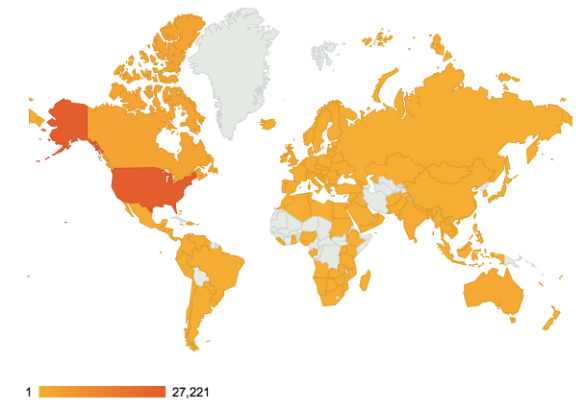
blog views by county, 2012

blog views by county, 2012

Since Feb. 25, 2012, when WordPress began tracking where views came from, over 27,000 views have come from the U.S., followed by Canada and the UK with about 2,500 each. Australia, India, Germany, South Africa, Ireland, Netherlands, and New Zealand round out the top 10 countries. Hi, y’all!

I had no views at all in 2012 from Greenland, Bolivia, Cuba, North Korea, Papua New Guinea, Iran, Turkmenistan, Uzbekistan, Somalia, several west and central African nations. and a few very tiny ones.

Most popular search terms

Almost 30,000 views came through people using search engines, mostly Google. (This is why tagging is so important.) These were the most popular search terms:

  1. yoga tattoos
  2. spartan trailer
  3. trauma release exercises
  4. spartan carousel
  5. starfish story
  6. yoga tattoo
  7. spartan trailers
  8. spartan carousel for sale
  9. standing desk height calculator
  10. glenn black yoga

Other search terms that got viewers here included:

  • sitting unhealthy
  • jobs that are not sedentary
  • constructive things to do
  • 100 naked people
  • tantric broad

Surprisingly, several search terms used the Russian and Turkish alphabets. I have no idea what the English equivalents are.  I had 125 views from Turkey and 70 from the Russian Federation, so I goess they found something of interest. 

Clicks and ads and earnings

If you enter Amazon through links on this blog and make a purchase, I get a small percentage of whatever you buy, through a program called Amazon Associates. Amazon got 973 clicks from this blog in 2012.

From those clicks and subsequent sales, I earned all of $110 in 2012.

Don’t ask how many hours I put into this website. I don’t track my time, but I’m sure it averaged at least a couple of hours per week, and often double that. $110 for 104 hours (52 x 2) works out to about $1 per hour. Hmmm.

I have yet to be paid a cent for allowing ads on the blog. I’ve earned $54.37 since February 2012, when I began allowing ads, but the minimum payout is $100, so I’m still waiting for a deposit.  Frankly, I’m not sure advertising is worth the aesthetic drag and distraction, and I worry that some company whose values I disagree with (like Monsanto) will advertise.

If that happens, please let me know as soon as possible, so I can quit taking ads.

Blogging is a labor of love for me. It would be nice to make more money at it (with integrity, of course). I consider writing projects from time to time that could bring in  income, but so far I haven’t followed through. I believe that could change!

Other data

I end 2012 with:

  • over 75,000 views total
  • 313 followers (156 at the end of 2011)
  • 727 total posts
  • 2,250 tags
  • 576 comments (including my replies to commenters)

It’s been a good year. Thank you for reading me!