Immobilization/shutdown/dissociation/frozen, a trauma response built into the nervous system

Back in March 2012, I posted that I had started reading Peter A. Levine’s latest book, In An Unspoken Voice: How the Body Releases Trauma and Restores Goodness. My post included excerpts from Levine’s description of being hit by a car and his experience afterwards.

His experience serves as a useful model for being and staying present through trauma and recovery. He knew how to allow his body and emotions to process naturally so that he did not get stuck in a traumatic state (i.e., PTSD).

Well, I am still reading that book. It’s very, very rich. Some parts are rather scientific. I’m taking my time to really understand it.

Levine uses polyvagal theory (I just posted an interview with Stephen Porges, who came up with the theory) to explain the states that people experience and can get stuck in from traumatic experiences.

Because Somatic Experiencing Practitioners and other therapists (as well as astute loved ones) who are helping someone recovery from trauma need to know which layer of the nervous system is dominant at any given time in a traumatized individual, I am going to describe them.

First, the primary job of our nervous system is to protect us. We have senses that alert us to danger. We may react to a perception of a threat in our bodies before it ever becomes conscious in the mind. That’s because the autonomic nervous system (which is not under our control) is involved when trauma occurs. We react instinctually.

This is good to know. It means that your trauma reactions are automatic, not something you can control, so there’s no need to feel shame or blame yourself. You were doing the best you could.

There are two defensive states that occur when encountering trauma: immobility/dissociation/shutdown (freeze) and sympathetic hyperarousal (fight or flight).

I’m going to write about them in separate posts to avoid being too lengthy.

The more primitive nervous system state is immobility. (Primitive in that evolutionarily it comes from jawless and cartilaginous fish and precedes sympathetic hyperarousal.)

It is triggered when a person perceives that death is imminent, from an external or internal threat.

Levine also uses the terms dissociation, shutdown, and freeze/frozen to describe this state. Note: If you’re an NLPer, dissociation means the separation of components of subjective experience from one another, such as cutting off the emotional component of a memory and simply remembering the visual and/or auditory components. (Source: Encyclopedia of NLP)

Keep in mind that Levine is talking about dissociation as an involuntary post-traumatic physiological state that trauma victims can sometimes get stuck with. There may be some overlap. According to Levine, symptoms of being in this state include frequent spaciness, unreality, depersonalization, and/or various somatic and health complaints, including gastrointestinal problems, migraines, some forms of asthma, persistent pain, chronic fatigue, and general disengagement from life.

Levine notes:

This last-ditch immobilization system is meant to function acutely and only for brief periods. When chronically activated, humans become trapped in the gray limbo of nonexistence, where one is neither really living nor actually dying. The therapist’s first job in reaching such shut down clients is to help them mobilize their energy: to help them, first, to become aware of their physiological paralysis and shutdown in a way that normalizes it, and to shift toward (sympathetic) mobilization. 

The more primitive the operative system, the more power it has to take over the overall function of the organism. It does this by inhibiting the more recent and more refined neurological subsystems, effectively preventing them from functioning. In particular, the immobilization system all but completely suppresses the social engagement/attachment system.

Highly traumatized and chronically neglected or abused individuals are dominated by the immobilization/shutdown system.

Signs that someone is operating from this state include:

  • constricted pupils
  • fixed or spaced-out eyes
  • collapsed posture (slumped forward)
  • markedly reduced breathing
  • abrupt slowing and feebleness of the heart rate
  • skin color that is a pasty, sickly white or even gray in color

Brainwise, volunteers in the immobility state exhibited a decrease in activity of the insula and the cingulate cortex. In one study, about 30% of PTSD sufferers experienced immobility and 70% experienced hyperarousal, with a dramatic increase of activity in these brain areas. Most traumatized people exhibit some symptoms from both nervous systems, Levine says.

I feel the deepest compassion for people in this state, because I have experienced it myself: the spaciness, depersonalization, sense of unreality, and passive, disengaged attitude toward life. It was many years ago. If I could, I would reach back in time to that injured woman and give her resources she just didn’t have back then.

I feel so grateful for the trauma recovery work I’ve done, both with a therapist and on my own. I haven’t experienced immobilization for years, except briefly.

Next up: sympathetic hyperarousal/fight or flight.

An interview with Stephen Porges: polyvagal theory, or how the nervous system is affected in autism, ADHD, borderline personality disorder, and trauma

Nexus, Colorado’s Holistic Health and Spirituality Journal.

This interview with Dr. Stephen Porges, whose career is based on understanding the evolution of the human nervous system, outlines some of the basics of polyvagal theory.

This theory is being tested in trauma recovery sessions. It’s exciting because it helps explain how and why people freeze or experience fight-flight reactions in response to trauma — and the route back to normal, healthy functioning, no matter how long ago the trauma occurred or how often it happened.

Polyvagal theory is increasingly becoming part of the training of bodyworkers, therapists, and educators. In a future post, I will describe how to tell which nervous system (freeze, fight or flight, or parasympathetic) is dominant at any given moment.

This theory is based on an in-depth understanding of the vagus nerve, also known as the 10th cranial nerve, which wanders (the Latin word vagus means wandering, like vagabond and vagrant) from the brain stem down through the body, affecting the face, heart, lungs, and gut.

The brain evolved hierarchically in vertebrates, and the neural circuits of the older nervous systems are still present, accessed hierarchically.

RD: So one thing happens then another thing happens then another thing?

SP: Right. This influences how we react to the world. The hierarchy is composed of three neural circuits. One circuit may override another. We usually react with our newest system, and if that doesn’t work, we try an older one, then the oldest. We start with our most modern systems, and work our way backward.

So polyvagal theory considers the evolution of the autonomic nervous system and its organization; but it also emphasizes that the vagal system is not a single unit, as we have long thought. There are actually two vagal systems, an old one and a new one. That’s where the name polyvagal comes from.

The final, or newest stage, which is unique to mammals, is characterized by a vagus having myelinated pathways. The vagus is the major nerve of the parasympathetic nervous system. There are two major branches. The most recent is myelinated and is linked to the cranial nerves that control facial expression and vocalization.

Here’s how it works in action:

SP: Let’s say you’re a therapist or a parent or a teacher, and one of your clients, students or children’s faces is flat, with no facial expression. The face has no muscle tone, the eyelids droop and gaze averts. It is highly likely that individual will also have auditory hypersensitivities and difficulty regulating his or her bodily state. These are common features of several psychiatric disorders, including anxiety disorders, borderline personality, bipolar, autism and hyperactivity. The neural system that regulates both bodily state and the muscles of the face goes off-line. Thus, people with these disorders often lack affect in their faces and are jittery, because their nervous system is not providing information to calm them down.

RD: How will polyvagal theory change treatment options for people with these disorders?

SP: Once we understand the mechanisms mediating the disorder, there will be ways to treat it. For example, you would no longer say “sit still” or punish a person because they can’t sit still. You would never say, “Why aren’t you smiling?” or “Try to listen better” or “Look in my eyes,” when these behaviors are absent. Often treatment programs attempt to teach clients to make eye contact. But teaching someone to make eye contact is often virtually impossible when the individual has a disorder, such as autism or bipolar disorder, because the neural system controlling spontaneous eye gaze is turned off. This newer, social engagement system can only be expressed when the nervous system detects the environment as safe.

There’s much more fascinating information you can read by clicking the link at the top of this post.

A video that could help you sleep

Insomnia is a malady I have rarely had over the last few years. Only when I drink caffeine late in the day (I usually know better), and even more rarely, when I feel so disturbed about some issue in my life that my mind can’t let go of it do I lie awake at night unable to sleep and feel like a zombie the next day.

I have experienced months of insomnia every night in the past, however, and that experience has given me great compassion for those who suffer from it. A good night’s sleep is just essential for well-being.

I’ve posted about various remedies for insomnia occasionally. You can search my blog on “insomnia” to find those posts if you wish.

Cures or relief from insomnia is a topic of great interest. New information emerges. I’m interested in what works. Could it be that there is not a “one size fits all” cure for insomnia?

Today I stumbled across a video purportedly created by scientists to help you sleep. I listened to it (and did not fall asleep, but it’s morning and I am well rested already). I found it very peaceful. I can imagine that it would help me fall asleep.

Here’s the link if you want to give it a try:

http://www.wimp.com/scientistscreated/

The only other information I could find is that the video and music are by a band called Marconi Union. I don’t know if this is a band of scientists or what!

The best help I know of for insomnia (and the most expensive) is brainwave optimization.   I wasn’t experiencing any insomnia when I did the five days of brain training in June 2011. But it has been known to help with insomnia, and a study is underway to learn more about its effects on insomnia.

Even more awesome, Wake Forest Baptist Medical Center is undertaking this study of insomnia, and other studies are planned for migraines, mild cognitive impairment, and traumatic brain injury/concussion later this year!

What if everybody only knew what we know about trauma?

Understanding Trauma | What a world if everybody only knew!.

Longtime readers know I’m a huge fan and grateful recipient of the trauma recovery work of Peter A. Levine. I’ve been exploring Beyond Trauma, the Somatic Experiencing blog. I just read the post linked to above and thought I’d share.

The post contains a link to a 30-minute podcast that inspires some great questions:

  • What if everybody knew that a fixated stress response (a.k.a. trauma) is the result of a disrupted neurophysiological process— a process that desires completion?
  • What if people knew that our sense of well-being can be recovered, even after surviving extreme events, as long as we receive proper support and facilitation (to complete those processes that were disrupted)?
  • What if everybody knew that this is not some arcane, exclusive field— that just about anyone can readily understand the most important aspects of stress and trauma?
  • What if everybody knew that tuning into our innate ability, as organisms, to respond and recover from trauma can significantly enhance our health and well-being?
  • What if we all knew that a change of perspective is taking place in the helping professions, one that places more emphasis on the critical role the body can play in easing distress?

New alternative for sedentary desk work: the FitDesk

Since I’ve posted before on how prolonged sitting is unhealthy and how to counteract it, and I’ve promoted standing desks, I want to bring this to your attention (and thanks, Shelley Seale, for bringing it to mine).

This is on the heel of news that sitting less could add two years to your life expectancy.

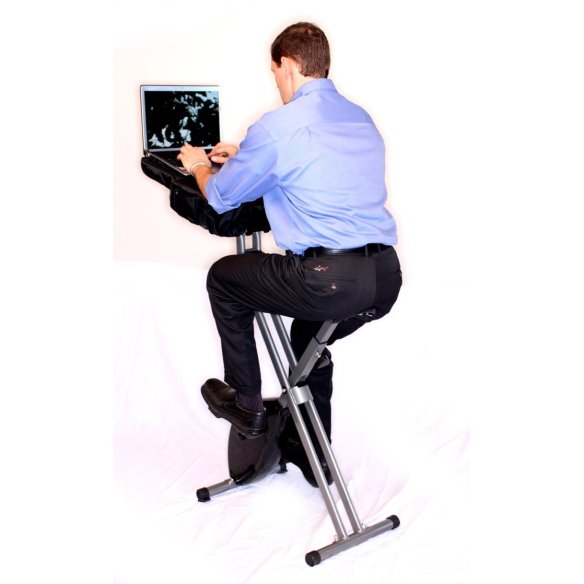
It is a stationary bicycle with a desktop attached to the front of it. You can pedal and keep your leg muscles active, improve circulation, burn calories, circulate lymph, move cerebrospinal fluid, and more, while working or playing video games!

The FitDesk X Compact Pedal Desk is for sale on Amazon for $249.99. Amazon will cross-sell you a comfy bicycle seat and a laptop/iPad holder to go with it.

The seller offers a full refund (plus shipping) within 30 days if you are not satisfied with it. (Hint: Save the carton.)

One thing I really love about Amazon is reading the customer reviews. This product gets an average of 4.5 stars from 111 reviewers (all gave it 3 to 5 stars). Here are what some said:

  • A grad student in an online program lost 10 pounds the first month (30 lbs. over six months) using this product. She raves about the product being sturdy and quiet (quiet enough to use in the same room as a sleeping spouse), and about the customer service. The 2011 model has a timer/calorie counter/speed/distance monitor like stationary bikes at the gym.
  • Another reviewer mentions the great customer service: “Steve, the inventor of FitDesk, will answer your call or email himself. Some day he’ll probably have a huge company because this is such an awesome invention and then he won’t have time to talk to customers himself, but for the moment, he’s the best customer service rep you’ll ever talk to because he believes in his product and is doing everything he can to make it even better.”
  • The critical review rated “most helpful” gave the product 3 stars and said the exercise bike is not that great, that it’s hard to get a consistent pedaling rhythm. This reviewer is also an avid mountain biker who also regularly rides exercise bikes at the Y.

It sounds like it won’t compare to serious exercise bikes, but the whole point of it is not getting a strenuous workout but rather getting a light workout over time while getting computer work accomplished or playing video games.

Okay, okay! I want one! I’m drooling at the thought of cycling while writing blog posts! Would be awesome to have one at my next corporate stint.

The FitDesk weighs 33 lbs., holds users up to 250 pounds, and has a “seat extender” available for tall people. It is easy to fold up and move.

Also, there may (or may not, since the product is being continually improved) be issues with the electronic monitor, and I couldn’t get the straight dope on that.

The company has a video showing the product in use:

You can “like” FitDesk on Facebook (where they offer discount codes and giveaways) and follow @fitdesk on Twitter.

~~

Follow-up on 7.13.2012: The maker of the FitDesk has offered to send me one to try out! I love it! Will post on the experience, with photos!


Recovering from a pulled muscle, I apply my massage skills and heal. Voila!

A couple of weeks ago, I started self-training in running, and I was walking/running on the trail, building up endurance while avoiding fatigue and injury (so I intended). I’d done the warmups recommended by my trainer and felt really good in my running—lifting my knees, almost sprinting, feeling that great-to-be-alive, heart-pounding, hard-breathing experience of really challenging my body in a healthy way. I was loving the run!

Then, running up a hill, I pulled my left calf muscle. I immediately slowed to a walk, walked for about 10 minutes, and then (ruh roh), I decided it wasn’t so bad and ran some more.

Afterwards, I could feel the pull, but it seemed pretty minor. I could walk fine, without a limp. However, I did wisely decide not to run again until it felt really fine.

Six days passed, and I went to ecstatic dance, where everyone dances like no one is watching. I love this practice, moving to music, going with the flow, connecting with others, letting go, being part of the tribe. I can get pretty wild, jumping around with a big grin, leaping from foot to foot, being danced.

If you have no clue what I’m talking about, it’s like this:

The Power Wave

So anyway, while leaping about, I suddenly felt strong pain in my left calf. I limped to the side and did not feel like dancing any more.

Thinking it was my gastrocnemius (the superficial calf muscle), I had a massage therapist work on it that afternoon. I was still limping badly afterwards, although definitely more relaxed. I went home and iced it, and then…

 A massage magazine I’d been reading was next to my bed. I picked it up and saw there was an article by Dr. Ben Benjamin on the soleus, the deeper calf muscle. It included diagnostic tests, and I verified that it was my soleus muscle that was injured. (The image shows it without the gastrocnemius.)

Guess what? It could take 4-6 weeks to fully heal. That was depressing.

Benjamin (who also wrote the fantastic reference book about muscle injuries that belongs in the home library of every athlete (in my opinion), Listen to Your Pain) gave instructions for “friction therapy” massage, stretching, and strengthening. I also put ice on it, several times a day at first and now just once a day right after I do the clinical protocol.

My leg went from maybe 15 percent to 85 percent functional within a week. My limp gradually lessened, day by day. The calf still feels just a bit tight and tender. My hunch is that the last 15 percent of healing will happen more slowly.

Anyway, I feel really empowered about using clinical massage on my own injury and seeing (and feeling) rapid improvement.

I am ready to apply that to others.

Color, culture, and language: be warned, this is weird and fascinating!

The crayola-fication of the world: How we gave colors names, and it messed with our brains (part I) | Empirical Zeal.

The NLPer/cultural anthropology nerd in me was fascinated by this article, which looks at the names for colors among various cultures. In NLP, we say “the map is not the territory,” meaning we live through our maps of the world, not so much through the actual world, and language is a huge part of our maps.

Did you know that some cultures have only two words for colors, words that mean light and dark? All light and warm colors—white, reds, yellows, oranges, pinks—are called by the word meaning light, and all dark, shadowy, cool colors—blues, greens, browns, black—are called by the word meaning dark.

The Japanese language did not distinguish between blue and green until the 20th century, and only did so with American influence. (English recognizes 11 colors. It’s a colorful language.)

In studying words for colors across multiple cultures, researchers came up with algorithms for determining exactly where a color fits in with the shades in a color group. (Remember the 64-crayon box that had yellow-green and green yellow? Barely distinguishable, but one was slightly more yellowish and the other was slightly more greenish.)

The blog, Empirical Zeal, that published this publishes posts from several sources and all posts are written using primary sources. (Unlike my blog, obviously. I’m not a scientist, but I can appreciate science sometimes, and I really just like to share some of the amazing stuff I find out there on the inter webs. I think maybe “humanist” is a good description for my angle.)

The spectrum has no natural boundaries, it would seem, and the perception of color is not universal. Languages also change over time, and many have followed the same route. Since most languages have two to 11 names for colors, scientists have determined that the first two color terms will be light and dark, or white and black. The third will be red, and the next will be either green or yellow. Once both those distinctions come into use, green splits into two, and you now have blue. (The Japanese word for blue green is midori. Author’s note: Thanks to Tim for correcting me on this.)

The research done on native speakers of 110 different languages using 400 color tiles was called the World Color Survey. Further research used algorithms to distinguish color groups. The algorithms were fairly predictive of how actual cultures grouped shades.

The picture that’s emerging is that colors aren’t quite random slices of the visual pie. They’re somewhat basic categories that humans from different cultures gravitate towards, and must have to do with how the biology of how we see the world. In other words, rainbows have seams. We can distill a rainbow into its basic visual ingredients, and a handful of colors come out.

If you get to the end of this, click the link for Part Two, about how naming colors messes with our brains!

More on the power of standing

Stand Up, Walk Around, Even Just For ’20 Minutes’: NPR.

Terry Gross interviews Gretchen Reynolds (see my previous post  The easiest shortcut to health you can make) about her new book, The First 20 Minutes.

Reynolds recommends standing for two minutes every 20 minutes while desk-bound — even if you can’t move around your office. “That sounds so simple,” she tells Fresh Air‘s Terry Gross. “But that actually has profound consequences. If you can stand up every 20 minutes — even if you do nothing else — you change how your body responds physiologically.”

Reynolds says prolonged sitting affects diabetes, weight, heart disease, and brain function.

She talks about other new wisdom in regard to health and fitness, including stretching before a workout, warming up, running, walking, hydration, and more.

The easiest shortcut to health you can make

Gretchen Reynolds on ‘The First 20 Minutes’ – NYTimes.com.

Loved this article about Gretchen Reynolds’ (no relation) new book, The First 20 Minutes: Surprising Science Reveals How We Can Exercise Better, Train Smarter, Live Longer.

Reynolds, a New York Times health and fitness columnist, looks at what you can do to makes the most difference for your health with the least effort. It’s surprisingly easy. Exercise trumps diet, and it only takes 20 minutes a day, and it doesn’t have to be anything more than standing.

This interview reinforces the new knowledge that prolonged sitting is unhealthy. I now use a timer to remind me to stand up and move when I’m doing anything that requires long hours at a computer.

Here are some good bits:

The first 20 minutes of moving around, if someone has been really sedentary, provide most of the health benefits. You get prolonged life, reduced disease risk — all of those things come in in the first 20 minutes of being active.

If someone starts an exercise program and improves his fitness, even if he doesn’t lose an ounce, he will generally have a longer life and a much healthier life. 

But the science shows that if you just do anything, even stand in place 20 minutes, you will be healthier.What would be nice would be for people to identify with the whole idea of moving more as opposed to quote “exercise.”

There is a whole scientific discipline called inactivity physiology that looks at what happens if you just sit still for hours at a time. If the big muscles in your legs don’t contract for hours on end, then you get physiological changes in your body that exercise won’t necessarily undo. Exercise causes one set of changes in your body, and being completely sedentary causes another.

I really do stand up at least every 20 minutes now, because I was spending five or six hours unmoving in my chair. The science is really clear that that is very unhealthy, and that it promotes all sorts of disease. All you have to do to ameliorate that is to stand up. You don’t even have to move. 

The human body is a really excellent coach. If you listen to it, it will tell you if you’re going hard enough, if you’re going too hard. If it starts to hurt, then you back off. It should just feel good, because we really are built to move, and not moving is so unnatural. Just move, because it really can be so easy, and it really can change your life.

How to make real, lasting, and meaningful changes

I’ve recommended a very good book to several people recently and thought I’d blog about it as well. My peeps were either frustrated with their own failure to make a desired change in their lives, or they were helping professionals frustrated that their patients/clients were not making the changes they recommended.

The book is called Changing for Good: A Revolutionary Six-Stage Program for Overcoming Bad Habits and Moving Your Life Positively Forward. It has three authors — James Prochaska, John Norcross, and Carlo DiClemente, all Ph.D. psychology professors who did extensive research on the process of change. They modeled people who had successfully quit addictive and other problem behaviors (drinking, smoking, overeating, procrastinating, and many more).

Through this research, they discovered that successful change has six stages:

  1. Pre-contemplation (denial, ignorance, excuses, distancing, projection, blaming others)
  2. Contemplation (taking the problem behavior seriously, understanding consequences)
  3. Preparation (committing, setting a time frame, making a plan, telling people)
  4. Action (making the change, finding healthy ways to cope)
  5. Maintenance (staying motivated, encountering and weathering crises)
  6. Termination (no temptation, new identity)

The book goes into each stage in detail with tips on what you can do when you encounter problems or get stuck.

Since we all generalize, delete, and distort in our maps of reality, I can pretty much guarantee that this book will contain something you didn’t know enough about, never thought of before, or misunderstood about making a desired change.

The beauty is that you can take any change that you’ve tried to make but did not succeed at, identify the step where you fell down, get a better understanding of what it takes to succeed at that step, and come up with some better strategies and behaviors.

For instance, if you or a client has quit smoking numerous times but failed to “stay quit,” you know you or they need help with preparation and maintenance. Some years ago, this book helped me finally “stay quit” after quitting many times, and I’m no longer tempted at all. I prepared differently and put more emphasis on the importance of maintenance rather than action.

The National Cancer Institute found this program more than twice as effective as standard quit-smoking programs for 18 months. The National Association for Drug Abuse and Weight Watchers (or so I’ve heard) now also use this process.

Here’s my favorite customer review from Amazon.com:

It worked, I think. 
I still haven’t finished the book, but I decided to quit drinking and that was four months ago. Did it work? I dunno, but it sure is worth what I paid for the book.

It’s important to note that although the process has six stages, it is seldom linear. People recycle stages and may spiral through all the stages several times before being successful.

It’s also important to point out that you can use this to improve your game, be it golf, tennis, or surfing.

This book can really be helpful to frustrated change agents — therapists, coaches, health care providers. If you can identify where a client or patient is in their change process, you can actually address their needs much more effectively than just by recommending a change to them. They probably already know they “need to” change. Is it information they lack? Motivation? Support? Do they have problems with self-talk? Avoiding temptation?

Ask them about past changes they’ve made, and assess where they are on making this change. You can intervene more effectively if you know where they are stuck.

As my friend Glenda said recently,

I’ve worked hard at attracting and hanging onto heavy energy.

Now that’s someone in the contemplation stage. She’s getting motivated to experience something else.