Arjuna Ardagh: What Is the Spiritual Meaning Behind Occupy Wall Street? | Huffington Post

Arjuna Ardagh: What Is the Spiritual Meaning Behind Occupy Wall Street?.

This writer looks at the Occupy movement from a spiritual standpoint and finds separation and disconnection from one another and the planet at the heart of why it’s happening.

I agree.

Then he writes:

The way that the Occupy movement can be a revolutionary revolution instead of a run-of-the-mill ordinary revolution is if we start with ourselves. We can start by dropping our attention deeper than thoughts, rigid beliefs, reactive emotions and prejudice. We can start by discovering the dimension within each of us, not so far away, which is limitless and free, which needs nothing, but offers everything. Then you become a spiritual activist, an empowered mystic. You take a stand not against something or someone, but for something. You take a stand for life, for celebration, for generosity, for values that make everybody stronger.

Amen, brother.

Wouldn’t it be cool to have a revolutionary revolution, instead of an ordinary run-of-the-mill revolution where nothing really changes except who’s on top?

Hot buttons, EFT, and self-compassion

Ever get a whiff of your own craziness, the things you do or say that are less than kind? I did today. I caught it myself — I see myself writing that like I caught some kind of fish. Yeah, a stinky fish.

In an attempt to be thoughtful, I actually was thoughtless. When I perceived that, I felt so remorseful my heart ached.

Then I found this quote from Tricycle Daily Dharma in my inbox. I’d saved it for several weeks, not knowing why.

We all have personal sensitivities—“hot buttons”—that are evoked in close relationships. Mindfulness practice helps us to identify them and disengage from our habitual reactions, so that we can reconnect with our partners. We can mindfully address recurring problems with a simple four-step technique: (1) Feel the emotional pain of disconnection, (2) Accept that the pain is a natural and healthy sign of disconnection, and the need to make a change, (3) Compassionately explore the personal issues or beliefs being evoked within yourself, (4) Trust that a skillful response will arise at the right moment. – Christopher Germer, “Getting Along”

I want to add step 2.5 to the above. If you are feeling the pain, and you know there’s a need to make a change but the feeling is so sticky, you can’t detach enough to explore your issues, you can do the Emotional Freedom Technique (several times if needed) to reduce the pain enough to get to step 3. It helps us feeling types move on.

In step 3, I discovered that I projected something onto another that was really about me. I’m looking at a big owie in my life head on.

I’m not to step 4 yet but it feels good to just know it’s there waiting, whatever the outcome. All I can do is trust.

Dalai Lama quote: “Kindness is society”

Just encountered this quote by Jeffrey Hopkins, professor of Tibetan Studies at the University of Virginia and interpreter for the Dalai Lama for 10 years:

During a lecture while I was interpreting for the Dalai Lama, he said in what seemed to me to be broken English, “Kindness is society.” I wasn’t smart enough to think he was saying kindness is society. I thought he meant kindness is important to society; kindness is vital to society; but he was saying that kindness is so important that we cannot have society without it. Society is impossible without it. Thus, kindness IS society; society IS kindness. Without concern for other people it’s impossible to have society.

Do something kind for another person today.

10 things I love about massage

  1. Almost everyone loves massage and bodywork. It feels good and is nourishing to the body, mind, heart, and spirit.
  2. Caring touch, the basis of massage therapy, is probably the most ancient method of promoting well-being that human beings have used on each other.
  3. It’s the front line of health care. Massage therapists spend more time with their clients than most other health care providers.
  4. Your massage therapist gets to know you well. He or she may help you with alignment, posture, pain, emotional, breathing, self-worth, self-knowledge, and many more issues.
  5. If 90 percent of doctor visits are stress-related, why not just skip the doctor and get a massage? It is one of the healthiest ways to reduce stress that exists.
  6. There is no end to the methods of massage: Swedish, sports, deep, shiatsu, and more. Then there are branches: Rolfing, Trager, cranio-sacral, and more. A massage therapist can focus on mastering one method or practice several. Adventurous recipients can have a field day trying them all!
  7. Massage marries art and skill. Massage therapists have learned skills using specific methods and can also artfully mix and match techniques to meet your body’s needs.
  8. Studying massage includes studies in geeky subject matter, like anatomy, physiology, kinesiology, pathology. Massage therapists use both their right and left brains when learning and giving massage.
  9. It’s one of the top 50 careers of 2011, according to US News and World Report. It’s expected to keep growing over the next decade.
  10. Massage by itself is great, and it partners well with changework. Say you’ve been struggling with an issue and have a breakthrough of some sort. You feel it in your body, right? Massage helps you integrate it more deeply, literally embodying the change.

The Yoga of Protest. | elephant journal

The Yoga of Protest. | elephant journal.

Here’s a yogic take on the Occupy Wall Street movement. Excerpt:

In the midst of all this muddle, a yogic concept called ananda popped into my head. Ananda is Sanskrit; it is one of the highest purposes of Anusara Yoga, and can be translated as deep joy, deep expressiveness, or bliss. It can also be understood as “loving acceptance of what is.”

It hurts to think about practicing this idea in relation to what the Occupy Wall Street protesters are pointing at. It hurts to think about lovingly accepting the deep dysfunction and suffering that is occurring in this world. If I imagine doing that, my heart feels like it might stretch and break. Yet it is what the mystics call for us to do, to love what is hurting us, to empathize with our torturers. Not blindly, naively or passively, but powerfully, radiantly and compassionately.

All of us, 99% and 1%, need to be loved. We need to be seen in our wholeness. Our suffering, yes, our greatness.

Occupy Wall Street: No Demand is Big Enough | AlterNet

Occupy Wall Street: No Demand is Big Enough | | AlterNet.

It is important to read this for an expanded idea of what the Occupy movement is about.

Believe it or not, it’s about love and being part of the 100%. It’s a revolution in consciousness.

The author is Charles Eisenstein. You can find his website at http://www.ascentofhumanity.blogspot.com. He has made his book, The Ascent of Humanity, available online. You can pay what you wish.

Thanks to Bryan Williams for sharing this link on Facebook.

We look to a different kind of revolution. At risk of revealing the stars in my eyes, let me call it a revolution of love.

What else but love would motivate any person to abandon the quest to maximize rational self-interest? Love, the felt experience of connection to other beings, contradicts the laws of economics as we know them. Ultimately, we want to create a money system, and an economy, that is the ally not the enemy of love. We don’t want to forever fight the money power to create good in the world; we want to change the money power so that we don’t need to fight it. I will not in this essay describe my vision — one of many — of a money system aligned with the good in all of us. I will only say that such a shift can only happen atop an even deeper shift, a transformation of human consciousness. Happily, just such a transformation is underway today.

There’s more, lots more. Read it.

A changework and bodywork session

One evening this past week, I received a special honor. I got to do changework and bodywork with someone who has done changework and bodywork with me. I’m not going to provide any identifying information out of respect for her privacy. Think of this as a case study: it really happened, but you will never be able to tell whose experience it was, and in any case, it doesn’t really matter.

I’m writing this session up to illustrate what I am offering in my private practice: changework combined with bodywork.

Most everyone is at least familiar with what bodywork and massage are. Changework is less known. You can think of it as a kind of coaching, with applications for managing stress, becoming more relaxed, changing your stories, shelving beliefs that no longer apply, clarifying, removing obstacles, getting unstuck, achieving goals, knowing yourself, expanding, transforming emotions, and more.

I have some training and experience I can draw on, but mostly I listen to understand and offer support for a client to explore and find movement toward resolution. Sometimes just being really listened to makes a huge difference. Sometimes a client just needs another point of view. Sometimes a question or two can open up a whole new direction. Sometimes a technique can help.

When a positive shift has occurred, we move into the bodywork part of a session — to literally embody the change.

My client had overdone it with some physical activity and then made a ducking, twisting movement — and her back started spasming. After several days, the spasms were entirely gone and she went back to work…and they returned. She understood then that the spasms were probably tied to something else.

She had already done significant work on this before we met. She examined what had been happening emotionally before the injury occurred — especially in regard to work, because the spasms resumed when she went back to work.

She had been feeling irritated about some of her clients not taking care of themselves despite all she had put into their sessions. (This experience is pretty universal among health care providers.) She was just being with this awareness, not knowing what she was going to do about it, when she overdid it and started having back spasms. She put resolving this issue on hold.

Once she identified the unresolved issue, bringing it into the light, she made some changes in her work, and a deeper level of healing began.

She was still feeling like more exploration was needed when she came to me.

I asked how I could help, and she said maybe we could do a little tapping — EFT, the Emotional Freedom Technique. I shared with her a version I like, and she tapped away as we talked.

With EFT, you identify what you are feeling. Behind the irritability, she recognized that she felt sad about not being able to help.

I asked if she could really know that she wasn’t helping these clients, and she said no.

Sometimes people have to step in the hole again (or a thousand times; see Groundhog Day, one of my favorite movies) before they walk around it.

When someone finally makes a decision (or the decision makes itself) to walk around the hole, changing has become more attractive than not changing. Her clients’ experiences of her own healthy vibrancy, her work, and her commitment to well-being are of course part of the force-field that makes changing to healthier habits more attractive. It just might take them awhile to really be ready, though.

On her own, she came up with an inspiring course to take — if some of her clients are choosing the shadow over the light, and she’s resisting them doing that, then maybe now is a great time for her to examine her own shadow side.

Brilliant. Perfect for the season, too, as the nights get longer.

Then she got on the table, and I gave her a deep massage, which she had not previously experienced. She loved 9 points (TLC people, if you’re reading this, you’ll know what I mean). I reached some back muscle tenderness and melted into it.

She blissed out on the table, and I finished working on her, and we talked a little more, and she slipped away into the night — until we meet again.

10 Things Science Says Will Make You Happy | YES! Magazine

10 Things Science Says Will Make You Happy by Jen Angel — YES! Magazine.

Even though the title says “things,” these keys to happiness are not things. They all involve choices:

  • savoring the moment
  • training your mind in habits that bring more happiness
  • getting your priorities straight
  • knowing what is meaningful to you
  • being empowered to act
  • relating well to others
  • developing a positive outlook
  • cultivating an attitude of gratitude
  • moving your body
  • giving to others

My visit to Occupy Austin, part 1: people

I spent a couple of hours at Austin City Hall with Occupy Austin earlier today. I’ve supported Occupy Wall Street/Occupy Together from the start — it’s been pretty amazing to see this grassroots movement start and grow. I donated a little money and have kept up via Facebook and Twitter. Today I decided to visit in person and write about it.

I walked around, talked to people, and took photos. If you haven’t been there, here’s my report, and I hope it is reassuring to you about this movement.

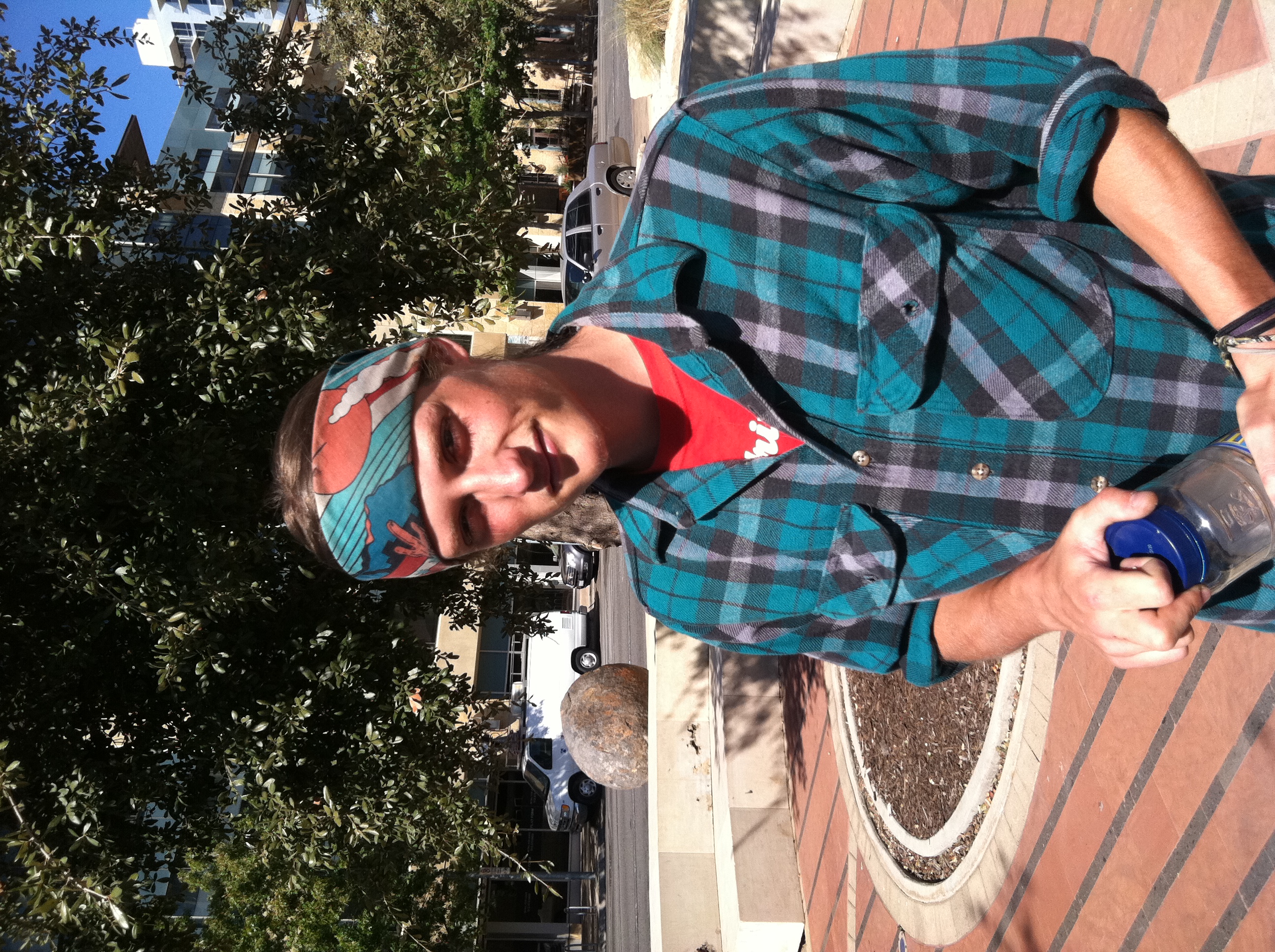
When I first walked up, I saw a young man on his hands and knees on the mulch around a tree at City Hall. His name is Brighton, and he was picking up cigarette butts and putting them into a plastic soda bottle. He’s been part of Occupy Austin since Day 1.

Brighton

Occupy Austin is a home-grown encampment, and the occupiers make it work. One of their efforts is aimed towards keeping it clean. Brighton took this task on himself. I’m sure some of the butts were there long before Occupy Austin, so he’s doing the city (and us) a favor by cleaning it up.

He’s 20. He worked at a pizza company for a couple of years. He made minimum wage. There was no hope for a raise or advancement because of the economy, and he had no hope of continuing his education or getting other training. That’s why he’s part of OA. He’d like to see some change.

Brighton told me that some of the homeless people in Austin now go to City Hall to eat and sleep along with the occupiers, because food and shelter exist there. Occupy Austin has received a lot of donations of food, other goods, and financial support. He said the homeless don’t take part in the decision-making. It’s not that they weren’t asked — they mostly choose to leave and hang out elsewhere except for meals and sleeping. The OA people are a peaceful self-governing community, and they recognize that the homeless are part of the 99% like them, and so they include them.

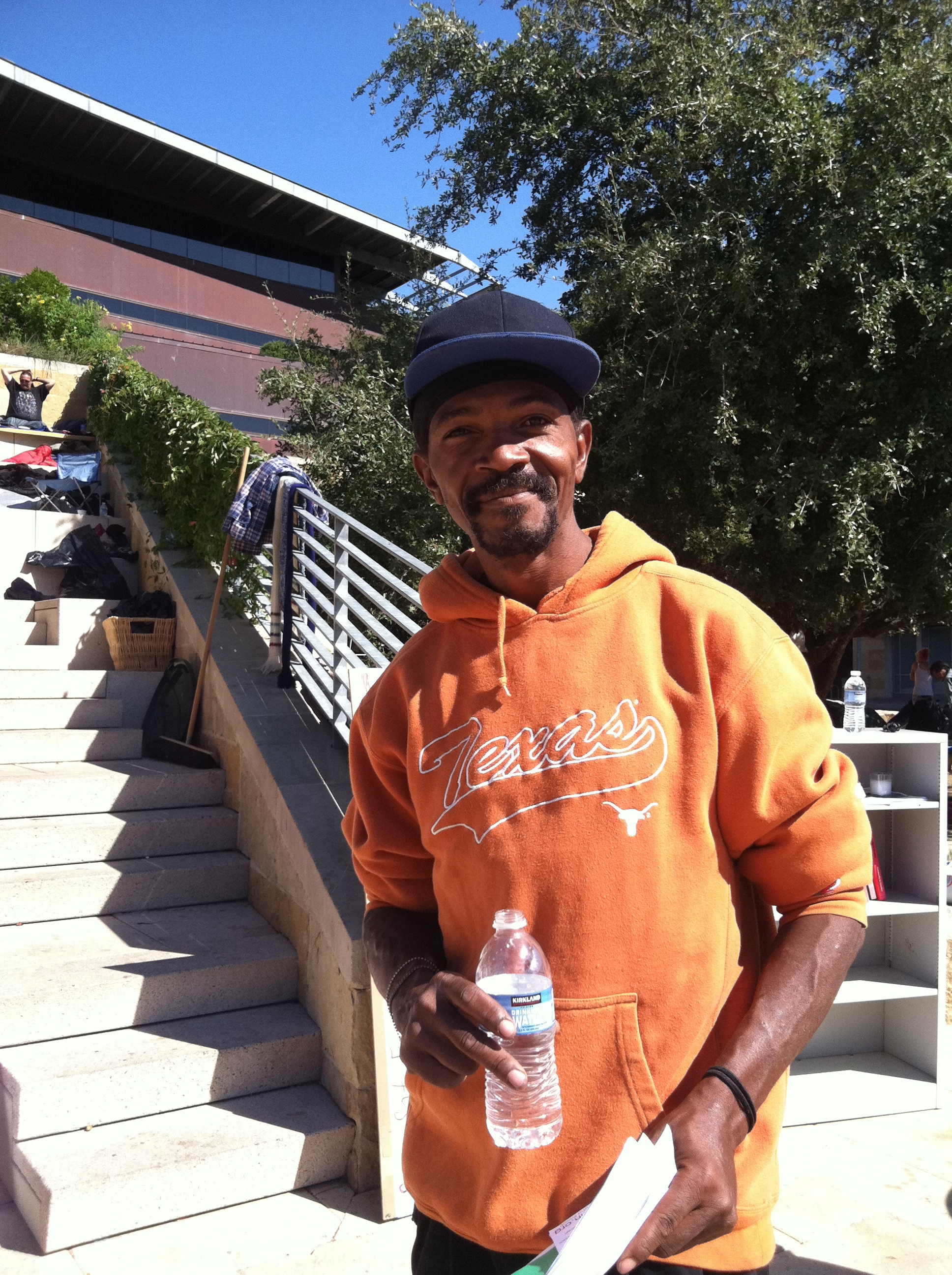
William

I encountered William, who had taken on the job of handing out literature. He gave me some flyers and handouts containing the following kinds of information:

          • Occupy Austin mission statement (solidarity with Occupy Wall Street, nonviolently reclaiming control of governments from the financial interests that have corrupted them, the people are the supreme authority)
          • Occupy Wall Street mission statement (leaderless resistance movement of the 99% not tolerating greed and corruption of the 1%, commitment to nonviolence)
          • Occupy Austin goals and demands (true democracy, economic security, corporate responsibility, and tax reform)
  • Occupy Austin core values (resisting corruption, not becoming a political institution, nonviolence/civil disobedience if needed, and solidarity with the national movement).
  • Occupyradioaustin is the first 24/7 online radio broadcast of the Occupy movement. Anyone can record his or her occupy or 99% story for broadcast through their website. On Twitter, it’s #occupyradioatx.
  • To donate supplies, go to 5011 E. Cesar Chavez.
  • Follow Occupy Austin on Twitter at #OccupyAustin.
  • Friend Occupy Austin  on Facebook.

Click the links to read more, if you like, about Occupy Austin and Occupy Wall Street.

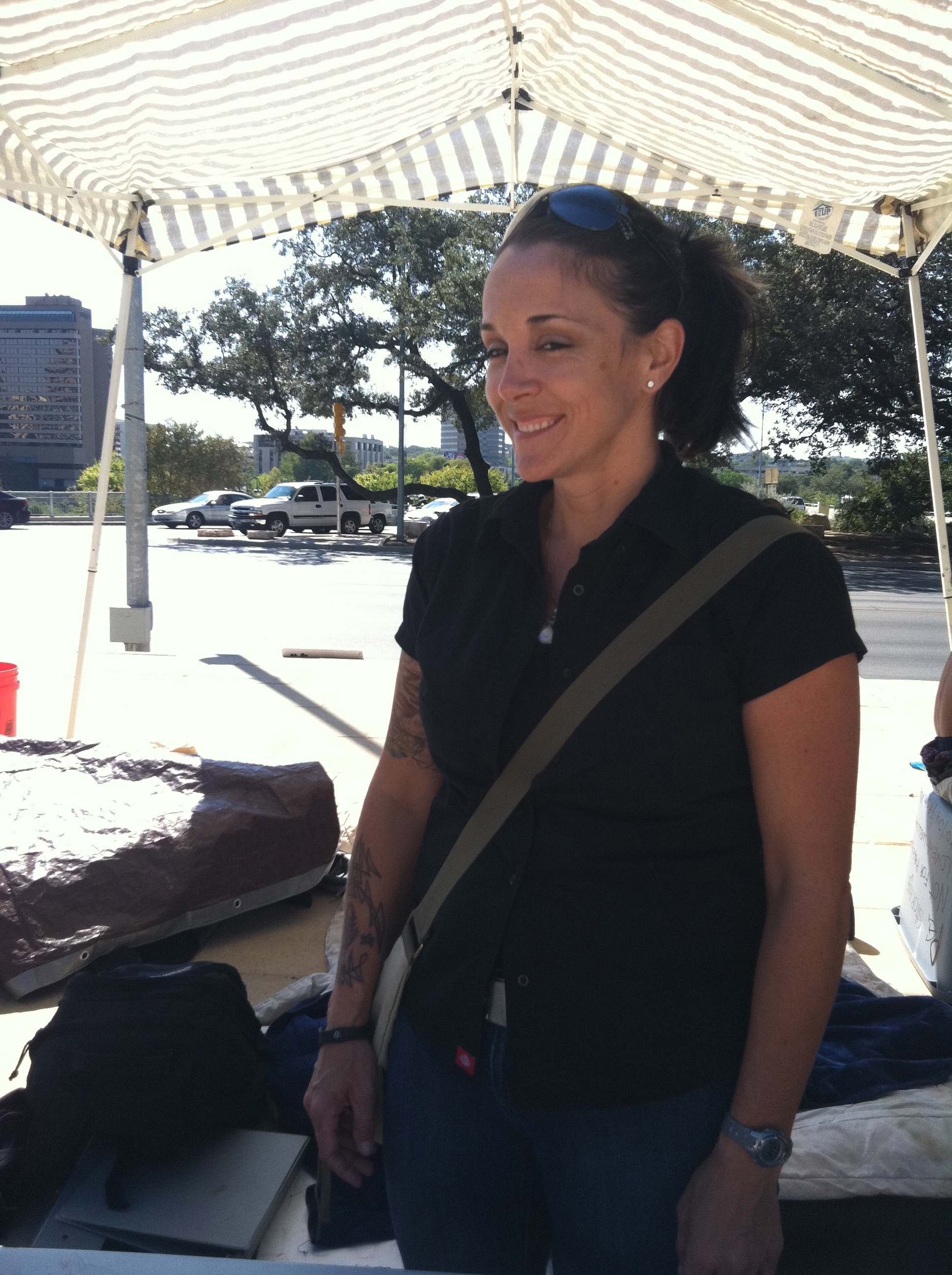
Josie

The next person I conversed with was Josie, who was sitting at the Information Desk. She is not a camper but a volunteer who comes in and works for the movement.

She seemed to me to be a very friendly, articulate, capable young woman. The information table had some of the same flyers that William gave me and more. It was a place anyone could go with questions.

Also, she was interested in why I was there, and she gave me a hug!

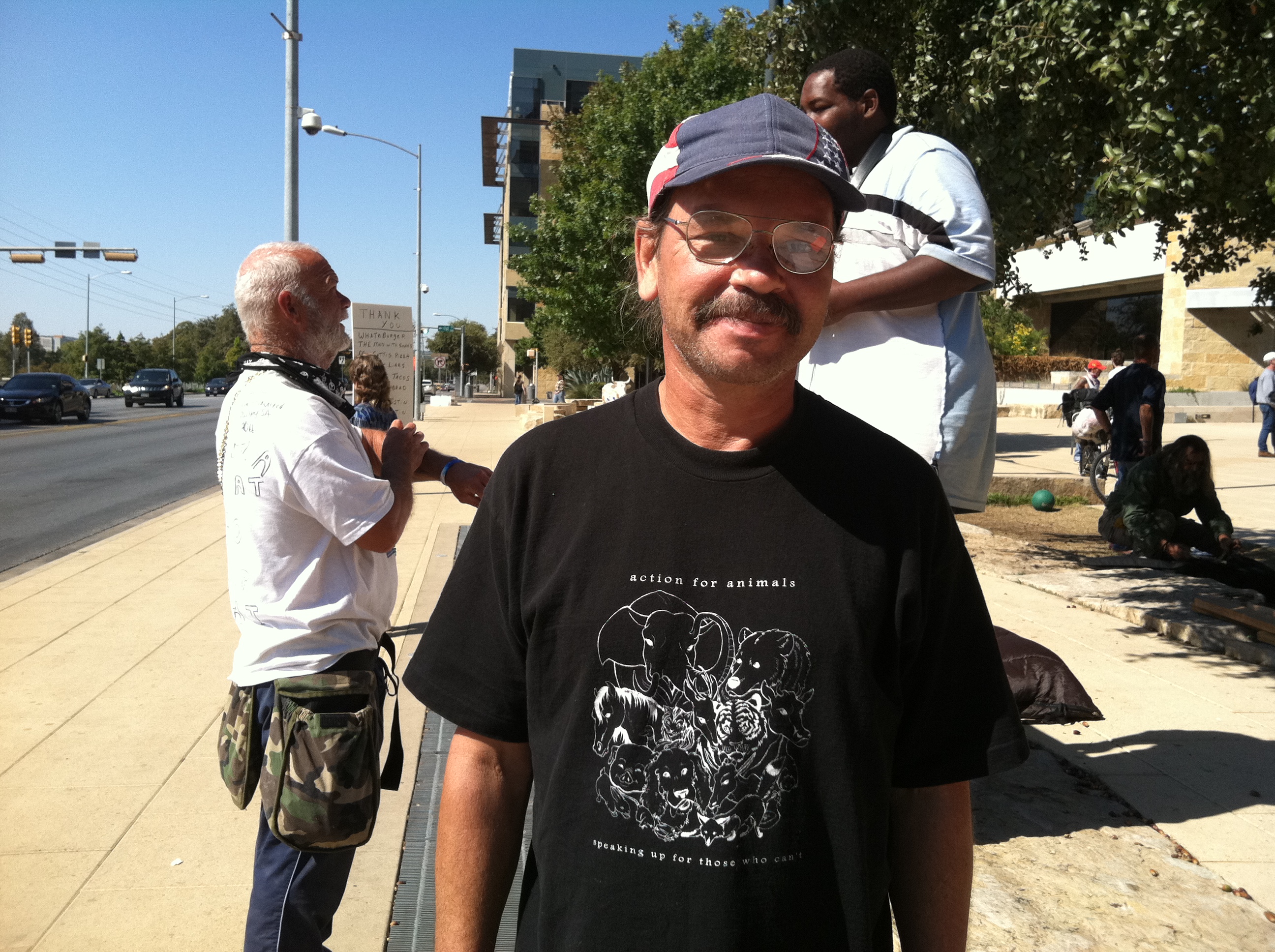
I talked to Larry Singleton, who was carrying a flag. Larry is a veteran, and he is homeless. He has a dream of getting funding for a new facility to serve the homeless. He says that God put him there at Occupy Austin, that he is dying (I think he said of emphysema), and that he is doing this so he can die knowing he made a difference.

Larry

Larry’s sign says “WE WON by faith.” I asked him what that was about. He said, “We won last night.”

I thought he was talking about the World Series game last night.

My mistake! He said that Occupy Austin won last night. I’m not sure I understood exactly why, but it may be related to an Occupy Austin march held in solidarity with the Occupy Oakland and Occupy Atlanta groups who have encountered some pretty awful police brutality.

Larry is profiled on an awesome blog that he steered me to. Check out the post for Occupy Austin Day 9.
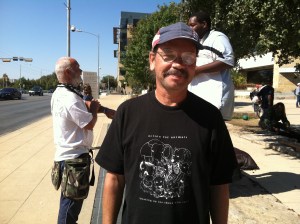
Joseph

Joseph Ryder has been on the plaza for eight days and five nights. Joseph said he was there because of his anger about the bailout of the big banks, who use their money to buy politicians so they can do whatever they want. (I’m paraphrasing, but you get the gist.)

Joseph was a friendly guy. I left to eat and came back later, and he remembered me and kidded, “You still around?”

It was Joseph who told me that Black Swan Yoga has been offering regular yoga classes on the plaza. That rocks.
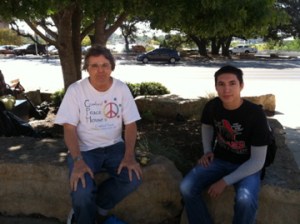
Ken and Jonathan

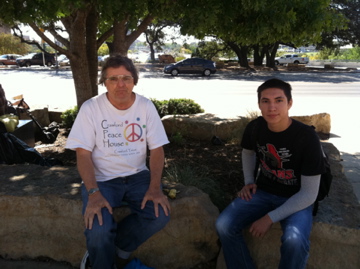
I talked to a couple of guys sitting on one of the low rock walls that are so user-friendly at City Hall. Ken and Jonathan, an older man and a younger man, were having one of those free-ranging conversations that I couldn’t help but overhear as I sat nearby checking my iPhone. (I could swear that I saw a call from Nelson Guda come in for just a second, then lost it. That would be weird and cool, since he’s in Rwanda photographing mixed marriages between Hutus and Tutsis for his Enemies project, and we do more Facebook communication, not phone, usually.)

Ken remembers a lot of history about freedom movements in the U.S. He described himself as an old hippie. Jonathan had come down to the plaza for the first time today, like me. Their conversation was lively, and it was lovely to overhear two generations meeting like this.
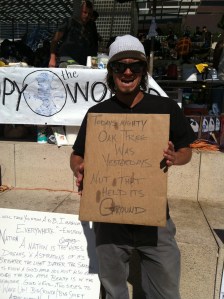
Diedrich

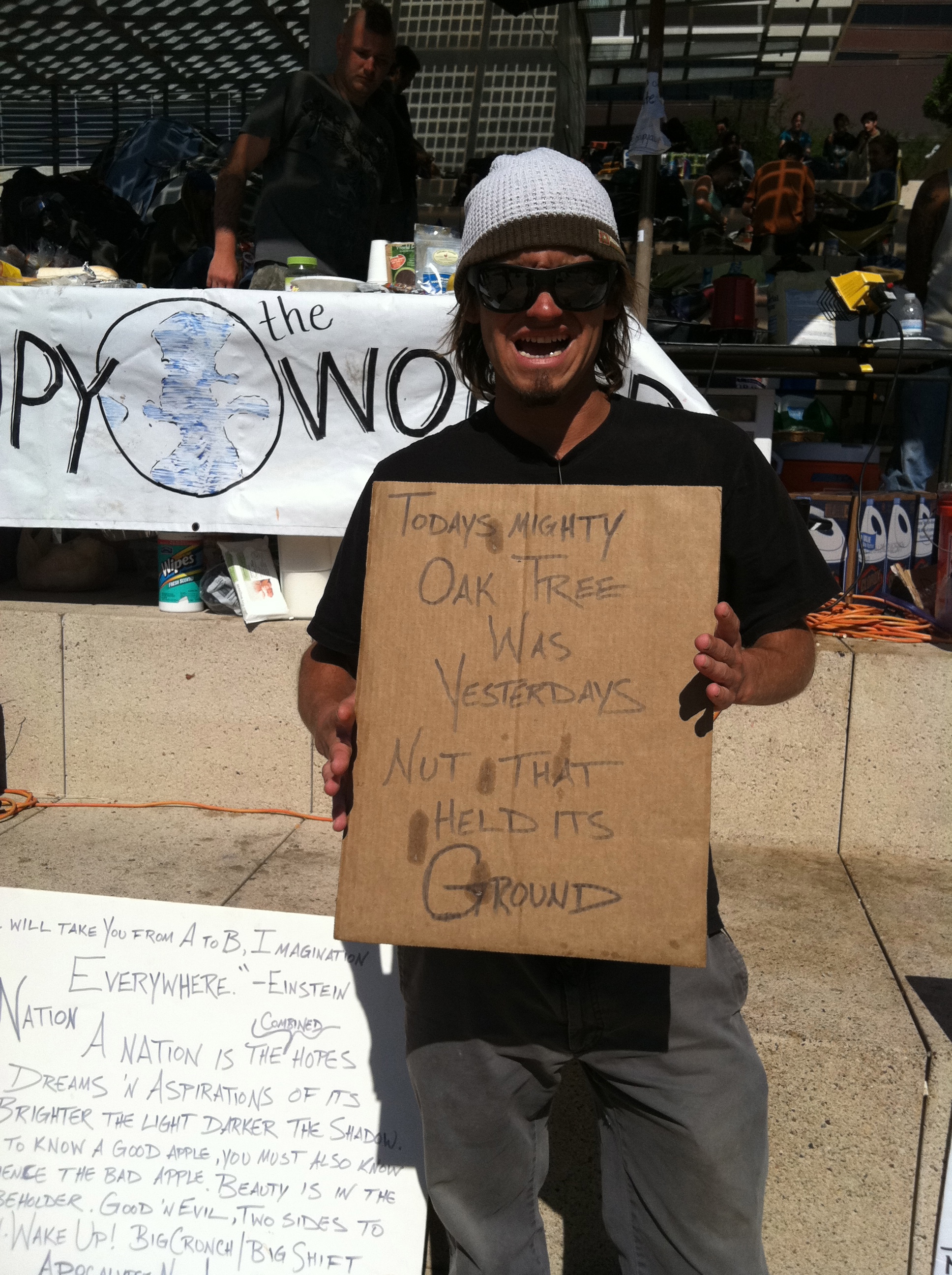
Diedrich Holgate is an affable fun guy who seems to be enjoying being part of this movement immensely. Diedrich said his dad is a local defense attorney. Diedrich and his dad do not see eye-to-eye about this.

Apparently Diedrich has had some run-ins with authority figures (something like that, didn’t get the details), but he came across to me as basically trustworthy. He made his own sign, which says:

Today’s mighty oak tree was yesterday’s nut that held its ground.

Somehow I feel that that is a statement about Diedrich’s own future. I see him becoming a mighty oak of a man. This Occupy experience will be talked about in decades to come.

Bathroom guard

Diedrich showed me where the bathroom was (not a porta-potty but a regular bathroom in the City Hall building accessible from the plaza). He said there had been problems with people tagging it, writing graffiti in there. A young woman occupier took it on herself to sit near the bathroom and monitor it (with warning signs that that was happening) after each person visited it so that if anyone left it less than clean or tagged, that person would be held accountable. The self-monitoring encampment polices itself.

I apologize, but I forgot to write down her name (it might have been Lisa), but here’s her photo.

Speaking of the police, there was an APD car parked next to the encampment. The police officer stayed inside the car while I was there. Several of the protesters told me that one of their goals was to not need police intervention — to solve problems themselves. I thought they were doing a good job of that. They said there had been a learning curve.
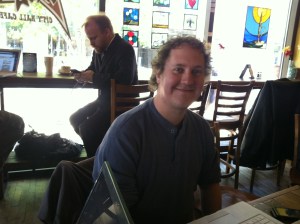
Brandon

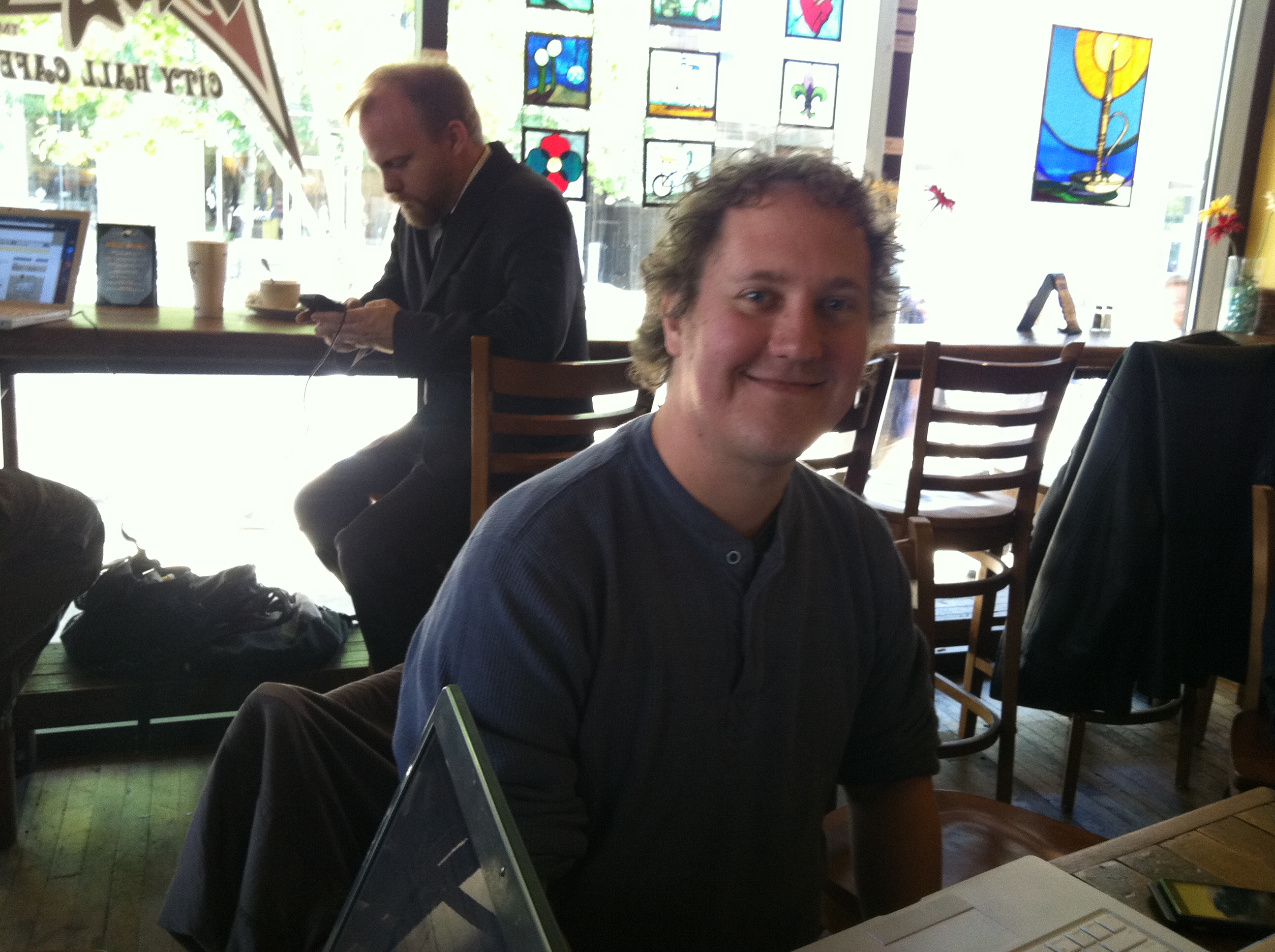
The next-to-the-last person I talked to was Brandon, who was sitting at a table with six or seven others in Austin Java at City Hall., where I went when I needed a break

All of them had laptops. My kind of people! I sometimes go nerding with friends, but usually it’s just one or two of us, and we have Macs. This group was mostly young and male, some of the awesome hardcore geeks who have been like rock stars to the programmers at some of the places I’ve worked as a technical writer. There was a lot of computing power around that table, and I’m not talking about the equipment.

I couldn’t help but be curious about whether they were just a random group of geeks meeting at Austin Java or whether they were associated with Occupy Austin. It turned out to be the latter. They are one of several geek squads working with Occupy Austin. Brandon was working on Occupy Apps, working on an application that would allow people to stay networked if the system went down when too many people got on. I’m sure there’s some other pretty cool stuff being worked on there, and that their work benefits all the Occupy movements around the country and the world. We live in a geeky town, and I’m glad they’re participating and using their skills to create better democracies.
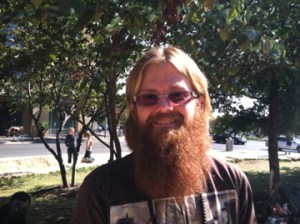
Eric

The last person I talked to was Eric Towler, a friend whom I first met at Appamada Zen Center last year, where we were both attendees of Sunday services. Eric has posted on the Appamada list about Occupy Austin before, so I wasn’t surprised at all to see him there. He’s been there several times and is contemplating doing some teaching about Zen in this community.

It was just lovely to bump into him and experience his peaceful, compassionate vitality and his interest in connecting Zen with real people and real problems.

The whole time I was there, people ebbed and flowed. I ran into Grace, whom I used to do yoga with. She had brought her neighbors there for the first time. Some people just came and held up signs along Cesar Chavez. There was a tent full of signs, and anyone could get a sign and stand on the street. Lots of cars honked and people gave the peace sign and yelled messages of support to the protesters.

Having fun

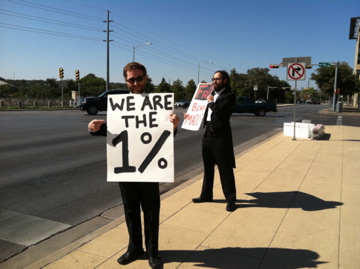
There was even some humor amid the earnestness. First three young men in tuxedos or tails, later joined by a young woman in an evening gown and the most awesome heels, stood along Cesar Chavez with signs that said “Free Bernie Madoff,” “We Are the 1%,” “What’s Best for Corporations is Best for Me!” and “Get a Job.”

They weren’t part of the regular Occupy Austin crowd, and some of the regulars were a bit suspicious of them, thinking they might be counter-protesters, but mostly they left them alone.

Halloween fun

I talked to them. They were just having some Halloween fun in the spirit of Abbie Hoffman and the Merry Pranksters. They recognized those names, which was heartening to me that the tradition of spicing social activism with some humor has not been lost.

These were probably their Halloween costumes.

What Kind of Buddhist was Steve Jobs, Really? | NeuroTribes

What Kind of Buddhist was Steve Jobs, Really? | NeuroTribes.

Great article by Steve Silberman (I have subscribed to his blog and follow him on Twitter — great find). I like reading about Steve Jobs, but even better is this simple, clear description of why we meditate:

Why would a former phone phreak who perseverated over the design of motherboards be interested in doing that? Using the mind to watch the mind, and ultimately to change how the mind works, is known in cognitive psychology as metacognition. Beneath the poetic cultural trappings of Buddhism, what intensive meditation offers to long-term practitioners is a kind of metacognitive hack of the human operating system (a metaphor that probably crossed Jobs’ mind at some point.) Sitting zazen offered Jobs a practical technique for upgrading the motherboard in his head.

The classic Buddhist image of this hack is that thoughts are like clouds passing through a spacious blue sky. All your life, you’ve been convinced that this succession of clouds comprises a stable, enduring identity — a “self.” But Buddhists believe this self this is an illusion that causes unnecessary suffering as you inevitably face change, loss, disease, old age, and death. One aim of practice is to reveal the gaps or discontinuities — the glimpses of blue sky —between the thoughts, so you’re not so taken in by the illusion, but instead learn to identify with the panoramic awareness in which the clouds arise and disappear.