Okay, so who REALLY wrote Texas SB5/HB2? Not a Texan.

Here’s why I say that:

  1. Screen Shot 2013-07-07 at 10.34.47 PMThe legislator reputed to be the bill’s author, Rep. Jodie “Rape Kits Clean Women Out” Laubenberg, R-Collin County, struggled when reading the bill aloud, stumbling over the words referring to parts of female anatomy (surprise surprise, she probably got her sex education in Republican-controlled Texas), according to a witness. When you write something, you have to read the words as you put them together. You don’t stumble on words you wrote.  Jodie, you have learned what “cleaning women out” after a rape is actually called, haven’t you?
  2.  A letter from my own state rep Paul Workman bore a red flag. It’s part of the spiel that those who support this bill have cited as justification, that holding abortion clinics to the standards of ambulatory surgical centers protects women’s health. The fact is that abortion clinics are safer. This bill has now been introduced three times, in the regular session and in two special sessions. Only last week was any testimony actually given by someone who works for the Texas Department of State Health Services. The DSHS Health Facility Licensing Manager said that Texas abortion clinics are inspected every year, while ambulatory surgical centers are inspected every three years. Abortion clinics are safer.
  3. Laubenberg is the Texas chair of the American Legislative Exchange Council (ALEC), the right-wing policy group based in Washington, DC. ALEC produces right-wing legislation for states.

Texas Republicans, it’s a bad bill, and it’s not even Texan. Don’t pass it.

Brainwave optimization follow-up, two years later

I received a phone call yesterday from someone who had read my original post about receiving brainwave optimization. Barbara in Houston was considering it. She’d read this blog and wanted to hear some follow-up. We had a nice long conversation, and I felt inspired by her courage.

This month marks two years since I underwent brainwave optimization — five days of twice-daily sessions designed to help my brain function better using biofeedback.

I have no regrets about doing it. I’m glad I took that leap of faith.

Of course it’s impossible to say how I might be different had I not received it. It’s also impossible to separate the BWO from the meditation, diet, yoga, and other work I’ve done. (I still think BWO is probably the equivalent of five years of daily meditation.)

What I can say is that when I compare how I experience myself now and how I experienced myself then, now is better. I feel more myself — I occupy my body and my life more fully and with more pleasure and serenity and depth and wholeness than I did before. I make better decisions. I am happier.

One of my reasons for doing it was that I had experienced trauma in my childhood that plagued me with ill effects for decades. Facing the trauma, healing and integrating it were turning points toward health in my life. I wanted to see if brainwave optimization could relieve me from any more dysfunctional patterns that might remain.

Last year, a year after undergoing BWO, I did get triggered by someone who didn’t recognize the extent of his own traumatic experiences and was unable to communicate responsibly about it. I experienced the flood of stress hormones and adrenal exhaustion that went along with being triggered.

The useful part of that experience was being able to witness how those stress hormones affected my thinking. I got a clear sense of what I’m like unaffected by trauma and what I’m like after being triggered. Day and night. Equanimity vs. fear and anger. Sunshine and butterflies vs. creepy shadows with hidden monsters.

The unpleasant part was that it took months to completely clear the effects of the cascade of stress hormones and return to robust, excellent well-being. During this time, I forgot that I could have gotten follow-up sessions of brainwave optimization, which are much less expensive than the initial assessment and 10 sessions.

In hindsight, it would have been really smart of me to experience just enough of being triggered to learn its lessons and then to shorten my suffering by going in for some follow-up work. I don’t know if it would have worked, but I believe that it would have made a difference, because when you make an effort on behalf of your own well-being, that commitment to action makes a big difference and amplifies the measures you choose to take. 

I regret now that it did not occur to me to do that.

It’s clear to me now that undergoing BWO does not give someone who’s experienced trauma a bulletproof vest against being further traumatized or being triggered. It does give you more resilience, because experiencing wholeness is so desirable. The brain is aware of its own well-being and likes it and will return to it as soon as it can. That’s a big part of how BWO works, in my understanding.

If you’re not sure your brain has experienced well-being because of past trauma, or if it’s been so long it’s hard to remember what well-being was like, I recommend getting brainwave optimization. It can’t hurt, and if it doesn’t help in the way you think it might, then at the least you’ve ruled something out on your path to recovery. You have not left that stone unturned.

And it might help in ways you haven’t thought of, so please be open to that. It’s hard to describe well-being if you’ve never experienced it. It’s hard to know what to expect before you do it.

Also, the brainwave changes keep happening for a long time after you finish the treatments. Hold your story lightly and keep a journal. I have been told by people who’ve known me for awhile that I’ve changed for the better more than anyone they know.

I also take the Buddha’s Brain supplements to support my post-BWO brain health, and I recommend that.

This is water.

Here’s a video made about a  commencement speech, about the banality that is the water we swim in in our modern daily lives, and where our freedom truly lies.

The capital T Truth is about life before death. It is about the real value of a real education, which has almost nothing to do with knowledge and everything to do with simple awareness, awareness of what is so real and essential, so hidden in plain sight all around us all the time, that we have to keep reminding ourselves over and over, “This is water. This is water.”

Anne Lamott on how to become yourself

lamottI love Anne Lamott. I follow her on Twitter (oh, my, she’s fierce and funny!) and have read her wonderful Bird by Bird: Some Instructions on Writing and Life and other books. She’s open about being a screwed-up human being, and she has a lot of wisdom to share and the writing skills to convey it truthfully, with humor.

Somehow I stumbled upon a post she’d written for O, The Oprah Magazine (does anyone ever say, “I got my copy of O in the mail”?), that I want to share.

Excerpts:

We begin to find and become ourselves when we notice how we are already found, already truly, entirely, wildly, messily, marvelously who we were born to be. The only problem is that there is also so much other stuff, typically fixations with how people perceive us, how to get more of the things that we think will make us happy, and with keeping our weight down. So the real issue is how do we gently stop being who we aren’t? How do we relieve ourselves of the false fronts of people-pleasing and affectation, the obsessive need for power and security, the backpack of old pain, and the psychic Spanx that keeps us smaller and contained?…

I had to stop living unconsciously, as if I had all the time in the world. The love and good and the wild and the peace and creation that are you will reveal themselves, but it is harder when they have to catch up to you in roadrunner mode. So one day I did stop. I began consciously to break the rules I learned in childhood…

Dealing with your rage and grief will give you life. That is both the good news and the bad news: The solution is at hand. Wherever the great dilemma exists is where the great growth is, too. It would be very nice for nervous types like me if things were black-and-white, and you could tell where one thing ended and the next thing began, but as Einstein taught us, everything in the future and the past is right here now. There’s always something ending and something beginning. Yet in the very center is the truth of your spiritual identity: is you. Fabulous, hilarious, darling, screwed-up you.

Actually, not on purpose, I’ve left out the funniest parts! Read more and enjoy: http://www.oprah.com/spirit/How-To-Find-Out-Who-You-Really-Are-by-Anne-Lamott/

Pay-what-you-wish days and massage email list

I occasionally offer pay-what-you-wish Ashiatsu days. If you haven’t experienced pay-what-you-wish bodywork, you balance what you can afford with the value you receive.

This allows people with irregular income or suffering a temporary financial setback to get the attention they need when they need it — and often the increase in well-being receiving bodywork helps the money energy start flowing favorably again.

I do appreciate your positive word-of-mouth, glowing written testimonials ;-), and referrals as forms of reciprocity. And if you can afford to pay extra to help subsidize someone else, fantastic. Otherwise, you can pay it forward.

Pay-what-you-wish sessions average about $50 per hour, if you’re curious about that, and they’ve ranged from $20 to $100 per hour.

And if the whole idea disturbs you, you can always pay my regular rate of $65 per hour.

To find out when I schedule pay-what-you-wish days, please send me an email request (mareynolds27 at gmail dot com) to be added to my massage email list. I send no more than one email per month.

For more about The Well Ashiatsu Barefoot Massage Austin, see my home page.

Two remedies for muscle pain that everyone should know about: arnica and epsom salt

A marathon took place this past Sunday in Austin, Texas, and I’ve seen a few runners who came in for massages. It surprises me that so many runners, triathletes, bicyclists, and people who work out are unaware of two over-the-counter remedies that are very effective at relieving muscle pain. Hence this blog post!

It’s not that I don’t want to see you on the massage table. I do. Massage has great benefits, including pain relief. But it’s like this: Very few people can afford to get massage every time they work their muscles hard enough that they feel pain afterwards. Wouldn’t that be nice, though?

In between massages, here’s how you can find relief from muscle pain. These are remedies professional athletes, dancers, and others who work their bodies hard use. I first learned about them 20 years ago while attending a dance workshop.

Arnica gel and tabletsarnicagel

Arnica montana is an herb that grows in Europe. The homeopathic pharmaceutical industry sells an arnica gel that you can apply to your skin to relieve pain. It’s clear, goes on cool, has no odor, and once it dries, you can’t tell it’s there.

You can also get arnica cream, which blends more easily with lotion or creamy sunscreen.

Arnica relieves muscles aches and stiffness, reduces swelling, and prevents bruising. It relieves osteoarthritis pain as well as ibuprofen, without any side effects. I always have it available when I’m doing massage, to apply to bruises and to extremely sore, stiff, or swollen muscles.
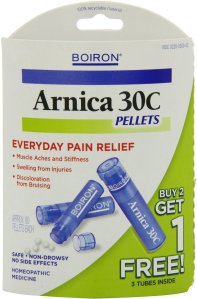
arnicapelletsIf you’re more adventurous, you can take arnica tablets. There’s a little trick to dispensing the tablets: twist the lid to loosen. Hold the container upside down and twist it, keeping the lid stable. Pellets will fall into the lid one at a time. When you’ve released 5 pellets, remove the lid from the container and empty the lid under your tongue. Let the pellets melt in your mouth.

If you know you will be doing something where you’ll be in pain afterwards, like lifting heavy boxes, gardening, getting Rolfed, hiking with a heavy pack, etc., take the tablets beforehand to prevent or lessen pain, or take it afterwards for whole-body relief.

Where to get arnica

Here’s the tricky part. People “in the know” like athletes and dancers use arnica, but the makers don’t advertise (as far as I know), so others tend to learn about arnica via word of mouth. To buy it, you need to go to a store that sells homeopathic medicines. Ordinary drug stores and groceries typically do not (although that may be changing), but compounding pharmacies and health food stores (including Whole Foods and Sprouts) do. If it’s not available where you live, you can buy it online.

Note: You may have heard people say homeopathy doesn’t work. If you’re skeptical, try this: The next time you feel muscle pain equally on both sides of your body, apply arnica to one side and do nothing to the other side. Wait a few hours or overnight and note the difference. Or you could apply it to half a bruise and see what happens.

Epsom salt baths

My second recommendation for muscle pain is taking epsom salt baths. Epsom salt (magnesium sulfate) is a mineral made from sea water that looks like rock salt. It has several uses, including taking internally to relieve constipation (taking too much orally can cause diarrhea) and fertilizing plants.

Fortunately, the body absorbs magnesium really well through the skin, and there are no adverse side-effects.

epsomsaltThe best use for sore bodies is to add two cups of epsom salt to a warm or hot bath and soak in it for 12-20 minutes. Swish the water until the epsom salt dissolves. If I take an epsom salt bath in the evening, it calms me and I sleep like a baby.

Epsom salt eases muscle cramps, pain, and inflammation. It reduces insomnia and anxiety. It pulls toxins out of cells, softens skin, improves blood circulation and oxygen use, increases the effectiveness of insulin, aids in nutrient absorption, lowers blood pressure, and relieves migraines and cold/flu symptoms.

Most of us are deficient in magnesium. Stress (including muscle overuse) depletes magnesium, and depleted magnesium creates stress, so it’s easy to get stuck in magnesium depletion.

I believe magnesium is the new Vitamin D because most of us don’t know we’re deficient, and once the deficiency is remedied, well-being increases.

I’m not the only one that thinks so.

According to the National Academy of Sciences, American’s magnesium deficiency helps to account for high rates of heart disease, stroke, osteoporosis, arthritis and joint pain, digestive maladies, stress-related illnesses, chronic fatigue and a number of other ailments.

The other component of epsom salt, sulfate aids joint health, improves absorption of nutrients, strengthens the gut lining, forms healthy brain tissue, and plays an essential role in detoxing. It may ease or prevent the pain of migraines.

If you think you might be deficient, take 2-3 epsom salt baths a week for a month. Once the blood levels reach optimum level, you stop absorbing it, so it’s safe.

Where to buy epsom salt

You can buy plain epsom salt at mainstream grocery stores and pharmacies. I bought a 4 pound bag from the Texas grocery chain H-E-B for $2.86. Four pounds makes 8 cups, so using two cups per bath, a bag provides enough for four baths at $.71 per bath.

Think about it: For a little over $2 per week, you could sleep like a baby, ease sore muscles, detoxify your body, improve digestion, lower blood pressure, and increase your feeling of well-being!

Bonus: You can reuse the bath water as a plant fertilizer! Epsom salt is often used to fertilize tomato and pepper plants as well as rose bushes. My bathtub drains into a hose that I can move around outside so various plants get the benefit of this fertilizer.

Also, you may see epsom salt sold in smaller quantities that’s had fragrant essential oils added. It’s usually marked up quite a bit. If you’re frugally experimental like me, you’ll want to get the plain generic epsom salt and experiment with adding your own fragrance.

For relaxation, add lavender, chamomile, frankincense, sandalwood, patchouli, or florals like rose, jasmine, neroli, geranium. To stimulate your energy, add citrus scents, mint, ginger, cinnamon, or rosemary. Put the scented epsom salt into pretty jars, tie with ribbons, and give as gifts.

Quote: Finding your spiritual home

From Martha Beck’s Daily Inspirations:

Many people take umbrage when someone sets out to find his or her spiritual home. If you embark on a similar journey, you should expect some people to be shocked, to be angry, to tell you you’re breaking the rules. That has certainly been my experience. However, the rewards are inexpressibly wonderful. Heading towards that inner home will take you places—both inside yourself and in the external world—which your heart will recognize as its native environment, even though you have never been there before. I would go so far as to say that this may be the purpose for human life; that we are set free into a lonely universe like homing pigeons meant to find our way back to joy.

I just love this lady. She’s incredibly wise and insightful.

The 4 Noble Truths, simplified

I’ve forgotten where I first encountered this, but here it is, an update on the four noble truths of Buddhism. It may seem humorous, but it also seems apt:

(1) Life sucks.

(2) Get over it.

(3) That means, get over yourself.

(4) Now, move on.

The value of confession is that it softens us

Aside

Dzigar Kongtrul Rinpoche (one of Pema Chodron’s teachers) writes:

The gap between ourselves and the Buddhas and Bodhisattvas exists because of our own denial, that could not be penetrated by any blessings. But that denial comes from and covers, deep down, a lack of harmony with oneself, a conflict inside, between how things are and how they appear. Having these two in harmony is enlightenment. As we confess, we feel the lack of the aggression and rejection that underlies our denial. A little white light opens up in our being that one day can expand to the vastness of the sky. We can avail ourselves of help from which we were previously blocked. This is why honest and intelligent confession practice is so valued by many religious traditions.

Leaning into 2013: how to make meditation a near-daily pleasure.

I’ve been thinking a lot this December about what changes I’d like to make in 2013.

In the past, I usually didn’t think much about it at all, and when I did, my thoughts on the matter all took place in the last week of the year, after Christmas.

Unfortunately, my New Year resolutions were usually short-lived.

I’d like to change that. I’d like to become more disciplined, and I’d like to be realistic about what that means so I can actually make lasting changes in my life.

The problem is, I like to rebel against “the rules”, so when I set up strict rules for myself, I am setting myself up to break them. It’s counterproductive.

I spent a year meditating for 30 minutes nearly every day, and when that year was up, I rebelled and didn’t meditate every day any more. My sitting practice became sporadic.

I’d like to figure out a way to make meditation a pleasure.

One possibility: Instead of creating a rule to meditate for 30 minutes every day, I can meditate for at least 15 minutes 5 out of 7 days.

I like that flexibility. However, it still sounds like a chore. Why am I making meditation such a joyless task to be done somewhat regularly and checked off a list?

Looking at what keeps me from meditating: I often allow myself to get sucked into reading email and checking Facebook, my online massage booking site, Twitter, Tumblr, blog stats, and so on in the morning, and before I know it, it’s time to get ready for work, and I haven’t meditated.

And…if I don’t meditate in the morning, it usually doesn’t happen.

I don’t know why this is, except perhaps that it takes more effort to do nothing than you’d think, to tear myself away from my laptop and sit myself down on the cushion.

Once I start sitting, I actually love meditation. I love getting really present with myself, breathing, hearing, seeing (if my eyes are open), feeling my body, witnessing my thoughts, noticing my chakras open, experiencing the silent stillness that contains everything, even just feeling the little aches, pains, and tensions as I sit.

To experience this is a joy that keeps on giving throughout the day, somehow connecting me with resources that help me meet life with more equanimity and love, including self-love, than I could otherwise summon.

How can I make this a pleasure? It’s so much more rewarding than being online in terms of enhancing my well-being and the quality of my life, relationships, activities, decisions!

What if…I stay offline until I’ve meditated, and I make it my goal to meditate no longer than an hour, except when I really want to (and have time) to go longer? I can set the timer for an hour, end it then or when it seems complete, and be happy about it all.

Now we’re cooking!