The dancing genes, sociability, transcendence, and genetic flexibility

A recent article published online says that dancers are genetically different. Some Israeli researchers found that dancers show consistent differences from the general population in two genes.

The researchers said this did not surprise them, because studies have found that athletes and musicians have genetic differences.

I can only speak for myself, but my dance is very connected to music — my movement is a way to participate musically, as if I were playing an instrument. It’s also very physical.

I did a little Googling to see if I could find which specific genes differ in athletes and musicians, but I didn’t find anything that was very clear. Race seems to be the biggest issue in the media when it comes to genetics, athletes, and musicians.

The researchers studied dancers and advanced dance students and found they had variants in two genes, those affecting serotonin transport and arginine vasopressin reception.

Serotonin (“the happiness molecule”) is a neurotransmitter that contributes to spiritual experience — the capacity for transcendence and a proclivity to spiritual acceptance. (See this Psychology Today article for more about that.) It also affects optimism, the healing of wounds, resilience from stress, metabolism, sleep, and more.

“Serotonin transport” sounds like a dance inside the body!

Interestingly, exercise can raise serotonin levels in the body, so dancing itself reinforces dancers’ high serotonin levels!

I admit — I get into an altered state from ecstatic dance. That’s why they call it ecstatic dance, I suspect. 😉

The vasopressin receptor modulates social communication and affiliative bonding. Wikipedia says “…accumulating evidence suggests it plays an important role in social behavior, bonding, and maternal responses to stress.” It has a very similar structure to oxytocin (“the love hormone”), and the two can cross-react.

When the results were combined and analyzed, it was clearly shown that the dancers exhibited particular genetic and personality characteristics that were not found in the other two groups.

The dancer “type,” says Ebstein, clearly demonstrates qualities that are not necessarily lacking but are not expressed as strongly in other people: a heightened sense of communication, often of a symbolic and ceremonial nature, and a strong spiritual personality trait.

I know this is controversial, but I want to weigh in on the side of flexibility when it comes to genetics. For much of my life, genes were thought to be destiny, unalterable. Now it is known that the expression of genes is much more dynamic than previously believed. They can switch on and off.

I don’t know that much about it, except that stress tends to switch on the bad genes. I don’t know which or how many genes truly create destiny and therefore cannot be influenced, except that there probably are some. We just don’t know enough about this in our current level of understanding.

I want to encourage people who believe they don’t have the dancing genes to give dancing a try.

Two left feet? That’s a myth. If you can walk, you have rhythm and coordination.

If you think you can’t dance, try just moving to some music alone in your own home if you feel self-conscious. Play something catchy, like “I Heard It Through the Grapevine.”

Start simple, just swaying your hips to the beat, keeping your feet in place. Do you like it? Do you feel any sense of pleasure? Play with it. Add your arms. Walk to it. Make it fun and goofy!

Those dancing genes may be just sitting there waiting to be activated, for all we know, and they might help you become happier.
If inflammation is the culprit behind autism, heart disease, and more, the cure is to get parasites and eat real food

Tonight I read two articles that each blamed inflammation for serious health issues.

One, by a world-renowned heart surgeon, said that the medical profession got it wrong when it began advocating a low-fat diet to control cholesterol. It is now known that inflammation in the artery wall is the real cause of heart disease. More people will die from heart disease this year than ever. The low-fat diet doesn’t work.

And…the dietary recommendations for lowering cholesterol are responsible for the high rates of diabetes and the obesity epidemic.

Only inflammation of artery walls causes cholesterol buildup. It has nothing to do with a low-fat diet.

The biggest culprits in inflammation, according to Dr. Lundell, are highly processed carbohydrates like sugar and flour and an excess consumption of omega 6 oils like soybean, corn, and sunflower.

There is no escaping the fact that the more we consume prepared and processed foods, the more we trip the inflammation switch little by little each day. The human body cannot process, nor was it designed to consume, foods packed with sugars and soaked in omega-6 oils.

There is but one answer to quieting inflammation, and that is returning to foods closer to their natural state. To build muscle, eat more protein. Choose carbohydrates that are very complex such as colorful fruits and vegetables. Cut down on or eliminate inflammation-causing omega-6 fats like corn and soybean oil and the processed foods that are made from them…. Instead, use olive oil or butter from grass-fed beef.

What you can do is choose whole foods your grandmother served and not those your mom turned to as grocery store aisles filled with manufactured foods. By eliminating inflammatory foods and adding essential nutrients from fresh unprocessed food, you will reverse years of damage in your arteries and throughout your body from consuming the typical American diet.

Here’s a link to the original article: World Renowned Heart Surgeon Speaks Out on What Really Causes Heart Disease. And for good measure, read this to learn about the top 10 anti-inflammatory foods.


The second article was from the Sunday New York Times Magazine and showed a link between inflammation and autism. At least a third, and very likely more, of the cases of autism are linked to inflammatory diseases, including a mother’s inflammatory response to bacterial and viral infections, asthma, metabolic syndrome, autoimmune disorders such as rheumatoid arthritis and celiac disease, even allergies, during pregnancy.

Rather than blaming diet, this article blames sanitation for high levels of inflammation found in the developed world.

Scientists have repeatedly observed that people living in environments that resemble our evolutionary past, full of microbes and parasites, don’t suffer from inflammatory diseases as frequently as we do.

William Parker at Duke University has chimed in. He’s not, by training, an autism expert. But his work focuses on the immune system and its role in biology and disease, so he’s particularly qualified to point out the following: the immune system we consider normal is actually an evolutionary aberration.

Some years back, he began comparing wild sewer rats with clean lab rats. They were, in his words, “completely different organisms.” Wild rats tightly controlled inflammation. Not so the lab rats. Why? The wild rodents were rife with parasites. Parasites are famous for limiting inflammation.

Humans also evolved with plenty of parasites. Dr. Parker and many others think that we’re biologically dependent on the immune suppression provided by these hangers-on and that their removal has left us prone to inflammation. “We were willing to put up with hay fever, even some autoimmune disease,” he told me recently. “But autism? That’s it! You’ve got to stop this insanity.”

This article’s only mention of diet is that a probiotic taken during pregnancy may help prevent autism.

Read the original to learn about a medicalized parasite being tested on autistic adults. Here’s the link: An Immune Disorder at the Root of Autism.

My take? Do it all! One in 88 children now is born with autism in the U.S. The stress and difficulties of raising an autistic child are huge, not to mention who will care for (and pay for) these autistic adults who will someday have no family to take them in.

If that is due to diet and cleanliness, it’s worth eating fresh, unprocessed foods and living with some parasites. In my opinion.

Repost: Why Your Health Is Bigger Than Your Body

Why Your Health Is Bigger Than Your Body

Thanks to Eric Towler for posting this article from YES magazine on Facebook.

There is a link between health, economics, politics, and ecology.

[Dr. Ted Schettler,] the Harvard-educated physician, frustrated by the limitations of science in combating disease, believes that finding answers to the most persistent medical challenges of our time—conditions that now threaten to overwhelm our health care system—depends on understanding the human body as a system nested within a series of other, larger systems: one’s family and community, environment, culture, and socioeconomic class, all of which affect each other.

It is a complex, even daunting view—where does one begin when trying to solve problems this way?

Currently getting over a case of Lyme disease, Schettler notes that the condition wasn’t even on the radar three decades ago. Likewise, West Nile Virus. And dengue fever, first identified in the late 18th century, has soared since the 1960s, now infecting up to 100 million people worldwide each year.

“Can there be any doubt that human health is enormously dependent on ecological systems that we are having a major influence on?” Schettler says. “It’s all one world. Our tendency to describe the natural world as something without humans is part of the problem.”

Click the link to read on. Farm policy, obesity, diabetes, pesticides, Parkinson’s disease, inequality, asthma, breast cancer, DDT, school lunches, lead poisoning, iron deficiencies, hospital food, medical waste… There are a lot of dots being connected.

Thoracic Park: California chickens treated better than human office workers

I encountered this great post on Elephant Journal and thought I’d share, since I’ve posted before on the health risks of sedentary work.

I love a good play on words.

The modern office is a thoracic park—stooped shoulders and curved upper backs repeated on every row, on every floor in every building in every city of the world.

We should all be standing up for a good part of the day, but realize that we’re going to meet considerable organizational resistance if we do.

The cultural and social norms of most organizations and the narrow-minded acceptance of the chair as the easiest way to do business can be a stronger force than our will to create a better working environment for ourselves.

Former corporate employee in Australia and current Ashtanga teacher in Istanbul Rocco Marinelli rigged up a standing workstation to this result:

The greatest resistance, however, didn’t come from colleagues but from the very group in the organization there to assist. I returned from holiday to find my desk that had been returned to the uniform state of those around it. My make-shift workstation had been thrown out by, of all people, the Occupational Health and Safety Manager.

An audit was being carried out for work-place safety and my standing workstation was deemed a blemish. Note that it hadn’t been just dismantled but thrown out straight in to a dumpster, a finality in decision making that closed the matter, never to be discussed again.

It may have been jerry-built, it mightn’t have been pretty but it wasn’t a safety issue. The issue was with homogeneity, with regularity, with being able to walk an auditor down a hallway to show off symmetry and unblemished uniformity.

Fortunately Rocco doesn’t leave us there:

The trend is changing, and in less than a few years standing up will not only be accepted, it will be the cool thing to do.

Groups of workers will rotate between sitting down, standing up and moving around because it will be sold to the health departments of corporates by clever people who will make a lot of money. A number of studies already support the idea and the imperative is now being felt by employers to be seen to be doing something.

Within a generation we’ll reflect the same way we look back at smoking in the office. But don’t wait for a study to corroborate what good sense tells you is already true: we are active creatures by design and to switch off your core for eight hours a day is inviting injury and atrophy.

Who cares if you’re the only one? Others will follow and wouldn’t you rather feel energized and healthy?

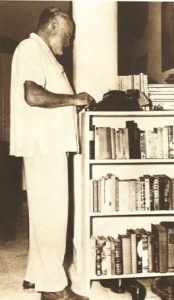
hemingway

Ernest Hemingway

Immobilization/shutdown/dissociation/frozen, a trauma response built into the nervous system

Back in March 2012, I posted that I had started reading Peter A. Levine’s latest book, In An Unspoken Voice: How the Body Releases Trauma and Restores Goodness. My post included excerpts from Levine’s description of being hit by a car and his experience afterwards.

His experience serves as a useful model for being and staying present through trauma and recovery. He knew how to allow his body and emotions to process naturally so that he did not get stuck in a traumatic state (i.e., PTSD).

Well, I am still reading that book. It’s very, very rich. Some parts are rather scientific. I’m taking my time to really understand it.

Levine uses polyvagal theory (I just posted an interview with Stephen Porges, who came up with the theory) to explain the states that people experience and can get stuck in from traumatic experiences.

Because Somatic Experiencing Practitioners and other therapists (as well as astute loved ones) who are helping someone recovery from trauma need to know which layer of the nervous system is dominant at any given time in a traumatized individual, I am going to describe them.

First, the primary job of our nervous system is to protect us. We have senses that alert us to danger. We may react to a perception of a threat in our bodies before it ever becomes conscious in the mind. That’s because the autonomic nervous system (which is not under our control) is involved when trauma occurs. We react instinctually.

This is good to know. It means that your trauma reactions are automatic, not something you can control, so there’s no need to feel shame or blame yourself. You were doing the best you could.

There are two defensive states that occur when encountering trauma: immobility/dissociation/shutdown (freeze) and sympathetic hyperarousal (fight or flight).

I’m going to write about them in separate posts to avoid being too lengthy.

The more primitive nervous system state is immobility. (Primitive in that evolutionarily it comes from jawless and cartilaginous fish and precedes sympathetic hyperarousal.)

It is triggered when a person perceives that death is imminent, from an external or internal threat.

Levine also uses the terms dissociation, shutdown, and freeze/frozen to describe this state. Note: If you’re an NLPer, dissociation means the separation of components of subjective experience from one another, such as cutting off the emotional component of a memory and simply remembering the visual and/or auditory components. (Source: Encyclopedia of NLP)

Keep in mind that Levine is talking about dissociation as an involuntary post-traumatic physiological state that trauma victims can sometimes get stuck with. There may be some overlap. According to Levine, symptoms of being in this state include frequent spaciness, unreality, depersonalization, and/or various somatic and health complaints, including gastrointestinal problems, migraines, some forms of asthma, persistent pain, chronic fatigue, and general disengagement from life.

Levine notes:

This last-ditch immobilization system is meant to function acutely and only for brief periods. When chronically activated, humans become trapped in the gray limbo of nonexistence, where one is neither really living nor actually dying. The therapist’s first job in reaching such shut down clients is to help them mobilize their energy: to help them, first, to become aware of their physiological paralysis and shutdown in a way that normalizes it, and to shift toward (sympathetic) mobilization. 

The more primitive the operative system, the more power it has to take over the overall function of the organism. It does this by inhibiting the more recent and more refined neurological subsystems, effectively preventing them from functioning. In particular, the immobilization system all but completely suppresses the social engagement/attachment system.

Highly traumatized and chronically neglected or abused individuals are dominated by the immobilization/shutdown system.

Signs that someone is operating from this state include:

  • constricted pupils
  • fixed or spaced-out eyes
  • collapsed posture (slumped forward)
  • markedly reduced breathing
  • abrupt slowing and feebleness of the heart rate
  • skin color that is a pasty, sickly white or even gray in color

Brainwise, volunteers in the immobility state exhibited a decrease in activity of the insula and the cingulate cortex. In one study, about 30% of PTSD sufferers experienced immobility and 70% experienced hyperarousal, with a dramatic increase of activity in these brain areas. Most traumatized people exhibit some symptoms from both nervous systems, Levine says.

I feel the deepest compassion for people in this state, because I have experienced it myself: the spaciness, depersonalization, sense of unreality, and passive, disengaged attitude toward life. It was many years ago. If I could, I would reach back in time to that injured woman and give her resources she just didn’t have back then.

I feel so grateful for the trauma recovery work I’ve done, both with a therapist and on my own. I haven’t experienced immobilization for years, except briefly.

Next up: sympathetic hyperarousal/fight or flight.

A video that could help you sleep

Insomnia is a malady I have rarely had over the last few years. Only when I drink caffeine late in the day (I usually know better), and even more rarely, when I feel so disturbed about some issue in my life that my mind can’t let go of it do I lie awake at night unable to sleep and feel like a zombie the next day.

I have experienced months of insomnia every night in the past, however, and that experience has given me great compassion for those who suffer from it. A good night’s sleep is just essential for well-being.

I’ve posted about various remedies for insomnia occasionally. You can search my blog on “insomnia” to find those posts if you wish.

Cures or relief from insomnia is a topic of great interest. New information emerges. I’m interested in what works. Could it be that there is not a “one size fits all” cure for insomnia?

Today I stumbled across a video purportedly created by scientists to help you sleep. I listened to it (and did not fall asleep, but it’s morning and I am well rested already). I found it very peaceful. I can imagine that it would help me fall asleep.

Here’s the link if you want to give it a try:

http://www.wimp.com/scientistscreated/

The only other information I could find is that the video and music are by a band called Marconi Union. I don’t know if this is a band of scientists or what!

The best help I know of for insomnia (and the most expensive) is brainwave optimization.   I wasn’t experiencing any insomnia when I did the five days of brain training in June 2011. But it has been known to help with insomnia, and a study is underway to learn more about its effects on insomnia.

Even more awesome, Wake Forest Baptist Medical Center is undertaking this study of insomnia, and other studies are planned for migraines, mild cognitive impairment, and traumatic brain injury/concussion later this year!

Testing the FitDesk: an update

Last week I posted on testing the FitDesk. Here’s an update.

I discovered I had mounted the desktop backward. I had assembled it intuitively and then thought the velcro for attaching the electronic monitor was missing. I held the laptop in place with the giant rubber bands the company provided.

Later, I saw a piece of velcro on what I thought was the wrong side, and the little wheels in my mind started turning. I got out the instructions, looked at the photo, and sure enough, the fat end of the desktop is closer to the rider.

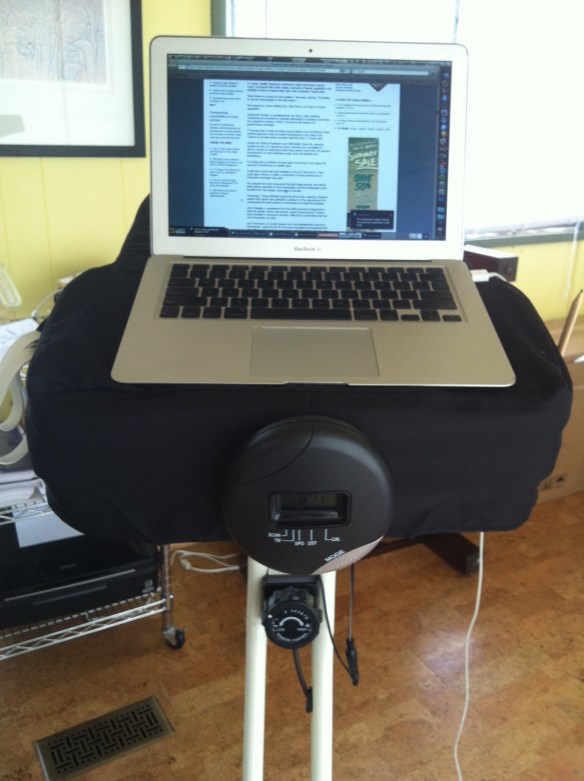
Here’s a photo with it mounted correctly, electronic monitor attached:

FitDesk

This way, there’s a slight ledge that you can’t really see but can feel on the desktop (which is made of dense foam covered with cloth) that will keep your laptop from sliding off. Although giant rubber bands are included, I did not find them necessary to hold my laptop in place with the desktop mounted correctly.

Note: I didn’t really use the electronic monitor. I just looked at the clock or set a timer on my iPhone and pedaled for a set length of time. Since I’m not using it to meet fitness goals, I found it more of a bother.

FitDesk pocketThis way of mounting the desktop also places the pockets closer to the rider. I used my iPhone to take these photos, but when not in use, I store it in one of the pockets, with Post-Its and writing instruments in the other pocket.

My friend Edward Spurlock tested it out. He adjusted the seat to fit his leg length. He is a cyclist and concurred with me that the FitDesk is not comparable in quality with exercise bikes at the gym (which are built for heavy, nearly constant use mimicking hills and so on). But for simply keeping your legs active while doing computer work, it’s great.

(Note: I took the photo below before figuring out the right way to mount the desktop!)

Edward monitored calories burned using an app called BodyBugg and reported the following:

I spent the entire interval from 12:42 PM to 12:48 PM turning the pedals on the FitDesk and burned 23 calories total during that time.

By comparison, I highlighted and selected the interval from 1:06 to 1:12 PM, when I was sitting in stop-and-go traffic on IH35 on my way home. The ‘Bugg registered a total of 8 calories burned for the interval, or around 1.4 calories / minute.

I usually burn 1.2 – 1.4 calories per minute on a normal workday sitting at my desk. If I used the FitDesk for a longer period, I might have slowed down a bit – but I think it’s fair to assume that one would burn at least twice as many calories turning the pedals and holding one’s body upright using the FitDesk than sitting still in the standard office chair with backrest.

Two to four calories per minute is pretty good compared to 1.2 – 1.4. You could definitely lose weight/eat more delicious food using a FitDesk regularly!

And finally, I want to report that the FitDesk does seem very feasible for use in an actual office wearing actual office clothing. I rode it for 30 minutes with the pedal tension set to 1 (no tension). You may remember that my first test was for an hour with the tension set midway at 4. I got sweaty then.

I did not sweat using the lowest setting, which is pretty remarkable considering I keep my trailer a bit warmer than the typical 72 degree setting found in most offices, closer to 76.

So I would say that the FitDesk is a desirable option in an office setting as well as for working at home.

Check out my tips for improving your health while sitting less (written while pedaling on a FitDesk)!

12 ways to improve your health by sitting less (written while pedaling on a FitDesk)

If you commute (usually sitting) to a desk job (mostly sitting) and then go home and watch television (sitting) and/or spend a lot of time on your computer (sitting), even if you manage to work in an hour at the gym, your health is at risk.

You can Google to learn more about the science of this — and they’re just beginning to learn. I’m just here to give free advice on behavioral changes you can make.

To counteract all the sitting, you could consider:

  1. Cutting the car commute and work from home as much as possible. Seriously. Present this option to your manager as a way to cut their costs, improve your health, and therefore make you more productive!
  2. If you can’t avoid car commuting, every time you’re at a red light or stop sign or gridlocked in a traffic jam, stretch your legs, and tense and relax them several times. Really pull the muscles to the bone. (Okay, that’s the yoga teacher in me talking.) Point and flex your feet and rotate your ankles.
  3. Take public transportation and stand during your commute, a la New York City subway riders.
  4. Bicycle to and from work, or combine biking with riding the bus or light rail. Many now have bike racks available. You may want to request that your workplace provide showering facilities.
  5. At work, take frequent breaks (1-2 minutes every 20 minutes) to stand up and walk around. Set a timer and do it. Go get a drink of water, go to the bathroom, stretch, shake the tension out of your body, do a forward bend to stretch the backs of your legs. Walk to the best view from your building and partake of it to refresh your spirit.
  6. Sit on an exercise ball. You have to use your legs to balance. You can also bounce when no one is watching. It will strengthen your core muscles because there’s no back — you have to hold your torso up. This will burn more calories, if you’re interested in doing that.
  7. Instead of emailing, texting, or phoning, walk over to a colleague’s office to communicate with him/her. I know, I know, this is really analog, but it’s also refreshing. Think of how much more information you get from seeing their face and hearing their voice in person. You might even learn something about them from seeing their office decor.FitDesk
  8. Persuade your office to invest in a FitDesk. One FitDesk shared among eight employees sounds like a great start. I imagine 30 minutes in the morning and 30 in the afternoon would make a big difference in the health and longevity of those eight employees, especially if they’re doing some of these other things when not pedaling. Of course, if your office can afford it, get a FitDesk for every employee! If you can’t afford it, you could phase this in over time as finances allow, as employees using it report they’re feeling better, missing less work, being in better moods, and being more productive, improving the company’s bottom line. Hey, maybe this is the key to the economic recovery and the obesity epidemic! FitDesks for every employee!
  9. When you get home, turn off the TV and computer and do something that uses your legs: cook, go for a walk, clean house, garden, do yard work, do yoga, lift weights, kick box, have sex, play with the dog, take a shower, swing your kids around, give them piggy-back rides, roughhouse, dance, put on a show. Also known as “living life” and “being embodied”.
  10. If you can’t eliminate TV or video games or Facebook or whatever is so compelling on your computer (okay, blogging and Facebook for me), limit it to an hour (with a break every 20 minutes; see #5 above) and get up during commercials unless you are on your feet while watching. Or…
  11. Get a FitDesk for your home so you can move your legs while watching TV and being on the computer.
  12. Do this with other people. It will be more fun.

Making the world a healthier place, one blog post at a time…

My trauma recovery manifesto: the deepest compassion, the strongest boundary

I originally posted this earlier this year. Yesterday I received this comment:

Well said! I’m a clergy person with PTSD who can handle almost any trauma while in the collar thanks to good training and very clear boundaries, but when traumatized people insinuate themselves into my personal life, it sends me into a tailspin even after decades of hard therapeutic work. Caring does not involve being receptacles for others’ misery. Setting limits and sending them for the help they need is the very best thing any of us can do.

It inspired me to repost the original. I feel the same way as the commenter: Tell me up front you’re traumatized, and our relationship will be good. I will set the boundaries I need to keep it healthy.

If you fail to disclose your trauma, we’re probably not going to have a healthy, trusting relationship, and when I find out, it could send me back to a place I worked really, really hard to get out of. I don’t take kindly to that. It’s irresponsible and very unfriendly on your part.

Traumatic symptoms have a way of showing up in behaviors beyond your control until you face and heal the trauma, and specialized professional help (Somatic Experiencing and the like) is almost always required. I guessed you had been emotionally abused from your behavior because you were so weird. I just didn’t know the extent of it until I had that clairvoyant experience after seeing you be triggered that sent me into major fight-or-flight mode. The truth will come out.

I empathize with where you are. If you ever want to be a real friend to me, and not an unhealthy co-dependent, I need you to actively work on your recovery and “get on the other side of it”. I know it probably seems harsh, but I know whereof I’m speaking, having been there myself. You getting well is the best thing you can do for yourself and the quality of your future relationships. I wish you well.

~

Occasionally people who have been traumatized have gravitated to me because I’m open about having experienced a serious trauma and (mostly) recovered, but they don’t seem to realize how deeply their past still affects them. They haven’t done any trauma recovery work, and they show up in my life.

I believe they show up because their unconscious is seeking healing. Or perhaps angels bring these people to me so they can see for themselves that recovery is possible. You know, I don’t mind being a role model for recovery from trauma. I’ve come a long way in 10 years. I’ve worked at it.

It’s not like traumatized people wear signs stating that. The sudden discovery that a friend or love interest has been traumatized can create a huge amount of distress for me. Even though in hindsight, their craziness now makes more sense (“oh, of course, that weird behavior was a trauma response”), it can still really be a shock.

So I just want to put this message out there:

If you’ve been traumatized and feel attracted to me because I’m open about having experienced trauma and having done a lot of work on my recovery, first of all, please tell me clearly and up front (or as soon as you realize) that you’ve been traumatized, emotionally abused, get triggered, have flashbacks or nightmares, are shell-shocked, or whatever history or symptoms are affecting you.

There’s no shame in it — you didn’t ask for it. I’d rather know than not, and I just might be able to proceed with appropriate boundaries. I will help you find good help and support you emotionally — in a way that is healthy and not co-dependent.

If that’s what draws you to me, just own it. Do not be asking me out on dates and withholding information about your untreated trauma. That’s creepy. You may naively think you can hide it, but it seriously disregulates your autonomic nervous system, which means it’s beyond your control. Your trauma-related weird behavior will show up in your most intimate relationships sooner or later.

Having untreated trauma is like ignoring an elephant in your living room whose shit is piling up. It will stay there until you see what it’s doing to your life and determine to get it out of your house. Which takes help.

Secondly, if you’re not getting professional help, please do that — get professional help. And let me know that too, because I’m going to worry about you if you don’t, and I’d rather be happy than worried.

Please do not look to me to help you beyond being a cheerleader for your recovery work. I am a blogger who’s open about having experienced trauma and having done a lot of work on recovery. This blog (read About me, and do a search on PTSD or trauma to find related posts) describes some of my recovery experiences. Please feel free to ask me about them or try them yourself.

There is absolutely no need for you to just show me your wounds without any verbal warning. Seeing you suddenly be triggered by your past trauma triggered painful memories of my long struggle of not knowing I had PTSD and finding out, and then spending months processing, healing, and putting my life back together in a new, healthier way.

Your behavior freaked me out badly. It took acupuncture, herbs, and therapeutic assistance to start to get over it (at my expense, I might add, which you have ignored, which also makes me think less of you), and I really don’t trust you now.

Recovery from trauma doesn’t mean being bulletproof. It means being more embodied, emotionally present, and energetically open than before recovery, while still being an ordinary person who cannot read minds. I have more compassion now and am more of a whole person, and I need to set clear boundaries to take care of myself. I do know the difference between friendship and co-dependence.

It breaks my heart more than you can imagine that the innocent gesture I made triggered fear in you. It’s not anything I take casually or lightly. It’s emotionally disturbing to witness someone with their wires crossed, whose body mind mistakes someone who has never emotionally abused them with someone who did.

With help, you can heal your poor damaged nervous system and experience peace and stability and aliveness in your life. I am recommending Somatic Experiencing to people these days.

Please find your way to help. I wish you well.

So this is for everyone: if you know that I have had PTSD and you have had untreated trauma in your life, and you come around seeking a relationship, please tell me up front, do your own recovery work (I’ll be rooting for you), and get yourself in decent emotional and relational shape before you seek friendship or dating from me, for both our sakes.

I look forward to talking with the healthy you.

I’m pedaling on a FitDesk as I write this!

The FitDesk that I wrote about previously arrived last week in a big box — and today was the first day I had time to devote to assembling it, testing it, and inviting friends to come over later and try it out.

I am pedaling as I write this blog post! After hopping on for seat adjustment (none needed for my 5’1″ height on the lowest setting), I decided to cycle for an hour while I read email, caught up on FB and Twitter, read some articles, and wrote this post. I set the tension control midway.

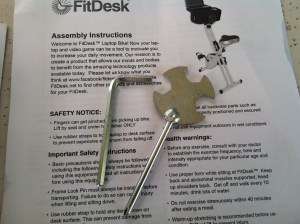
The FitDesk came with its own assembly tools! I didn’t even need a screwdriver or wrench, just a sharp knife for opening the box and unpacking the parts. Assembly was very easy and took about 15 minutes. There are 12 bolts already in place, and the desktop just slides onto the handlebars. The laptop is held in place with giant rubber bands.

FitDesk assembly tools

I did discover that the cloth covering the desktop did not have any Velcro (TM) in place for attaching the electronic monitor (which measures time, speed, distance, and calories), so I used it without the monitor. Since the purpose is to be active while getting computer work done, the monitor seemed like it would be a distraction.

I imagine the company would rectify this quickly if asked.

And now I’ve finished one hour! I did get off it a couple of times to make hard-boiled eggs and drain them.

I got a little sweaty using the midway tension control setting, which was comparable to going up a very low incline. I’m wearing exercise clothes, so no problem.

I will try it later at a lower setting dressed in business casual clothing because I’d like to find out if an office worker could use it at work and look fresh afterwards.

I can feel my sit bones! There’s no pain, but it’s been awhile since I’ve ridden a bike. The seat is wide and cushy. I imagine it just takes time to adjust to riding, no matter what kind of seat. The company suggests standing frequently, using a gel cover for the first few weeks, wearing padded cycling shorts, and, lastly, trying a different saddle (they have an accessory that allows universal saddle mounting) if it bothers you too much.


FitDesk bike seat


This is my initial report. Please let me know if you have any questions. I will write more later.