Try to catch yourself if …

Quote

Try to catch yourself if they are making you unhappy today. When you feel that unhappiness start to whisper in your brain take a step back and say, “Do I really need to be thinking about this this very second?” Almost all the time, the answer is “no”.

I add, “Then just dissolve the image, the internal dialogue, the feeling. Let it lose substance. Let it become atoms and be swept away on the solar winds.”

James Altucher wrote this in his blog post Don’t Kill Anyone today. 

The price of busy-ness. If you need a massage, call me. I’m good.

I just encountered this great article, an opinion piece from the New York Times, about busy-ness and thought I’d share my thoughts.

Not only am I a recovering serious person, I’m also a recovering busy person. For several years, I worked full-time and went to graduate school while raising a child as a single mother. In hindsight, that was insane.

This downtime after my last contract job in the technology world ended about six weeks ago has been lovely. I’m recovering from adrenal exhaustion, and then, just when I was starting a running practice that I felt joyful about and ready for, I pulled a calf muscle and have had to lay low for longer while it heals. (It’s healing very nicely, with self-care and other healing hands working on it. Thanks, Brigitte and Pauline!)

The universe is telling me to slow down, and I’m listening. I’ve been letting a lot of stuff slide, trusting that the important things will rise to the top of the list and the rest will get done when and if they get to the top. One day at a time. I’m loving my daily Tarot readings, the cards that influence my awareness and development and trust in the universe. My favorite deck is the Osho Zen deck.

During this period I’ve also attended several trainings in Somatic Experiencing, which is based on the truly great trauma recovery research and writing of Peter Levine. (I’m currently reading In An Unspoken Voice: How the Body Releases Trauma and Restores Goodness.) I fell in love with it. The main premise is that trauma deregulates the nervous system (into freeze or fight or flight), and that the body can heal itself, with loving attention and guidance.

I’ve been practicing body awareness as well as writing about grounding, centering, and having boundaries. You can expect more posts along those lines.

I also seem to be developing an organic vision for my bodywork and changework practice that involves more teaching and writing. And—I am available now! Call me if you need a massage. I am really good, my rate is reasonable ($1 per minute), and I give discounts for regular customers and referrals.

Who knew that all this time, throughout the history of the human species with all of its atrocities and traumas, that the secret to trauma recovery was right there all along, being ignored by the mind, which in order to “be civilized” began to believe itself superior to the body?

How cut off are we from our own lives? Have you ever had something like this happen to you?

I recently wrote a friend to ask if he wanted to do something this week, and he answered that he didn’t have a lot of time but if something was going on to let him know and maybe he could ditch work for a few hours. I wanted to clarify that my question had not been a preliminary heads-up to some future invitation; this was the invitation. But his busyness was like some vast churning noise through which he was shouting out at me, and I gave up trying to shout back over it.

Self-importance is a joy killer, and that’s all most busy-ness is, when you get right down to it. If you are swept away in a current of busy-ness, why, then you must be somebody important! Or at least somebody.

It’s the opposite of being here now, of being present and grounded/centered/boundaried/etc. in your own body. It’s dissociation.

Here’s more, about a New York artist who moved to a village in the south of France:

What she had mistakenly assumed was her personality — driven, cranky, anxious and sad — turned out to be a deformative effect of her environment. It’s not as if any of us wants to live like this, any more than any one person wants to be part of a traffic jam or stadium trampling or the hierarchy of cruelty in high school — it’s something we collectively force one another to do.

How do we collectively force one another to be too busy to be real? It’s as I suspected:

Busyness serves as a kind of existential reassurance, a hedge against emptiness; obviously your life cannot possibly be silly or trivial or meaningless if you are so busy, completely booked, in demand every hour of the day.

I’m listening, feeling, and letting each day unfold while not losing myself in breathless busy-ness. Isn’t that what summer is for?

The space and quiet that idleness provides is a necessary condition for standing back from life and seeing it whole, for making unexpected connections and waiting for the wild summer lightning strikes of inspiration — it is, paradoxically, necessary to getting any work done.

Well, it’s almost noon, and I’m still in bed on this Monday morning, in bed with my laptop, tarot cards, book. Actually, my butt is getting numb, and I feel thirsty. I believe I’ll get up, stretch, drink some green tea, and mosey over to the yoga mat. I hear a down-ward facing dog calling my name.

How to have good boundaries: the third energy

In the energy of being grounded, you learned that you have a space, a position on this planet. You fully connected your energy with the earth’s energy and felt the strength and power of that.

Then you learned about being centered in your own energy, further strengthening your felt sense of yourself.

Having boundaries involves knowing where you end and not-you begins, and knowing when and how to protect and defend that space and give others their space. This is the third energy.

Have you ever experienced someone’s bad boundaries? Perhaps they stood too close when they were talking to you. Perhaps they got in your face or stepped on your toes. Or someone touched you inappropriately, or worse. Connect that to how you felt in your body. Uncomfortable, crowded, resistant, fearful, violated, powerless, worthless, what else might someone feel whose boundaries have been crossed?

We’re often not really aware of our boundaries until someone violates them. This can distort our boundaries. Think of all the incest, physical abuse, emotional abuse, rape, molestation, sexual abuse, child abuse, and more-power taking advantage of less-power stories that you’ve heard, seen on TV, or read about. There’s a lot of suffering in this world because of this type of behavior.

When someone’s boundaries have been violated, their sense of their own boundaries can easily become distorted, or maybe it wasn’t that strong to begin with. Part of recovery is restoring those boundaries and strengthening them by learning how to better protect and defend your space. Without doing this, people can suffer for years, by being distant and isolated, by violating others’ boundaries, or both. Having a good sense of boundaries has a positive impact on social and intimate relationships and your trustworthiness in general.

This energy is important for feeling like you can be yourself in the world and be safe, for trusting life. This is a huge component of well-being, and most of us have no real training in it.

Here’s how you begin to experience your boundaries:

The first boundary is your skin. Everything inside is you; everything outside is not you. Stand up and get centered and grounded. With your hands, pat yourself from head to toe and back up again. Feel your skin with your hands, your hands with your skin. Take your time and really notice. Appreciate your skin.

Did your skin notice the rhythm of your hands patting? Did you notice changes in sensation as you patted different areas of your body? What does your skin do for you?

Close your eyes and imagine the distance where you feel comfortable when talking to another person. Imagine them walking up to you. How far away do you want them to stop? (Or if you’re with someone, talk to them and notice the distance.) Notice if the distance is different with different people. Imagine your mother, your best friend, a lover, a stranger.

Next: If a growling wild animal were to slowly walk toward you, and you couldn’t run, how would you set a boundary? Think of the length of your leg. You could kick the animal if you had to. (But hopefully you can avoid hurting any animal.) So the length of your legs creates a boundary.

The length of your arms forms another boundary. You can use your arms to push someone out of your space. If they got even closer, you could bite them to get them out of your space.

This next experiment requires a partner. Stand several feet apart, grounded and centered.  Extend your arms and notice that boundary. You may feel that arm’s-length space as a column that extends from the ground to over your head. This is an important boundary.

Now face your partner and slowly walk toward them, arms extended. Stop with your palms against your partner’s. Notice how you feel. Determine who is Partner A and who is B.

With palms still together, A steps into B’s space and tries to get closer. B pushes A back to the comfort zone. A: Really push! B: Tell A “This is my space. Get out of my space!” as you push them back. Feel the effort.

This is going to feel uncomfortable at first. It’s not so hard for children, so pretend you’re on the playground if that makes it easier. I hope you’re breathless from the effort and laughing when you’ve each done it!

Boundaries are a lot more complex than centering and grounding because they’re relational and situational. Maintaining good boundaries requires your attention, especially in new relationships, when someone’s behavior changes toward you (or yours toward them), in new situations, when meeting people from other cultures.

Being able to say “no” without alienating someone is also part of the art of setting good boundaries. Have you ever been roped into doing something you didn’t want to do? That could be a whole blog post or maybe even a book!

Quickly, here’s how I like to do it: I appreciate the other person’s intent, and then tell them no. I may tell them why, but I don’t have to.

Other person: MaryAnn, we’d love to have you on that committee.

MaryAnn: I appreciate you thinking of me, but I cannot take that on at this time. I have too much on my plate already, and I doubt I could do the job as well as someone with more time. Have you thought of asking Lucy?

You get the idea! That’s the nice way. If someone is persistent, don’t hesitate to get tougher. “Absolutely not!”

Good luck with sensing your boundaries and making them real. Thanks to Brian D. Mahan, SEP, for inspiring me!

Just discovered this blog and post on the psoas muscle, one of the deepest muscles in the body as well as the most fascinating.

body divine yoga

psoas

I was delighted when I first came across Liz Koch’s amazing work because it confirmed much of what I’d been intuiting on my own. I had begun to open and close my yoga practise with hip opening poses with the specific intention of releasing tension in my psoas and hip flexors. I’d breathe and imagine tension flowing out of constricted muscles to be released as energy into the torso.

It worked, I’d feel my body soften yet somehow grow stronger.

Reading Liz Koch I instantly realized what I was doing – by learning to relax my psoas I was literally energizing my deepest core by reconnecting with the powerful energy of the earth. According to Koch, the psoas is far more than a core stabilizing muscle; it is an organ of perception composed of bio-intelligent tissue and “literally embodies our deepest urge for survival, and more profoundly, our elemental desire…

View original post 762 more words

How to get centered: the second energy

You’ve heard people say “I’m not feeling centered right now” or “He seems very centered”. If you do not relate to statements about being centered or experience that yourself, you can benefit from increasing your kinesthetic awareness. Being centered is a real aspect of the felt sense that is integral to living a healthy, happy, embodied life.

Like being grounded (my previous post), being centered is a body energy that has a direction:

bullseye

There are many ways to find your center, and there are different names for it: the literal center, the energetic center, the center of gravity. What’s important is to find one that makes you feel stable in your being.

Here’s how to find your literal center:

Stand up barefooted. Wiggle a little to release tension. Ground yourself.

Locate the plane that divides your body into left and right halves. In the front, your sternum (breastbone), navel, and pubic bone mark it; in the back, your spine (unless you have alignment issues like scoliosis).

Here’s a little trivia: This “line” corresponds to two meridians in Chinese medicine, the conception vessel (front) and governing vessel (back).

Now imagine the plane that divides your body into upper and lower halves. It can help to look in a mirror or even a tape measure to find this. Depending on the relative length of your legs, torso, neck, and head, it will lie between your pubic bone and solar plexus somewhere around your navel.

Now imagine the plane that divides your body into front and back, somewhere in the center of your torso.

The place where those three planes meet (left/right, upper/lower, front/back) is your literal center.

three planes dividing the body into halves

To find your energetic center, send your awareness into your literal center. Move your attention around in that area, and you may notice a slightly stronger sensation marking your energetic center. Practice moving your attention out of your energetic center and back in.

A quick way of finding center is to put your hands in prayer position with shoulders relaxed and forearms parallel to the floor. The place where the bottom of your hands meet or thereabouts marks your center. It is not exactly a pinpoint. I experience my center as being about the size of a tennis ball.

Here’s another way to get centered: Stand with your feet hip width apart, knees relaxed, body slightly loose, and close your eyes. Rock slightly forward, shifting more weight onto the balls of your feet. Rock slightly backward toward your heels. Rock to the left and then to the right.

Now center yourself with your weight evenly distributed front/back and left/right. Are you feeling a sense of stability? Good. You’re centered.

Each body also has a center of gravity, which has to do with the body’s mass. Think of ice skaters spinning. They could not perform safely without keen awareness of their centers of gravity.

Usually women’s center of gravity is a bit lower than men’s, because of how the chest and pelvis are proportioned.

If you already know where your center of gravity is, you probably already know how to be grounded and centered. If you don’t know, it’s discovered through movement, and you can begin to discover it by standing and twisting your torso from side to side, or by whirling/spinning.

Whirling Dervishes

Words indicating the centering energy: being centered, off-kilter, balanced.

I hope these methods have helped you experience first-hand being centered.

Now combine it with being grounded, and notice how being both grounded and centered may differ from how you usually experience life. Does it add a dimension of feeling, sensation, or awareness? Does it add richness to everyday experience?

Thanks to Brian Mahan, SEP, for the inspiration.

How to get grounded: the first energy

Somatic Experiencing (SE) is a training program for professionals assisting individuals in trauma recovery that was developed from the work Peter Levine, author of Waking the Tiger and many more books on trauma recovery. You can learn more about Somatic Experiencing here.

If you’ve read much of my blog, you know that reading Waking the Tiger was instrumental in my trauma recovery, that I spontaneously released blocked energy from a major childhood trauma while reading the book decades later, which not only was amazing but initiated a huge paradigm shift toward health and well-being for me.

I’ve been fortunate enough to attend several trainings and workshops with Brian D. Mahan, who’s a Somatic Experiencing Practitioner (SEP). Brian teaches SE to help people learn to help others with trauma recovery. Check out his website here: Brian Mahan, Body Centered Therapist.

(I particularly love his blog post When Is Prayer, Yoga, and Meditation No Different Than Sex, Drugs, and Rock and Roll? Because you and I know people who are addicted to prayer, yoga, and meditation, trying to bliss out while avoiding feeling what they’re actually feeling!  I think I may have been one of them….)

Back to Brian’s workshop. It had the longest title of any workshop I’ve ever attended, and the title conveys the content: Imagine feeling present, grounded, centered, boundaried, embodied, empowered, in the moment, safe and joyful!  It was so much fun! I recommend this if you ever get the chance!

Also, schedule an SE session with him next time he’s in Austin or remotely via Skype. (You can email him at BrianDMahanSEP@gmail.com and view his Facebook page. Here’s a link to his YouTube videos. Here’s an offer for a 5-minute meditation video. To set up a session, his phone number is 323-459-1845, and he’s on Skype as SomaticExperience.)

I’m going to write about what attending that workshop brought up for me about some of these energies, with Brian’s artful facilitation in directing our attention to the body and using the “felt” sense. This content is universal (we all have bodies and awareness) and I’m running it  through my personal filters (writing, yoga, NLP, massage).

This felt sense is available to everyone with a nervous system. My NLP training is that we represent the world through visual, auditory, and kinesthetic channels, often favoring one at the expense of another. Therefore many people do not develop the felt sense (kinesthetic awareness for you NLPers), and they don’t know they don’t know—until someone starts talking about something they’re unfamiliar with, like boundaries, energy flowing in a certain direction, internal sensations/emotions (both kinesthetic).

I had a doctor once who had never heard of chakras. You get the idea.

Using and developing this felt sense is actually very significant to your overall well-being, and if you don’t experience much kinesthetic awareness, you can benefit from learning about it and experiencing it. I’ve been there. I know.

Many forces conspire to get us to numb out, to go to sleep, to not know who we really are. Think of TV, food,  alcohol, drugs, work, sex, busy-ness, perfectionism, emotional drama—the things people get addicted to serve the purpose of distracting us from experiencing our real, essential selves and all those feelings.

You know what? You don’t have to give any of those things up, right now or ever. Follow along if you’d like to add a new dimension to your aliveness, to wake up a little more, to put a little more life in your life.

If you are someone who wonders what the heck people are talking about when they say things like “I’m not feeling very grounded right now,” “He’s not his body,” or “Wow, that really threw me off center,” this is for you. If you’ve felt grounded before but feel ungrounded now, this is for you.

Being grounded refers to your body’s energetic connection to the planet, to the earth, to the ground. This energy always flows in the same direction in your body:

To experience this, do an exercise (and you may want to have someone read this to you):

Right where you are, without doing anything else, check in with your body. Scan it from head to toe and notice the sensations and lack of sensations.

Now take your shoes and socks off and stand up. Put your attention on the sensation of your feet against the floor. Take your time and really feel.

Feel the entire weight of your body squishing the skin cells on the soles of your feet into the floor.

Feel your heaviness. Just walk around and feel your weight.

Now stop and feel as if your feet have suction cups on them holding you in place.

Feel as if each leg is a tree, sending roots down deep into the earth. 
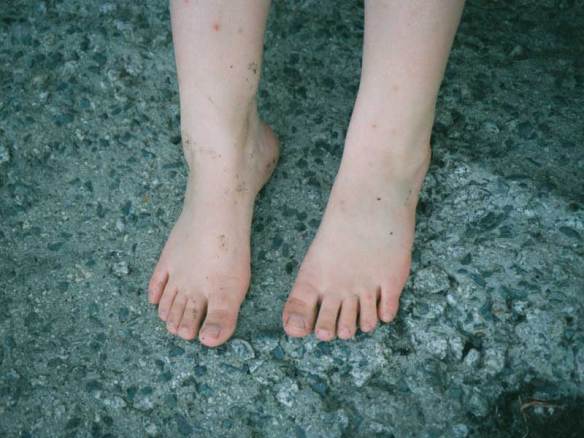
Now roll more of your weight onto one foot and feel the strength in that leg. Now lift the other heel ever so slightly. Switch sides and repeat. Now lift each foot higher. You’re rocking from foot to foot!

Do you feel a sticky sensation on the sole of the lifted foot? Can you sense its desire to return to the floor? Can you imagine invisible elastic between each foot and the floor?

Now stand still, evenly on both feet. Imagine the earth’s energy field embracing you, pulling you toward it with a gentle hug. Imagine mother Earth, Terra, Gaia, Pachamama holding you closely like a mother holds her baby. You can even prostrate yourself and surrender to it, hugging the earth back if you like. (If not, that’s okay too.)

Stand back up and imagine there’s an opening in the top of your head that opens to the sky/spirit/God/the cosmos. Imagine this energy flowing into your head and going down through the center of your body and down each leg and out your feet and into the earth.

This is you, fully grounded. Check in again, fully.

End of exercise.

Notice that our language has many ways of describing this energy: being grounded, feeling ungrounded, holding your ground, standing your ground, standing on your own two feet, without a leg to stand on, being sure-footed, steady on your feet, sticking a foot in the door, getting in on the ground floor.

Being grounded gives you a position on this planet, a space, a place that belongs to you and no one else, and it also connects you to this planet. You belong to the earth.

What does it feel like to be grounded? Remember what you felt like before the exercise, and compare that to feeling grounded. How would you describe the difference?

More importantly, when could feeling grounded be useful in your life? When might you particularly want to feel grounded? What ungrounded you?

Just for this moment, bring your attention back to your feet. Notice if you feel any shift of energy in your body.

Realize you can play with this, enjoy this, practice this as often as you like until it comes effortlessly (because the body is attracted to joy and pleasure, even the subtle ones). Then you can forget about it, knowing that whenever you need it, the resource of being grounded belongs to you.

Next: how to get centered.
Recovering from a pulled muscle, I apply my massage skills and heal. Voila!

A couple of weeks ago, I started self-training in running, and I was walking/running on the trail, building up endurance while avoiding fatigue and injury (so I intended). I’d done the warmups recommended by my trainer and felt really good in my running—lifting my knees, almost sprinting, feeling that great-to-be-alive, heart-pounding, hard-breathing experience of really challenging my body in a healthy way. I was loving the run!

Then, running up a hill, I pulled my left calf muscle. I immediately slowed to a walk, walked for about 10 minutes, and then (ruh roh), I decided it wasn’t so bad and ran some more.

Afterwards, I could feel the pull, but it seemed pretty minor. I could walk fine, without a limp. However, I did wisely decide not to run again until it felt really fine.

Six days passed, and I went to ecstatic dance, where everyone dances like no one is watching. I love this practice, moving to music, going with the flow, connecting with others, letting go, being part of the tribe. I can get pretty wild, jumping around with a big grin, leaping from foot to foot, being danced.

If you have no clue what I’m talking about, it’s like this:

The Power Wave

So anyway, while leaping about, I suddenly felt strong pain in my left calf. I limped to the side and did not feel like dancing any more.

Thinking it was my gastrocnemius (the superficial calf muscle), I had a massage therapist work on it that afternoon. I was still limping badly afterwards, although definitely more relaxed. I went home and iced it, and then…

 A massage magazine I’d been reading was next to my bed. I picked it up and saw there was an article by Dr. Ben Benjamin on the soleus, the deeper calf muscle. It included diagnostic tests, and I verified that it was my soleus muscle that was injured. (The image shows it without the gastrocnemius.)

Guess what? It could take 4-6 weeks to fully heal. That was depressing.

Benjamin (who also wrote the fantastic reference book about muscle injuries that belongs in the home library of every athlete (in my opinion), Listen to Your Pain) gave instructions for “friction therapy” massage, stretching, and strengthening. I also put ice on it, several times a day at first and now just once a day right after I do the clinical protocol.

My leg went from maybe 15 percent to 85 percent functional within a week. My limp gradually lessened, day by day. The calf still feels just a bit tight and tender. My hunch is that the last 15 percent of healing will happen more slowly.

Anyway, I feel really empowered about using clinical massage on my own injury and seeing (and feeling) rapid improvement.

I am ready to apply that to others.

Awareness through hearing: a three-minute exercise

All experience is embodied!

I feel like shouting that from the rooftop right now after several days of learning from and working with Bryan Mahan, Somatic Experiencing Practitioner.

There is no separation of body and mind except the one that the mind makes. When that happens, it’s called “not being in your body”. It’s also beginning to dawn on me that perhaps that is what “ego” is—and that is my mind playing and making busywork!

This may be a complete no-brainer (hah!) to you, but I can tell you that most people do not fully inhabit their bodies.

So here’s a three-minute experiment that could be quite profound in you experiencing life-as-it-is:

Use a timer. Spend one minute listening to actual sounds in your external environment. Notice whatever sounds enter your ears, even the background noises like the air conditioning that you usually tune out, as well as voices, TV, whatever, in the foreground. Notice sounds coming in your left ear and sounds coming in your right ear and sounds coming in both ears. Notice changes in sounds, rhythms and silence and pitch, as well. If your attention wanders, quickly bring it back to just listening.

After the minute is up, check in. What is the state of your bodymind?

Now spend one minute listening to your internal sounds. Swallow and notice the sound. Notice the sounds of your breathing, inhaling and exhaling. Notice your stomach rumbling. Is there a constant internal background noise? Do you have a sense of hearing your heartbeat or pulse? Notice pauses and rhythms.

Check in. What are you feeling? How are you experiencing yourself?

Now spend a minute letting your mind operate as it usually does. Notice your internal dialogue. Notice the quality of the dialogue. Is it wandering? Choppy? Inquisitive? Doubtful? Opinionated? Judgmental? Are there pauses, or is it constant? Is there a voice? If so, whose?

Check in. What’s happening?

I can tell you what my experience was.

After the first two exercises, I felt calm and present in my body. My mind thought, “I like this really hearing. There’s a lot of richness there. I feel happy.”

After the third exercise, I felt separate from my environment, with very little body awareness. I felt not present. I felt caught up in the future (“What’s for dinner?”—even though I’m not hungry at all) or the past (“Whoa, that was a bad experience”). My mind evaluated, “I don’t feel very calm or happy when I’m in my head like that.”

Now I could certainly write a long blah-blah-blah about this experience and what it “means”. I’m not.

I’d rather that you just let your experience speak to you itself. What literally makes you happy?

Four steps for discovering your Enneagram type

The Enneagram is a system that classifies people by type, like personality typing. It’s kin to the Myers-Briggs Type Indicator. But it’s about more than personality—it’s based on fixation.

According to Enneagram theory, we are either born with or acquire in the earliest years of life a fixation that deeply influences our identity: who we believe we are and how we view life. The fixation is what keeps you from experiencing your essential (healthy) self. It’s how you get in your own way. It’s a filter that in some ways has worked for you, but it can eventually limit you into a habitual way of living that feels too small. You may suspect there’s more to you than that. You can transcend your fixation to find more essence, more freedom, more joy.

Maybe this is what enlightenment is.

There are nine Enneagram types. Each type has two wings and three subtypes. Furthermore, each type moves toward two different types when you are stressed and when you feel secure. Plus, your development level changes with age, experience, and your desire and ability to grow. So it’s a fairly dynamic model, even though (according to theory) people remain their type their entire lives.

To illustrate, my type is Five. Other names: The Investigator and The Observer. We Fives are classic nerds: bookish, shy, avoiding conflict, private, attracted to minimalism, curious, alert, intense, innovative, insightful, cerebral, having a rich inner life, seeking mastery.

I also have a Four wing. Nickname: The Iconoclast. I am interested in people and healing. The Four wing adds sensitivity.

Would you believe that part of the path to my essential self is exercise? Living in my body connects me to a vitality and presence that I could never experience just living in my head. It took the painful aftermath of a car wreck in my 40s—and the subsequent healing journey—to really understand this.

Daily yoga, the outdoor activities I love like snorkeling and kayaking, dance, meditation, giving and receiving massage, hugs, touch, and sex all help me more fully occupy my body, and be more present in my full vitality, my essential energy that radiates joy, love, peace, and happiness.

So if you knew me as a child, you’d have known a shy, bookish, smart, aloof nerd. If you know me now, you’d see some of those qualities at times, but you’d also see someone who has a lot of vitality, who lives with an open heart (and who still really likes to think).

For me, the journey from being immersed in my type to living more from my essence has been like moving from a black-and-white world into a world full of amazing colors of infinite variety. I can’t say it’s all due to knowing about the Enneagram, but it has helped and provided much insight.

If you are interested in using the Enneagram as a tool for personal growth, and you don’t know your type, here’s how to find out. It’s not always easy (but sometimes it’s very obvious). You can definitely narrow it down to a couple of types, and then you’ll get an aha! (And you may change your mind later on.) Plus, you will easily recognize some people you’ve known.

It’s important to first note that we often do not see ourselves as others see us. Therefore, learning your Enneagram type might make you feel uncomfortable. Prepare yourself. The truth often hurts before it sets us free.

  1. The Enneagram Institute offers free and low-cost online tests. The free, brief QUEST takes 5 minutes.
  2. Watch a brief video of each of the nine types and self-identify your type.
  3. Watch the videos with people you trust with the intent to identify each person’s type with compassion. Others who know us can be honest yet tactful and supportive (as you can be with them—agree on this beforehand and don’t invite anyone who is insensitive).
  4. If you’re still confused about your type, read how types are often misidentified.

To learn more about how it works, read books. I suggest The Wisdom of the Enneagram and The Enneagram for beginners. For more advanced students, I recommend The Spiritual Dimension of the Enneagram.

Once you are more or less settled on which type most accurately describes you, you can subscribe to a daily “EnneaThought” email for your type that can support your developmental growth.

Here’s my EnneaThought for today:

EnneaThought example

The easiest, tastiest summer salad imaginable: insalata caprese

Last Sunday, it was my turn to cook dinner for my friend. I wanted to serve food that was healthy, seasonal, and delicious, and I went to the farmer’s market on Saturday for inspiration.

Heirloom tomatoes are in season, and they are exceptionally delicious. However, they don’t keep for a long time like the modern tomatoes do. Eat ’em right up is what I say, and never let them see the inside of your refrigerator. Buy organic, please. Support your health and the growers. Or grown your own.

I have been known to get home with an heirloom tomato and eat it immediately, standing over the sink to catch the juice.

In hindsight, I could have invited my friend to do the same—that would have made the dinner memorable, and it would have been a fun surprise—but alas, that didn’t occur to me at the time.

Instead, I served insalata caprese, which Wikipedia tells me means “salad in the style of the island of Capri.” Capri is an island off the coast of southern Italy (the front of the “ankle” of Italy’s boot). That area, Campania (where Naples and Mount Vesuvius are also located), has a rich gastronomic history, being the birthplace of pizza and spaghetti, as well as being one of the first areas of Europe to fall in love with that New World wonder, the tomato.

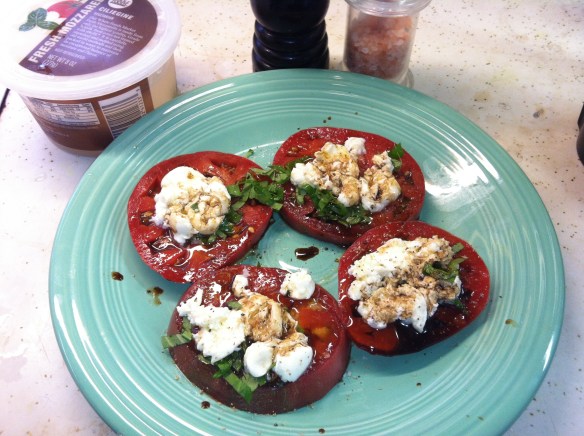
Insalata caprese sounds fancy, particularly when you say it with an Italian accent (try it: een-suh-LAHH-tuh kuh-PRAY-say), but it is almost as simple as eating over the sink. Here are the ingredients to assemble:

  • one large, ripe Brandywine tomato without soft spots
  • eight or so large fresh basil leaves
  • mozzarella cheese (I used Whole Foods brand without rBGH)
  • organic extra-virgin olive oil
  • balsamic vinegar (if you’re adventurous, try this version over the supermarket stuff—a little goes a very long way and although expensive, it’s not astronomical like some)
  • freshly ground salt (I love Himalayan pink salt)
  • freshly ground pepper
  1. With a serrated knife, slice the stem end off the tomato and cut the remainder into four thick slices. Put slices on plates (one or two per salad plate, or all four on a dinner plate for a full meal for one greedy tomato lover, ahem).
  2. Being careful not to crush them, slice the basil leaves crosswise and evenly distribute on top of the tomatoes.
  3. Slice the mozzarella and distribute evenly over tomatoes.
  4. Drizzle olive oil over each tomato slice.
  5. Drizzle balsamic vinegar over each slice.
  6. Season with freshly ground salt and pepper to taste.

That’s it. You will need a knife and fork. Now indulge in some summer bliss!

(You will want to drink the juices left on the plate and then lick the plate. I won’t tell.)