Getting healthy: adaptogens, chocolate berry and green smoothies, and sprouted lentil salad

My acupuncturist, who is consistently the healthiest, most vibrant person I know, told me at my last visit that I have a bit of adrenal depletion from the stresses of my 10-week contract editing job in a big technology company, now over. It was a long commute until everything was finally aligned for me to work from home the last two weeks.

When my contract ended, I had plans to swim, hike, and get outdoors, but my energy was low. All I wanted to do was veg out at home.

She told me to take over-the-counter rhodiola (for the endocrine system) and eleuthero (also known as Siberian ginseng). Both are adaptogens, meaning they are metabolic regulators that increase the ability to adapt to environmental factors both physiological and psychological, and avoid damage from such.

That means they help you recover from stress and alleviate its adverse effects.

After a week, I feel better. Yesterday I had a big surge of energy and walked 3.5 miles and kayaked for an hour. Today is a slow day. Tomorrow, I want to do some hiking and swimming. I want my full energy and vibrancy back!

She shared her diet with me:

  • For breakfast, a chocolate berry smoothie made with raw cacao, organic berries, chia and flax seeds soaked in filtered water for a couple of hours, coconut/almond milk, and whatever other kinds of goodies you want to add. I add pomegranate molasses, goji berries, coconut water or fresh grapefruit juice, maca powder, hemp seeds, and peeled ginger. Add other fruit if you like, but berries are awesome for brain health and not that laden with fructose. Filling up my blender yields about 3 servings, and I will sip on one all morning.
  • For lunch, a green smoothie made with something picked fresh from the garden (kale or chard), more soaked chia and flax seeds, and garlic. I add coconut water or grapefruit juice, hemp seeds, maca powder, turmeric, spirulina, ginger. I also added some packaged fresh spinach and lettuce and a leaf of Romaine, plus celery—what I had in the fridge. I will sip on one all afternoon.
  • She eats one regular meal a day, at dinner.
  • She eats some seaweed every day, like a sheet of nori that you’d use for sushi.
  • She sprouts lentils and finds ways to include them in her diet. I’ve been sprouting red lentils, which are so tiny, they soften and sprout quickly. Sprouting amplifies the nutrients in the lentils as it turns a dormant seed into a living plant.  The legumes become much easier to digest, and more minerals and enzymes become available. By eating them raw, you preserve the enzymes.

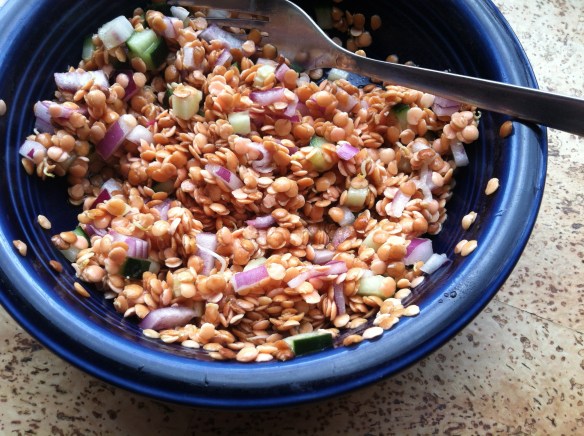
Here is my recipe for sprouted lentil salad:

  • Soak red lentils overnight in plenty of filtered water since they triple in size. Drain, rinse, and cover jar with a cloth. Rinse and drain every eight hours. You can use them as soon as they soften—they start releasing their goodness from soaking even before they sprout, or you can wait until they develop little sprouts in a day or two.
  • Give them a final rinse and put in a bowl. Refrigerate what you don’t use—they’ll last up to two weeks.
  • Add some chopped cucumber.
  • Add some chopped red onion.
  • Add 1 tsp of olive oil and 2-3 tsp. of apple cider vinegar or lemon juice, to taste.
  • Add a light sprinkling of good salt to taste and mix well.

sprouted lentil saladYou can tell I’m making this up as I go along, can’t you? : )

Try adding avocado, celery, tomato, green pepper, herbs, green onion, cabbage, beet, greens, carrot, apple, green (brown) lentils—your only limit is your sense of adventure!

The fear of emotional overwhelm

Ann, a new reader of this blog, recently sent me a message on my MaryAnn’s Bodywork and Changework Shop Facebook page that she is doing the trauma releasing exercises, and I thought I would move the discussion here so more people can participate:

hi maryann!

i have just discovered your blog online. thank you for sharing your story and advice to the world. i feel a kinship to you, as i am in the third month of my trauma releasing process.
i practice spring forest qigong (5 yrs)

i have done tre exercises 3 or 4 times a couple of months ago and now i can do them at will.

as fear and anxiety are aspects of myself that i am reclaiming/ integrating… i tend to stop the tremors that seem to want to happen a lot now because my mind wants to understand what is actually happening and will this clear the messages from the subconscious. i have apprehension that the amount i release will then need to be felt consciously afterwards and maybe i shouldn’t do them a lot so i can maintain a balance/ keep up with the processing of the emotions…. or do they just go away?…i saw that you posted to do them as much as they want to come out at first. any thoughts?

i have read that the symptoms come back if you stop…so how do they clear?

maybe they get pushed out in a continual cycle that allows you to consciously release what you can… the release just keeps them suspended for a time?

well, that’s enough thinking… any thoughts?

you are lovely.

heartfelt gratitude.

ann 

p.s. the other day i tremored, kicked, wailed, spoke in about 6 different languages… very grateful i have read waking the tiger as i guess you do need to release the things you would have done when you froze. in the english parts i said “no, i said no!” and i didn’t just “say” it. and at the end of it i went back into english and i said “NO. YOU GET OUT OF ME!” it felt awesome.

A little later, Ann sent the following message:

in re-reading this i could sum it up as : fear of emotional overwhelm 

Well put, Ann. To Ann and everyone else who has ever feared being overwhelmed emotionally, whether by grief, anger, or some other emotion (even bliss), I just want to say that this is very, very common.

We all have emotions. Infants and toddlers seem to have a very full range of them and express them freely and with their whole selves.

And at some young age, we begin to receive messages about emotions: which ones are good, which are bad (or positive and negative, if you prefer), which ones are not okay to express in public, maybe which are not okay to even have, which ones are harmful to repress or bottle up.

Maybe we’ve been on the receiving end of someone’s rage, bad boundaries, or lack of feeling, or have felt/not-felt those ourselves. Maybe we’ve felt emotional pain so strongly we’d do anything to avoid feeling it again, including numbing out for years.

No wonder we get messed up emotionally.

It can feel unsafe to let go emotionally, as if we could die or crumble or never come out on the other side. We fear our own emotions, especially the strong ones, because part of us wants to be in control, and emotions can be very intense.

Ann, it seems to me that needing to experience a balance between release and conscious processing is a belief you have acquired. Try on this belief and see if you like it: allowing the emotion/trembling/etc. to flow through you IS clearing the subconscious. You don’t have to understand it for it to work!

And if understanding does come, it will come AFTER you clear the channels and return to a calm state in which other parts of your brain can come online to create whole-brain insight.

I also imagine you experimenting with releasing as much emotionally/physiologically as you feel comfortable with for a few days, letting your conscious mind work at its own pace, and seeing for yourself what happens. That cannot mess you up—it’s just you discovering what mix of emotion and thought, conscious and unconscious works best for you.

I remember feeling rage about 10 years ago for the first time since I was about two, because it wasn’t acceptable in my family or in much of society. I was alone, remembering something I hadn’t thought about in years, when suddenly I had a different understanding of it that brought up hot, intense anger.

I didn’t know what was happening at first, so I kept allowing it to happen because I was curious—and alone. I am sure I got red in the face. There was definitely an upward surge of hot energy toward my head and a stiffening of my posture. I stopped in mid-stride.

Right after I was feeling the most intense anger, my inner witness was marveling, “So this is what rage feels like! I get it how steam comes out of Elmer Fudd’s ears and the grimace and posture he makes!”

It actually had a very, very cleansing effect. It renewed my self-esteem and motivated me to protect my interests. Afterwards, I felt like I had on a cloak of protection. It was actually near the beginning of my trauma recovery process, but I didn’t know that then.

Interestingly enough, fully allowing that rage to flow through me and feeling it completely took maybe 30 seconds. A very slow 30 seconds, to be sure.

Imagine: I had spent years denying/repressing my anger, and when I let it ripple through me, it only took half a minute of intensity, and the benefits were enormous and lasting.

Lesson 1: Emotions have two components. You experience them in your body, and they change you (you resolve an inner conflict, and then you take action: set a boundary, express a concern, reframe your identity, make a decision, right a wrong, and so on).

Lesson 2: You can allow yourself the experience of feeling the emotion fully without having to take action right away. That can come later. Unless the situation is life or death, you can let it settle before doing anything. That provides time for other less emotional parts of your brain to add their gifts on the wisest course of action for you to take. Meanwhile, you’re not bottling up something toxic.

Lesson 3: This is easier said than done. We’re all here in the School of Life. We mess up, we learn, we forgive, we grow.

So this is the thing. I can’t really tell you what’s right for you, but maybe these lessons can help you get through the labyrinth.

I found this quote on Tricycle Daily Dharma, and it’s perfect for this post:

The ebb and flow of life is not unlike the sea. Sure, sometimes it’s calm and serene, but at other times the waves can be so big that they threaten to overwhelm us. These fluctuations are an inevitable part of life. But when you forget this simple fact, it’s easy to get swept away by strong waves of difficult emotions.— Andy Puddicombe, “10 Tips for Living More Mindfully”

I would be remiss if I did not mention one of the best books I’ve read about emotions and their messages, The Emotional Hostage: Rescuing Your Emotional Life by Leslie Cameron-Bandler. It’s an oldie but goodie that helps you decode the purpose of each emotion and use your emotions to live more authentically.

Photos from Tom Best memorial

Scroll all the way down to the bottom of the right column and click the More Photos link (or just click this link) to view the photos I posted from Tom’s memorial service yesterday.

If you didn’t know him, maybe you can tell from the pictures how special he was.

I am happy I got to have him for a teacher and a model.

Many, many people helped make this happen, especially Katie Raver and Linaka Hana. Kudos, you two!


One happy introvert

I just spent three days—from Friday afternoon until Monday afternoon—with other people, on retreat, then preparing for and holding a celebration of the life of my dear teacher, Tom Best, who died about a month ago, and cleaning up afterwards.

I was with some of the dearest people I know. Smart, good, resourceful people. Beautiful, fun, funny, loving, adorable, competent, capable people. I met new people I’d love to know better. People came in from Serbia, Germany, Arizona, New York, Florida, and elsewhere.

Since nearly everyone there had at least taken NLP practitioner training (Tom taught NLP, but he really taught love), and some much more advanced training, the quantity and quality of resourcefulness present in the circle honoring him was probably more than I’ve ever experienced. Maybe more than I’m likely to experience again. Of course, I leave room for unlikely possibilities. I don’t know the future. But that was one illustrious company to be part of.

And finally, I am home, by myself, and it feels so expansive and relaxing to have this solitude.

I cherish this time to sort through my impressions, understand people more deeply, absorb and integrate the experience at my own pace.

Best gluten-free burger in Austin at Hopdoddy’s!

I’m not sure I’ve mentioned this, but my body does not digest wheat well at all. I learned this five or six years ago, and after going without it for a couple of months while on a strict diet to clear excess candida, I noticed a very unfamiliar feeling — I felt, well, well, and I had hardly any fatigue, digestive issues, or feeling like my mood and energy level were on a roller coaster ride. For the first time in, like, forever.

I changed my diet drastically, although it took time for me to really accept that if I ate that piece of pizza, I’d feel bad and “pay for it” later for a few days. I did learn, though. Over time, I learned that I can handle maybe a quarter teaspoon of wheat (such as dusted on blackened fish) without problems.

So being an all-American girl raised in Texas, I missed eating burgers. Not that they were ever a mainstay of my diet, but when you can’t have wheat, you find out what you miss. (Burgers and pizza.)

A couple of times I craved one so badly, I went out and ate one, gluten bun and all, and paid the price for satisfying my craving, which was several days of digestive upset and not feeling too well.

Then I’d make them at home with ground bison patty and toasted Ezekiel bread made from sprouted grains, which my body tolerates. (Toasting it is the only way to make it palatable, in my opinion.) It was good, but I still missed being able to just go out to a burger joint and eat a burger.

Well, today was bliss. I ate lunch with my daughter at Hopdoddy’s, a fairly new and very popular Austin restaurant on South Congress that offers a variety of burgers on a variety of buns — including gluten-free. I’d read reviews about how good their burgers were and that they offered gluten-free buns. I looked forward to tasting for myself.

This is what I had:

That, my friends, is a gluten-free bun, and it was light and kind of crispy on the outside. Toasted! And it actually had some flavor, too.

The Buffalo Bill burger (using bison from Thunderheart Bison, South Texas) came with blue cheese, apple-smoked bacon, “Frank’s hot sauce,” and “sassy sauce.”

All I can say is that it was delicious, and it feels so great to know I won’t feel ill. I’m not a big meat or burger eater, but it’s great to know I can indulge occasionally.

I’ll be back!

~~~

Postscript, 11/17/13: For a down-home, less expensive alternative to Hopdoddy’s, I’d also like to give kudos to Wholly Cow (downtown and South Lamar) for making grass-fed burgers (request Udi’s gluten-free buns) and for their awesome Fit Cross Paleo Burger, served with portabello mushroom caps in place of buns! Both made with local, grass-fed beef.

Share your story of healing or transformation through yoga

I received this as a comment on a recent post, but since comments are not that visible on this blog, I thought I’d give it its own post:

Hi there,

Do you have a story of healing or transformation with yoga that you’d like to share with the world? The Yoga Diaries is now accepting submissions. http://theyogadiaries.net/ Please spread the word!

Cheers, The Yoga Diaries

I may be doing the same with trauma recovery stories soon. Bloggers and blog readers, help each other out! I’m looking forward to reading stories about yogic transformation!

The simplest way to improve your posture

If you’re at all familiar with this blog, I bet you think I’m going to say meditation. Guess what? Ha ha, I’m not!

It’s way simpler than that:

Whenever you’re doing something that does not require use of your hands, turn them so that they’re palm-side up (see the picture above). You also can do it while standing or walking, leaving your arms down at your sides and turning your palms so that they face outward in the direction you’re facing.

This palms-up position may be familiar to committed meditators and yogis who practice shavasana, but it’s foreign to those of us who spend a lot of time at a computer, behind the wheel of a car, holding babies, making lattes, or doing pretty much anything else that requires constant hand use. Even when we’re not using our hands, it’s just habit to sit, walk or stand with our hands facing down or behind us.

Wait for it — there’s a meridian connection: 

In acupuncture, the meridians that run along the inside of the arm, from the chest/underarm to the palm, are Heart, Pericardium and Lung….

Here is just a smattering of the functions each meridian is involved in (there are many more):

  • Heart: breathing, cardiac function, sleep, emotional balance and heat regulation.
  • Pericardium: breathing, blood circulation and upper digestive function.
  • Lung: breathing, immune function, perspiration, body temperature and urination.

…our lifestyles force our hands and arms into an almost constant downward/backward position, creating a tendency to slouch forward. This causes us to cave our upper bodies inward, crunching the Heart, Pericardium and Lung meridians.

Allowing these meridians to flow more freely optimizes their ability to perform their respective functions.

These three meridians are all yin meridians, flowing from the torso to the fingertips.

This is a mudra (energetic gesture in Hinduism and Buddhism). The palms-up mudra, you might have guessed, has to do with receiving energy from spirit or the universe, with allowing. It has to do with being open and surrendering yourself to the Mystery.

Try it when you think about it. Let one or both palms rest facing up, or outward if you’re on your feet. Notice the subtle but significant changes in posture.

Then make it a habit.

Thanks to Sara Calabro for this article.

Reframing trauma recovery as detoxing the whole system

These days I’m thinking of trauma recovery more and more like detoxing.

We all know people — or even do this ourselves — who do fasts or cleanses to rid their bodies of toxins from too much sugar or alcohol, meat, or junk food, after taking drugs, after food poisoning, and so on. I’ve written about the colon/parasite cleanse and the liver/gallbladder flush on this blog. I’ve also done the Master Cleanse, once.

There’s a lot to be said for cleansing for getting rid of recent toxins as well as those that have accumulated in our systems over the years. The proof is feeling better afterwards. If you don’t feel better after doing a cleanse, don’t do it again. Try something else. Be good to your body. It works hard so that you may live and is taken for granted a lot.

Well, trauma recovery is like detoxing your entire system. It’s not so much getting rid of the toxins in your digestive system as letting the harsh, non-nourishing behavior and events that your whole system took in make their way back out of your system.

It may not be pretty, but it’s actually a good sign — it’s so much healthier than keeping it locked up inside, repressed, frozen.

I’m thinking now that there is a natural period after you are safe when you detox, unless you get stuck in a situation with no support for your detoxing, and that’s another story. You have a basis of comparison — safe versus non-safe — now. Because you are safe, you can start to relax. You might want to think, “Whew, that’s it. I’m safe now and can get on with my life.”

Well, that is true, and you will start to bloom. But you might not be prepared for stuff from the past unpredictably sneaking into the present and biting you on the butt. You might not be prepared for intense emotions that may arise. You might not be prepared for the cognitive reframing that occurs as your identity changes from victim to hero of your own journey.

You may sometimes feel pulled in various directions. It is unsettling.  It’s good to find a physical outlet that grounds you. Yoga, bicycling, and walking were all helpful to me. Those things are healthy to do anyway, but it really helps to feel like you have control of some part of your life (your body) at a time when your mind/heart/spirit are in such flux. Exercise/movement is grounding, and the sweat help you detox. Your system wants to release that stuff.

You may reach equilibrium that feels like a few days of inner peace, and then something else — a memory, a dream, a trigger — may come up for you to experience and integrate, bringing you to a new equilibrium, and that cycle repeats, with the periods of equilibrium getting longer and longer. Actually, it’s life.

You  eventually reach a state where the past pretty much stays in the past unless you decide to delve in.

My advice: Let it arise as it arises, because it will do that anyway. It’s a process; it takes time. Notice and honor it. Document it, even — at least write down your dreams.

And it might be good to let a few people know. Ask for help if you need it, and definitely ask for support. You have mine.

Tao Porchon-Lynch: teaching yoga, ballroom dancing videos

I found more videos of Tao Porchon-Lynch, the world’s oldest living yoga teacher. I just can’t get enough of her! She’s my inspiration, my role model for wellness, because what she can do now is based on what she did when she was much younger: a lifetime of good habits.

She looks, sounds, and feels so healthy! She seems to be wonderfully sweet and so full of vitality! Seeing her living so well is very motivating.

In the first video, she talks about yoga, and you see her teaching a class:

In the second video, she displays amazing ballroom dancing skills. That was filmed in 2009, when she was “only” 91. Her partner looks to be about one-third her age, yet they are well matched on the dance floor.

If you didn’t know, would you ever have guessed she was even over 70?

She has her own website here: http://taoporchon-lynch.com/.

Also, if you missed them, see my earlier posts, The world’s oldest living yoga teacher and More from the world’s oldest living yoga teacher: she tangos!

More from the world’s oldest living yoga teacher: she tangos!

I found this 2006 YouTube video of Tao Porchon-Lynch, whom I posted about recently in The world’s oldest living yoga teacher.

This video was made in 2006, when Tao was “only” 86.

Isn’t she adorable? I aspire to be like her when I’m 86.

Oh, and she also likes to waltz, jitterbug, samba, cha-cha, foxtrot, and tango.

“It lightens up your spirit,” she says.