50,000 views! Thanks, readers!

Sometime during the night, when July 3 was turning into July 4, my blog passed 50,000 views. I like milestones, and this one is pretty major! The fireworks tonight will have a little extra meaning for me because I am celebrating.

Who knew, when I started? It’s like relationships. No matter what promises are made, you don’t know if they’ll last until they do. There have been times when I’ve thought I had nothing to write about, and then something came up that I wanted to share. Early on, I had some connectivity problems and didn’t post for a couple of weeks, but since then, it’s rare for me not to post at least twice a week.

Since my last milestone posting in April, I’ve met with a psychic who told me that I’ve been a writer for many lifetimes, and that in one lifetime, I was a man who wrote with a quill pen.

I hope what I wrote was interesting, well-written, and effective. (Don’t you know I wish I knew the name of that previous self so I could look up his/my writings???)

Here’s a graphic from my WordPress dashboard displaying the views by month:

You can see how slow it was for the first year, 2010, when I averaged 11 views a day. It started taking off in 2011, and 2012 has been great, so far averaging 125 views per day.

I guess this really tells what it takes to be successful at blogging—that it takes time and consistent posting to build a following. The success is on my terms, too.

The most popular post of all time is an update on my Spartan trailer, which is off the wellness/aliveness topic. Search engines bring viewers interested in Spartan trailers here. Some may even stick around for the wellness stuff!

I wish I knew which posts were most popular with subscribers and regular readers, whom I believe are more interested in trauma recovery, health, wellness, and wisdom.

And okay, I am an eclectic blogger.

Subscribers and readers, what would you like to see more of? 

WordPress began showing views by country in February 2012. Here’s an image of the top 10 countries for viewers since then:
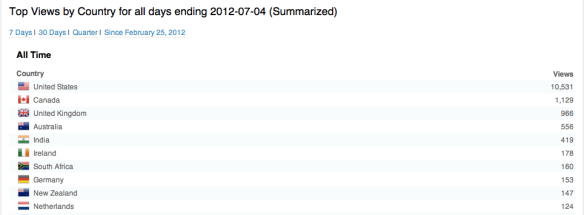
You can see that over 10,000 of the 50,000 views have occurred since late February, by Americans. That’s pretty amazing!

The bottom of the list is equally impressive. It’s amazing to realize that I’ve had viewers from distant countries like Liberia, Fiji, the Faroe Islands, New Caledonia, Libyan Arab Jamahiriya, and Zimbabwe.

I don’t even know where New Caledonia is. Wikipedia tells me it’s a French archipelago east of Australia in Melanesia.

The Faroe Islands are Danish Islands halfway between Norway and Iceland.

Hello and welcome. The Internet really does make the world smaller.

There is no master plan for this blog, except to post what interests me. As I build my massage practice and continue to investigate the keys to wellness, including new discoveries about the ways to be healthy, I’m sure I will blog more on those topics.

I love hearing from you via comments, likes, and shares.

Thank you, readers, for stopping by here, and I especially thank those of you devoted enough to subscribe. You really make it worth my while.

The price of busy-ness. If you need a massage, call me. I’m good.

I just encountered this great article, an opinion piece from the New York Times, about busy-ness and thought I’d share my thoughts.

Not only am I a recovering serious person, I’m also a recovering busy person. For several years, I worked full-time and went to graduate school while raising a child as a single mother. In hindsight, that was insane.

This downtime after my last contract job in the technology world ended about six weeks ago has been lovely. I’m recovering from adrenal exhaustion, and then, just when I was starting a running practice that I felt joyful about and ready for, I pulled a calf muscle and have had to lay low for longer while it heals. (It’s healing very nicely, with self-care and other healing hands working on it. Thanks, Brigitte and Pauline!)

The universe is telling me to slow down, and I’m listening. I’ve been letting a lot of stuff slide, trusting that the important things will rise to the top of the list and the rest will get done when and if they get to the top. One day at a time. I’m loving my daily Tarot readings, the cards that influence my awareness and development and trust in the universe. My favorite deck is the Osho Zen deck.

During this period I’ve also attended several trainings in Somatic Experiencing, which is based on the truly great trauma recovery research and writing of Peter Levine. (I’m currently reading In An Unspoken Voice: How the Body Releases Trauma and Restores Goodness.) I fell in love with it. The main premise is that trauma deregulates the nervous system (into freeze or fight or flight), and that the body can heal itself, with loving attention and guidance.

I’ve been practicing body awareness as well as writing about grounding, centering, and having boundaries. You can expect more posts along those lines.

I also seem to be developing an organic vision for my bodywork and changework practice that involves more teaching and writing. And—I am available now! Call me if you need a massage. I am really good, my rate is reasonable ($1 per minute), and I give discounts for regular customers and referrals.

Who knew that all this time, throughout the history of the human species with all of its atrocities and traumas, that the secret to trauma recovery was right there all along, being ignored by the mind, which in order to “be civilized” began to believe itself superior to the body?

How cut off are we from our own lives? Have you ever had something like this happen to you?

I recently wrote a friend to ask if he wanted to do something this week, and he answered that he didn’t have a lot of time but if something was going on to let him know and maybe he could ditch work for a few hours. I wanted to clarify that my question had not been a preliminary heads-up to some future invitation; this was the invitation. But his busyness was like some vast churning noise through which he was shouting out at me, and I gave up trying to shout back over it.

Self-importance is a joy killer, and that’s all most busy-ness is, when you get right down to it. If you are swept away in a current of busy-ness, why, then you must be somebody important! Or at least somebody.

It’s the opposite of being here now, of being present and grounded/centered/boundaried/etc. in your own body. It’s dissociation.

Here’s more, about a New York artist who moved to a village in the south of France:

What she had mistakenly assumed was her personality — driven, cranky, anxious and sad — turned out to be a deformative effect of her environment. It’s not as if any of us wants to live like this, any more than any one person wants to be part of a traffic jam or stadium trampling or the hierarchy of cruelty in high school — it’s something we collectively force one another to do.

How do we collectively force one another to be too busy to be real? It’s as I suspected:

Busyness serves as a kind of existential reassurance, a hedge against emptiness; obviously your life cannot possibly be silly or trivial or meaningless if you are so busy, completely booked, in demand every hour of the day.

I’m listening, feeling, and letting each day unfold while not losing myself in breathless busy-ness. Isn’t that what summer is for?

The space and quiet that idleness provides is a necessary condition for standing back from life and seeing it whole, for making unexpected connections and waiting for the wild summer lightning strikes of inspiration — it is, paradoxically, necessary to getting any work done.

Well, it’s almost noon, and I’m still in bed on this Monday morning, in bed with my laptop, tarot cards, book. Actually, my butt is getting numb, and I feel thirsty. I believe I’ll get up, stretch, drink some green tea, and mosey over to the yoga mat. I hear a down-ward facing dog calling my name.

Color, culture, and language: be warned, this is weird and fascinating!

The crayola-fication of the world: How we gave colors names, and it messed with our brains (part I) | Empirical Zeal.

The NLPer/cultural anthropology nerd in me was fascinated by this article, which looks at the names for colors among various cultures. In NLP, we say “the map is not the territory,” meaning we live through our maps of the world, not so much through the actual world, and language is a huge part of our maps.

Did you know that some cultures have only two words for colors, words that mean light and dark? All light and warm colors—white, reds, yellows, oranges, pinks—are called by the word meaning light, and all dark, shadowy, cool colors—blues, greens, browns, black—are called by the word meaning dark.

The Japanese language did not distinguish between blue and green until the 20th century, and only did so with American influence. (English recognizes 11 colors. It’s a colorful language.)

In studying words for colors across multiple cultures, researchers came up with algorithms for determining exactly where a color fits in with the shades in a color group. (Remember the 64-crayon box that had yellow-green and green yellow? Barely distinguishable, but one was slightly more yellowish and the other was slightly more greenish.)

The blog, Empirical Zeal, that published this publishes posts from several sources and all posts are written using primary sources. (Unlike my blog, obviously. I’m not a scientist, but I can appreciate science sometimes, and I really just like to share some of the amazing stuff I find out there on the inter webs. I think maybe “humanist” is a good description for my angle.)

The spectrum has no natural boundaries, it would seem, and the perception of color is not universal. Languages also change over time, and many have followed the same route. Since most languages have two to 11 names for colors, scientists have determined that the first two color terms will be light and dark, or white and black. The third will be red, and the next will be either green or yellow. Once both those distinctions come into use, green splits into two, and you now have blue. (The Japanese word for blue green is midori. Author’s note: Thanks to Tim for correcting me on this.)

The research done on native speakers of 110 different languages using 400 color tiles was called the World Color Survey. Further research used algorithms to distinguish color groups. The algorithms were fairly predictive of how actual cultures grouped shades.

The picture that’s emerging is that colors aren’t quite random slices of the visual pie. They’re somewhat basic categories that humans from different cultures gravitate towards, and must have to do with how the biology of how we see the world. In other words, rainbows have seams. We can distill a rainbow into its basic visual ingredients, and a handful of colors come out.

If you get to the end of this, click the link for Part Two, about how naming colors messes with our brains!

New toy: Yoga Teacher Barbie

She Exists: ‘I can be…’ A Yoga Teacher Barbie Doll.

Still with the feet. Bet she can’t do tree pose, and her triangle probably looks really weird.

Plus a chihuahua. Huh?

Get yours today, at Target.

Courtesy of Yogadork.

Practicing wellness of body, mind, heart, and spirit: James Altucher’s Daily Practice

One of my favorite discoveries in the blogging world is James Altucher. He’s a good prolific writer, inventive, irreverent, smart, down-to-earth, no-nonsense, and he comes across as a regular person who has learned from his mistakes.

I get the impression that he’s done really, really well in business, lost it all, started over, more than once. HBO, hedge funds, start-ups, investments, Wall Street, whatever. I don’t really know that world, but I imagine his blog reaches a lot of people in the financial world.

He’s also experienced some relationship ups and downs and a marriage that didn’t work out, and now he is married to Claudia Altucher, a yoga teacher. He practices yoga.

What impresses me most in his writing is that he combines his financial background with amazingly sensible wisdom about how to live life well. I follow him on Twitter and Facebook and look forward to reading his blog posts.

You can check out his blog here: The Altucher Confidential: Ideas for a World Out of Balance.

The reason I’m writing about him here on my blog is because he advocates doing something he calls The Daily Practice, which he calls

a simple tool to improve, inspire, and unlock greatness.

It’s pure genius and truly simple. He has three big goals in life:

  • He wants to be happy.
  • He wants to eradicate unhappiness in his life.
  • He wants every day to be as smooth as possible. No hassles.

If you’d like to achieve those goals in your life, read on.

James discovered that every time he hit a low point in life, after a major failure, feeling unhappy and hassled, he did something every day for himself in four areas that helped move him closer to the three big goals. You can do this too:

  1. Do something physical for yourself to get and keep yourself in good shape. He mentions doing yoga every day and exercising vigorously enough to break a sweat for 10 minutes. Being healthy is a prerequisite for being happy, and exercise also helps calm your mind. You get to choose how you want to do this.
  2. Do something emotionally good for yourself. He mentions that if someone is a drag on you, cut them out or minimize your time with them, and if they lift you up, spend more time with them. He mentions being honest without being hurtful and never doing anything you don’t want to do—he doesn’t go to weddings.
  3. Do something to stimulate yourself mentally. He suggests thinking of 10 businesses you can start from home or listing every productive thing you did yesterday. You could learn a foreign language in daily sessions, memorize a song, or do a crossword puzzle, whatever works for you. Altucher carries around waiter pads to write down his ideas.
  4. Practice something spiritual, which can include praying, meditating, being grateful, forgiving, or studying a spiritually uplifting text. I like this suggestion: You can also meditate for 15 seconds by really visualizing what it would be like meditate for 60 minutes. 

Altucher says every time he has hit a low point and then started doing things in these four areas every day, his life would improve. He’d begin to feel lucky. Ideas would flow, he’d start executing them, and people would help him. People would smile at him.

He calls this improving the internal fire. I think that concept is from yoga, but you get the picture. Living fully, in joy, lit from within.

I get that this is a great practice! And I want to think that I already do this, but you know what? I don’t keep track of what I do every day, and I haven’t tied my behavioral choices to three big goals. I have not made a commitment to work on myself daily in specific ways in these four areas.

Well, James has thought of that, and he has set up a website called The Daily Practice where you can set up your own activities in the four categories (plus a new fifth one, Fun) as well as how often you want to do them, and track your actual behavior.

It’s in beta right now, but I’m trying it out, and so far everything seems to work.

Also, your big three goals might be a little different. Who doesn’t want happiness? But I actually don’t mind a few occasional not-too-major hassles because they challenge me to grow, and that gives me something to write about. So my third goal is to spread the wellness and joy to others.

If you’d like to set up physical, mental, emotional, spiritual, and fun challenges for yourself and track your activity using The Daily Practice, go to tdp.me and set yourself up! It’s also a Facebook app, but you don’t have to share your postings. In fact, if you’re my friend, please don’t. TMI. Tell me your results, instead.

Today I have done a tarot reading and watched a fun movie (fun), meditated for 15 minutes and forgave someone I had problems with (spiritual), connected with two people who lift me up (emotional), read something stimulating (mental), and did sun salutations and slept well (physical).

Thanks, James!

Repost: Tracking the Hadzabe: One of Africa’s Last Nomadic Bush Tribes

Tracking the Hadzabe: One of Africa’s Last Nomadic Bush Tribes.

My friend and fellow writer Shelley Seale went to Africa and had one of the most interesting days I can imagine, spending time with the Hadzabe, a small, remote bush tribe who still live by hunting and gathering, speak using clicks, and are uninterested in seeing photographs. Fascinating!

She also camped in the Serengeti and awoke to giraffes grazing right outside her tent!

Lucky gal!

Buddha’s Brain supplements: an update

My October 2010 post about the supplements recommended in the book Buddha’s Brain now has links so you can order these supplements online from Amazon.com (which offers discounts for subscription shipping) if you wish.

Some of these supplements are difficult to find in stores, meaning Whole Foods doesn’t carry them.

Here’s the original post with the new links. None of the data has changed except an error about the recommended dosage of huperzine A. I changed mg to mcg after further research.

Share your story of healing or transformation through yoga

I received this as a comment on a recent post, but since comments are not that visible on this blog, I thought I’d give it its own post:

Hi there,

Do you have a story of healing or transformation with yoga that you’d like to share with the world? The Yoga Diaries is now accepting submissions. http://theyogadiaries.net/ Please spread the word!

Cheers, The Yoga Diaries

I may be doing the same with trauma recovery stories soon. Bloggers and blog readers, help each other out! I’m looking forward to reading stories about yogic transformation!

Knowing and Mystery walked into a bar…

The Curse Of Certainty In Science And Religion : 13.7: Cosmos And Culture : NPR.

Thought-provoking essay on an NPR blog (Cosmos and Culture) by Adam Frank about the only constant in life being change, and how we hunger for certainty, solidity, knowing.

Religions try to provide certainty:

Scriptures are transformed into unwavering blueprints for an unchanging order.

Science might seem the antidote to the constrictions of religion:

Science, in the purest forms of its expression as a practice, holds to no doctrine other than that the world might be known.

But:

When science as an idea is used to push away the tremulous reality of our lived existential uncertainty then it … becomes just another imaginary fixed point in a life without fixed points.

So how about “spiritual but not necessarily religious”?

The world’s history of spiritual endeavor contains many beautiful descriptions of authentic encounters with uncertainty. Ironically these often serve as gateways to the most compassionate experience of what can be called sacred in human life… Dig around in most of the world’s great religious traditions and you find people finding their sense of grace by embracing uncertainty rather than trying to bury it in codified dogmas.

For science, embracing uncertainty means…

… embracing the fuzzy boundaries of the very process of asking questions. It means embracing the frontiers of what explanations, for all their power, can do. It means understanding that a life of deepest inquiry requires all kinds of vehicles: from poetry to particle accelerators; from quiet reveries to abstract analysis.

So how can we live with so much uncertainty? We become patient, forgiving, generous, and inclusive. We find humor, good will, and compassion.

We embrace the mystery of ourselves and these lives we live. A little humility goes far.

I like knowing, or rather, believing I know. I’ve spent much of my life wanting to know, trying to know, believing if I just knew, then … I’d be protected from misfortune, or something like that.

Misfortune happened anyway.

Yet can I really know? Can I really know you? Can I really know truth? Can I even really know myself? No, I cannot.

I operate on assumptions that involve temporary (fictional) certainties. I cling to certainty from moment to moment as I go about my life, taking this-that-the other for granted, and it could all change in any given moment. Yes, tomorrow will come. Yes, I’m going to take that trip, do that thing in the future. I’m going to arrive safely on the other side of the street. I’m going to get home again. I’m going to be emotionally intact at the end of the day. I will see the people who have been important to me again.

And I don’t really know.

Knowing is a convenient truth that works better for me when I understand that it is always accompanied by something much bigger and more powerful, The Mystery. This is the sea of the Nagual.

15 Things You Should Give Up To Be Happy

15 Things You Should Give Up To Be Happy.

I was so impressed by reading 15 Power Things Happy People Do Differently that I checked out more of Purpose Fairy’s website and found another jewel.

This one, as the title says, is about things you can give up to increase your level of happiness.

These are things we often do without thinking, such as believing we cannot do something, talking negatively to ourselves, making excuses, being afraid. All are makers of unhappiness.

It seems easy to say something like “give up your need for control”. Hoo boy, this is a big one! We all would like to have more control over what happens to us! I know I would.

So here’s a way to examine it. Think of something that bothers you. Is it something you yourself do? Then you have some control over it.

If it is something another person does, then you don’t really have control. You might as well give up the needing to control them and just let them be them. Serenity Prayer and all. You will have less inner and outer conflict in your life and more inner and outer peace.

I want that.

You can make this list work for you by first noticing something that makes you feel unhappy. Go down the list. Are you blaming? Complaining? Criticizing? Trying to impress someone? Odds are, it’s on this list.

Now imagine what it would be like if you didn’t do that. How would your life be changed? What if you no longer had the ability to do that?

Try that on and see how it feels. See how you feel.

The beauty is, once you imagine it, you are changed. Your brain now has a choice that you may not have recognized before.

The  more you train your brain to be happy, the more it starts behaving in a happy way.

Before you know it, you’re a lot happier.