Glenn Close reads Neruda’s poem “I Like for You to Be Still”

love how poetry feeds my soul. enjoy this sunday bonus.

What if everybody only knew what we know about trauma?

Understanding Trauma | What a world if everybody only knew!.

Longtime readers know I’m a huge fan and grateful recipient of the trauma recovery work of Peter A. Levine. I’ve been exploring Beyond Trauma, the Somatic Experiencing blog. I just read the post linked to above and thought I’d share.

The post contains a link to a 30-minute podcast that inspires some great questions:

  • What if everybody knew that a fixated stress response (a.k.a. trauma) is the result of a disrupted neurophysiological process— a process that desires completion?
  • What if people knew that our sense of well-being can be recovered, even after surviving extreme events, as long as we receive proper support and facilitation (to complete those processes that were disrupted)?
  • What if everybody knew that this is not some arcane, exclusive field— that just about anyone can readily understand the most important aspects of stress and trauma?
  • What if everybody knew that tuning into our innate ability, as organisms, to respond and recover from trauma can significantly enhance our health and well-being?
  • What if we all knew that a change of perspective is taking place in the helping professions, one that places more emphasis on the critical role the body can play in easing distress?

The most effective diet tip of all

Get in touch with your hunger.

That’s all. Just get in touch with your hunger.

How long has it been since you actually felt hunger? We live with abundant food all around us, but our bodies haven’t evolved much from 10,000 years ago when the human species was hunting and gathering its food, feasting in times of plenty and going hungry in lean times.

Many modern people go for years without ever feeling hungry, so that when it does happen, they don’t know the sensation—and if they do know it, they gobble food down to avoid feeling it as quickly as possible. Feeling anything has become something to be avoided.

Many people eat according to the clock, not according to their stomachs. And we wonder why we have such an obesity problem. It’s not just the HFCS. It’s not being in touch with our bodies, with our hunger, with what “enough” actually is.

If you feel stuck with unnecessary weight or a poor diet, if you’ve used food to numb your feelings while comforting yourself, try this:

Postpone your next meal until you feel hungry and really notice the sensations in your body of feeling hungry.

There are wonderful wise lessons to learn from feeling hunger that can help you live a healthy life that you actually experience and enjoy first-hand.

  • You can allow yourself to feel hunger and know that you are going to survive. You are not going to starve to death from a little hunger (even though your mind may be telling you so). Death by starvation unfortunately did happen 10,000 years ago and sadly still happens even now, but it’s pretty rare in first world countries. How much discomfort is actually there, on a scale of 1 to 10 with 10 being excruciating discomfort? Can you feel it as simply sensation without judging it as painful?
  • You can recognize the signature of feeling hungry. How do you know it’s hunger? Where in your body do you feel it? Feel it for 5 or 10 or 30 minutes. How does it change—does it ebb or constantly get more intense? Do you forget sometimes that you’re feeling hungry? Can you distinguish between feeling hungry and feeling thirsty? What happens to your hunger if you drink water?
  • You can experiment with how much food, and what kinds of foods, you can eat to no longer feel hungry. After fully experiencing your hunger, eat three bites of food slowly, savoring the taste and the mouth-feel and thoroughly chewing each bite before swallowing. Wait one minute and notice your hunger again. How has it changed? Now eat three more bites and notice. Notice how many bites of food you need to eat for your hunger to go away, and notice how long it stays away before it returns.

You can totally play with eating in this way! A couple of weeks of eating like this is quite refreshing after mindless eating and pretty much guarantees that just by being in touch with your hunger and eating accordingly, you will drop a few pounds.

More importantly, you may feel more energy and gratitude for your life.

~

Caveat: When is it not a good idea to play with hunger? When you have issues with your blood sugar. If you are diabetic or pre-diabetic or have hypo- or hyperglycemia, or get really shaky when hungry, you need to take extra good care of yourself and consult a knowledgeable professional first.

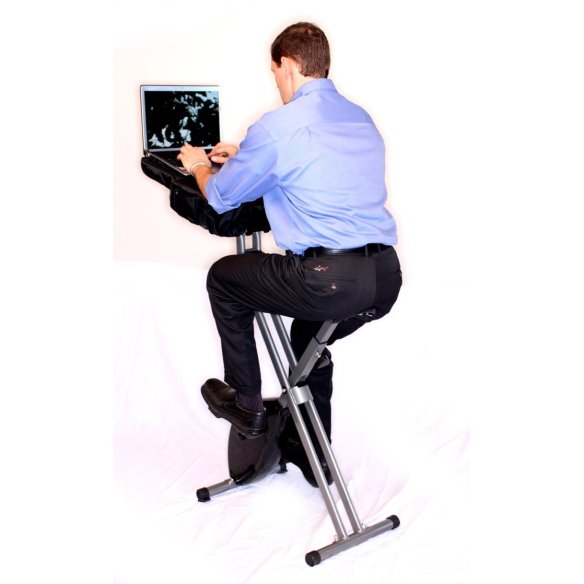
New alternative for sedentary desk work: the FitDesk

Since I’ve posted before on how prolonged sitting is unhealthy and how to counteract it, and I’ve promoted standing desks, I want to bring this to your attention (and thanks, Shelley Seale, for bringing it to mine).

This is on the heel of news that sitting less could add two years to your life expectancy.

It is a stationary bicycle with a desktop attached to the front of it. You can pedal and keep your leg muscles active, improve circulation, burn calories, circulate lymph, move cerebrospinal fluid, and more, while working or playing video games!

The FitDesk X Compact Pedal Desk is for sale on Amazon for $249.99. Amazon will cross-sell you a comfy bicycle seat and a laptop/iPad holder to go with it.

The seller offers a full refund (plus shipping) within 30 days if you are not satisfied with it. (Hint: Save the carton.)

One thing I really love about Amazon is reading the customer reviews. This product gets an average of 4.5 stars from 111 reviewers (all gave it 3 to 5 stars). Here are what some said:

  • A grad student in an online program lost 10 pounds the first month (30 lbs. over six months) using this product. She raves about the product being sturdy and quiet (quiet enough to use in the same room as a sleeping spouse), and about the customer service. The 2011 model has a timer/calorie counter/speed/distance monitor like stationary bikes at the gym.
  • Another reviewer mentions the great customer service: “Steve, the inventor of FitDesk, will answer your call or email himself. Some day he’ll probably have a huge company because this is such an awesome invention and then he won’t have time to talk to customers himself, but for the moment, he’s the best customer service rep you’ll ever talk to because he believes in his product and is doing everything he can to make it even better.”
  • The critical review rated “most helpful” gave the product 3 stars and said the exercise bike is not that great, that it’s hard to get a consistent pedaling rhythm. This reviewer is also an avid mountain biker who also regularly rides exercise bikes at the Y.

It sounds like it won’t compare to serious exercise bikes, but the whole point of it is not getting a strenuous workout but rather getting a light workout over time while getting computer work accomplished or playing video games.

Okay, okay! I want one! I’m drooling at the thought of cycling while writing blog posts! Would be awesome to have one at my next corporate stint.

The FitDesk weighs 33 lbs., holds users up to 250 pounds, and has a “seat extender” available for tall people. It is easy to fold up and move.

Also, there may (or may not, since the product is being continually improved) be issues with the electronic monitor, and I couldn’t get the straight dope on that.

The company has a video showing the product in use:

You can “like” FitDesk on Facebook (where they offer discount codes and giveaways) and follow @fitdesk on Twitter.

~~

Follow-up on 7.13.2012: The maker of the FitDesk has offered to send me one to try out! I love it! Will post on the experience, with photos!


What would you do if … ? Stories of conflict resolution.

What would you do in the following situations?

  • You’re a psychiatrist working in a mental hospital. A homicidal patient has hidden in the elevator. Without seeing him, you enter and close the door, which locks. The patient announces that he’s been waiting for you while everyone is at the other end of the ward, and now he’s going to kill you.
  • An illiterate punk robs your uncle, a beloved doctor who has a heart attack and dies, and the DA wants to charge him with a capital crime. The punk plans to plead guilty. The defense attorney asks your family for justice, not vengeance.
  • You’re a kindergarten teacher who learns that a student is ashamed of her father, who speaks with an accent, after you’ve invited the children to bring a parent to school to teach something they do.
  • A woman comes to you alone for couples counseling. She and her husband live together “for the sake of the children” but are estranged, embittered, and distant in every other way.
  • You’re asleep in your bed when a strange man kicks open the door to your bedroom. You’re a woman, home alone, unarmed, and the phone is downstairs.

These are just a few of the 61 real-life stories in the new book Sweet Fruit from the Bitter Tree by Mark Andreas. I highly recommend reading this book if you like being resourceful in situations of conflict and desire more peace in your life and in the world.

By the way, the psychiatrist asked the homicidal maniac exactly where he planned to kill him—in this spot or in that spot. While the would-be killer thought it over, the psychiatrist pulled out his key and unlocked the elevator. Calmly stepping out into the hallway, he points to a chair that the killer could sit in afterward. Then he points out another chair, and another at the end of the hallway.

Eventually they arrive at the station where the attendants are gathered.

The psychiatrist was Milton Erickson.

If you want to find out what happened in the other situations, order the book!

How to create inner peace

This morning I woke early and sensed a shift in my energy.

Without thinking about it, I started happily organizing some accumulated clutter in my bedroom that I’d been procrastinating on. I even fixed a couple of broken things. I cleared some space, found good places for stuff, and created more visual order.

I found a business card I’d been looking for, someone who asked me to contact her once I got my massage license, which I did about a month ago. I’ll call her today. Yay.

I do care about having an orderly home, and yet managing stuff (even living in a trailer!) often gets the better of me.  I make it a low priority. It’s not that I’m a terrible slob, although I’m sure I am in someone’s eyes. I pile things up to deal with later. I start doing things and get distracted and don’t finish. I leave stuff out to remind me that it’s not “done”. Then I notice I have a lot of piles, and clearing them seems like drudgery of the worst kind.

Today I created order and completion without thinking about it, because something opened up. I felt more upbeat. I was observing myself, thinking, “Wow, I am behaving differently. I like this. I feel energized and productive. Something has shifted. What happened?”

This is what I attribute the shift to. (Or perhaps the stars had something to do with it.)

On Tuesday evening, I went to bed aware of how much I mentally obsess about problems. By obsess, I mean they occupy my attention during times when I am not actually communicating with the person I have issues with, or I am imagining how I will handle something in the future. I do this often, usually not making much progress.

This ruminating helps me get clearer about my feelings and what I want, but it also distracts me from being fully present. I’m “in my head”. I’m feeling tense and anxious. I’ve become a slave to my thoughts, especially my fears. I get stuck and then don’t know how to stop. And then I become aware of my state.

It’s a way that I create my own suffering. I’d like to get out of my own way.

I vowed to myself that night that since this habit doesn’t really serve me all that well (except when it does give me insight and direction), that I was going to do something different yesterday.

I decided to dissolve my preoccupation. That is, when I realized that I was not feeling happy and present and content because my mind was rehashing some issue and I was feeling lack of joy in my body, I would take an impression, a snapshot, of my full experience—the images and words in my mind and the feelings in my body representing the person or the problem—and imagine that whatever power gave it substance (Higgs boson?) simply withdrew from it.

I saw, heard, and felt it fall apart. Images of faces and places, my own internal dialogue about it, and the worries, fears, and stuckness I felt in my body all lost coherence, dimensionality, reality. They fell apart into a pile of atoms that were swept away by the solar winds.

If it’s all illusion anyway, you might as well make it work for you. You can dissolve the illusions that don’t bring inner peace, joy, and freedom. It’s like dissolving whatever is within that keeps me from fully occupying and experiencing myself in this moment.

Mind you, I’ve just been doing this for one day, and I only did it a handful of times, but that was enough to create the energy shift I felt this morning.

If you’d like to try this, here you go:

  1. Think of something that’s been worrying, preoccupying, or troubling you, something you feel anxious or disturbed about.
  2. Take a snapshot of your whole internal state, and notice how you represent it. Is it a memory or something you imagine happening in the future? What does it look like? Are you telling yourself about it in an internal dialogue or monologue? What sensation are you feeling and where is it in your body?
  3. Just like a movie scene dissolves or fades so another scene can begin, allow the images to dissolve into pixels, dust, atoms. Turn down the volume of the sounds and words until you hear silence. Tune into your body and the sensations you are actually feeling. Let the feelings drain down into the ground. Note: It’s important to really take your time with this step. First you acknowledge your internal visions, words, and sensations. Then you allow each one to exit in a way that works for you.
  4. Notice the absence of the preoccupation. What are you experiencing? If there’s anything else related to the original state, allow it to fully exit.
  5. Bring back the images, words, and/or feelings. How is this experience different from the first time?
  6. Dissolve them again. How is this different from the first time?
  7. Imagine that any time in the future, when you notice you are not being present/feeling happy/being preoccupied, you have this powerful tool to create inner peace at your disposal.

Book reading: Sweet Fruit from the Bitter Tree, stories of compassionate communication, July 7

Mark Andreas, son of the eminent Neuro-Linguistic Programming (NLP) innovators Steve and Connirae Andreas, has published a book of stories called Sweet Fruit from the Bitter Tree. He’ll be in Austin on Saturday, July 7, reading from his book. You’re invited to attend. Details are below.

Click the link above to read a couple of stories on Amazon.com.

NLP and story-telling go hand in hand. We study two different language models (meta and Milton) in practitioner training, and of course, NLP arose in the mid-1970s from modeling the influential, effective linguistic patterns of Milton Erickson, Fritz Perls, and Virginia Satir (hypnotherapy, gestalt, and family therapy, respectively), none of whom were slouches at using a good story to great effect.

Sweet Fruit includes 61 stories by numerous authors, including Erickson, Steve Andreas, Robert Dilts, Tom Best (my dear late NLP teacher), Marshall Rosenberg (Non-Violent Communication), Muhammed Yunus (banker, Nobel Peace Prize winner), and many more.

These are real-life stories, not fiction. They are stories about people experiencing conflict both with others and within themselves, about how to stay connected through difficulty, about drawing on creative inner resources to resolve conflicts.

The book has received all 5-star reviews on Amazon.com. One reviewer says:

This book is a moving page-turner that brought me to laughter and to tears, but the best thing about it is the way the stories settle into your consciousness and keep surfacing over the days and weeks after you’ve read them. I’ve found myself applying principles I read about in the stories to situations in my own life without even noticing until I’m reflecting back later. “Sweet Fruit from the Bitter Tree” isn’t overtly trying to teach anyone how to live peacefully, but it goes ahead and does just that through its artful sharing of such varied human experiences of connection and conciliation.

Another reviewer wrote:

As a bodyworker, a big part of my job involves communication, so I started telling all my fellow bodyworkers about this book. Then one of them mentioned to me that no matter who we are or what we do for a living, our lives depend on compassionate communication. Good point. These inspirational stories help me think of different ways to view potentially harmful situations, and re-define what can lead to peaceful conflict resolution. These stories will make you laugh, make you cry, and above all get you thinking about your fellow human beings in a different way.

A friend of mine who got the book on Kindle says it reminds her of Rachel Naomi Remen’s Kitchen Table Wisdom. Every story expands your capability of being a more resourceful, generative human being.

There’s not much I love as much as listening to someone read a really good story aloud or tell a great story from their own experience. My parents read stories to my siblings and me when I was a child, and I’ve loved it ever since. I’ve been blessed to hear some really great storytellers tell some really great stories.

I’m going to an afternoon of readings from the book on July 7 sponsored by NLP Resources Austin. There will also be some exercises and discussion, followed by a book signing.

If you’re interested in attending, click here for details. You can bring your own book, buy one at the event, or just listen.

Hope to see you there.

Recovering from a pulled muscle, I apply my massage skills and heal. Voila!

A couple of weeks ago, I started self-training in running, and I was walking/running on the trail, building up endurance while avoiding fatigue and injury (so I intended). I’d done the warmups recommended by my trainer and felt really good in my running—lifting my knees, almost sprinting, feeling that great-to-be-alive, heart-pounding, hard-breathing experience of really challenging my body in a healthy way. I was loving the run!

Then, running up a hill, I pulled my left calf muscle. I immediately slowed to a walk, walked for about 10 minutes, and then (ruh roh), I decided it wasn’t so bad and ran some more.

Afterwards, I could feel the pull, but it seemed pretty minor. I could walk fine, without a limp. However, I did wisely decide not to run again until it felt really fine.

Six days passed, and I went to ecstatic dance, where everyone dances like no one is watching. I love this practice, moving to music, going with the flow, connecting with others, letting go, being part of the tribe. I can get pretty wild, jumping around with a big grin, leaping from foot to foot, being danced.

If you have no clue what I’m talking about, it’s like this:

The Power Wave

So anyway, while leaping about, I suddenly felt strong pain in my left calf. I limped to the side and did not feel like dancing any more.

Thinking it was my gastrocnemius (the superficial calf muscle), I had a massage therapist work on it that afternoon. I was still limping badly afterwards, although definitely more relaxed. I went home and iced it, and then…

 A massage magazine I’d been reading was next to my bed. I picked it up and saw there was an article by Dr. Ben Benjamin on the soleus, the deeper calf muscle. It included diagnostic tests, and I verified that it was my soleus muscle that was injured. (The image shows it without the gastrocnemius.)

Guess what? It could take 4-6 weeks to fully heal. That was depressing.

Benjamin (who also wrote the fantastic reference book about muscle injuries that belongs in the home library of every athlete (in my opinion), Listen to Your Pain) gave instructions for “friction therapy” massage, stretching, and strengthening. I also put ice on it, several times a day at first and now just once a day right after I do the clinical protocol.

My leg went from maybe 15 percent to 85 percent functional within a week. My limp gradually lessened, day by day. The calf still feels just a bit tight and tender. My hunch is that the last 15 percent of healing will happen more slowly.

Anyway, I feel really empowered about using clinical massage on my own injury and seeing (and feeling) rapid improvement.

I am ready to apply that to others.

Awareness through hearing: a three-minute exercise

All experience is embodied!

I feel like shouting that from the rooftop right now after several days of learning from and working with Bryan Mahan, Somatic Experiencing Practitioner.

There is no separation of body and mind except the one that the mind makes. When that happens, it’s called “not being in your body”. It’s also beginning to dawn on me that perhaps that is what “ego” is—and that is my mind playing and making busywork!

This may be a complete no-brainer (hah!) to you, but I can tell you that most people do not fully inhabit their bodies.

So here’s a three-minute experiment that could be quite profound in you experiencing life-as-it-is:

Use a timer. Spend one minute listening to actual sounds in your external environment. Notice whatever sounds enter your ears, even the background noises like the air conditioning that you usually tune out, as well as voices, TV, whatever, in the foreground. Notice sounds coming in your left ear and sounds coming in your right ear and sounds coming in both ears. Notice changes in sounds, rhythms and silence and pitch, as well. If your attention wanders, quickly bring it back to just listening.

After the minute is up, check in. What is the state of your bodymind?

Now spend one minute listening to your internal sounds. Swallow and notice the sound. Notice the sounds of your breathing, inhaling and exhaling. Notice your stomach rumbling. Is there a constant internal background noise? Do you have a sense of hearing your heartbeat or pulse? Notice pauses and rhythms.

Check in. What are you feeling? How are you experiencing yourself?

Now spend a minute letting your mind operate as it usually does. Notice your internal dialogue. Notice the quality of the dialogue. Is it wandering? Choppy? Inquisitive? Doubtful? Opinionated? Judgmental? Are there pauses, or is it constant? Is there a voice? If so, whose?

Check in. What’s happening?

I can tell you what my experience was.

After the first two exercises, I felt calm and present in my body. My mind thought, “I like this really hearing. There’s a lot of richness there. I feel happy.”

After the third exercise, I felt separate from my environment, with very little body awareness. I felt not present. I felt caught up in the future (“What’s for dinner?”—even though I’m not hungry at all) or the past (“Whoa, that was a bad experience”). My mind evaluated, “I don’t feel very calm or happy when I’m in my head like that.”

Now I could certainly write a long blah-blah-blah about this experience and what it “means”. I’m not.

I’d rather that you just let your experience speak to you itself. What literally makes you happy?

Some thoughts on mapmaking: A cameleopard made me write this post!

Thanks to my lovely subscriber, kissingthecockroach, for her inspiration!

She read a previous post, The 12 Symptoms of Spiritual Awakening, and commented that she had problems with #9, A loss of interest in interpreting the actions of others.

You know what? I also have problems with this one. That got me thinking.

I make mental maps of other people. Since I can’t be them, I try to understand them. I want to put myself in their shoes, to see the world through their eyes, to understand what makes them tick. And I can’t do that entirely, although I have found this effort worthwhile because it helped me develop my compassion for others’ experiences of life.

I notice someone do or say something that’s puzzling to me, and I become aware there’s a hole in my map of them, or an error that needs to be corrected.

My mind comes up with an explanation: “Oh, they said that because they were feeling insecure.” Sometimes I ask myself, after observing some very puzzling new behavior, “What probably happened to them that would explain that behavior?” (I’ve gotten clairvoyant hits on another’s experience that made me wish I had never been curious.)

I imagine that other people do the same with me. In fact, I believe it’s very difficult for human beings not to do this with each other. People are weird sometimes—strange, puzzling, nonsensical, difficult. Map-making, or interpreting the actions of others, is a major hobby for a lot of people. We like explanations, reasons, causality. We like to peg people, typecast them, make them fit our maps.

It’s a good practice to keep your map loose, ready to be redrawn at any time. You can take it for granted that any map has holes in it, and shortcuts and inaccuracies. Else it wouldn’t be a map, it would actually be the person, impossible to carry around in your head.

People are infinitely more alive and complex than anyone’s map could ever depict. Actually, people are infinitely more alive and complex than their own maps of themselves depict, much less those of others.

Also, time is an illusion, a useful convention we’ve devised. There is no past or future, only the present. Does the past explain the present, which explains the future? Maybe it works in reverse. Who can really say? We make these maps to create a consensual reality, and it falls way short of the real thing.

Who really knows why anyone does anything? The simplest explanation I know of is to attribute it all to chi, life force, moving vital energy. That’s how their chi flows in the present moment. Perceive it with wonder.

The most playful way of understanding the puzzles of living with others is to make like the medieval mapmakers and fill in the blank spots with images of beasts such as sea monsters, unicorns, and cameleopards.

In case you were wondering, here’s what a cameleopard looks like:

It makes me smile so much that just for the pure experience of more joy, when I don’t understand someone (or myself), instead of heavily puzzling on the reasons for their (my) behavior, I’m just going to attribute it to a cameleopard. Yes, a cameleopard made them (me) do it!

Doesn’t that feel lighter?