Brainwave optimization follow-up, two years later

I received a phone call yesterday from someone who had read my original post about receiving brainwave optimization. Barbara in Houston was considering it. She’d read this blog and wanted to hear some follow-up. We had a nice long conversation, and I felt inspired by her courage.

This month marks two years since I underwent brainwave optimization — five days of twice-daily sessions designed to help my brain function better using biofeedback.

I have no regrets about doing it. I’m glad I took that leap of faith.

Of course it’s impossible to say how I might be different had I not received it. It’s also impossible to separate the BWO from the meditation, diet, yoga, and other work I’ve done. (I still think BWO is probably the equivalent of five years of daily meditation.)

What I can say is that when I compare how I experience myself now and how I experienced myself then, now is better. I feel more myself — I occupy my body and my life more fully and with more pleasure and serenity and depth and wholeness than I did before. I make better decisions. I am happier.

One of my reasons for doing it was that I had experienced trauma in my childhood that plagued me with ill effects for decades. Facing the trauma, healing and integrating it were turning points toward health in my life. I wanted to see if brainwave optimization could relieve me from any more dysfunctional patterns that might remain.

Last year, a year after undergoing BWO, I did get triggered by someone who didn’t recognize the extent of his own traumatic experiences and was unable to communicate responsibly about it. I experienced the flood of stress hormones and adrenal exhaustion that went along with being triggered.

The useful part of that experience was being able to witness how those stress hormones affected my thinking. I got a clear sense of what I’m like unaffected by trauma and what I’m like after being triggered. Day and night. Equanimity vs. fear and anger. Sunshine and butterflies vs. creepy shadows with hidden monsters.

The unpleasant part was that it took months to completely clear the effects of the cascade of stress hormones and return to robust, excellent well-being. During this time, I forgot that I could have gotten follow-up sessions of brainwave optimization, which are much less expensive than the initial assessment and 10 sessions.

In hindsight, it would have been really smart of me to experience just enough of being triggered to learn its lessons and then to shorten my suffering by going in for some follow-up work. I don’t know if it would have worked, but I believe that it would have made a difference, because when you make an effort on behalf of your own well-being, that commitment to action makes a big difference and amplifies the measures you choose to take. 

I regret now that it did not occur to me to do that.

It’s clear to me now that undergoing BWO does not give someone who’s experienced trauma a bulletproof vest against being further traumatized or being triggered. It does give you more resilience, because experiencing wholeness is so desirable. The brain is aware of its own well-being and likes it and will return to it as soon as it can. That’s a big part of how BWO works, in my understanding.

If you’re not sure your brain has experienced well-being because of past trauma, or if it’s been so long it’s hard to remember what well-being was like, I recommend getting brainwave optimization. It can’t hurt, and if it doesn’t help in the way you think it might, then at the least you’ve ruled something out on your path to recovery. You have not left that stone unturned.

And it might help in ways you haven’t thought of, so please be open to that. It’s hard to describe well-being if you’ve never experienced it. It’s hard to know what to expect before you do it.

Also, the brainwave changes keep happening for a long time after you finish the treatments. Hold your story lightly and keep a journal. I have been told by people who’ve known me for awhile that I’ve changed for the better more than anyone they know.

I also take the Buddha’s Brain supplements to support my post-BWO brain health, and I recommend that.

Science says massage relieves stress!

Researchers assigned healthy adults to receive 45 minutes of Swedish massage while the control group received light touch “using highly specified and identical protocols.”

(This is from a New York Times article, Regimens: Massage Benefits Are More Than Skin Deep. Here’s the abstract.)

The researchers took blood samples immediately before and for up to an hour after the massage.

Those who received Swedish massage had significant decreases in stress hormones. Their white blood cell counts went up as well, indicating the immune system was stimulated.

If replicated, these findings may have implications for managing inflammatory and autoimmune conditions.

Those who received light touch showed higher levels of oxytocin, the “bonding” hormone, and greater decreases in a hormone that stimulates the adrenal glands to produce more cortisol.

So basically, massage relieves stress and light touch increases bonding.

Now that science says so, the skeptics can come get on the table and experience it for themselves!

Several things pop out. One is that the research was sponsored by the National Center for Complementary and Alternative Medicine, a branch of the National Institutes of Health. I’m pretty sure the NIH is heavily biased toward MDs and western medicine, and that NCCAM fields like massage and acupuncture are considered flaky and suspect.

But if 75 or 90% of illness is stress-related, shouldn’t the NIH be emphasizing research on stress relief to prevent illness? That would be a great use of my tax money!

I would like to see more studies done on massage.

  • I’d like to see the blood tested to see how long these changes last, because my strong hunch is that if a massage recipient can avoid stress afterwards, the massage keeps working on the body for hours. Maybe 24 or 48 hours, but no one knows, because no one has studied it. Yet.
  • Could a control group be added of people who don’t receive massage or light touch?
  • Scientific study of prenatal massage and its effect on the women — and their childbirth and babies — would be wonderful.
  • I’d also like to see recipients’ brain waves tested, before, during, and after massage.
  • Does massage work equally well on everyone? Are there people who don’t benefit and “super beneficiaries”?
  • This study was on the effects of a single massage. I’d like to see longitudinal studies done of the long-term effect of regular massage: people who receive massage weekly, biweekly, and monthly for at least a year, five years, and ten years. All we have now is anecdotal evidence that people who receive regular massage are healthier into their senior years, falling and getting sick less often and recovering faster when they do.

The other thing that popped out was that the researchers were surprised by the results! They must have never received a massage. I wonder if they do now.

When I read the abstract, I saw that the authors did a follow-up study in 2012 on the effects of repeated massage. So I did get one wish, but these subjects received Swedish massage or light touch either weekly or twice a week for just five weeks. Otherwise, it was the same as the first study, which means they looked for changes for up to an hour after each massage.

Those receiving weekly Swedish massage sustained a higher level of white blood cells like those receiving a single massage, with minimal effect on stress hormones. Come on, not even the first massage changed stress hormone levels? That contradicts the first study!

Those receiving twice-weekly massage had increased oxytocin levels and lower stress hormone levels. So people getting more frequent massage bond more easily. I wonder if they used the same massage therapist each time.

The abstract says nothing about the light touch group. (And by the way, I have a hard time reading scientific research and understanding the findings and implications in plain English. This is the best I can do. If you know better, please comment!)

The authors conclude:

There are sustained cumulative biologic actions for the massage and touch interventions that persist for several days or a week, and these differ profoundly depending on the dosage (frequency) of sessions. Confirmatory studies in larger samples are needed.

Yes. And I am very glad that this research is happening and raising more questions.

This is water.

Here’s a video made about a  commencement speech, about the banality that is the water we swim in in our modern daily lives, and where our freedom truly lies.

The capital T Truth is about life before death. It is about the real value of a real education, which has almost nothing to do with knowledge and everything to do with simple awareness, awareness of what is so real and essential, so hidden in plain sight all around us all the time, that we have to keep reminding ourselves over and over, “This is water. This is water.”

What does being healthy mean to you?

Quote

Health is a state of complete physical, mental and social well-being, and not merely the absence of disease or infirmity. ~World Health Organization, 1948

Words are important. They influence our thinking greatly, and therefore our behavior. I recently ran across this decades-old definition of health. It made an impression.

How do you characterize health? As “something is wrong” or as “something is right”? As something you move toward or away from?

As an experiment in the power of words, let’s take apart the statement above.

First, say to yourself, “Health is the absence of disease or infirmity.” What does that mean to you? How does it resonate?

To me, it means that as long as I don’t have a disease (that is, anything “wrong” with me, like cancer, chicken pox, an infection) or an infirmity (like being feeble or frail), then I am healthy.

Notice that the statement focuses on physical health. So as long as I avoid getting sick or infirm, I am healthy.

(You may also realize how much of the “health care system” is set up using this model. You go to the doctor to find out what’s wrong with you.)

Now say to yourself, “Health is a state of complete physical, mental, and social well-being.” Think about what that means to you.

What would it be like to have complete physical well-being? I imagine waking up each day completely refreshed from a good night’s sleep, feeling able-bodied, with a robust immune system working for me, and having stamina to spare as I go about my daily life. I imagine feeling vibrant, full of vitality, glowing with health.

I imagine eating healthily, getting regular massages, and exercising to maintain and improve my physical well-being.

How about complete mental well-being? What would that be like? Well, I think I would feel good about myself and others most of the time. I would acknowledge disappointments and disturbances, feel the pain, and let go of it, learning whatever I can from the experience.

I would sort whether information coming my way was true or useful, so I wouldn’t be a sucker for the latest buzz in my ears.

I would use both hemispheres of my brain, employing reason and intuition as needed.

I would make it a habit to develop my mental capabilities. Lifelong learning keeps your mind healthy.

Now, what about complete social well-being? What does that look/sound/feel like to you?

In my opinion, it would mean being centered in my own being, having good boundaries with others, and not needing drama in my relationships.

It would mean being open to others while trusting my own inner radar about what is true and good.

It would mean forgiving others but not being a doormat, allowing myself and others to be vulnerable, being trustworthy with good judgment about others’ trustworthiness, being accountable and expecting others to be accountable as well.

It would mean learning and growing from all my relationships.

I like the well-being definition (of course I do, look at the name of my blog!). It has a direction of “moving toward” rather than “avoiding,” which the absence definition does.

The well-being definition brings up a companion question:

How can I be healthier, physically, mentally, and socially?

And it’s that question that is constantly with me. Yes, of course, sometimes I rest, and sometimes I fall asleep, yet the inquiring has become a habit.

What clients say about integrative massage

One recipient of an integrative massage (which combines Swedish massage, Lauterstein deep massage, acupressure points, foot reflexology, body mobilization techniques, muscle testing, stretching, trigger point therapy, and craniosacral work, as needed and desired) wrote afterwards:

Just a note to say I really enjoyed our conversation and my massage. The massage you gave me has allowed me to sleep soundly two nights in a row. My stress level also feels much lower than usual. Thank you for enhancing my life with your friendship and magical/healing massages! Sending happiness & blessings & love your way.

Here’s a testimonial for an integrative massage I gave to a dear friend suffering from insomnia.

I sit here at my computer after the best night’s sleep I’ve had in weeks. I am so deeply grateful for your loving energy yesterday. Your integrity, touch, and presence were exactly what I needed to break open the clogged dam of emotions that’s been keeping me from sleep.

All throughout the massage, I could feel and take in your love and healing energy which is abundantly transferred through your hands. When you said ‘How you feel matters,’ my soul got the message that you cared enough to hear, see, and touch me.

When you did the cranial-sacral hold, I felt like I was being cradled by my mother.

You had asked the question, “What happened three weeks ago?” … My insomnia has been “waking me up” to the fact of unfinished business….

Your work allowed me to dive through the opening and swim the turbulent waters on top of a still well. I’m not quite at the still well yet, but I have faith that I’ll get there.

Another client wrote to say:

MaryAnn has a special gift to connect with you and gently nurture your entire being. She is unique in that she offers unconditional love so freely. I highly recommend her massage therapy. ❤

For more about The Well Ashiatsu Barefoot Massage Austin, see my home page.

What Ashiatsu clients say about it

Here’s what my clients are saying about Ashiatsu:

“Just got a great ashiatsu session from MaryAnn Reynolds in her cozy office on W. 12th Street. She was able to deliver bodywork with deep and responsive pressure, and my sore calves (hiking in vibrams anyone?) feel much looser & less painful now. Would highly recommend her bodywork as well as her deep personal knowledge of the body itself. Thanks!”

“I don’t know what you did to my shoulders last time, but afterwards they were so loose it felt like my hands were dragging on the ground.”

“That was the best massage I’ve ever had.”

“One Ashi session is the equivalent of three regular massages. It saves time and money and really gets the stress out. I feel great afterwards.”

“Ashiatsu is good medicine.”

“Great pressure and contact. Felt safe and cared for. MaryAnn knows her anatomy!”

“I loved this! It was very different, but I enjoyed experiencing these long, deep strokesVery refreshing experience. Thank you so much!!!”

“I really relaxed and felt better afterwards.”

Reiki at the end — great job — thank you!”

“I enjoyed her intuition and perception of my needs! Her ability to adjust and incorporate different strokes to better meet a particular need in my body. Thank you!”

My home page has more about The Well Ashiatsu Barefoot Massage Austin!

Two remedies for muscle pain that everyone should know about: arnica and epsom salt

A marathon took place this past Sunday in Austin, Texas, and I’ve seen a few runners who came in for massages. It surprises me that so many runners, triathletes, bicyclists, and people who work out are unaware of two over-the-counter remedies that are very effective at relieving muscle pain. Hence this blog post!

It’s not that I don’t want to see you on the massage table. I do. Massage has great benefits, including pain relief. But it’s like this: Very few people can afford to get massage every time they work their muscles hard enough that they feel pain afterwards. Wouldn’t that be nice, though?

In between massages, here’s how you can find relief from muscle pain. These are remedies professional athletes, dancers, and others who work their bodies hard use. I first learned about them 20 years ago while attending a dance workshop.

Arnica gel and tabletsarnicagel

Arnica montana is an herb that grows in Europe. The homeopathic pharmaceutical industry sells an arnica gel that you can apply to your skin to relieve pain. It’s clear, goes on cool, has no odor, and once it dries, you can’t tell it’s there.

You can also get arnica cream, which blends more easily with lotion or creamy sunscreen.

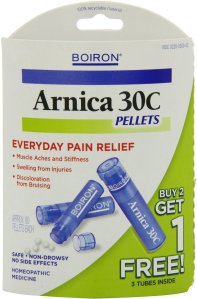
Arnica relieves muscles aches and stiffness, reduces swelling, and prevents bruising. It relieves osteoarthritis pain as well as ibuprofen, without any side effects. I always have it available when I’m doing massage, to apply to bruises and to extremely sore, stiff, or swollen muscles.

arnicapelletsIf you’re more adventurous, you can take arnica tablets. There’s a little trick to dispensing the tablets: twist the lid to loosen. Hold the container upside down and twist it, keeping the lid stable. Pellets will fall into the lid one at a time. When you’ve released 5 pellets, remove the lid from the container and empty the lid under your tongue. Let the pellets melt in your mouth.

If you know you will be doing something where you’ll be in pain afterwards, like lifting heavy boxes, gardening, getting Rolfed, hiking with a heavy pack, etc., take the tablets beforehand to prevent or lessen pain, or take it afterwards for whole-body relief.

Where to get arnica

Here’s the tricky part. People “in the know” like athletes and dancers use arnica, but the makers don’t advertise (as far as I know), so others tend to learn about arnica via word of mouth. To buy it, you need to go to a store that sells homeopathic medicines. Ordinary drug stores and groceries typically do not (although that may be changing), but compounding pharmacies and health food stores (including Whole Foods and Sprouts) do. If it’s not available where you live, you can buy it online.

Note: You may have heard people say homeopathy doesn’t work. If you’re skeptical, try this: The next time you feel muscle pain equally on both sides of your body, apply arnica to one side and do nothing to the other side. Wait a few hours or overnight and note the difference. Or you could apply it to half a bruise and see what happens.

Epsom salt baths

My second recommendation for muscle pain is taking epsom salt baths. Epsom salt (magnesium sulfate) is a mineral made from sea water that looks like rock salt. It has several uses, including taking internally to relieve constipation (taking too much orally can cause diarrhea) and fertilizing plants.

Fortunately, the body absorbs magnesium really well through the skin, and there are no adverse side-effects.

epsomsaltThe best use for sore bodies is to add two cups of epsom salt to a warm or hot bath and soak in it for 12-20 minutes. Swish the water until the epsom salt dissolves. If I take an epsom salt bath in the evening, it calms me and I sleep like a baby.

Epsom salt eases muscle cramps, pain, and inflammation. It reduces insomnia and anxiety. It pulls toxins out of cells, softens skin, improves blood circulation and oxygen use, increases the effectiveness of insulin, aids in nutrient absorption, lowers blood pressure, and relieves migraines and cold/flu symptoms.

Most of us are deficient in magnesium. Stress (including muscle overuse) depletes magnesium, and depleted magnesium creates stress, so it’s easy to get stuck in magnesium depletion.

I believe magnesium is the new Vitamin D because most of us don’t know we’re deficient, and once the deficiency is remedied, well-being increases.

I’m not the only one that thinks so.

According to the National Academy of Sciences, American’s magnesium deficiency helps to account for high rates of heart disease, stroke, osteoporosis, arthritis and joint pain, digestive maladies, stress-related illnesses, chronic fatigue and a number of other ailments.

The other component of epsom salt, sulfate aids joint health, improves absorption of nutrients, strengthens the gut lining, forms healthy brain tissue, and plays an essential role in detoxing. It may ease or prevent the pain of migraines.

If you think you might be deficient, take 2-3 epsom salt baths a week for a month. Once the blood levels reach optimum level, you stop absorbing it, so it’s safe.

Where to buy epsom salt

You can buy plain epsom salt at mainstream grocery stores and pharmacies. I bought a 4 pound bag from the Texas grocery chain H-E-B for $2.86. Four pounds makes 8 cups, so using two cups per bath, a bag provides enough for four baths at $.71 per bath.

Think about it: For a little over $2 per week, you could sleep like a baby, ease sore muscles, detoxify your body, improve digestion, lower blood pressure, and increase your feeling of well-being!

Bonus: You can reuse the bath water as a plant fertilizer! Epsom salt is often used to fertilize tomato and pepper plants as well as rose bushes. My bathtub drains into a hose that I can move around outside so various plants get the benefit of this fertilizer.

Also, you may see epsom salt sold in smaller quantities that’s had fragrant essential oils added. It’s usually marked up quite a bit. If you’re frugally experimental like me, you’ll want to get the plain generic epsom salt and experiment with adding your own fragrance.

For relaxation, add lavender, chamomile, frankincense, sandalwood, patchouli, or florals like rose, jasmine, neroli, geranium. To stimulate your energy, add citrus scents, mint, ginger, cinnamon, or rosemary. Put the scented epsom salt into pretty jars, tie with ribbons, and give as gifts.

Quote: Finding your spiritual home

From Martha Beck’s Daily Inspirations:

Many people take umbrage when someone sets out to find his or her spiritual home. If you embark on a similar journey, you should expect some people to be shocked, to be angry, to tell you you’re breaking the rules. That has certainly been my experience. However, the rewards are inexpressibly wonderful. Heading towards that inner home will take you places—both inside yourself and in the external world—which your heart will recognize as its native environment, even though you have never been there before. I would go so far as to say that this may be the purpose for human life; that we are set free into a lonely universe like homing pigeons meant to find our way back to joy.

I just love this lady. She’s incredibly wise and insightful.

Beautiful video of the Earth’s ocean currents

Love this video produced by NASA of our planet’s ocean currents.

The man who taught the biodynamic craniosacral therapy training I took last week shared this. We have currents inside and all around us.

If that metaphor had been a snake, it would have bit me!

If you don’t remember from high school English what a metaphor is, it is a figure of speech in which a word or phrase ordinarily used to designate one thing is used to designate something else.

Examples: Time is money. Life is a journey. She’s dancing toward happiness. When I reach the top of that mountain, then I’ll be free. I’ve got a knot in my stomach. He’s a real pain in the ass. Let me get something off my chest. Give me a hand. I’m looking for the right path. There’s a light at the end of the tunnel. If the shoe fits, wear it. The map is not the territory. Life is like a box of chocolates. It’s like pulling teeth. It’s like herding cats. The poem points a finger at the moon. Before/after enlightenment, chop wood, carry water.

In each of these examples, the metaphor uses a word or phrase that has a literal, embodied meaning (people do reach the tops of mountains, journeys exist, lights at the ends of tunnels exist) to symbolize an experience.

I’ve been paying attention to metaphors in conversation and writing, and it’s almost unbelievable how pervasive they are. Metaphors are everywhere! I can’t turn around without bumping into a metaphor! If that metaphor had been a snake, it would have bit me!

I’m writing about metaphors because I just spent some time learning the basics of and practicing Symbolic Modelling, aka Clean Language, an approach to changework, which is another hat I wear. (See?)

The workshop and retreat were led by James Lawley and Penny Tompkins. Their book is Metaphors in Mind: Transformation through Symbolic Modelling, and their website is The Clean Collection.

I’m going to be writing more about this, but for now, let me offer some prompts to discover your own personal metaphors.

Fill in the rest of the sentence:

Life is [like] ….

Time is ….

Money is …..

Love is ….

Work is ….

See you back here soon with more on this topic!