What if everybody only knew what we know about trauma?

Understanding Trauma | What a world if everybody only knew!.

Longtime readers know I’m a huge fan and grateful recipient of the trauma recovery work of Peter A. Levine. I’ve been exploring Beyond Trauma, the Somatic Experiencing blog. I just read the post linked to above and thought I’d share.

The post contains a link to a 30-minute podcast that inspires some great questions:

  • What if everybody knew that a fixated stress response (a.k.a. trauma) is the result of a disrupted neurophysiological process— a process that desires completion?
  • What if people knew that our sense of well-being can be recovered, even after surviving extreme events, as long as we receive proper support and facilitation (to complete those processes that were disrupted)?
  • What if everybody knew that this is not some arcane, exclusive field— that just about anyone can readily understand the most important aspects of stress and trauma?
  • What if everybody knew that tuning into our innate ability, as organisms, to respond and recover from trauma can significantly enhance our health and well-being?
  • What if we all knew that a change of perspective is taking place in the helping professions, one that places more emphasis on the critical role the body can play in easing distress?

Another reader shares his experience with the trauma releasing exercises

Several readers have shared their experiences of doing the trauma releasing exercises of David Berceli here on this blog. Here’s a new report. David writes:

I ordered the video and it arrived yesterday. I tried the exercises for a second time today. I did the preparatory stretches and then did the wall position. Leaning against the wall I just tried to get deeper into my breathing, but for the longest time very little happened. I was having little tremors, but they still felt half-way forced.

Then gradually, after about seven minutes, some real trembling and shaking started. The more relaxed I became the more pronounced they were. I had no control over them at all. I almost felt like shouting down to my wife to come upstairs and see what was happening, because it was so strange. Just overall, rapid involuntary tremors in my legs, through my pelvis and along my torso. They went on and on for at least ten minutes.

Then I tried the lying position and it was less successful. Still, I’m grateful I tried and I’ll keep doing them.

Thank you, David, for writing.

Doing the exercises can generate the release of muscle tension in the form of shaking and trembling, but it doesn’t happen automatically.

It’s great that David kept at it. Tried the exercises a second time and continued to be willing for the trembling and shaking to start after having little “half-way forced” tremors.

There is a step in inducing tremors for the first time that no one can instruct you how to do. Between doing the exercises and involuntarily shaking and trembling, there’s a step that I think of as surrendering. It is a skill, but it’s a skill of “not doing” rather than doing. You have to be able to let go of your need to control your body.

That can be scary, but it can be done.

For some people, surrendering is easy and natural. For others, especially people who have been traumatized and who are carrying tension in their bodies, it isn’t easy or natural at all.

If you are one of these people, I urge you not to give up. Just keep at it and eventually you will surrender and shake.

The most effective diet tip of all

Get in touch with your hunger.

That’s all. Just get in touch with your hunger.

How long has it been since you actually felt hunger? We live with abundant food all around us, but our bodies haven’t evolved much from 10,000 years ago when the human species was hunting and gathering its food, feasting in times of plenty and going hungry in lean times.

Many modern people go for years without ever feeling hungry, so that when it does happen, they don’t know the sensation—and if they do know it, they gobble food down to avoid feeling it as quickly as possible. Feeling anything has become something to be avoided.

Many people eat according to the clock, not according to their stomachs. And we wonder why we have such an obesity problem. It’s not just the HFCS. It’s not being in touch with our bodies, with our hunger, with what “enough” actually is.

If you feel stuck with unnecessary weight or a poor diet, if you’ve used food to numb your feelings while comforting yourself, try this:

Postpone your next meal until you feel hungry and really notice the sensations in your body of feeling hungry.

There are wonderful wise lessons to learn from feeling hunger that can help you live a healthy life that you actually experience and enjoy first-hand.

  • You can allow yourself to feel hunger and know that you are going to survive. You are not going to starve to death from a little hunger (even though your mind may be telling you so). Death by starvation unfortunately did happen 10,000 years ago and sadly still happens even now, but it’s pretty rare in first world countries. How much discomfort is actually there, on a scale of 1 to 10 with 10 being excruciating discomfort? Can you feel it as simply sensation without judging it as painful?
  • You can recognize the signature of feeling hungry. How do you know it’s hunger? Where in your body do you feel it? Feel it for 5 or 10 or 30 minutes. How does it change—does it ebb or constantly get more intense? Do you forget sometimes that you’re feeling hungry? Can you distinguish between feeling hungry and feeling thirsty? What happens to your hunger if you drink water?
  • You can experiment with how much food, and what kinds of foods, you can eat to no longer feel hungry. After fully experiencing your hunger, eat three bites of food slowly, savoring the taste and the mouth-feel and thoroughly chewing each bite before swallowing. Wait one minute and notice your hunger again. How has it changed? Now eat three more bites and notice. Notice how many bites of food you need to eat for your hunger to go away, and notice how long it stays away before it returns.

You can totally play with eating in this way! A couple of weeks of eating like this is quite refreshing after mindless eating and pretty much guarantees that just by being in touch with your hunger and eating accordingly, you will drop a few pounds.

More importantly, you may feel more energy and gratitude for your life.

~

Caveat: When is it not a good idea to play with hunger? When you have issues with your blood sugar. If you are diabetic or pre-diabetic or have hypo- or hyperglycemia, or get really shaky when hungry, you need to take extra good care of yourself and consult a knowledgeable professional first.

What would you do if … ? Stories of conflict resolution.

What would you do in the following situations?

  • You’re a psychiatrist working in a mental hospital. A homicidal patient has hidden in the elevator. Without seeing him, you enter and close the door, which locks. The patient announces that he’s been waiting for you while everyone is at the other end of the ward, and now he’s going to kill you.
  • An illiterate punk robs your uncle, a beloved doctor who has a heart attack and dies, and the DA wants to charge him with a capital crime. The punk plans to plead guilty. The defense attorney asks your family for justice, not vengeance.
  • You’re a kindergarten teacher who learns that a student is ashamed of her father, who speaks with an accent, after you’ve invited the children to bring a parent to school to teach something they do.
  • A woman comes to you alone for couples counseling. She and her husband live together “for the sake of the children” but are estranged, embittered, and distant in every other way.
  • You’re asleep in your bed when a strange man kicks open the door to your bedroom. You’re a woman, home alone, unarmed, and the phone is downstairs.

These are just a few of the 61 real-life stories in the new book Sweet Fruit from the Bitter Tree by Mark Andreas. I highly recommend reading this book if you like being resourceful in situations of conflict and desire more peace in your life and in the world.

By the way, the psychiatrist asked the homicidal maniac exactly where he planned to kill him—in this spot or in that spot. While the would-be killer thought it over, the psychiatrist pulled out his key and unlocked the elevator. Calmly stepping out into the hallway, he points to a chair that the killer could sit in afterward. Then he points out another chair, and another at the end of the hallway.

Eventually they arrive at the station where the attendants are gathered.

The psychiatrist was Milton Erickson.

If you want to find out what happened in the other situations, order the book!

How to create inner peace

This morning I woke early and sensed a shift in my energy.

Without thinking about it, I started happily organizing some accumulated clutter in my bedroom that I’d been procrastinating on. I even fixed a couple of broken things. I cleared some space, found good places for stuff, and created more visual order.

I found a business card I’d been looking for, someone who asked me to contact her once I got my massage license, which I did about a month ago. I’ll call her today. Yay.

I do care about having an orderly home, and yet managing stuff (even living in a trailer!) often gets the better of me.  I make it a low priority. It’s not that I’m a terrible slob, although I’m sure I am in someone’s eyes. I pile things up to deal with later. I start doing things and get distracted and don’t finish. I leave stuff out to remind me that it’s not “done”. Then I notice I have a lot of piles, and clearing them seems like drudgery of the worst kind.

Today I created order and completion without thinking about it, because something opened up. I felt more upbeat. I was observing myself, thinking, “Wow, I am behaving differently. I like this. I feel energized and productive. Something has shifted. What happened?”

This is what I attribute the shift to. (Or perhaps the stars had something to do with it.)

On Tuesday evening, I went to bed aware of how much I mentally obsess about problems. By obsess, I mean they occupy my attention during times when I am not actually communicating with the person I have issues with, or I am imagining how I will handle something in the future. I do this often, usually not making much progress.

This ruminating helps me get clearer about my feelings and what I want, but it also distracts me from being fully present. I’m “in my head”. I’m feeling tense and anxious. I’ve become a slave to my thoughts, especially my fears. I get stuck and then don’t know how to stop. And then I become aware of my state.

It’s a way that I create my own suffering. I’d like to get out of my own way.

I vowed to myself that night that since this habit doesn’t really serve me all that well (except when it does give me insight and direction), that I was going to do something different yesterday.

I decided to dissolve my preoccupation. That is, when I realized that I was not feeling happy and present and content because my mind was rehashing some issue and I was feeling lack of joy in my body, I would take an impression, a snapshot, of my full experience—the images and words in my mind and the feelings in my body representing the person or the problem—and imagine that whatever power gave it substance (Higgs boson?) simply withdrew from it.

I saw, heard, and felt it fall apart. Images of faces and places, my own internal dialogue about it, and the worries, fears, and stuckness I felt in my body all lost coherence, dimensionality, reality. They fell apart into a pile of atoms that were swept away by the solar winds.

If it’s all illusion anyway, you might as well make it work for you. You can dissolve the illusions that don’t bring inner peace, joy, and freedom. It’s like dissolving whatever is within that keeps me from fully occupying and experiencing myself in this moment.

Mind you, I’ve just been doing this for one day, and I only did it a handful of times, but that was enough to create the energy shift I felt this morning.

If you’d like to try this, here you go:

  1. Think of something that’s been worrying, preoccupying, or troubling you, something you feel anxious or disturbed about.
  2. Take a snapshot of your whole internal state, and notice how you represent it. Is it a memory or something you imagine happening in the future? What does it look like? Are you telling yourself about it in an internal dialogue or monologue? What sensation are you feeling and where is it in your body?
  3. Just like a movie scene dissolves or fades so another scene can begin, allow the images to dissolve into pixels, dust, atoms. Turn down the volume of the sounds and words until you hear silence. Tune into your body and the sensations you are actually feeling. Let the feelings drain down into the ground. Note: It’s important to really take your time with this step. First you acknowledge your internal visions, words, and sensations. Then you allow each one to exit in a way that works for you.
  4. Notice the absence of the preoccupation. What are you experiencing? If there’s anything else related to the original state, allow it to fully exit.
  5. Bring back the images, words, and/or feelings. How is this experience different from the first time?
  6. Dissolve them again. How is this different from the first time?
  7. Imagine that any time in the future, when you notice you are not being present/feeling happy/being preoccupied, you have this powerful tool to create inner peace at your disposal.


Book reading: Sweet Fruit from the Bitter Tree, stories of compassionate communication, July 7

Mark Andreas, son of the eminent Neuro-Linguistic Programming (NLP) innovators Steve and Connirae Andreas, has published a book of stories called Sweet Fruit from the Bitter Tree. He’ll be in Austin on Saturday, July 7, reading from his book. You’re invited to attend. Details are below.

Click the link above to read a couple of stories on Amazon.com.

NLP and story-telling go hand in hand. We study two different language models (meta and Milton) in practitioner training, and of course, NLP arose in the mid-1970s from modeling the influential, effective linguistic patterns of Milton Erickson, Fritz Perls, and Virginia Satir (hypnotherapy, gestalt, and family therapy, respectively), none of whom were slouches at using a good story to great effect.

Sweet Fruit includes 61 stories by numerous authors, including Erickson, Steve Andreas, Robert Dilts, Tom Best (my dear late NLP teacher), Marshall Rosenberg (Non-Violent Communication), Muhammed Yunus (banker, Nobel Peace Prize winner), and many more.

These are real-life stories, not fiction. They are stories about people experiencing conflict both with others and within themselves, about how to stay connected through difficulty, about drawing on creative inner resources to resolve conflicts.

The book has received all 5-star reviews on Amazon.com. One reviewer says:

This book is a moving page-turner that brought me to laughter and to tears, but the best thing about it is the way the stories settle into your consciousness and keep surfacing over the days and weeks after you’ve read them. I’ve found myself applying principles I read about in the stories to situations in my own life without even noticing until I’m reflecting back later. “Sweet Fruit from the Bitter Tree” isn’t overtly trying to teach anyone how to live peacefully, but it goes ahead and does just that through its artful sharing of such varied human experiences of connection and conciliation.

Another reviewer wrote:

As a bodyworker, a big part of my job involves communication, so I started telling all my fellow bodyworkers about this book. Then one of them mentioned to me that no matter who we are or what we do for a living, our lives depend on compassionate communication. Good point. These inspirational stories help me think of different ways to view potentially harmful situations, and re-define what can lead to peaceful conflict resolution. These stories will make you laugh, make you cry, and above all get you thinking about your fellow human beings in a different way.

A friend of mine who got the book on Kindle says it reminds her of Rachel Naomi Remen’s Kitchen Table Wisdom. Every story expands your capability of being a more resourceful, generative human being.

There’s not much I love as much as listening to someone read a really good story aloud or tell a great story from their own experience. My parents read stories to my siblings and me when I was a child, and I’ve loved it ever since. I’ve been blessed to hear some really great storytellers tell some really great stories.

I’m going to an afternoon of readings from the book on July 7 sponsored by NLP Resources Austin. There will also be some exercises and discussion, followed by a book signing.

If you’re interested in attending, click here for details. You can bring your own book, buy one at the event, or just listen.

Hope to see you there.

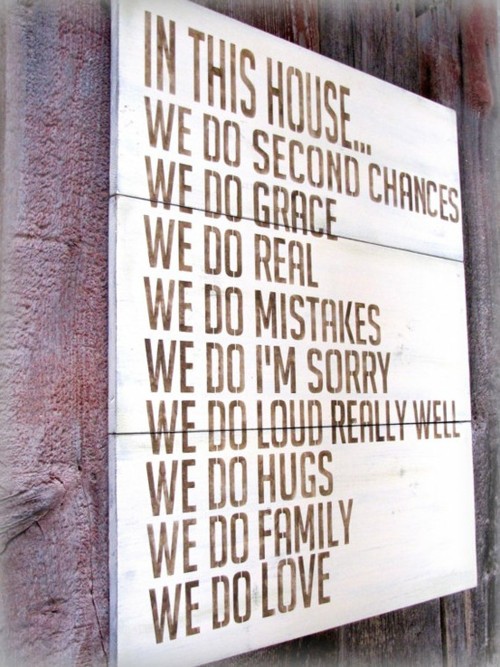
In this house…we do love

Sharing an image I saw on Elephant Journal. I dedicate this to all my families—past, present, future, blood-related, my ohana, the communities and tribes I belong to, including the animal members. (Waylon Lewis’ family is his dog.)

And, okay, so maybe I’d substitute laughter for loud and my grace may a silent gratitude, but the rest of it stands. What would you add or subtract?

It’s available (in slightly different form) as a vinyl wall sticker decal here on Etsy.

in this house...we do love

The 12 Symptoms of Spiritual Awakening

Image

The 12 Symptoms of Spiritual Awakening

Making the rounds on Facebook, worth sharing here.

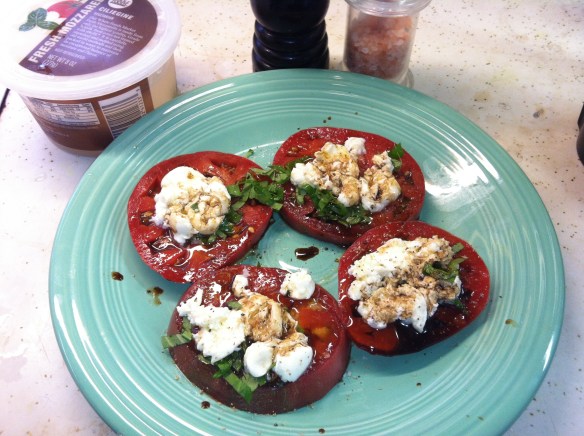
The easiest, tastiest summer salad imaginable: insalata caprese

Last Sunday, it was my turn to cook dinner for my friend. I wanted to serve food that was healthy, seasonal, and delicious, and I went to the farmer’s market on Saturday for inspiration.

Heirloom tomatoes are in season, and they are exceptionally delicious. However, they don’t keep for a long time like the modern tomatoes do. Eat ’em right up is what I say, and never let them see the inside of your refrigerator. Buy organic, please. Support your health and the growers. Or grown your own.

I have been known to get home with an heirloom tomato and eat it immediately, standing over the sink to catch the juice.

In hindsight, I could have invited my friend to do the same—that would have made the dinner memorable, and it would have been a fun surprise—but alas, that didn’t occur to me at the time.

Instead, I served insalata caprese, which Wikipedia tells me means “salad in the style of the island of Capri.” Capri is an island off the coast of southern Italy (the front of the “ankle” of Italy’s boot). That area, Campania (where Naples and Mount Vesuvius are also located), has a rich gastronomic history, being the birthplace of pizza and spaghetti, as well as being one of the first areas of Europe to fall in love with that New World wonder, the tomato.

Insalata caprese sounds fancy, particularly when you say it with an Italian accent (try it: een-suh-LAHH-tuh kuh-PRAY-say), but it is almost as simple as eating over the sink. Here are the ingredients to assemble:

  • one large, ripe Brandywine tomato without soft spots
  • eight or so large fresh basil leaves
  • mozzarella cheese (I used Whole Foods brand without rBGH)
  • organic extra-virgin olive oil
  • balsamic vinegar (if you’re adventurous, try this version over the supermarket stuff—a little goes a very long way and although expensive, it’s not astronomical like some)
  • freshly ground salt (I love Himalayan pink salt)
  • freshly ground pepper
  1. With a serrated knife, slice the stem end off the tomato and cut the remainder into four thick slices. Put slices on plates (one or two per salad plate, or all four on a dinner plate for a full meal for one greedy tomato lover, ahem).
  2. Being careful not to crush them, slice the basil leaves crosswise and evenly distribute on top of the tomatoes.
  3. Slice the mozzarella and distribute evenly over tomatoes.
  4. Drizzle olive oil over each tomato slice.
  5. Drizzle balsamic vinegar over each slice.
  6. Season with freshly ground salt and pepper to taste.

That’s it. You will need a knife and fork. Now indulge in some summer bliss!

(You will want to drink the juices left on the plate and then lick the plate. I won’t tell.)

Ruth Reichl’s delicious deviled eggs recipe

My favorite food writer is Ruth Reichl, former food critic of the New York Times and the Los Angeles Times, editor of Gourmet magazine, book author (Tender at the Bone, Comfort Me with Apples, Garlic and Sapphires, Not Becoming My Mother, and more) and a wonderful tweeter to follow on Twitter.

Her tweets are poetry, jewels of sensual delight. Here’s a recent one:

Late spring. Damp green grass beneath my feet. A flock of tiny yellow birds. Local strawberries, so sweet, drenched in thick Jersey cream.

Doesn’t that make you want to hang out with Ruth, wherever she is? She’s so present, so alive, so appreciative.

She wrote about how to make deviled eggs, and I learned several things:

  • Fresh eggs do not peel well. Get farm or backyard organic eggs from free-range chickens and let them sit in the fridge for a week before hard-boiling.
  • The term “deviled” was used starting in the 18th century to refer to spicy foods, such as deviled eggs and deviled ham. They are also called “stuffed eggs” and “mimosa eggs”.
  • If you want perfectly centered egg yolks, store the eggs on their sides.
  • Bring cold water with eggs in it to a boil, then cover and turn off the heat for exactly 12 minutes.
  • After cooking, immediately chill the eggs in a bowl of ice water to prevent the greenish tinge on the outside of the cooked yolk.

I made deviled eggs yesterday, before I read this article. They are so easy and yummy in summer! I use store-bought mayo (made with olive oil—Ruth provides the recipe for homemade—click the link above) and topped each filled egg with paprika and exactly three capers.

Below, two eggs are store-bought organic, and two are from Hal’s backyard chickens. Guess which is which? Also notice the greenish tinge on one of the yolks. That egg must not have cooled quickly enough!

My granddaughter, who turns 12 today, has a shortcut to get deviled egg flavor without the work: She peels a hard-boiled egg, cuts it in half, and smears a little yellow prepared mustard on it. Pop it in your mouth, and voila! Quick and easy!