If that metaphor had been a snake, it would have bit me!

If you don’t remember from high school English what a metaphor is, it is a figure of speech in which a word or phrase ordinarily used to designate one thing is used to designate something else.

Examples: Time is money. Life is a journey. She’s dancing toward happiness. When I reach the top of that mountain, then I’ll be free. I’ve got a knot in my stomach. He’s a real pain in the ass. Let me get something off my chest. Give me a hand. I’m looking for the right path. There’s a light at the end of the tunnel. If the shoe fits, wear it. The map is not the territory. Life is like a box of chocolates. It’s like pulling teeth. It’s like herding cats. The poem points a finger at the moon. Before/after enlightenment, chop wood, carry water.

In each of these examples, the metaphor uses a word or phrase that has a literal, embodied meaning (people do reach the tops of mountains, journeys exist, lights at the ends of tunnels exist) to symbolize an experience.

I’ve been paying attention to metaphors in conversation and writing, and it’s almost unbelievable how pervasive they are. Metaphors are everywhere! I can’t turn around without bumping into a metaphor! If that metaphor had been a snake, it would have bit me!

I’m writing about metaphors because I just spent some time learning the basics of and practicing Symbolic Modelling, aka Clean Language, an approach to changework, which is another hat I wear. (See?)

The workshop and retreat were led by James Lawley and Penny Tompkins. Their book is Metaphors in Mind: Transformation through Symbolic Modelling, and their website is The Clean Collection.

I’m going to be writing more about this, but for now, let me offer some prompts to discover your own personal metaphors.

Fill in the rest of the sentence:

Life is [like] ….

Time is ….

Money is …..

Love is ….

Work is ….

See you back here soon with more on this topic!

Waking up quote

“Waking up to who you are requires letting go of who you imagine yourself to be.” ~ Alan Watts

NYT: Response after trauma may be as crucial as trauma itself

This New York Times article presents research that suggests that what happens right after a traumatic event may be just as important as the trauma in determining how a traumatized person fares.

This may seem like common sense, but the world surely can use more of it.

Here’s the link: A New Focus on the ‘Post’ in Post-Traumatic Stress. And I really dislike the paywall where you can only see so many NYT articles per month for free. It’s early in the month, and I hope you can read it if you’re interested.

One of the damaging things that happened a day or two after my childhood trauma was telling an adult that I wanted to go home and being told I needed to stay where I was.

It wasn’t even that I wanted to literally go home. I can see now that I wanted reassurance that things would be or even could be okay again. I wanted the comfort of my mother’s presence. That’s what home meant then. And at age 11, I just didn’t have the right words to communicate what I needed so badly.

Was that the moment that trauma became PTSD? I don’t know.

Part of my recovery (after the big chunks were in place) was having a series of dreams for a couple of years in which I was trying to get home and couldn’t. I’d find myself stranded and making the best of it in some town miles away from Austin, but always looking out for a way to get home.

Then I finally had a dream in which I was at home, and it was a home I didn’t recognize, but it was my home.

At both ages, home was a metaphor for living in my body and feeling safe.

A note: The work of Dr. Peter A Levine spells out how important it is for a person to connect with and be tended to by a kind, calm person after a traumatic event. He recognizes that “the human connection” is critical in preventing PTSD after a trauma — in his book In An Unspoken Voice, he describes his own trauma and recovery in detail, including a bystander who offered a steady, reassuring presence.

He is one of the most renowned trauma researchers and writers in the world. It seems like an oversight to me for his work to go unmentioned in this article.

Nine days into a cleansing diet

Today is a cold rainy day here in Austin, and I’m in a great place right now as I write this — in bed, where it’s warm and cozy. I hear drops hitting the trailer roof with that satisfying sound that metal roofs provide.

I’m in the 9th day of a cleansing diet.

Usually sometime between Thanksgiving and Christmas every year, I get the strong idea that I want to eat simple food — once the holidays are over.

Don’t get me wrong — I partake of feasts and many holiday goodies. I don’t eat gluten ever, if I can help it, but I indulged in gluten-free muffins, bread, and cookies, not to mention sugar, mostly combined with chocolate. And wine. And a delicious Wensleydale cheese with cranberries.

The richness is delicious, of course, but it just gets to be too much. I start making lentil soup to simplify and make plans to really clean up my eating in January…

Now the holidays are over and we’re into January, and I’m doing the strict candida diet that I first did 5 or 6 years ago. That diet includes very limited grains (only quinoa, millet, and a few others), no dairy except plain yogurt and kefir, no fruit except lemon/lime/pomegranate, no sugar in any form, no fermented/pickled/brined foods.

You can have a lot of non-starchy vegetables, meat/poultry/fish/eggs, nuts and seeds. The only sweetener you can use is stevia.

I remember the first time I did it. I followed it so strictly. I had read that with candida, if you messed up and ate any of the forbidden foods, you could lose all the progress you had made toward clearing excess candida out of your body, and you’d have to start completely over. That’s because the forbidden foods contain sugar or become sugars that feed candida.

So my idea then was that this change in eating was so painful, I wasn’t going to mess up, because I never wanted to do it again.

Now here I am, doing it again. Not because I have candida again, but because I remember that after about two and a half months of eating so cleanly like this, I realized that I felt different.

I couldn’t describe how I felt.

After checking in closely and realizing that I had many fewer aches and pains, more energy, and no issues with my digestive system, it gradually dawned on me that I felt well.

And I’ve built on that for years.

And that’s what I’m going for again. Feeling really well. It’s not that I’m sick. I actually feel pretty blessed to have good health and be able to work 20-25 hours a week doing massage. But I could feel better.

I figured that I might as well ride the impulse to clean up my diet in January and really clean it up. And it’s not that painful, just another adventure in learning about the relationship between the food I eat and my well-being.

This might be something I do every January. It’s hard to maintain perfectly, and I miss certain foods, which I usually indulge in in moderation. The diet is like a baseline to go back to, and it has influenced my food choices quite a bit.

The book I used the first time was The Body Ecology Diet by Donna Gates. It explains the whole inner ecosystem idea (balancing the gut flora and fauna) pretty well without being overwhelmingly scientific and walks you through doing the diet, including recipes.

I lent that book out afterwards and never got it back, but I remember it pretty well, and some of that material is available online.

In the interim, I discovered green smoothies, which I can make differently every time, using different greens and adding fresh mint and other herbs. I’ve been making those (anyone got a Vitamix they want to sell cheap? my blender is wearing out) for breakfast, lunch, dinner.

I’m also planning to make cultured red cabbage!

I’ll report back after January ends on whether I experienced a surge in well-being and how I want to move forwards.

Meanwhile, I’m feeling pretty good, except for some aches and pains from doing massage.

Wind map

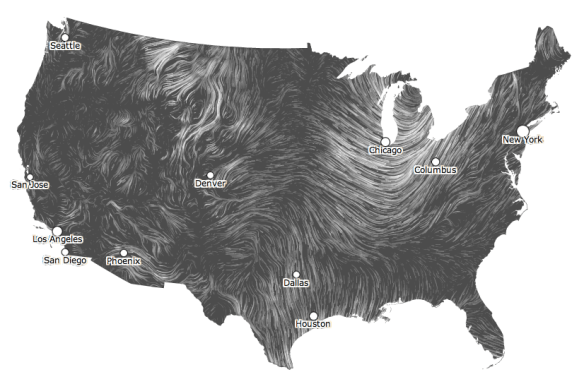
Okay, so this is probably unrelated to anything else on my blog except my curiosity (and that would make a good name for a blog — “My Curiosity”), but I discovered this website a while back, and I keep it open on my laptop screen and refresh it several times a day just to marvel.

It’s a wind map of the continental U.S., that shows wind velocity and direction based on thousands of places that collect data. It takes a few seconds to load, and then you can see movement…

Here’s a snapshot of current wind data, and here’s a link to see it live:

Wind Map

Wind Map

Amazingly, this is a personal art project of two people who lead Google’s visualization group. You can check them out here. They’ve done a lot of other cool stuff.

There’s a gallery depicting wind patterns during Hurricane Sandy and at other times. You can see that the Midwest is very windy.

It reminds me of when I watched the weather report on television, and there were highs and lows. I’m no meteorologist, but I bet they influence wind patterns greatly.


The 4 Noble Truths, simplified

I’ve forgotten where I first encountered this, but here it is, an update on the four noble truths of Buddhism. It may seem humorous, but it also seems apt:

(1) Life sucks.

(2) Get over it.

(3) That means, get over yourself.

(4) Now, move on.

The value of confession is that it softens us

Aside

Dzigar Kongtrul Rinpoche (one of Pema Chodron’s teachers) writes:

The gap between ourselves and the Buddhas and Bodhisattvas exists because of our own denial, that could not be penetrated by any blessings. But that denial comes from and covers, deep down, a lack of harmony with oneself, a conflict inside, between how things are and how they appear. Having these two in harmony is enlightenment. As we confess, we feel the lack of the aggression and rejection that underlies our denial. A little white light opens up in our being that one day can expand to the vastness of the sky. We can avail ourselves of help from which we were previously blocked. This is why honest and intelligent confession practice is so valued by many religious traditions.

New Year blessings for you from The Well

May you breathe fully and easily.

May you fully inhabit your body with your awareness.

May you discern the difference between stress and relaxation.

IMG_2383


May you experience more and deeper relaxation.

May you experience just enough stress to keep you aware and safe.

May you delight in exploring how good you can feel.


May the relation between your diet and well-being become clear.

May the relation between your conscious and unconscious minds become clear.

May you soften to yourself and others.


May you seek help when needed.

May you feel gratitude for all the resources you have.

May you move toward happiness.

IMG_2382

May you notice shine, wherever it appears.

May inspiration find you frequently.

May you have compassion for yourself and others.


May you set boundaries and manage conflicts with love.

May you experience breakthroughs in maturity and insight.

May you be present in every possible moment.

Resolutions, schmresolutions

It feels natural, at the turning of the year, to review the old year and anticipate the new one. We see what we’d like to do better and how to have more of the life we want.

However, I’ve come to the conclusion that New Year’s resolutions are well-meaning but ineffective, for several reasons:

  • How many people do you actually know who not only remember at year’s end what their resolutions for that year were but can actually say they kept them? (Actually, I am one. See my recent post on meditation.)
  • Resolutions are vague and grandiose without planning, commitment, and follow-through. They don’t take into account bad days, bad memories, changing your mind, new information, major life changes, or the lack of motivation that drudgery brings.
  • They presume your idea won’t change all year long. As if we were static beings from one year to the next except for this one thing we want to change!

If you’ve set resolutions before and failed to keep them, why not try something else?

  • Make sure your resolution is something in your control. Unfortunately, world peace takes a lot of cooperation! But you could resolve to take a class on conflict resolution, or practice a peaceful meditation technique, or volunteer with a peace organization.
  • Chunk it down. Fifteen minutes a day of practice on a musical instrument will make a huge difference at the end of a year. Or make it for a shorter period of time. And…just because it is a new year doesn’t mean resolutions have to be for the whole year! Some things just don’t take that long. You could learn to salsa and be ready to go clubbing in way less than a year, I imagine.
  • Make it fun. If you don’t look forward to it, what’s going to keep you motivated?

That said, my mind has been full of things I’d like to do in 2013:

  • get good enough on the pennywhistle to join a jam session without embarrassing myself
  • learn to balance for 10 seconds in handstand away from the wall
  • get massage or acupuncture frequently
  • build a steady clientele for my massage practice and earn a certain amount
  • solve car problem (repair old car or get a newer one)
  • read more
  • write down creative ideas
  • take tango lessons
  • join a regular group meditation
  • listen to Brane Power CDs every day for a month
  • do the candida diet for the month of January
  • be awake and present as much as possible

It’s nice to have these noted and public. At the end of 2013, we’ll see which I actually did! I am curious too!

2012 in review by WordPress

The WordPress.com stats helper monkeys prepared a 2012 annual report for this blog.

Here’s an excerpt:

4,329 films were submitted to the 2012 Cannes Film Festival. This blog had 49,000 views in 2012. If each view were a film, this blog would power 11 Film Festivals

Click here to see the complete report.