Knowing and Mystery walked into a bar…

The Curse Of Certainty In Science And Religion : 13.7: Cosmos And Culture : NPR.

Thought-provoking essay on an NPR blog (Cosmos and Culture) by Adam Frank about the only constant in life being change, and how we hunger for certainty, solidity, knowing.

Religions try to provide certainty:

Scriptures are transformed into unwavering blueprints for an unchanging order.

Science might seem the antidote to the constrictions of religion:

Science, in the purest forms of its expression as a practice, holds to no doctrine other than that the world might be known.

But:

When science as an idea is used to push away the tremulous reality of our lived existential uncertainty then it … becomes just another imaginary fixed point in a life without fixed points.

So how about “spiritual but not necessarily religious”?

The world’s history of spiritual endeavor contains many beautiful descriptions of authentic encounters with uncertainty. Ironically these often serve as gateways to the most compassionate experience of what can be called sacred in human life… Dig around in most of the world’s great religious traditions and you find people finding their sense of grace by embracing uncertainty rather than trying to bury it in codified dogmas.

For science, embracing uncertainty means…

… embracing the fuzzy boundaries of the very process of asking questions. It means embracing the frontiers of what explanations, for all their power, can do. It means understanding that a life of deepest inquiry requires all kinds of vehicles: from poetry to particle accelerators; from quiet reveries to abstract analysis.

So how can we live with so much uncertainty? We become patient, forgiving, generous, and inclusive. We find humor, good will, and compassion.

We embrace the mystery of ourselves and these lives we live. A little humility goes far.

I like knowing, or rather, believing I know. I’ve spent much of my life wanting to know, trying to know, believing if I just knew, then … I’d be protected from misfortune, or something like that.

Misfortune happened anyway.

Yet can I really know? Can I really know you? Can I really know truth? Can I even really know myself? No, I cannot.

I operate on assumptions that involve temporary (fictional) certainties. I cling to certainty from moment to moment as I go about my life, taking this-that-the other for granted, and it could all change in any given moment. Yes, tomorrow will come. Yes, I’m going to take that trip, do that thing in the future. I’m going to arrive safely on the other side of the street. I’m going to get home again. I’m going to be emotionally intact at the end of the day. I will see the people who have been important to me again.

And I don’t really know.

Knowing is a convenient truth that works better for me when I understand that it is always accompanied by something much bigger and more powerful, The Mystery. This is the sea of the Nagual.

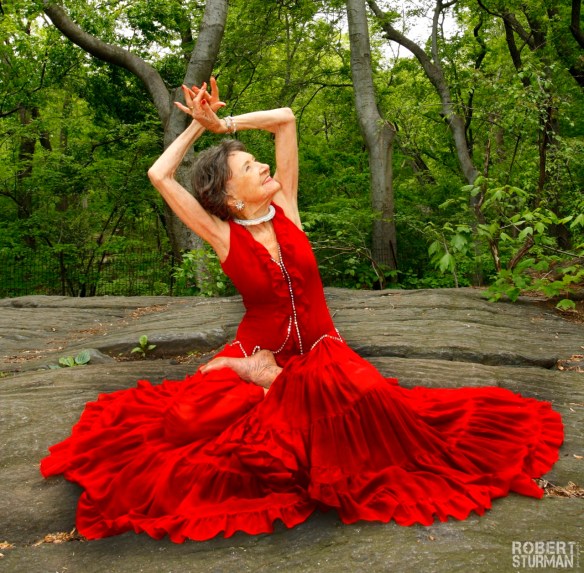
More from the world’s oldest living yoga teacher: she tangos!

I found this 2006 YouTube video of Tao Porchon-Lynch, whom I posted about recently in The world’s oldest living yoga teacher.

This video was made in 2006, when Tao was “only” 86.

Isn’t she adorable? I aspire to be like her when I’m 86.

Oh, and she also likes to waltz, jitterbug, samba, cha-cha, foxtrot, and tango.

“It lightens up your spirit,” she says.

Video: Baby being bathed in love. Happy YOU day from a mother.

Many of us are not mothers.

Many of us no longer have our mothers.

All of us were born of a mother, have been loved by our mothers (I fervently hope).

This video of a very young infant being bathed gives me pleasure, watching the baby’s response to the water and being held and the caregiver’s gentle touch and attentive nurturing. Notice that not only is the baby calm throughout, it falls asleep!

I like imagining that all infants everywhere receive love like this, and that we carry it forward with us the rest of our lives.

Enjoy.

Meditation develops your brain

Role of Meditation in Brain Development Gains Scientific Support – NYTimes.com.

This New York Times article reports on new research findings about the effects of long-term meditation on the brain.

The role that meditation plays in brain development has been the subject of several theories and a number of studies. One of them, conducted at the Laboratory of Neuro Imaging at the University of California, Los Angeles, found that long-term meditators like Ms. Splain had greater gyrification — a term that describes the folding of the cerebral cortex, the outermost part of the brain.

No one knows exactly what that means. “You could argue that more folds mean more neurons,” said Dr. Eileen Luders, the recent study’s lead author, who practices meditation herself. “These are the processing units of the brain, and so having more might mean that you have greater cognitive capacities.”

Previous studies found that the brains of long-term meditators had increased amounts of so-called gray and white matter (the former is believed to be involved in processing information; the latter is thought of as the “wiring” of the brain’s communication system.)

So basically, meditation, over time, creates more folds and creases in the brain, and your brain functions better through more gray and white matter for processing and communication with other parts of the brain.

What I really liked about this article is what one long-term meditator was able to accomplish.

Ms. Splain’s practice of meditation has, over the years, deepened into something far more than a way to flex her cognitive muscles…

In 2005, at age 57, she embarked on a rigorous graduate program in the interdisciplinary approach to schooling known as Waldorf education. Working full time and taking classes at night, she finished the program at Sunbridge Institute in Spring Valley, N.Y., in three years. She retired from her United Nations job in 2008 and teaches in the early childhood program at the Waldorf School of Garden City on Long Island. She credits the discipline developed through four decades of meditation for her ability to handle the intellectual workload of graduate school — and begin a second career at age 60.

“The mentor of our master’s program acknowledged the challenge of doing this while working full time,” she said. “But when I was able to hand in an 80-page thesis well ahead of the class, he attributed it to the fact that, quote, ‘She’s a meditator.’ ”

So…if you want to do something extraordinary, or even if you just want to live your “normal” life but to experience better brain functioning (and who wouldn’t want that?), it’s like planting a tree.

The best time to do it was 20 years ago. The second best time to start is now.

15 Things You Should Give Up To Be Happy

15 Things You Should Give Up To Be Happy.

I was so impressed by reading 15 Power Things Happy People Do Differently that I checked out more of Purpose Fairy’s website and found another jewel.

This one, as the title says, is about things you can give up to increase your level of happiness.

These are things we often do without thinking, such as believing we cannot do something, talking negatively to ourselves, making excuses, being afraid. All are makers of unhappiness.

It seems easy to say something like “give up your need for control”. Hoo boy, this is a big one! We all would like to have more control over what happens to us! I know I would.

So here’s a way to examine it. Think of something that bothers you. Is it something you yourself do? Then you have some control over it.

If it is something another person does, then you don’t really have control. You might as well give up the needing to control them and just let them be them. Serenity Prayer and all. You will have less inner and outer conflict in your life and more inner and outer peace.

I want that.

You can make this list work for you by first noticing something that makes you feel unhappy. Go down the list. Are you blaming? Complaining? Criticizing? Trying to impress someone? Odds are, it’s on this list.

Now imagine what it would be like if you didn’t do that. How would your life be changed? What if you no longer had the ability to do that?

Try that on and see how it feels. See how you feel.

The beauty is, once you imagine it, you are changed. Your brain now has a choice that you may not have recognized before.

The  more you train your brain to be happy, the more it starts behaving in a happy way.

Before you know it, you’re a lot happier.

15 Powerful Things Happy People Do Differently

15 Powerful Things Happy People Do Differently.

Worth reading. Some are pretty obvious, like love versus fear, forgiveness versus unforgiveness, praising versus criticizing, challenges versus problems.

Think about this: meaning versus ambition.

They do the things they do because of the meaning it brings into their lives and because they get a sense of purpose by doing so. They understand that “Doing what you love is the cornerstone of having abundance in your life” like Wayne Dyer puts it, and they care more about living a life full of meaning rather than, what in our modern society we would call, living a successful life.

I also discovered a new “life hacking” site, Purpose Fairy: Ideas and suggestions about life. I signed up for their emails because it seems I am on a quest for inspiration!

More on the power of standing

Stand Up, Walk Around, Even Just For ’20 Minutes’: NPR.

Terry Gross interviews Gretchen Reynolds (see my previous post  The easiest shortcut to health you can make) about her new book, The First 20 Minutes.

Reynolds recommends standing for two minutes every 20 minutes while desk-bound — even if you can’t move around your office. “That sounds so simple,” she tells Fresh Air‘s Terry Gross. “But that actually has profound consequences. If you can stand up every 20 minutes — even if you do nothing else — you change how your body responds physiologically.”

Reynolds says prolonged sitting affects diabetes, weight, heart disease, and brain function.

She talks about other new wisdom in regard to health and fitness, including stretching before a workout, warming up, running, walking, hydration, and more.

Structural integration (aka Rolfing) video

I loved this video that describes the reason for seeking structural integration bodywork, which is the official term for Rolfing, after the creator, Ida Rolf.

It frees you up from habitual patterns of restriction. It heightens bodily experience, as if you are “painting with more colors.”

I’ve had this work done, and I recommend it. I was told that being Rolfed was the equivalent of doing yoga for five years in terms of how much lighter and freer you feel afterwards.

Thanks so much to David Lauterstein for sharing it on Facebook.

Tom gets an idea

Just wanted to share with you something that a dear friend of Tom Best’s created. It’s called “Tom Gets an Idea.” David Moerbe is the artist.

The world’s oldest living yoga teacher

A Meeting In Central Park With The Oldest Living Yoga Teacher In The World. ~ Photographed by Robert Sturman | elephant journal.

Well, I’m not sure about that — BKS Iyengar is at least a comparable age — but these photos are gorgeous, and it is inspiring to see how yoga can keep a person fit and flexible into their nineties.

And would you look at that smile? Such grace and radiance!

Here’s my favorite photo: