Is anyone else doing the trauma releasing exercises?

Just checking. I’ve taught them to one person so far during this challenge and am curious to learn whether anyone else is doing them or has tried them at least once or intends to do them.

If so, would you please comment? I’d just like to know someone’s there.

Last night my releasing was mild compared to the previous wild session. A little shaking in my left hand, but not my left shoulder this time. Mostly my legs shook. I experienced some mild, gentle pelvic rocking. Lasted about 10 minutes.

~~~

This morning I went to Appamada Zen Center for the Sunday service. I got there just as the clappers signaled time to get seated before the service begins.

Had a nice practice inquiry session with Peg Syverson, my teacher. So much has changed since I saw her last, which was maybe in early January. We had a really good connection. She asked what stays the same while so much of my life is changing — selling my house, moving out, doing temporary work — and advised to notice it all.

During the sitting parts of the service, I noticed tight places in my body. I attribute it to the kettlebell swings I’ve been doing to strengthen my body. I’m working my way up from 10 swings with a 15 lb. kettlebell. Right now I’m at 20, and I feel it slightly afterwards.

Then I had tea afterwards with some sangha members, and we chatted about the revolution in Egypt, Islamic finance, the environment, and people’s difficulty in dealing with long-term incremental change like climate change, among other things. Some of my sangha read a lot.

I haven’t been to Appamada for weeks. I’ve been spending time with my granddaughter while my daughter works at her nursing job on Sundays. She had this weekend off, and I got to sit with my sangha.

I’m grateful to have my daughter and granddaughter in the same city as I and to be able to spend time with them.

I’m grateful for Appamada, Peg, the Buddha, Zen, the sangha, and my zafu.

I’m grateful to be exploring the trauma releasing exercises.

The most abandoned TRE experience yet

Wow. I just got up off the floor after the most abandoned TRE experience yet.

I wasn’t paying that much attention as I did the exercises. I’ve learned them pretty well by now and was doing them by rote. I actually was watching, and then just listening to, a crazy Werner Herzog video called Even Dwarves Started Small, which is in German (with English subtitles), and the cast — as far as I can tell — is entirely composed of dwarves. Boisterous, noisy, German-speaking, laughing, cackling, yelling dwarves.

Whew.

So the theme tonight was chaos, and chaos I got.

The real releasing started with the last step of Exercise 7, when I placed my feet flat on the floor. It started out with my usual leg shaking. Then pelvic rocking.

Then my left hand started quivering, then my left arm was shaking, then it was wildly flapping like a crazy bird! My left shoulder got involved and at times was pounding into the floor.

It just went on and on and on. Two separate times I went through wildly chaotic lengthy releases of my left shoulder and arm.

My whole body released in a way it hadn’t before. I was not only rocking vertically, but I began to roll horizontally as well! I had some big neck releases.

Tonight as soon as I slowed and one movement ended, another one started up elsewhere in my body.

My legs got wild again, knees slamming into each other.

Now, as I type this, my whole left arm feels different, buzzing with a kind of energy I don’t ever remember feeling there.

Left shoulder. What is that? I had a rotator cuff injury several years ago that didn’t go away until months later when I finally got treatment for it. Maybe living with that pain was trauma I stored, and even though my injury healed, my energy didn’t. And now, through these exercises, my energy body is healing itself.

Then again, I’ve had many issues that these exercises could be helping me recover from: birth injury to a sacral nerve, scoliosis, PTSD.

Who knows? It’s a mystery. We’re a mystery.

I just know it’s good to release tension.

And…it’s very sexual without being sexual at all. It’s pure tension release, with that same element of abandonment and surrender to the body’s processes that really good passionate sex has.

I have a feeling that doing these exercises for a couple of months may add passion to my sex life when I have a lover again!

I wonder if distracting my conscious mind with the crazy video helped my unconscious mind let go even more.

Hmm.

My left hand just wanted to do some more releasing.

Okay. That’s better.

The gut’s “second brain” influences mood and well-being

This article from Scientific American is about the enteric nervous system (gut intelligence).

Some excerpts:

The second brain informs our state of mind in other more obscure ways, as well. “A big part of our emotions are probably influenced by the nerves in our gut,” Mayer says. Butterflies in the stomach—signaling in the gut as part of our physiological stress response, Gershon says—is but one example. Although gastrointestinal (GI) turmoil can sour one’s moods, everyday emotional well-being may rely on messages from the brain below to the brain above.

The enteric nervous system uses more than 30 neurotransmitters, just like the brain, and in fact 95 percent of the body’s serotonin is found in the bowels. Because antidepressant medications called selective serotonin reuptake inhibitors (SSRIs) increase serotonin levels, it’s little wonder that meds meant to cause chemical changes in the mind often provoke GI issues as a side effect. Irritable bowel syndrome—which afflicts more than two million Americans—also arises in part from too much serotonin in our entrails, and could perhaps be regarded as a “mental illness” of the second brain.

In a new Nature Medicine study published online February 7, a drug that inhibited the release of serotonin from the gut counteracted the bone-deteriorating disease osteoporosis in postmenopausal rodents. (Scientific American is part of Nature Publishing Group.) “It was totally unexpected that the gut would regulate bone mass to the extent that one could use this regulation to cure—at least in rodents—osteoporosis,” says Gerard Karsenty, lead author of the study and chair of the Department of Genetics and Development at Columbia University Medical Center.

Serotonin seeping from the second brain might even play some part in autism, the developmental disorder often first noticed in early childhood. Gershon has discovered that the same genes involved in synapse formation between neurons in the brain are involved in the alimentary synapse formation. “If these genes are affected in autism,” he says, “it could explain why so many kids with autism have GI motor abnormalities” in addition to elevated levels of gut-produced serotonin in their blood.

Doing the trauma releasing exercises for the first time

Monday night I taught the TRE exercises to someone who is interested and curious but who can’t afford to purchase the book or video at this time. I was happy to trade bodywork for a TRE teaching session. We did the exercises together.

I was reminded that the first time you do them, you really do not know what you’re getting into. You’ve heard or read about them, or seen them on a video, maybe even seen someone else do them in person, but you don’t know how your body is going to respond.

And frankly, seeing someone quivering on the floor looks … well, odd, and … awkward, and … hmm.

Is my body really going to do that?

Take my word for it. It will feel odd and awkward the first time. These exercises are like nothing you’ve ever done before — stressing your body to induce shaking and release tension? Huh? It seems counterintuitive.

You may or may not experience trembling the first time. You may have involuntary jerks. You may feel a very fine quiver. You may feel nothing at all.

The first time I did them, I had no quivering in Exercise 6, Step 1. In Exercise 6, Step 2, in the forward bend, I noticed that my pants legs were quivering ever so slightly.

I wouldn’t have known my legs were quivering if I hadn’t seen my pants moving!

I began to really release with bigger involuntary movements in Exercise 7, after raising my knees two inches the second time.

I want to reassure newbies to TRE that this releasing process is actually learnable. Even though it’s involuntary, you learn how to release control and surrender to the process by continuing to do the exercises.

This is where it’s really nice to do them in the company of others. You give each other permission to shake, rattle, and roll, quiver, tremble. The energy is contagious.

My opinion is that if you don’t tremble the first time, you are probably habitually holding tension in your muscles, and you really need to keep doing them!

If you’ve been chronically stressed, you may not remember what it’s like to release tension and really feel relaxed in your body. This will get you there, but it may take time.

Each person learns at his or her own pace. If you do these exercises and you don’t get full trembling or shaking, be patient. When you do each exercise, notice where in your body you feel it. Each exercise is designed to stress a particular set of muscles. Notice which muscles are feeling what. Usually at least one place on your body will call your attention to itself with each exercise. You will learn more body intelligence.

The other thing you can do, if you don’t tremble the first time, is to just play. Remember playing? Just lift your hand up and flap it around. Shake water off it. Wiggle your fingers. Circle from your wrist in each direction. Do the other hand. Now do both hands.

You can also push your heels into the floor to start your pelvis rocking. Push and release. You will feel this with your back and head.

While playing or rocking, you may feel an impulsive gush of “release energy” just take over, and before you know it, your legs are trembling on their own!

Whatever, do not worry that you’re not doing it right. It will happen when your mind and your body are ready.

Today’s TRE experience

I’ve got to load my yoga props in my car, scoot out the door, and head off to NLP master practitioner training, where I’m assisting, and then go directly to teach my restorative yoga class. So today, Feb. 6, my report will be short.

What I noticed this morning, sometime after I started doing the TRE exercises, is that my breathing had changed into quick inhalations through my nose and long, slow exhalations through my mouth. Like sighs. Sighs of relief, sighs of release. Ahhh.

Today I experienced more leg trembling and noticed a variety in the rhythms, from fast, hard shaking, which would slowly lessen, then come to a stop, and then repeat.

At times my knees were slamming into each other — good thing I’ve got a little padding there, or I might have bruises.

Only toward the end did I begin to do the pelvic rocking that rocks me all the way up my spine and head.

I stopped after 10 minutes because of time constraints. (Also, I confess, I only did Exercise 1 three times on each side.)

Here’s a video of Dr. David Berceli talking about how strange it looks and feels when you first do the TRE exercises. Basically he says it’s the ego that keeps us traumatized. In TRE, the body takes over from the ego. After the first minute or two, it feels relaxing.

Whole lotta shakin’ goin’ on

And trembling, quivering, rocking, shivering, rolling, flapping…

Just got down for day two of my every-even-numbered-day-in-February practice of the trauma releasing exercises.

If you’ve done these exercises, I’d love to hear from you.

Several people have expressed an interest in learning how to do these, and I’m checking into teaching a class. I’d like to find a health-oriented office or clinic to sponsor and help publicize a class. Not everyone has access to (or learns best) from a book or video.

Anyone else interested?

I’ve realized several things:

  1. Before this challenge started, the trembling didn’t start for me until I got to Exercise 7. Upon closer reading, the trembling is supposed to start in Exercise 6! Now, after reading that, that’s when it starts for me. That shows how suggestible my mind is to another person’s authority!
  2. I realized that I had been suppressing my own body’s trauma/stress release response! That’s something to definitely get more aware of. How often do we disrespect our bodies and make them do what our minds will have them do? Often it’s for the sake of convenience or decorum! This is pretty huge.

What might the world be like if people recognized the effects of stress on their bodies felt compelled to release it so that it never built up and resulted in illness and discord?

World peace through the trauma releasing exercises!

Today my legs began to quiver about 35 seconds into Exercise 6. I noticed that sometimes I pressed my sacrum into the wall, and sometimes my thoracic vertebrae were pressing into the wall. The back of my head is constantly into the wall.

Also, it’s important in Exercise 6, Step 1, that your feet are further away from the wall than your knees. This makes sense to me as a yoga instructor. Protect your knees.

Note: In Exercise 6, Step 2, when you do a forward bend, you do not need to touch the floor with your hands, as shown in the illustration on page 184. This is impossible for many people. If you can’t do it, don’t be discouraged. You can rest your hands on yoga blocks, a coffee table, a chair seat.

At first in Exercise 7, I had a lot of leg shaking. A lot. Then hands and forearms — and my right arm is shaking almost as much as my left, after months of nothing happening there.

I did some circular movements with my hands.

(It’s weird saying “I did…” because this is really involuntary movement. It was more like this: “At times my hands made movements that I recognized as circular.”)

And then my body went into gentle, rhythmic pelvic rocking. It felt soothing and comforting. Experiencing my body as this out of control is disconcerting, but I am getting more comfortable with it because of the relaxed emptiness that follows.

Then the leg quivering would return for a while. I cycled between these two patterns for a long time. I even stopped moving completely for a few seconds several times, and then my legs began trembling again.

Finally, I just knew I was finished for today. From the start to the end of Exercise 7 took about 12 minutes.

Right now I feel pleasantly relaxed and empty and slightly fatigued. Since it’s a snow holiday, I think I’ll take a little nap.

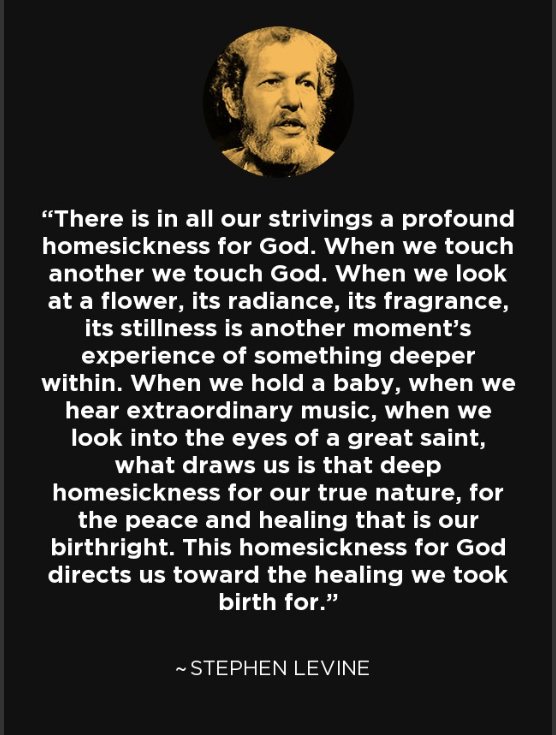
The completion of our birth

Today these words took my breath away, and I continue to be astonished at Stephen Levine’s truly gifted way with words to convey the heart of the matter.

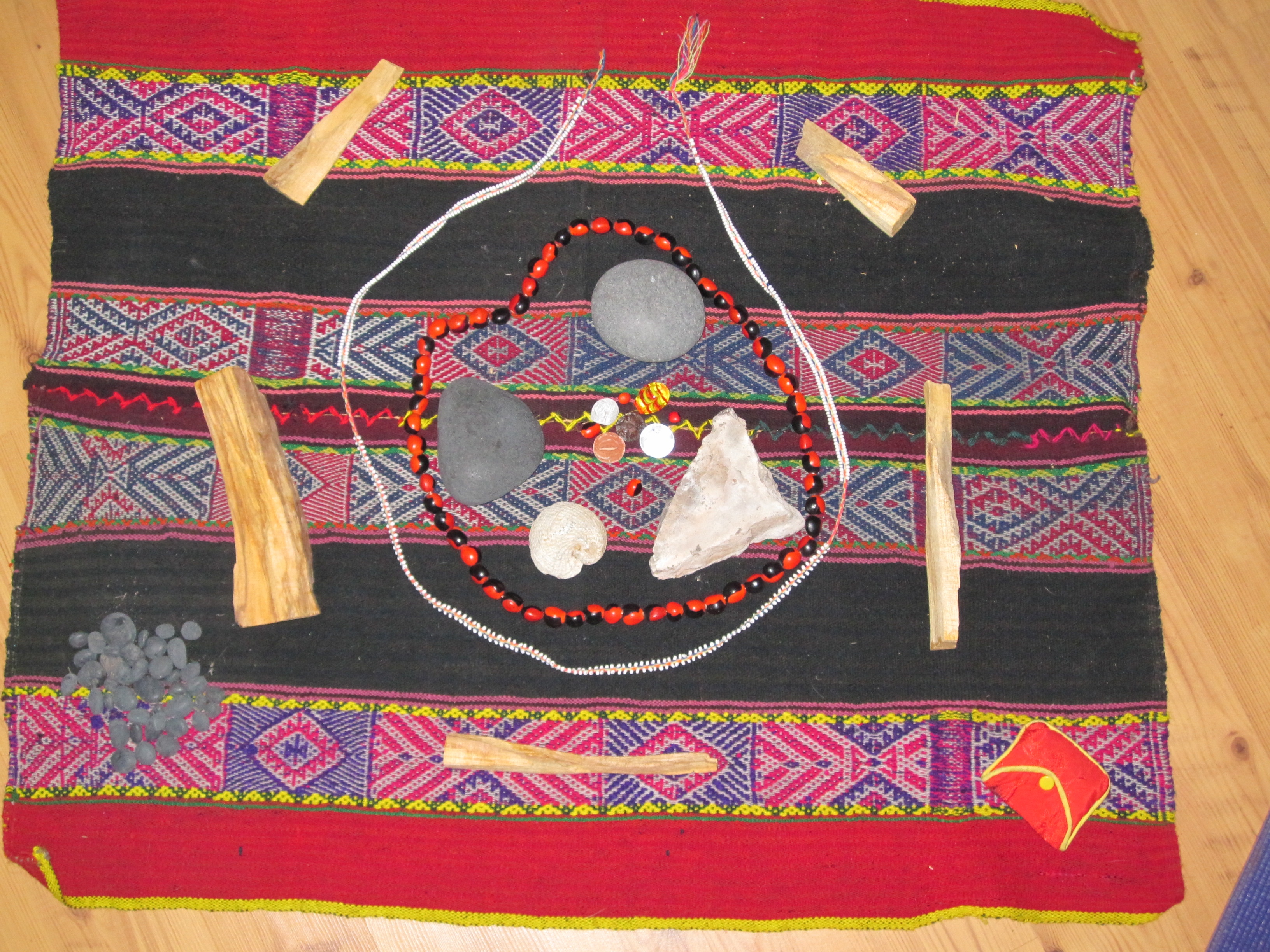
Cloth, stones, wood, beads, seeds

Cloth, stones, wood, beads, seeds

Measuring your stress level

I want to have a baseline measure of my stress level at the start of this two-month Chronic Stress and Trauma Recovery Challenge.

  • My immune system is functioning well. I haven’t suffered from allergies or colds since last May.
  • I’ve never had high blood pressure. It’s usually about 100/70.
  • I usually sleep well. I take melatonin and Rescue Remedy Sleep when I don’t, and they work.
  • If negative emotions start to run away with me in the form of anxiety, fear, anger, or guilt, I do EFT and t-a-p them away.

Still, in the last six months, since August 3rd:

  • I completed yoga teacher training.
  • I left a job that was stressful to me.
  • I started doing new types of work (NLP coaching, teaching yoga), moving toward a new livelihood.
  • I downsized my stuff and put my house on the market.
  • My house was burglarized and my laptop and some other stuff stolen.
  • I had a collision that left my car in the shop for over a month, without rental coverage.
  • I started a three-month technical writing contract at a large corporation with a long but scenic commute.

All of this is stressful, according to the WebMD Life Change Stress Test. You’ve probably read before now that major life events, both negative and positive, are stressful. Now  you can measure your stress level online.

Stress can interrupt sleep and make you cranky. Chronic stress can raise your blood pressure, weaken your immune system, and affect physical and mental health. Wikipedia has a long list of the symptoms of chronic stress.

I took the test, and the results showed I have moderate stress. How are you doing on stress?

I believe that doing the trauma releasing exercises for the next two months will help keep me healthy. I just need to keep doing more of what I’m already doing (meditation, yoga, EFT). In addition, I’d like to get more aerobic and weight-bearing exercise.

And I will! I’m getting a kettlebell!

Please share this post about the Chronic Stress and Trauma Recovery challenge!

In an effort to reach as many people as possible who can benefit from the Chronic Stress and Trauma Recovery Challenge, may I ask that you please share this post — by emailing it to friend who could benefit and/or by sharing on Facebook, retweeting on Twitter, sharing on Stumbleupon, Digg, Reddit — using whatever social media programs you like?

There’s even a little +SHARE icon below the post that you can use. I’m trying to get some momentum going here!

The all-time daily high for people viewing this blog was 89 views on Feb. 3, 2010 — a year ago tomorrow. Right now I’m at 15 views for today — would love to beat that record!!!

I’m including the links to all my posts about this challenge below to make it easier to catch up on the info.

In order from oldest to newest, please read these three posts:

These posts will get anyone caught up with the challenge, which starts today. You don’t have to do it like I do it, but please try them at least once.

Doing these exercises can help anyone release stress and trauma. If enough people do them, we could co-create a world with more peace and love, and less violence, substance abuse, and suffering. Would you like that?

If you don’t think you can benefit, I ask you to try them just once. If you do these exercises and don’t tremble, I’ll kiss your feet and tell the world!

If you’re in Austin, Texas, I’ll be glad to teach you how and do them with you, at my home, your home, or maybe a more public place.

Thank you for sharing this.