Each moment, life as it is, the only teacher: quotes from Joko Beck

I posted this originally on June 16, 2011. Needing to remind myself of her wisdom, I thought you might want to (re)read her words and appreciate her wisdom too.

~~

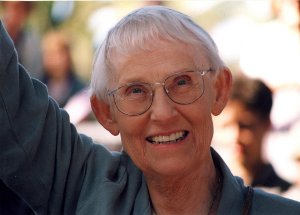
Charlotte Joko Beck died yesterday, very peacefully, at the age of 94. She was a Zen teacher who made a major impact on American Buddhism.

Here’s a quote from article that puts her work into perspective (no longer available):

The Ordinary Mind School was among the first Zen communities to consciously engage the emotional life and the shadows of the human mind as Zen practice. The late Charlotte Joko Beck and her dharma heirs adapted elements of the vipassana tradition — a relentless inquiry into the contours of the human mind — as unambiguous Zen discipline.

Here are some quotes from her:

With unfailing kindness, your life always presents what you need to learn. Whether you stay home or work in an office or whatever, the next teacher is going to pop right up.

Caught in the self-centered dream, only suffering;
holding to self-centered thoughts, exactly the dream;
each moment, life as it is, the only teacher;
being just this moment, compassion’s way.

Enlightenment is not something you achieve. It is the absence of something. All your life you have been going forward after something, pursuing some goal. Enlightenment is dropping all that.

Wisdom is to see that there is nothing to search for. If you live with a difficult person, that’s nirvana. Perfect. If you’re miserable, that’s it. And I’m not saying to be passive, not to take action; then you would be trying to hold nirvana as a fixed state. It’s never fixed, but always changing. There is no implication of ‘doing nothing.’ But deeds done that are born of this understanding are free of anger and judgment. No expectation, just pure and compassionate action.

Practice is just hearing, just seeing, just feeling. This is what Christians call the face of God: simply taking in this world as it manifests. We feel our body; we hear the cars and birds. That’s all there is.

Life always gives us exactly the teacher we need at every moment. This includes every mosquito, every misfortune, every red light, every traffic jam, every obnoxious supervisor (or employee), every illness, every loss, every moment of joy or depression, every addiction, every piece of garbage, every breath. Every moment is the guru.

So a relationship is a great gift, not because it makes us happy — it often doesn’t — but because any intimate relationship, if we view it as practice, is the clearest mirror we can find.

Practice can be stated very simply. It is moving from a life of hurting myself and others to a life of not hurting myself and others. That seems so simple — except when we substitute for real practice some idea that we should be different or better than we are, or that our lives should be different from the way they are. When we substitute our ideas about what should be (such notions as “I should not be angry or confused or unwilling”) for our life as it truly is, then we’re off base and our practice is barren.

We have to face the pain we have been running from. In fact, we need to learn to rest in it and let its searing power transform us.

We learn in our guts, not just in our brain, that a life of joy is not in seeking happiness, but in experiencing and simply being the circumstances of our life as they are; not in fulfilling personal wants, but in fulfilling the needs of life.

Meditation is not about some state, it is about the meditator.

Zen practice isn’t about a special place or a special peace, or something other than being with our life just as it is. It’s one of the hardest things for people to get: that my very difficulties in this very moment are the perfection… When we are attached to the way we think we should be or the way we think anyone else should be, we can have very little appreciation of life as it is…whether or not we commit physical suicide, if our attachment to our dream remains unquestioned and untouched, we are killing ourselves, because our true life goes by almost unnoticed.

Self-care for massage therapists, part 2 (what works for me)

In part 1, I listed various self-care methods that massage therapists use for their own aches and pains from giving massage. In part 2, I want to share what I’ve tried (so far) that works.

First, I want to say that my strength and endurance have increased with practice. I used to be in pain after giving 3 hour-long massages in a row several days in a row. Now I can do 4 hours 5 days a week with just a few twinges and aches afterwards. For several weeks, though, I was hurting and feeling some despair about having upended my life to get trained and start working in this new profession and the possibility of not being physically able to do it.

Key learnings from a newbie:

  • I no longer attempt deep tissue work, sticking to Swedish and reflexology. My Swedish massages are good and getting better. I incorporate some of David Lauterstein’s deep massage strokes into every Swedish massage, and I use pressure points, stretching, techniques from sports massage, body mobilization techniques, and reflexology, depending on the client’s issues and the amount of time I have. I cannot deliver the pressure that some clients (well-informed or not about what “deep tissue” means) seem to want. If I work within my limitations, it’s win-win for everyone.
  • I trained in Ashiatsu Oriental Bar Therapy so that I can deliver deeper pressure using my feet and body weight, controlled by holding onto overhead bars. It’s so much easier on my body and a lot of fun, too.
  • I rock with my feet and leverage my body weight strategically as I deliver Swedish massage so my arms and shoulders do less work.
  • Hydrotherapy totally rocks after a long shift. I fill my double kitchen sinks with hot water (my water heater is set to 130 degrees F. for sanitizing laundry) and cold water that I dump a quart or two of ice into. I immerse my aching forearms and hands in the water, alternating cold-hot-cold-hot-cold, for one minute each. I can barely stand it, and yet it makes a huge difference in just 5 minutes. Seems to flush toxins and swelling and pain right out.
  • I stretch my fingers and wrists, holding each stretch for 15 seconds. Good to do when driving, at red lights.
  • I press into the trigger points for the elbow and wrist (see part 1 for links).
  • I apply magnesium gel with seaweed extract topically. According to Wikipedia, symptoms of magnesium deficiency include muscle cramps, weakness, and fatigue, and fifty-seven percent of the US population does not get enough magnesium from food.
  • I love epsom salts in a bath. (Guess what? They contain magnesium!) When I was feeling a lot of pain all over, I would dump a cup or two of epsom salts into a fairly hot bath and add a few drops of lavender oil, then soak for 15-20 minutes. I felt like a new woman when I came out! I learned this years ago from dancers.
  • I use Young Living’s OrthoEase oil on clients’ painful muscles, and I use it on mine as well. Contains wintergreen, peppermint, eucalyptus, lemongrass, and more that are analgesic and anti-inflammatory.
  • I keep hydrated and have been avoiding nightshades lately. I’m already gluten-free and eat fairly healthily. I’m interested in following an anti-inflammatory diet but haven’t done the research yet.
  • I take at least a couple of days off per week, not always together, though. I’m still finding my ideal schedule.
  • I do 10-15 minutes of yoga every morning. Sun salutations stretch and strengthen my body. Plus, it’s a great check-in to do something that starts the same every day. I start slowly and really let my hamstrings lengthen in forward bend before I move on to the next pose. I add standing poses, balance poses, and pigeon as I feel the need and to keep it interesting.
  • I get at least a chair massage every week. I’m interested in setting up a weekly trade for a full-body massage with someone, too.
  • I use a foam roller on back when needed, and a tennis ball to my gluteus.
  • I have two tennis balls tied into a sock that I use when driving to massage my back. I’ve also learned to “pop” my own back while giving massage!

Here’s something that just doesn’t fit into any of the categories I’ve seen so far about self-care for MTs. It’s about how you use your attention. I’ve learned to keep some of my attention on my body most of the time.

When I focused exclusively on the client’s body, delivering what I thought they wanted, I hurt and fatigued myself. I listen more to my body now and check in verbally with the client if I am not noticing nonverbal feedback.

If I notice that I feel rigid anywhere in my body, I say to myself, “Soften,” and my body softens.

Sometimes I put my attention on the soles of my feet and their connection to the floor/earth (I massage with bare feet always for Ashiatsu and as much as possible for Swedish), making the movements of giving massage into a soft, fluid dance.

Sometimes I attend to my breath, letting it become easy and relaxing (and audible to the client, as a nonverbal suggestion that they relax too).

All of these techniques activate the inner body, subtle body, energy body, whatever you want to call it. It feels better to give massage with this “soft present alive expanded body” than not. There is definitely an aspect of being “in the flow” that seems somehow related to doing Reiki, but I don’t know how to put it into words (yet).

Another bonus: the sensations of pain and fatigue become distant as peace and love fill my awareness.

I don’t know if clients perceive the difference, but I don’t think it could hurt. I do it for me because I “in-joy” it!

It’s been four months since I got licensed and began working. I look forward to learning even more new things about self-care and sharing them here.

Lessons from the 21-day Byron Katie challenge

The challenge to focus on The Work of Byron Katie for 21 days was worthwhile. I examined a painful thought that has been a thread running through my life, that my father didn’t care about me.

I subjected that belief to inquiry, and it did not hold up. My father did care about me. I know that deeply now. The way he chose to express it — nonverbally, without physical, verbal, or visual signs of affection, without playfulness, and pretty much without much eye contact or much facial expression at all — was not a way I understood or valued when I was young and first had this thought.

I realize now that he showed his caring by simply being there with his family and not somewhere else, supporting me from infancy through adulthood, reading aloud to his children, helping with homework, and creating order through daily rituals (dinner time, bath time, bed time). He wasn’t really that different from many men who were fathers in the 1950s and 1960s — who had been through sobering times (the Great Depression and World War II). He was not frivolous, not expressive, and a man who had lost his own father at age 9.

I took him for granted.

I did this challenge a bit differently than I initially envisioned doing it. I had thought that I would do one worksheet a day, answering the four questions and doing the turnarounds for 21 days.

That would have been extremely time-consuming. My blog posts would have been quite lengthy, and I fear you, dear readers, might have completely lost patience and interest.

So instead, I worked on one issue, my relationship with my dad, which even though he’s been dead for years, I still felt some tender sensitivity and pain about. I liked doing it slowly and deeply like this. Sometimes at Katie’s workshops, there just isn’t time to really go deep with my own stuff. This was satisfying and memorable. I feel like I got the process in my bones and now find myself asking, “Is that true?” and “What happens when I believe that thought?” Just noticing…

I have turned over that rock and examined the ground under it, the creepy-crawlies, the shadow, took a good thorough look, and then put the rock back and moved on.

Of course there are more rocks to investigate, but I can see that each time I do inquiry, the remaining rocks are perhaps fewer, lighter, and smaller.

And wow. Would I ever like to get to the bottom of how I create my own suffering with my thinking! That would require a lot of discernment. Speaking of which, this great quote on that topic came up today on Tricycle Daily Dharma:

The fundamental aim of Buddhist practice is not belief; it’s enlightenment, the awakening that takes place when illusion has been overcome. It may sound simple, but it’s probably the most difficult thing of all to achieve. It isn’t some kind of magical reward that someone can give you or that a strong belief will enable you to acquire. The true path to awakening is genuine discernment; it’s the very opposite of belief. ~ Trinlay Tulku Rinpoche, “The Seeds of Life”

So yeah. Enlightenment comes through examining illusion, that is, using inquiry and discerning the truth. This is how it works in real life.

In filling out the worksheet, I went back to the last years I lived at home, when I was in high school, and how it was then between my father and me. I remembered yearning for his positive personal attention, and it never even crossing my mind to just ask him for it! Because “we didn’t do that in our family,” it wasn’t even in my realm of possibilities back then.

I am so grateful to have busted out of that prison. I’m not sure when that happened.  At some point, I gained the quality of brashness. It usually works, too.

I think it’s a great idea for people to ask for attention when you need it. If the person who is asked can give it, fine, and if not, fine. There are always others, and of course, there’s the self. Doing The Work is a fine way to relate to the self. Quality time.

My relationship with my father, which transcends his death, has expanded. It’s become lighter and broader. I can consider other possibilities for his behavior than the narrow, joyless ones I laid on him.

This opens me up too. My hurting self, the wounded child, has healed (at least about this topic). It’s a memory now, in the past.

After having done the work, it doesn’t matter whether my father did or didn’t have Asperger’s Syndrome. That’s only a concept, just a theory to explain his behavior.

When I ask, “How do I react, what happens, when I think that thought?” I realize that it just doesn’t matter that much to me. I wonder more how he would have reacted had he known, fully aware that whatever I think is idle speculation, just opinion. It was his business, not mine.

I like to think that if he wanted help with it, which he never asked for, I would have gladly been willing to give it.

Just like he would have been glad to give me more attention, if I had asked for it.

People are like that, aren’t we.

Day 19 of The Work: Do you believe life should be free from pain?

This Tricycle Daily Dharma quotation reinforces Byron Katie’s work:

We suffer because we marry our instinctive aversion to pain to the deep-seated belief that life should be free from pain. In resisting our pain by holding this belief, we strengthen just what we’re trying to avoid. When we make pain the enemy, we solidify it. This resistance is where our suffering begins. ~ Ezra Bayda, “When It Happens to Us”

Next time you’re feeling emotional pain, I invite you to examine whether a “should” is involved. “Shoulds” are always beliefs, as far as I can tell.

Imagine (that is, make up stories about) what you believe should happen.

Now think about what you believe shouldn’t happen, and create two stories. In one, imagine having no resistance to what shouldn’t happen. Just let it unfold and witness it. In this scenario, if there’s pain, there’s pain, but there’s no drama or story.

Then create a worst-case scenario, complete with lots of drama and a compelling story!

Just see if you can do this. Now you have three options.

The point is, how much do you add to your own suffering? Without the story, the pain can just come and go, and that’s it. It hurts. You move on.

How we got the idea that life should be free from pain is something to be curious about. It seems to me that if you have a nervous system, pain is inevitable. (Although I have gone to great lengths to avoid it myself!)

Day 10 of Byron Katie’s inquiry process: turn it around to myself

I’ve asked the four questions about my judgment “my father didn’t care about me”.

I continue the inquiry process about this painful thought, which I’ve already established isn’t true, by turning it around. There are three turnarounds in The Work. The first one asks me to turn the statement around to myself.

“My father didn’t care about me” gets turned around like this:

I didn’t care about me.

How did I not care about myself?

Katie asks for at least three instances of each turnaround, but even more important is that the turnarounds penetrate and set you free.

  1. I did not ask my father for more attention. How could he have known I wanted it if I didn’t say so? I didn’t care about myself enough to make this request. I didn’t even give him a chance to respond (or not).
  2. I kept my feelings completely to myself. I did not tell anyone that I was unhappy about my relationship with my father. I was clueless about what I could have done about it, and I assumed others would be clueless too. That might not have been the case. This is a new realization.
  3. Because my father didn’t care about me and I was therefore unworthy, this low self-esteem spilled over into other areas of my life. I can see that now with hindsight. I was rather troubled back then and did not pursue living up to my full potential. I did not believe in myself or my abilities back then. This realization is also a new insight.

It takes self-respect to ask for attention, to tell someone when feeling troubled, and to deal with a problem before it grows.

Next: turning it around to the other.

Day 9 of The Work: Who would you be without the thought?

The fourth question to ask when you are doing inquiry (i.e., “The Work” of Byron Katie) about a situation that is emotionally painful is this:

Who would I be without the thought?

Applying this question to my statement that my father didn’t care about me is astonishing.

Without the thought, I am free of these painful feelings. When the thought leaves, the feelings leave.

What’s left is an empty openness. I feel it in my chest. There’s a freedom there that wasn’t there before. It’s as if that thought never existed.

Who would I be? Well, I experience myself as more expansive, more open, lighter.

“Who I am” is my identity, composed of my thoughts, emotions, sensations, and emptiness or spaciousness. Who I am is pretty much how I experience myself in each moment. (Everything else is about me, not me.)

What are you experiencing this very moment as you read this?

It’s so easy to think that who I am is my story: “the woman whose father didn’t care about her” or “the woman whose father had Asperger’s” and so many more stories I’ve bought into and perpetuated about myself. Whenever I think a thought that’s accompanied by emotional pain, I can do inquiry, starting with question #1.

Who I am is not my story.

My father is also not who I formerly believed him to be. When I think of him without this thought, a series of images comes into my mind. Without my story and its emotional baggage, they are neutral snapshots: my father sitting on the sofa, my father at the dinner table, my father driving, my father standing outside his office building waiting for his ride home, my father kissing my mother.

These are much kinder images than those of a father who didn’t care about his daughter.

Man, where did that thought ever even come from? Never mind. Who cares? I’m just glad to have busted this painful, limiting story.

To recap, I’ve already asked:

  1. Is is true? (if no, skip to #3)
  2. Can I absolutely know it’s true?
  3. What happens when I believe the thought?

“Who would you be without the thought” can also be asked “What would you be without the thought?” And whatever your answer is, you can ask again, “What would you be without that thought?”

See where that takes you! (It takes me into a vast experience of empty presence where anything can happen.)

Next: the first turnaround.

10 things I love about massage

  1. Almost everyone loves massage and bodywork. It feels good and is nourishing to the body, mind, heart, and spirit.
  2. Caring touch, the basis of massage therapy, is probably the most ancient method of promoting well-being that human beings have used on each other.
  3. It’s the front line of health care. Massage therapists spend more time with their clients than most other health care providers.
  4. Your massage therapist gets to know you well. He or she may help you with alignment, posture, pain, emotional, breathing, self-worth, self-knowledge, and many more issues.
  5. If 90 percent of doctor visits are stress-related, why not just skip the doctor and get a massage? It is one of the healthiest ways to reduce stress that exists.
  6. There is no end to the methods of massage: Swedish, sports, deep, shiatsu, and more. Then there are branches: Rolfing, Trager, cranio-sacral, and more. A massage therapist can focus on mastering one method or practice several. Adventurous recipients can have a field day trying them all!
  7. Massage marries art and skill. Massage therapists have learned skills using specific methods and can also artfully mix and match techniques to meet your body’s needs.
  8. Studying massage includes studies in geeky subject matter, like anatomy, physiology, kinesiology, pathology. Massage therapists use both their right and left brains when learning and giving massage.
  9. It’s one of the top 50 careers of 2011, according to US News and World Report. It’s expected to keep growing over the next decade.
  10. Massage by itself is great, and it partners well with changework. Say you’ve been struggling with an issue and have a breakthrough of some sort. You feel it in your body, right? Massage helps you integrate it more deeply, literally embodying the change.

Each moment, life as it is, the only teacher: quotes from Joko Beck

Charlotte Joko Beck died yesterday, very peacefully, at the age of 94. She was a Zen teacher who made a major impact on American Buddhism.

Here’s a quote from an article that puts her work into perspective (no longer available online):

The Ordinary Mind School was among the first Zen communities to consciously engage the emotional life and the shadows of the human mind as Zen practice. The late Charlotte Joko Beck and her dharma heirs  adapted elements of the vipassana tradition — a relentless inquiry into the contours of the human mind—as unambiguous Zen discipline.

Here are some quotes from her:

With unfailing kindness, your life always presents what you need to learn. Whether you stay home or work in an office or whatever, the next teacher is going to pop right up.

Caught in the self-centered dream, only suffering;
holding to self-centered thoughts, exactly the dream;
each moment, life as it is, the only teacher;
being just this moment, compassion’s way.

Enlightenment is not something you achieve. It is the absence of something. All your life you have been going forward after something, pursuing some goal. Enlightenment is dropping all that.

One idea that really hampers us is to believe that people get ‘enlightened,’ and then they’re that way forever and ever. We may have our moments, and if we get sick and have lots of things happening, we may fall back. But a person who practices consistently over years and years is more that way, more of the time, all the time. And that’s enough. There is no such thing as getting it.

Wisdom is to see that there is nothing to search for. If you live with a difficult person, that’s nirvana. Perfect. If you’re miserable, that’s it. And I’m not saying to be passive, not to take action; then you would be trying to hold nirvana as a fixed state. It’s never fixed, but always changing. There is no implication of ‘doing nothing.’ But deeds done that are born of this understanding are free of anger and judgment. No expectation, just pure and compassionate action.

Practice is just hearing, just seeing, just feeling. This is what Christians call the face of God: simply taking in this world as it manifests. We feel our body; we hear the cars and birds. That’s all there is.

Life always gives us exactly the teacher we need at every moment. This includes every mosquito, every misfortune, every red light, every traffic jam, every obnoxious supervisor (or employee), every illness, every loss, every moment of joy or depression, every addiction, every piece of garbage, every breath. Every moment is the guru.

So a relationship is a great gift, not because it makes us happy – it often doesn’t – but because any intimate relationship, if we view it as practice, is the clearest mirror we can find.

Practice can be stated very simply. It is moving from a life of hurting myself and others to a life of not hurting myself and others. That seems so simple — except when we substitute for real practice some idea that we should be different or better than we are, or that our lives should be different from the way they are. When we substitute our ideas about what should be (such notions as “I should not be angry or confused or unwilling”) for our life as it truly is, then we’re off base and our practice is barren.

We have to face the pain we have been running from. In fact, we need to learn to rest in it and let its searing power transform us.

We learn in our guts, not just in our brain, that a life of joy is not in seeking happiness, but in experiencing and simply being the circumstances of our life as they are; not in fulfilling personal wants, but in fulfilling the needs of life.

Meditation is not about some state, it is about the meditator.

Zen practice isn’t about a special place or a special peace, or something other than being with our life just as it is. It’s one of the hardest things for people to get: that my very difficulties in this very moment are the perfection… When we are attached to the way we think we should be or the way we think anyone else should be, we can have very little appreciation of life as it is…whether or not we commit physical suicide, if our attachment to our dream remains unquestioned and untouched, we are killing ourselves, because our true life goes by almost unnoticed.

Pain and suffering: the distinction

Several people whom I follow on Twitter linked to this post, Does it hurt? Yes. Is that a problem? No.

Read it if you’ve ever wondered about the difference between pain and suffering. They’re not the same.

The title kind of gives it away, but it’s well worth reading anyway. Pain is inevitable because you have a nervous system. Pain is a form of communication. It lets us know to stop doing whatever caused it (if it is in our control — some pain is not), to seek safety, care, rest, healing.

Suffering comes from pain plus resistance. It’s the resistance to pain that causes suffering. If we could just surrender to pain, just let it wash through our awareness without judgment, it would leave more quickly.

But we judge and resist pain. “I don’t like pain.” “I hate pain.” “I fear pain.” “I shouldn’t feel this pain.”

Last year when I was just a couple of months into my practice of meditating for 30 minutes every day, my body hurt every time I sat. I kept expecting it to go away. My suffering was due to my belief that a sitting practice shouldn’t hurt.

When I checked in with my teacher, Peg Syverson, she said that pain is part of sitting. Every meditator faces this issue sooner or later.

Once I understood that pain was part of my body’s adaptation to the posture and that I might always experience some pain each time I sat, an odd thing happened. Or perhaps a natural and normal thing happened.

My body stopped hurting when I sat. The pain and the suffering both just left.

Interestingly, I’ve heard others’ stories about that: that the older you are, the more quickly your body adapts to sitting and the sooner you can sit without pain.

I suspect that in some cases, the opposite may be true. Habituation has a lot to do with it. Any new, prolonged activity that uses muscles differently than how you usually use them results in discomfort or pain.

Now it may be easier to do this with minor pain than major, but next time you feel some pain, get curious about it. Breathe slowly and deeply to relax, and feel it. Exactly where is it? Does it have a sharp boundary, or is it diffuse? What is the quality of the pain: is it dull, piercing, throbbing, steady, deep, shallow? How long does it last?

You may not feel joy, but you can rejoice in the fact that you can feel pain.

It means you’re alive.

A contract on house, relationship woes, and 1950s housewife takes LSD

I’m up very early today, which is going to be a long one full of NLP training for master practitioners. It’s metaphor weekend!

Yesterday I gratefully signed a contract on my house! It feels really, really good, seven and a half weeks after listing it. It looks like the couple who saw it Thursday night for the first time and came back Friday to see it in the daytime are offering a backup contract, if the first one falls through.

Also yesterday, several people I care about were experiencing relationship difficulties. Feelings of disappointment, betrayal, anger, hurt, sadness, disrespect; expressing feelings, finding support, creating distance, moving on in some way. (Don’t try to make sense of this — I’m talking about several conflicts and people here. I’m sure you have experienced something similar — a loved one’s pain.)

I’m especially grateful to my Facebook friend Fran who asked this key question:

What is the lesson? Therein lies the silver lining!

Great question! Thank you, Fran!

I thought about it for a while. I got how my energy had gone out into each person’s hurting heart, feeling their pain. I got clear that these difficulties belonged to them (even if some were of their own making — like, “Man, what did you expect would happen? Snap to! You’re hurting someone!”), and that I could just simply extend my heart to them.

The pain is in discovering that the world is not as we believe it to be, that people are not who we believe they are. It is as it is, they behave as they behave.

if you can’t trust ’em, move on with those you can trust. if you betrayed someone’s trust, know it will probably never be the same. forgiveness, compassion, good boundaries solve a lot of problems. i hold them in the light.

And finally, today I am grateful for the wonderful finds on the internet. Here’s an old film from the 1950s where a normal housewife is given LSD and interviewed by a scientist on camera. Back when Technicolor was new. ; ) Enjoy!