Pay what you wish: how it works

I’ve been offering pay-what-you-wish massage and bodywork off and on since 2011 for modalities I was getting certified in. This summer of 2014, I offered pay-what-you-wish for all my services at The Well during July and August.

It worked out well. I have had more people coming in to be worked on, new people (often via word of mouth) are coming in, and I am making ends meet, thanks to the generosity of my clients. It’s satisfying.

I am going to continue to offer it indefinitely. I like this way of working. It’s part of the gift economy. (If you’d like to learn more about it, read Sacred Economics by Charles Eisenstein, visit the website http://sacred-economics.com/, or watch the video below.)

The way I see it, bodywork and healing are what I do, and I’d like to stay busy doing it. I encourage you, if you’d like to receive regular or even occasional bodywork that you can afford to move your life to a higher level of well-being, to connect with me so we can talk about how we can work together, or just make an appointment.

Sometimes people are uncomfortable with this unorthodox concept of pay-what-you-wish, so here’s some thinking behind it, and I hope it will help you feel more comfortable deciding how much to pay for my services.

First of all, by offering pay-what-you-wish massage, it is not my intent to offer “cheap massage”. I work hard to improve my skills. I seek a lot of training, taking classes and workshops, reading, watching videos, and practicing with/on other massage therapists — way, way beyond what Texas law requires to maintain a license. Who knows? At some point in the future, I may be only offering some elite modality and charging top dollar. I’m not there now. I’m having a good time practicing and improving my skills.

Secondly, I want my practice to be full and thriving. If I hold out for top dollar, I will not be working as much. Since I learn so much from doing, making massage affordable gets people on my table more often, and the more I work, the better I get.

Thirdly, making a lot of money is not my top priority. I like money for what it can do for me, and my expenses and obligations are modest. I’m sharing this here because some readers may not be aware that there are real, regular people whose lives and decisions are not driven by the need to make as much money as possible by working at a job that is stressful. I too have had a mortgage, a child at home, a lot of debt, and stressful jobs. Not any more. My work now is driven by my desire to be of service and to take excellent care of myself while doing so.

Fourthly, in the so-called olden days, healers of all kinds – herbalists, hands-on healers, shamans – received support from their communities in many forms in exchange for their services. Entire villages could exist without money being exchanged because people traded and bartered for goods and services, and everyone did what they could to help the whole village thrive. If someone was poor and needed healing, the healers didn’t turn them away. If they could only pay with food or labor or kind deeds that benefited others in the community, that was acceptable.

Importantly, there would always be an exchange (because everyone has something to offer, and it’s crucial to recognize that), and if times were hard for the community, times were hard for the healers too.

Now we live in bigger communities in a society that uses money for most of its trade, but the good life is still about being connected and reciprocity.

Fifthly, if it’s not sustainable, it ends. I’ll change the way I do business or find another livelihood. This is what I wish to offer now, and so far I feel great about every single one of my pay-what-you-wish sessions and what I was offered in payment.

Here are some guidelines about how much to pay:

  • If you can afford full price, I gratefully accept. My full-price rate is $75 for an hour. For ninety minutes, full price is $105. (With the customary 20% gratuities, those amounts rise to $90 and $129 if you can afford it. Another great thing about pay-what-you-wish is that tipping is not accepted. Oh, I guess you could give me a tip about a good movie or restaurant, if you wish!)
  • If you are totally flush with money, and you totally loved your session, you can pay  more if you like!
  • If these are beyond your means at this time, here’s something to consider. As of late August 2014, two major “discount” massage chains in Austin offer a 50-60 minute massage for $44-60. Adding the gratuity expected at these establishments puts these massages in the range of $54-70. Scale up or down for 90 or 30 minute sessions. If these prices are what you can afford, please consider booking an appointment with me.
  • Here’s how I differ from a chain: I’m interested in getting to know your body, your tension patterns, your habitual postures, your tender points, so I can deliver relief and healing, so I take good notes and refer to them before your next visit. I want to work with you to reduce your overall stress and pain levels over time. I can advise you on how to prevent/relieve tension from working at a desk job. I can offer to teach you stretches, exercises, and self-care techniques you can do to enhance your quality of life. I can refer you to other good alternative health care practitioners and trainers. I give you the full time you pay for, if you are not running late. I offer better music, nature sounds, or silence if you prefer. I offer a variety of essential oil aromatherapy choices if you want it. I keep arnica on hand for your bruises and muscle pain. I’m more personal, less corporate.
  • If this is still beyond your means and you need bodywork, talk to me. I know incomes can fluctuate. Maybe you’re pursuing work you love, but the income isn’t there yet. Maybe you’re just not driven to earn a lot. Maybe you’ve had some misfortune. Maybe you feel stuck in a low-paying job. Maybe you’ve had some unexpectedly high expenses. You may even be stressed out about your situation, imagine that. I want to help you out, get you back on your feet, relieve your stress, change your energy for the better. Just ask what’s acceptable.
  • I am willing to trade or barter for services I need. Electrical work? Sign painting? Car detailing? Housekeeping? Gardening? Hauling? Delicious meals? Ask.
  • Also, if you would like to offer me a delightful non-monetary token of your esteem (some green or herbal tea, flowers or plants, a nice bottle of red wine, art, music, poetry, books, tickets, pickings from your garden, bone broth or other Paleo/WAPF diet food), please, just go right ahead and enchant me!
Postural alignment, functional movement, and bodywork for breath and head-forward posture

It’s coming up on a year since I started doing functional movement classes with Matt Fuhrman at Tao Health & Fitness. I thought I’d report on my progress.

I am way stronger and sturdier than before I started doing this. It wasn’t that I was unfit before, but my body was still twisted and unevenly developed. I couldn’t run without paying for it later, not just feeling soreness in the muscles worked. It felt like structurally, the pounding of running was pounding my compensations into my body. Continue reading

Announcing a new massage modality: Craniosacral therapy for jaw problems

Many people have problems with their temporomandibular joints (TMJ), such as:

  • pain in the jaw, neck, ear, and/or head
  • jaw tightness or stuckness
  • limited ability to open the mouth
  • clicking or popping noises or a grating feeling when opening and/or closing the jaw

TMJ issues are often accompanied by behaviors of clenching the jaw or grinding the teeth, sometimes in one’s sleep. Eating and even talking may become difficult. There isn’t a clear cause, although stress or injury probably bear some responsibility. Continue reading

He said, “Why aren’t you a craniosacral therapist?”

Years before I went to massage school, I received monthly craniosacral therapy sessions from Nina Davis for about 3 years. I didn’t know what craniosacral therapy was, exactly, but I figured that between trauma, head injuries, sacrum injuries, and scoliosis in my spine, that any kind of bodywork that focused on the cranium, sacrum, and points in between was going to be good for me.

I asked who was good. Nina was recommended.

And it was really good for me! Continue reading

Massaging levator scapula

I’m a massage therapist making sense of what I discover working on clients — the most common issues I encounter, why people have these problems, and what to do about them (massage-wise and making minor but meaningful lifestyle changes that result in more well-being).

Recently I posted about massaging the upper trapezius muscles. In that same shoulder/neck area, another muscle, levator scapula, gives some people a lot of problems.

As I mentioned in my earlier post, the upper trap issues seem to be from working with the hands out in front of the body, such as using a keyboard, cutting hair, chopping vegetables, operating a cash register, and so on.

If the bulk of your time is spent with  your arms just hanging down, surrendered to gravity, you wouldn’t have issues with your upper traps.

I don’t think there are many jobs like that! Irish dancer, perhaps?

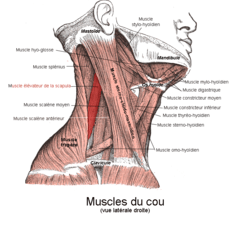
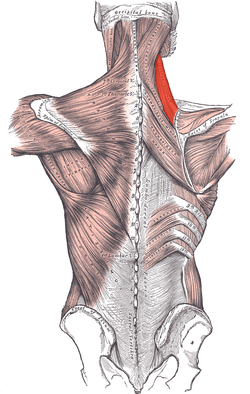
Levator scapula (sometimes called just levator) attaches to the upper inner corner of the shoulder blade and to the transverse processes of the top four neck vertebrae (the bony parts that stick out on the sides of your neck under your ears). Levator lies underneath the upper trap and other muscles.

250px-Muscle_élévateur_de_la_scapula

250px-Levator_scapulae

I notice that some folks just have upper trap issues, and some have both upper trap and levator scapula issues. Trap issues come from working with the hands out in front. Levator issues come from raising the shoulders up toward the ears. In fact, levator scapula means “elevating the shoulder blade”. This is often accompanied by the “head-forward” posture.

If you rub across the top of your shoulder between your neck and shoulder joint and feel your fingers crossing over a tight but tender lump of a muscle, it’s your levator.

People who have pain in levator are raising their shoulders toward their ears, and they are most likely unaware they are doing this. They just notice the pain.

Sometimes it’s one-sided pain. The cause is often cradling a telephone receiver between the ear and shoulder to have the hands free while talking on the phone. If you work in an office and talk on the phone for much of the day, you can avoid levator pain by using speakerphone or a device that sits on your shoulder and holds the phone receiver up to your ear….

When it’s two-sided pain, the cause is usually an unconscious, habitual tension, a response to stressors of raising the shoulders toward the ears (“turtling”).

As a stress response, this would protect the vulnerable neck area, but since our modern stressors are usually not predators out to have us for dinner, the solution is to start catching yourself doing it and consciously retrain yourself to lower your shoulders. Your body will eventually catch on, and lowered shoulders will become your new habitual posture! (Also practice moving your head slightly back, if you have the “forward head” posture.)

You can lengthen the levitator muscle by standing and letting your shoulders drop downward, surrendering to gravity. You can hold a light weight — 1 or 2 pounds, or a can of soup — to help pull your arms and shoulders down and let the levator lengthen.

It also feels good to make forward and backward circles with the shoulders. Spend more time where it does the most good.

You can also stand and lower your ear to your shoulder, alternating sides. I think slow is good.

Another good practice is letting the head float up, as if it were a helium balloon. You can release all kinds of neck tension this way.

For massaging the levator, it usually feels awesome to press on the end of the muscle that attaches to the top of the shoulder blade. This is a magical point on almost every body that feels terrific to have pressed!

If you have a hard time finding that corner of the shoulder blade, put the client’s hand behind their back to make the shoulder blade pop out. You will feel that upper corner more easily. Static pressure and rubbing the corner area both feel great.

Because levator is deep to the upper trap and neck muscles, it’s difficult to knead the way you can knead the upper trap. I like to work my fingers around the inner part and bottom corner of the shoulder blade. Then, standing at the head of the table, I pull on the edge of the triangle that’s opposite that upper inner corner, leaning back and pulling it toward me. (You can also push this edge toward the head when standing at the client’s side.)

This allows levator to go slack and shorten, taking the pressure off it. I usually hold this for about 15-30 seconds.

Then I do the opposite. Standing at the head, I place both thumbs on that upper inner corner of the shoulder blade and lean into it. This gives levator a nice stretch. I hold this for 15-30 seconds too. The entire shoulder blade will have more mobility.

And yes, I can shorten and lengthen levator scapula during Ashiatsu barefoot massage sessions, using my feet!

Massaging the upper traps

I’m going to begin sharing some thoughts from doing massage…

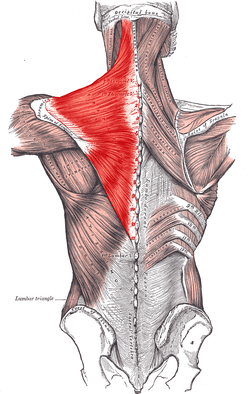
The trapezius is an interesting muscle. It’s big, shaped like a kite (a trapezoid), covers a large area of the back from T12 up and out to the shoulders, and then attaches to the back of the skull.

Unlike a bicep, the belly of the trapezius is not in the middle of the muscle. The belly is in the soft part of the shoulder, between the shoulder joint and the neck. This part is nicknamed the upper trap. The rest of the muscle is rather flat.

250px-Trapezius_Gray409

The upper traps hold a lot of tension on most people’s bodies. It’s rare to work on someone who doesn’t have tightness there. Often the upper trap is overdeveloped or unevenly developed. Usually one side is worse than the other (and it’s often but not always related to handedness).

Now, I could be wrong about this, but it seems to me that a lot of why this muscle is such a problem is because many of us work with our hands out in front of our torsos, and that muscle supports those lifted arms. I notice it on people who use a keyboard a lot. Also hairdressers, chefs, pianists, an interpreter for the deaf. Hands out in front, right?

Oh, yeah, and massage therapists.

When I do Swedish massage, I love working on the shoulders. My favorite part is the testing I do when I finish working on the first shoulder. I give both upper traps a gentle squeeze. I can really tell the difference between the shoulder that’s been massaged and the one that hasn’t. The upper trap that’s been massaged has tissue that feels lean and pliable, like a racehorse ready for a race. It seems to sparkle with energy.

The upper trap not worked on feels stiffer, more swollen, and congested.

That’s the difference that massage makes.

When I do Ashiatsu barefoot massage, I do a lot of work on the shoulders with my feet, both seated behind the client’s head and standing on the table. It makes a big difference. If you haven’t had Ashiatsu, you might be amazed at how I can work the shoulders with my feet. Loosening the shoulder blade, working the between-the-shoulder-blade area, pressing into the upper trap…

If a client needs extra attention to their shoulders (and we have time for it), after I finish the Ashiatsu, I manually work on the shoulders. Kneading is something I can do with my hands that I can’t do with my feet. Sometimes that’s the main thing the upper trap needs, to be kneaded repeatedly to really get the blood flowing throughout the upper traps. It’s that squeezing out of stale blood so it can be replaced by fresh blood bringing oxygen that changes the quality of the muscle tissue, at least in my understanding.

Wondering what to do about upper trap pain in between massages? One remedy available for office workers is to sit in a chair with arm rests that support your forearms comfortably while you use your keyboard. If you don’t use the existing armrests, then it’s not comfortable. Find out if you can adjust them to become comfortable.

That will take some of the load off the upper traps.

Also, even though putting heat on sore muscles feels good, ice is better. Too much heat for too long makes the tissue feel sluggish. If you feel like you just gotta use heat, alternate heat and cold, doing no more than 5 minutes of each. That will get your circulation going.

Don’t forget, there’s always arnica and epsom salt!

Coming soon: the levator scapula. Many people with upper trap issues also have levator scapula issues.

Science says massage relieves stress!

Researchers assigned healthy adults to receive 45 minutes of Swedish massage while the control group received light touch “using highly specified and identical protocols.”

(This is from a New York Times article, Regimens: Massage Benefits Are More Than Skin Deep. Here’s the abstract.)

The researchers took blood samples immediately before and for up to an hour after the massage.

Those who received Swedish massage had significant decreases in stress hormones. Their white blood cell counts went up as well, indicating the immune system was stimulated.

If replicated, these findings may have implications for managing inflammatory and autoimmune conditions.

Those who received light touch showed higher levels of oxytocin, the “bonding” hormone, and greater decreases in a hormone that stimulates the adrenal glands to produce more cortisol.

So basically, massage relieves stress and light touch increases bonding.

Now that science says so, the skeptics can come get on the table and experience it for themselves!

Several things pop out. One is that the research was sponsored by the National Center for Complementary and Alternative Medicine, a branch of the National Institutes of Health. I’m pretty sure the NIH is heavily biased toward MDs and western medicine, and that NCCAM fields like massage and acupuncture are considered flaky and suspect.

But if 75 or 90% of illness is stress-related, shouldn’t the NIH be emphasizing research on stress relief to prevent illness? That would be a great use of my tax money!

I would like to see more studies done on massage.

  • I’d like to see the blood tested to see how long these changes last, because my strong hunch is that if a massage recipient can avoid stress afterwards, the massage keeps working on the body for hours. Maybe 24 or 48 hours, but no one knows, because no one has studied it. Yet.
  • Could a control group be added of people who don’t receive massage or light touch?
  • Scientific study of prenatal massage and its effect on the women — and their childbirth and babies — would be wonderful.
  • I’d also like to see recipients’ brain waves tested, before, during, and after massage.
  • Does massage work equally well on everyone? Are there people who don’t benefit and “super beneficiaries”?
  • This study was on the effects of a single massage. I’d like to see longitudinal studies done of the long-term effect of regular massage: people who receive massage weekly, biweekly, and monthly for at least a year, five years, and ten years. All we have now is anecdotal evidence that people who receive regular massage are healthier into their senior years, falling and getting sick less often and recovering faster when they do.

The other thing that popped out was that the researchers were surprised by the results! They must have never received a massage. I wonder if they do now.

When I read the abstract, I saw that the authors did a follow-up study in 2012 on the effects of repeated massage. So I did get one wish, but these subjects received Swedish massage or light touch either weekly or twice a week for just five weeks. Otherwise, it was the same as the first study, which means they looked for changes for up to an hour after each massage.

Those receiving weekly Swedish massage sustained a higher level of white blood cells like those receiving a single massage, with minimal effect on stress hormones. Come on, not even the first massage changed stress hormone levels? That contradicts the first study!

Those receiving twice-weekly massage had increased oxytocin levels and lower stress hormone levels. So people getting more frequent massage bond more easily. I wonder if they used the same massage therapist each time.

The abstract says nothing about the light touch group. (And by the way, I have a hard time reading scientific research and understanding the findings and implications in plain English. This is the best I can do. If you know better, please comment!)

The authors conclude:

There are sustained cumulative biologic actions for the massage and touch interventions that persist for several days or a week, and these differ profoundly depending on the dosage (frequency) of sessions. Confirmatory studies in larger samples are needed.

Yes. And I am very glad that this research is happening and raising more questions.

Touch: Louder Than Words? | Psychology Today

Check out this article in Psychology Today about the power of touch. I just learned something new:

Field’s research has revealed that a person giving a massage experiences as great a reduction in stress hormones as the person on the receiving end.

It makes sense.

via Touch: Louder Than Words? | Psychology Today.

Gift certificates and referrals

A massage makes a great gift. We all know someone who would be incredibly grateful to receive one.

If you’d like to give the gift of massage, you can purchase gift certificates from me in any denomination (and you can also buy a package and give some or all of the sessions as gifts).

If you refer someone to me who then receives a full-price massage, you get 30 extra minutes of table time whenever you’d like to use it! I love it when you tell your friends, co-workers, neighbors, and family members about the great massage you received from me.

Your satisfaction and positive word of mouth are the best possible ways to build my business.

To return to the home page for The Well Ashiatsu Barefoot Massage Austin, click here.

Massage outcalls

I do outcalls only for established clients with whom I feel comfortable who have a massage table set up in their homes. There’s a fee for my travel time, usually $25 in the Austin area.

Having a massage therapist come to your home is a great luxury. You can really savor the refreshment and relaxation after your massage without having to deal with the stress of driving. You can relax in your own home, prolonging the benefit.

One great way to take advantage of this service is to schedule 2-4 people (household members, friends, relations) to receive consecutive massages, splitting the travel fee.

At this time, I am only offering integrative massage on outcalls.

If you’re interested but don’t yet have a table, you can buy massage tables in person at the Morningstar Trading Company in Austin or online from many places.

To return to the home page for The Well Ashiatsu Barefoot Massage Austin, click here.