12 ways to improve your health by sitting less (written while pedaling on a FitDesk)

If you commute (usually sitting) to a desk job (mostly sitting) and then go home and watch television (sitting) and/or spend a lot of time on your computer (sitting), even if you manage to work in an hour at the gym, your health is at risk.

You can Google to learn more about the science of this — and they’re just beginning to learn. I’m just here to give free advice on behavioral changes you can make.

To counteract all the sitting, you could consider:

  1. Cutting the car commute and work from home as much as possible. Seriously. Present this option to your manager as a way to cut their costs, improve your health, and therefore make you more productive!
  2. If you can’t avoid car commuting, every time you’re at a red light or stop sign or gridlocked in a traffic jam, stretch your legs, and tense and relax them several times. Really pull the muscles to the bone. (Okay, that’s the yoga teacher in me talking.) Point and flex your feet and rotate your ankles.
  3. Take public transportation and stand during your commute, a la New York City subway riders.
  4. Bicycle to and from work, or combine biking with riding the bus or light rail. Many now have bike racks available. You may want to request that your workplace provide showering facilities.
  5. At work, take frequent breaks (1-2 minutes every 20 minutes) to stand up and walk around. Set a timer and do it. Go get a drink of water, go to the bathroom, stretch, shake the tension out of your body, do a forward bend to stretch the backs of your legs. Walk to the best view from your building and partake of it to refresh your spirit.
  6. Sit on an exercise ball. You have to use your legs to balance. You can also bounce when no one is watching. It will strengthen your core muscles because there’s no back — you have to hold your torso up. This will burn more calories, if you’re interested in doing that.
  7. Instead of emailing, texting, or phoning, walk over to a colleague’s office to communicate with him/her. I know, I know, this is really analog, but it’s also refreshing. Think of how much more information you get from seeing their face and hearing their voice in person. You might even learn something about them from seeing their office decor.FitDesk
  8. Persuade your office to invest in a FitDesk. One FitDesk shared among eight employees sounds like a great start. I imagine 30 minutes in the morning and 30 in the afternoon would make a big difference in the health and longevity of those eight employees, especially if they’re doing some of these other things when not pedaling. Of course, if your office can afford it, get a FitDesk for every employee! If you can’t afford it, you could phase this in over time as finances allow, as employees using it report they’re feeling better, missing less work, being in better moods, and being more productive, improving the company’s bottom line. Hey, maybe this is the key to the economic recovery and the obesity epidemic! FitDesks for every employee!
  9. When you get home, turn off the TV and computer and do something that uses your legs: cook, go for a walk, clean house, garden, do yard work, do yoga, lift weights, kick box, have sex, play with the dog, take a shower, swing your kids around, give them piggy-back rides, roughhouse, dance, put on a show. Also known as “living life” and “being embodied”.
  10. If you can’t eliminate TV or video games or Facebook or whatever is so compelling on your computer (okay, blogging and Facebook for me), limit it to an hour (with a break every 20 minutes; see #5 above) and get up during commercials unless you are on your feet while watching. Or…
  11. Get a FitDesk for your home so you can move your legs while watching TV and being on the computer.
  12. Do this with other people. It will be more fun.

Making the world a healthier place, one blog post at a time…

I’m pedaling on a FitDesk as I write this!

The FitDesk that I wrote about previously arrived last week in a big box — and today was the first day I had time to devote to assembling it, testing it, and inviting friends to come over later and try it out.

I am pedaling as I write this blog post! After hopping on for seat adjustment (none needed for my 5’1″ height on the lowest setting), I decided to cycle for an hour while I read email, caught up on FB and Twitter, read some articles, and wrote this post. I set the tension control midway.

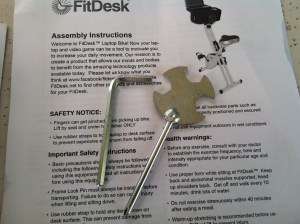
The FitDesk came with its own assembly tools! I didn’t even need a screwdriver or wrench, just a sharp knife for opening the box and unpacking the parts. Assembly was very easy and took about 15 minutes. There are 12 bolts already in place, and the desktop just slides onto the handlebars. The laptop is held in place with giant rubber bands.

FitDesk assembly tools

I did discover that the cloth covering the desktop did not have any Velcro (TM) in place for attaching the electronic monitor (which measures time, speed, distance, and calories), so I used it without the monitor. Since the purpose is to be active while getting computer work done, the monitor seemed like it would be a distraction.

I imagine the company would rectify this quickly if asked.

And now I’ve finished one hour! I did get off it a couple of times to make hard-boiled eggs and drain them.

I got a little sweaty using the midway tension control setting, which was comparable to going up a very low incline. I’m wearing exercise clothes, so no problem.

I will try it later at a lower setting dressed in business casual clothing because I’d like to find out if an office worker could use it at work and look fresh afterwards.

I can feel my sit bones! There’s no pain, but it’s been awhile since I’ve ridden a bike. The seat is wide and cushy. I imagine it just takes time to adjust to riding, no matter what kind of seat. The company suggests standing frequently, using a gel cover for the first few weeks, wearing padded cycling shorts, and, lastly, trying a different saddle (they have an accessory that allows universal saddle mounting) if it bothers you too much.


FitDesk bike seat


This is my initial report. Please let me know if you have any questions. I will write more later.


New alternative for sedentary desk work: the FitDesk

Since I’ve posted before on how prolonged sitting is unhealthy and how to counteract it, and I’ve promoted standing desks, I want to bring this to your attention (and thanks, Shelley Seale, for bringing it to mine).

This is on the heel of news that sitting less could add two years to your life expectancy.

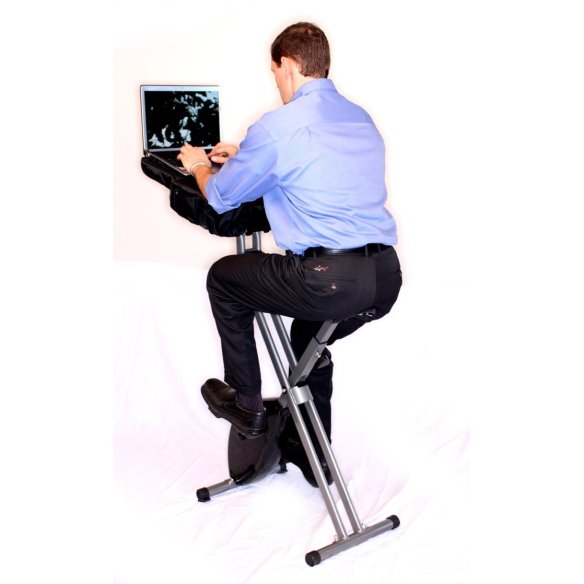
It is a stationary bicycle with a desktop attached to the front of it. You can pedal and keep your leg muscles active, improve circulation, burn calories, circulate lymph, move cerebrospinal fluid, and more, while working or playing video games!

The FitDesk X Compact Pedal Desk is for sale on Amazon for $249.99. Amazon will cross-sell you a comfy bicycle seat and a laptop/iPad holder to go with it.

The seller offers a full refund (plus shipping) within 30 days if you are not satisfied with it. (Hint: Save the carton.)

One thing I really love about Amazon is reading the customer reviews. This product gets an average of 4.5 stars from 111 reviewers (all gave it 3 to 5 stars). Here are what some said:

  • A grad student in an online program lost 10 pounds the first month (30 lbs. over six months) using this product. She raves about the product being sturdy and quiet (quiet enough to use in the same room as a sleeping spouse), and about the customer service. The 2011 model has a timer/calorie counter/speed/distance monitor like stationary bikes at the gym.
  • Another reviewer mentions the great customer service: “Steve, the inventor of FitDesk, will answer your call or email himself. Some day he’ll probably have a huge company because this is such an awesome invention and then he won’t have time to talk to customers himself, but for the moment, he’s the best customer service rep you’ll ever talk to because he believes in his product and is doing everything he can to make it even better.”
  • The critical review rated “most helpful” gave the product 3 stars and said the exercise bike is not that great, that it’s hard to get a consistent pedaling rhythm. This reviewer is also an avid mountain biker who also regularly rides exercise bikes at the Y.

It sounds like it won’t compare to serious exercise bikes, but the whole point of it is not getting a strenuous workout but rather getting a light workout over time while getting computer work accomplished or playing video games.

Okay, okay! I want one! I’m drooling at the thought of cycling while writing blog posts! Would be awesome to have one at my next corporate stint.

The FitDesk weighs 33 lbs., holds users up to 250 pounds, and has a “seat extender” available for tall people. It is easy to fold up and move.

Also, there may (or may not, since the product is being continually improved) be issues with the electronic monitor, and I couldn’t get the straight dope on that.

The company has a video showing the product in use:

You can “like” FitDesk on Facebook (where they offer discount codes and giveaways) and follow @fitdesk on Twitter.

~~

Follow-up on 7.13.2012: The maker of the FitDesk has offered to send me one to try out! I love it! Will post on the experience, with photos!


Videos: Visiting the Q’ero Indians of Peru with Tom Best

My dear, late teacher Tom Best every year took people high into the Andes to visit the Q’ero Indians of Peru. Tom translates from Spanish to English for Don Americo Yabar.

I believe Tom, a cultural anthropology major who had studied (and studied with) Native American and Hawaiian shamans), fell in love with the Q’ero and their concepts of energy, love, reciprocity with the earth (Pachamama), and healing.

More than most indigenous communities in Peru, the Q’ero have maintained their traditions from pre-Hispanic times. They strategically integrate only the new developments that are useful and adapt old traditions to the present day.

I did not get to visit Peru with Tom, who died in April. I hope to make the trip with his wife Bobbi when that comes together.

Here are some videos from a trip in 2007:

From the Map… 6:14

Connecting with Energy 3:13, and something interesting happens around 1:25!

Heavy Energy… Hucha 2:29

Mihui…the art of ‘eating’ heavy energy 1:59

Miguelito…Peruvian Master of Stones and Coca 2:12

Beyond the ‘Social Mirror’ 4:08

Dance of the Nauopa…Andean Ceremony 2:08

Ceremony with the Q’ero Indians 3:17


Try to catch yourself if …

Quote

Try to catch yourself if they are making you unhappy today. When you feel that unhappiness start to whisper in your brain take a step back and say, “Do I really need to be thinking about this this very second?” Almost all the time, the answer is “no”.

I add, “Then just dissolve the image, the internal dialogue, the feeling. Let it lose substance. Let it become atoms and be swept away on the solar winds.”

James Altucher wrote this in his blog post Don’t Kill Anyone today. 

Just discovered this blog and post on the psoas muscle, one of the deepest muscles in the body as well as the most fascinating.

body divine yoga

psoas

I was delighted when I first came across Liz Koch’s amazing work because it confirmed much of what I’d been intuiting on my own. I had begun to open and close my yoga practise with hip opening poses with the specific intention of releasing tension in my psoas and hip flexors. I’d breathe and imagine tension flowing out of constricted muscles to be released as energy into the torso.

It worked, I’d feel my body soften yet somehow grow stronger.

Reading Liz Koch I instantly realized what I was doing – by learning to relax my psoas I was literally energizing my deepest core by reconnecting with the powerful energy of the earth. According to Koch, the psoas is far more than a core stabilizing muscle; it is an organ of perception composed of bio-intelligent tissue and “literally embodies our deepest urge for survival, and more profoundly, our elemental desire…

View original post 762 more words

Four steps for discovering your Enneagram type

The Enneagram is a system that classifies people by type, like personality typing. It’s kin to the Myers-Briggs Type Indicator. But it’s about more than personality—it’s based on fixation.

According to Enneagram theory, we are either born with or acquire in the earliest years of life a fixation that deeply influences our identity: who we believe we are and how we view life. The fixation is what keeps you from experiencing your essential (healthy) self. It’s how you get in your own way. It’s a filter that in some ways has worked for you, but it can eventually limit you into a habitual way of living that feels too small. You may suspect there’s more to you than that. You can transcend your fixation to find more essence, more freedom, more joy.

Maybe this is what enlightenment is.

There are nine Enneagram types. Each type has two wings and three subtypes. Furthermore, each type moves toward two different types when you are stressed and when you feel secure. Plus, your development level changes with age, experience, and your desire and ability to grow. So it’s a fairly dynamic model, even though (according to theory) people remain their type their entire lives.

To illustrate, my type is Five. Other names: The Investigator and The Observer. We Fives are classic nerds: bookish, shy, avoiding conflict, private, attracted to minimalism, curious, alert, intense, innovative, insightful, cerebral, having a rich inner life, seeking mastery.

I also have a Four wing. Nickname: The Iconoclast. I am interested in people and healing. The Four wing adds sensitivity.

Would you believe that part of the path to my essential self is exercise? Living in my body connects me to a vitality and presence that I could never experience just living in my head. It took the painful aftermath of a car wreck in my 40s—and the subsequent healing journey—to really understand this.

Daily yoga, the outdoor activities I love like snorkeling and kayaking, dance, meditation, giving and receiving massage, hugs, touch, and sex all help me more fully occupy my body, and be more present in my full vitality, my essential energy that radiates joy, love, peace, and happiness.

So if you knew me as a child, you’d have known a shy, bookish, smart, aloof nerd. If you know me now, you’d see some of those qualities at times, but you’d also see someone who has a lot of vitality, who lives with an open heart (and who still really likes to think).

For me, the journey from being immersed in my type to living more from my essence has been like moving from a black-and-white world into a world full of amazing colors of infinite variety. I can’t say it’s all due to knowing about the Enneagram, but it has helped and provided much insight.

If you are interested in using the Enneagram as a tool for personal growth, and you don’t know your type, here’s how to find out. It’s not always easy (but sometimes it’s very obvious). You can definitely narrow it down to a couple of types, and then you’ll get an aha! (And you may change your mind later on.) Plus, you will easily recognize some people you’ve known.

It’s important to first note that we often do not see ourselves as others see us. Therefore, learning your Enneagram type might make you feel uncomfortable. Prepare yourself. The truth often hurts before it sets us free.

  1. The Enneagram Institute offers free and low-cost online tests. The free, brief QUEST takes 5 minutes.
  2. Watch a brief video of each of the nine types and self-identify your type.
  3. Watch the videos with people you trust with the intent to identify each person’s type with compassion. Others who know us can be honest yet tactful and supportive (as you can be with them—agree on this beforehand and don’t invite anyone who is insensitive).
  4. If you’re still confused about your type, read how types are often misidentified.

To learn more about how it works, read books. I suggest The Wisdom of the Enneagram and The Enneagram for beginners. For more advanced students, I recommend The Spiritual Dimension of the Enneagram.

Once you are more or less settled on which type most accurately describes you, you can subscribe to a daily “EnneaThought” email for your type that can support your developmental growth.

Here’s my EnneaThought for today:

EnneaThought example

The questions of the heart; seeking the sound of a normal heartbeat

I beg you, to have patience with everything unresolved in your heart and to try to love the questions themselves as if they were locked rooms or books written in a very foreign language.

Don’t search for the answers, which could not be given to you now, because you would not be able to live them. And the point is to live everything. Live the questions now.

Perhaps then, someday far in the future, you will gradually, without even noticing it, live your way into the answer. ~ Rainer Maria Rilke, Letters to a Young Poet

I have a friend who just had a second surgery on his heart in two weeks. His heartbeat has not had a regular rhythm for some time now.

I’m searching the internet for a sound file or an iPhone application that is just simply the sound of a normal heartbeat. The longer the better, and if he can loop it to listen to all night with headphones as he sleeps, fantastic.

At a minimum, it will be soothing, because if you can imagine, heart surgery is a pretty nerve-wracking big deal, especially when the problems aren’t fixed the first time.

At best, listening to the sounds could entrain his heart into a normal rhythm, which he did experience briefly after the first surgery.

If you know of anything, please comment or email me. Thank you.

Meanwhile, remember that besides the brain in your head (headquarters for the nervous system that runs throughout your entire body), you also have two other centers of intelligence: your heart and your gut.

I believe Rilke is onto something about the intelligence of the heart.

I have learned to sit with the questions in my heart and let them transform me, and I am a much better, broader, deeper person for it. I get perspective on my own fear-driven behaviors. I get insight into the behaviors and possible motivations of others.

I don’t know that I have answers. Perhaps the only answer is to be willing to sit with the feelings that are unresolved and allow them to change, not forcing or judging, just allowing and noticing.

It does seem to me that gradually healing occurs. Gradually forgiveness comes. Gradually lightness replaces heaviness. Gradually clarity replaces confusion. Gradually …

This is another rhythm of the heart.

Please say prayers for Marco. Thanks.

A little yoga humor…

YOGA STYLES: a simple, animated guide – yoga humor, yogini style, yoga personality, yoga tips – Y is for Yogini.

Click this link to go to a page that clearly delineates the various styles of yoga.

Seriously. Click the link.

The simplest way to improve your posture

If you’re at all familiar with this blog, I bet you think I’m going to say meditation. Guess what? Ha ha, I’m not!

It’s way simpler than that:

Whenever you’re doing something that does not require use of your hands, turn them so that they’re palm-side up (see the picture above). You also can do it while standing or walking, leaving your arms down at your sides and turning your palms so that they face outward in the direction you’re facing.

This palms-up position may be familiar to committed meditators and yogis who practice shavasana, but it’s foreign to those of us who spend a lot of time at a computer, behind the wheel of a car, holding babies, making lattes, or doing pretty much anything else that requires constant hand use. Even when we’re not using our hands, it’s just habit to sit, walk or stand with our hands facing down or behind us.

Wait for it — there’s a meridian connection: 

In acupuncture, the meridians that run along the inside of the arm, from the chest/underarm to the palm, are Heart, Pericardium and Lung….

Here is just a smattering of the functions each meridian is involved in (there are many more):

  • Heart: breathing, cardiac function, sleep, emotional balance and heat regulation.
  • Pericardium: breathing, blood circulation and upper digestive function.
  • Lung: breathing, immune function, perspiration, body temperature and urination.

…our lifestyles force our hands and arms into an almost constant downward/backward position, creating a tendency to slouch forward. This causes us to cave our upper bodies inward, crunching the Heart, Pericardium and Lung meridians.

Allowing these meridians to flow more freely optimizes their ability to perform their respective functions.

These three meridians are all yin meridians, flowing from the torso to the fingertips.

This is a mudra (energetic gesture in Hinduism and Buddhism). The palms-up mudra, you might have guessed, has to do with receiving energy from spirit or the universe, with allowing. It has to do with being open and surrendering yourself to the Mystery.

Try it when you think about it. Let one or both palms rest facing up, or outward if you’re on your feet. Notice the subtle but significant changes in posture.

Then make it a habit.

Thanks to Sara Calabro for this article.